BOEING CO: revenue up 3.9%, but commercial airplane cost overruns erased the profit
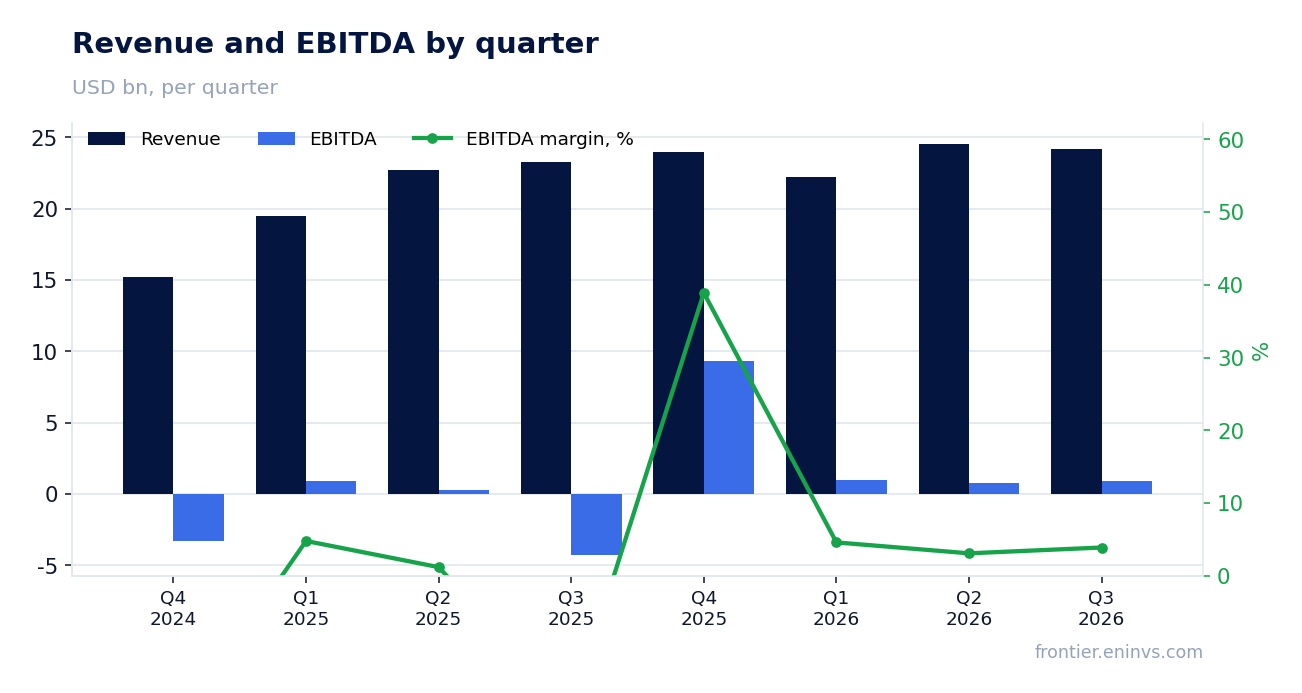
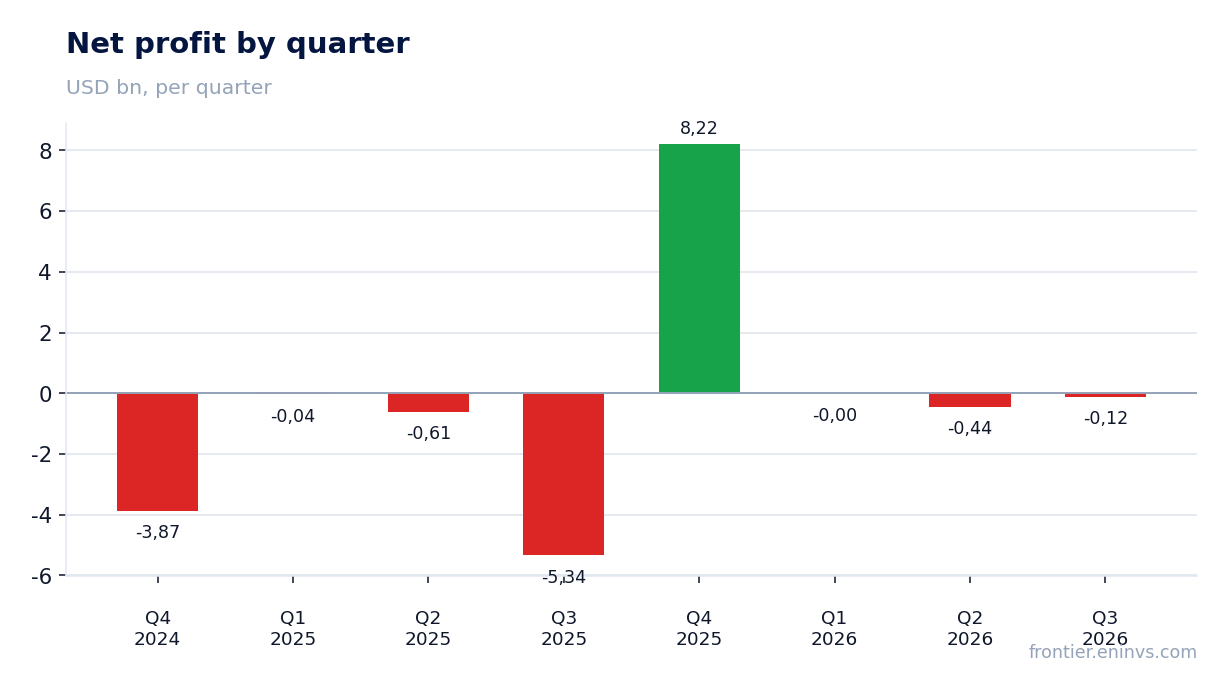
On 27 October BOEING CO reported third-quarter 2026 results. Revenue came in at $24,188 million, up 3.9% year on year, EBITDA was $938 million, operating profit $354 million and net loss $116 million. The improvement against last year's $5,337 million quarterly loss is real, but revenue growth decelerated from 8.0% in the second quarter to 3.9%, and Commercial Airplanes is again loss-making at the operating line. At 17.2 times trailing twelve-month earnings and 14.0 times EBITDA the share looks neutral: the recovery is under way, but durable profit is still some way off.
Key takeaways
— Revenue grew 3.9% year on year, but growth decelerated from 8.0% a quarter earlier
— Commercial Airplanes remained in an operating loss of $697 million
— Defense grew 15% and carried profit thanks to a one-off HRL Laboratories gain
— Global Services with an 18.3% margin remains the most stable profit source
— Free cash flow of $464 million does not cover the rise in debt
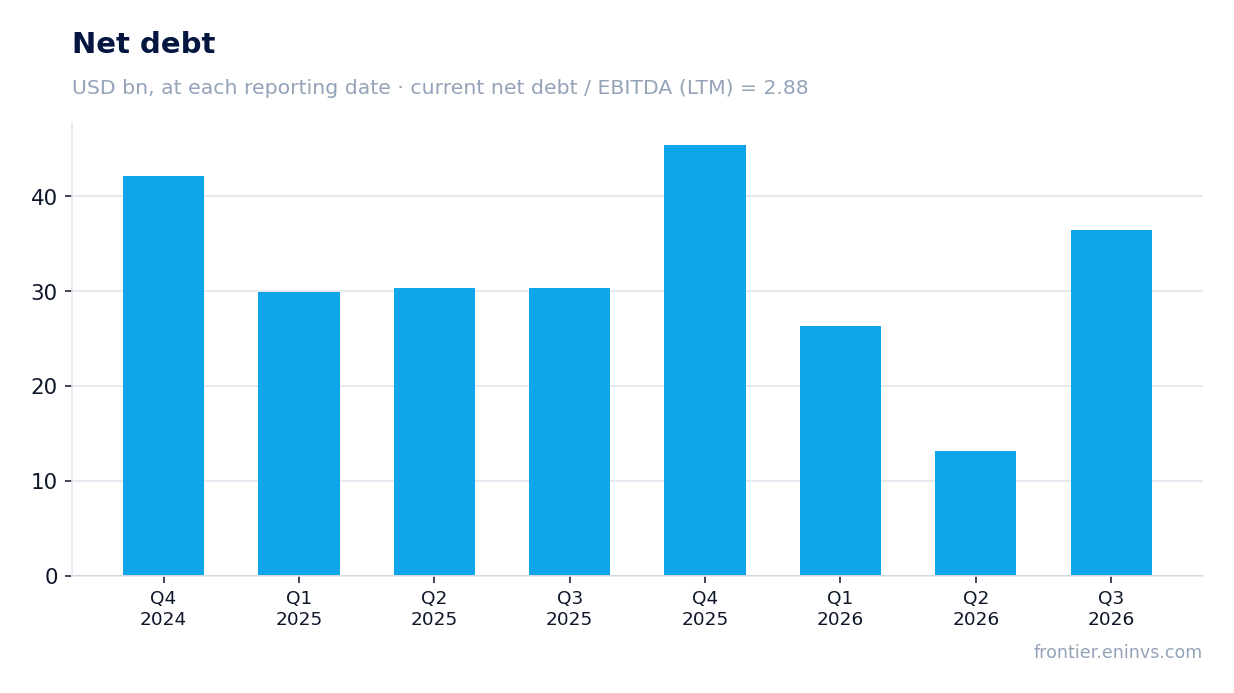
— Net debt rose to $36.4 billion, or 2.88 times EBITDA
— Backlog reached a record $745 billion, but conversion into profit lags
Attractiveness
Key figures, USD bn
| Metric | Q3 2025 | Q3 2026 | Change |
|---|---|---|---|
| Revenue | 23.3 | 24.2 | +3.9% |
| EBITDA | -4.29 | 0.94 | to profit |
| Operating profit | -4.78 | 0.35 | to profit |
| Net profit | -5.34 | -0.12 | — |
| Operating cash flow | 1.12 | 1.50 | +33.2% |
| Capex | 0.89 | 1.03 | +16.6% |
| EBITDA margin | -18.4% | 3.9% | +22.3 pp |
| Net margin | -22.9% | -0.5% | +22.4 pp |
Revenue grew 3.9% year on year, but growth decelerated from 8.0% a quarter earlier
Third-quarter 2026 revenue was $24,188 million, up 3.9% year on year. That is a deceleration from the second quarter, when growth was 8.0%. The slowdown reflects a less favourable commercial delivery mix: Commercial Airplanes revenue fell 3% to $10,720 million even as deliveries rose by just one aircraft.
Defense grew 15% to $7,935 million on higher volume, and Global Services rose 4% to $5,574 million. These two segments offset the weakness in commercial airplanes. For the nine months, revenue was $70,965 million, up 8% year on year.
The revenue mix shows the company leaning more heavily on defense and services contracts, while commercial airplanes, historically the main driver, have yet to recover either volumes or margin.
Commercial Airplanes remained in an operating loss of $697 million
Commercial Airplanes posted an operating loss of $697 million in the third quarter on revenue of $10,720 million, a margin of negative 6.5%. A year earlier the loss was $5,353 million because of a 777X charge, so the current result looks better but remains negative.
The release attributes the result to a less favourable delivery mix, higher projected costs tied to future production rate increases and higher supply-chain costs. The 737 programme is progressing toward a stabilised rate of 47 aircraft per month, the 787 holds 8 per month, and the 777X remains on track for first delivery in 2027.
Certification of the 737-7 and 737-10 removes some regulatory uncertainty but does not solve the cost problem. Until the segment returns to operating profit, the company's overall result will depend on defense and services.
Defense grew 15% and carried profit thanks to a one-off HRL Laboratories gain
Defense, Space & Security revenue rose 15% to $7,935 million, operating profit was $492 million against $114 million a year earlier, and the margin was 6.2%. The release states directly that the result includes a $252 million gain on the sale of HRL Laboratories.
Without that sale, segment operating profit would have been about $240 million and the margin roughly 3%. That is materially less impressive than the reported figure. Operational improvement is present too, but its contribution is smaller than the one-off effect.
The segment won a U.S. Navy contract to design and build the F/A-XX fighter, not yet included in backlog, and a seven-year award to expand PAC-3 Seeker production. Segment backlog reached a record $101 billion, 23% of it from non-U.S. customers.
Global Services with an 18.3% margin remains the most stable profit source
Global Services revenue rose 4% to $5,574 million, operating profit was $1,019 million, and the margin was 18.3% against 17.5% a year earlier. It is the only segment that consistently generates profit and cash flow.
The margin improvement reflects favourable volume and mix. The segment won a U.S. Army contract to maintain the AH-64 Apache fleet, and its backlog reached $33 billion.
On quarterly revenue of about $5.6 billion, services generate almost $1 billion of operating profit – more than all other segments combined. It is what covers the commercial airplane losses and underpins cash flow stability.
Free cash flow of $464 million does not cover the rise in debt
Third-quarter operating cash flow was $1,496 million, capital expenditure $1,032 million and free cash flow $464 million. A year earlier free cash flow was $238 million, so there is improvement, but it is modest.
The release notes that operating cash flow reflects working-capital timing, partly offset by about $0.7 billion of Department of Justice settlement payments. Capex rose on higher investment at the Charleston and St. Louis sites.
For the nine months, free cash flow remains negative at minus $359 million. That is not enough to service debt: net debt rose from $13.1 billion on 30 June 2026 to $36.4 billion on 30 September, a $23.3 billion increase in the quarter.
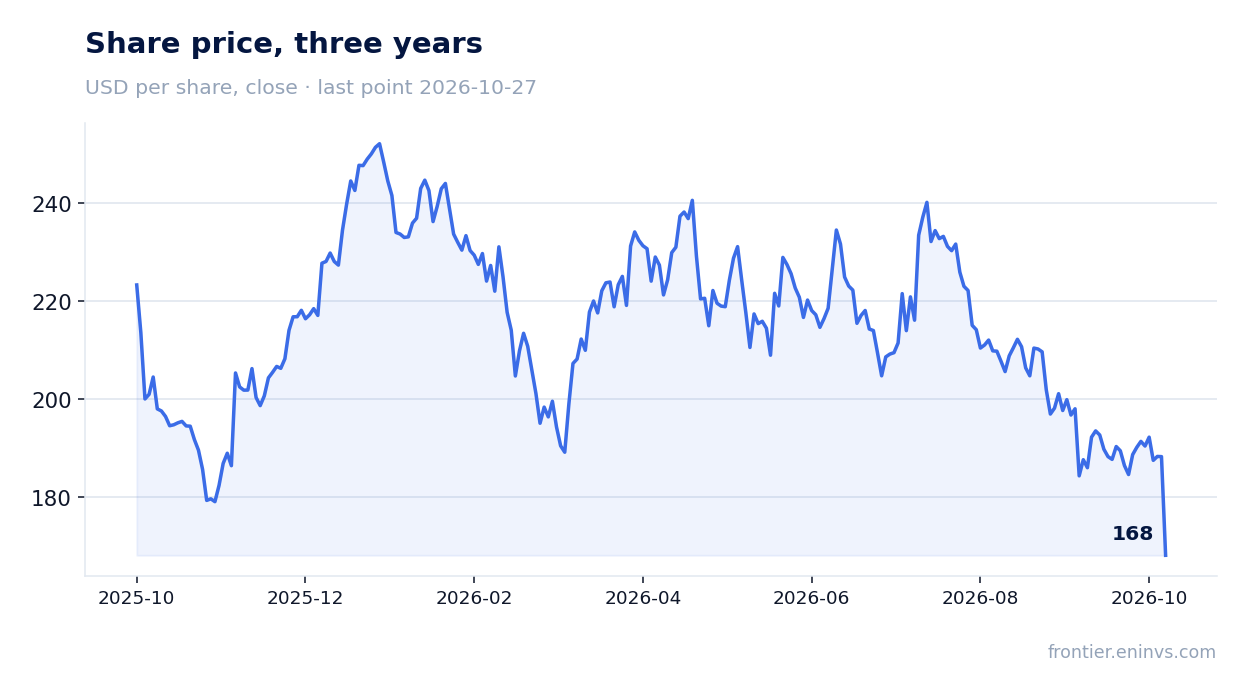
Net debt rose to $36.4 billion, or 2.88 times EBITDA
Net debt at 30 September 2026 was $36,422 million. The ratio of net debt to trailing twelve-month EBITDA is 2.88. A year earlier, on 30 September 2025, net debt was $30.4 billion, so it rose by $6.1 billion over the year.
Consolidated debt is $45.9 billion, cash and marketable securities $20.7 billion. The company has $10.0 billion of undrawn credit facilities, providing a liquidity buffer.
Quarterly interest expense was $573 million, and $1,789 million for the nine months. With trailing twelve-month EBITDA of $12,668 million, leverage remains moderate, but the $23.3 billion quarterly increase in net debt needs an explanation that the release does not provide.
Backlog reached a record $745 billion, but conversion into profit lags
Total backlog rose to a record $745 billion, including more than 6,300 commercial airplanes worth $612 billion. Defense backlog is $101 billion and services $33 billion.
Such a backlog provides years of revenue visibility, but its conversion into profit depends on production rates and costs. While commercial airplanes run a negative margin, backlog growth does not translate into earnings.
In the third quarter Commercial Airplanes booked 300 net orders, including from Turkish Airlines, Ethiopian Airlines and Lufthansa. That confirms demand but does not solve the profitability problem.
Valuation on the latest reported figures
| Metric | Value |
|---|---|
| Market cap | 132 bn USD |
| P/E (LTM) | 17.2 |
| EV/EBITDA (LTM) | 14.0 |
| P/B | 24.20 |
| Net debt / EBITDA (LTM) | 2.88 |
| Operating cash flow (LTM) | 4.01 bn |
| ROE | -2.4% |
Bottom line
The strength of the report was defense and services: Defense revenue rose 15%, the services margin reached 18.3%, and backlog hit a record $745 billion. But Commercial Airplanes is still in an operating loss, and revenue growth decelerated from 8.0% to 3.9%. Defense profit was partly one-off – $252 million from the HRL Laboratories sale. Net debt rose to $36.4 billion, and nine-month free cash flow is negative. The key question for a holder is when commercial airplanes will return to profit and generate enough cash flow to reduce debt. The verdict is neutral: the recovery is under way, but at 17.2 times earnings and 14.0 times EBITDA there is no margin for error.
Open the company's financial profile BA →
See also: market overview · valuation map · stock screeners