US_C: profit up 39.8% but revenue growth decelerates to 7.9%

On November 25, US_C released its third-quarter 2026 results. Revenue came in at $23,845 million, up 7.9% year-on-year, while net profit reached $5,245 million, up 39.8% year-on-year. Revenue growth decelerated from 14.3% in the second quarter of 2026. At the current price, the shares look neutral: strong profitability and no debt support the valuation, but decelerating revenue and limited dividend information do not provide a clear edge for buying.
Key takeaways
— Revenue grew 7.9% year-on-year, but this is markedly slower than the 14.3% a quarter earlier
— Net profit rose 39.8% year-on-year, with net margin improving from 17.0% to 22.0%
— The company maintains a net cash position: net debt at end-2025 stood at minus $18,017 million
— Return on equity (ROE) is 11.0%, indicating moderate efficiency in using shareholders' funds
— Operating cash flow was negative in the first half of 2026, which for a financial company reflects client fund movements rather than losses
— The stock is held in the portal's model strategies US Financials (banks), confirming its profile but not constituting a recommendation
Attractiveness
Key figures, USD bn
| Metric | Q3 2025 | Q3 2026 | Change |
|---|---|---|---|
| Revenue | 22.1 | 23.8 | +7.9% |
| EBITDA | 6.43 | — | — |
| Net profit | 3.75 | 5.25 | +39.8% |
| Capex | 1.62 | — | — |
| EBITDA margin | 29.1% | — | — |
| Net margin | 17.0% | 22.0% | +5.0 pp |
Revenue grew 7.9% year-on-year, but this is markedly slower than the 14.3% a quarter earlier
In the third quarter of 2026, US_C revenue reached $23,845 million, up 7.9% from the same period a year earlier. This extends the growth streak, but the pace has slowed: in the second quarter of 2026, revenue rose 14.3% year-on-year, and in the first quarter, 14.1%. The deceleration became noticeable after two quarters of double-digit growth.
The slowdown was likely driven by a high base effect: in the third quarter of 2025, revenue had already grown 9.3% year-on-year. Additionally, quarterly revenue declined by $921 million compared to the second quarter of 2026 (from $24,766 million to $23,845 million), which may indicate seasonality or one-off factors, but the exact cause is not disclosed in the provided data.
For investors, the key point is that the company can still grow revenue, but the sustainability of this growth is in question. If the deceleration continues, it could limit further profit growth even at the current margin level.
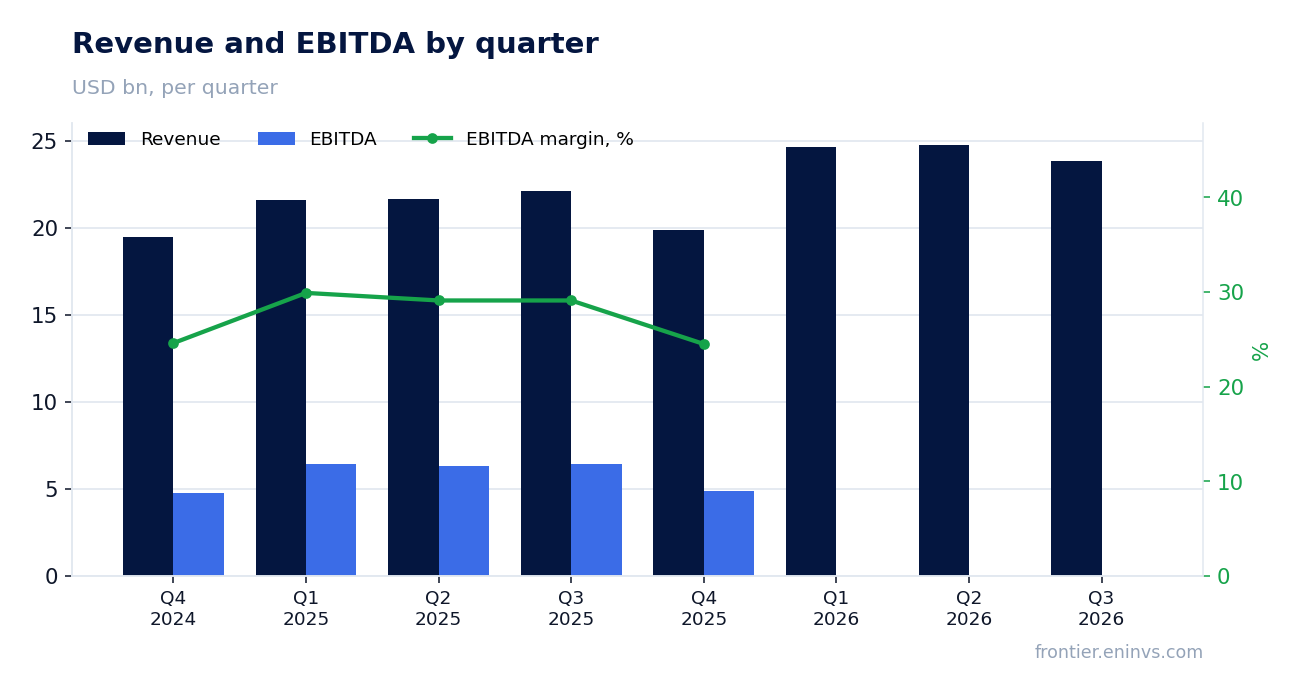
Net profit rose 39.8% year-on-year, with net margin improving from 17.0% to 22.0%
Net profit in the third quarter of 2026 reached $5,245 million, up 39.8% year-on-year. Net margin rose to 22.0% from 17.0% a year earlier. Such profit growth on relatively modest revenue growth indicates significant improvement in operating efficiency or cost reduction.
A 5 percentage point increase in margin is a substantial change. It could be driven by cost optimisation, a shift in business mix, or one-off factors not detailed in the provided data. Without additional information, it is difficult to assess the sustainability of this improvement.
Nevertheless, the company's ability to grow profit faster than revenue is a positive signal. If the margin holds at this level, it will support profit even if revenue growth continues to decelerate.
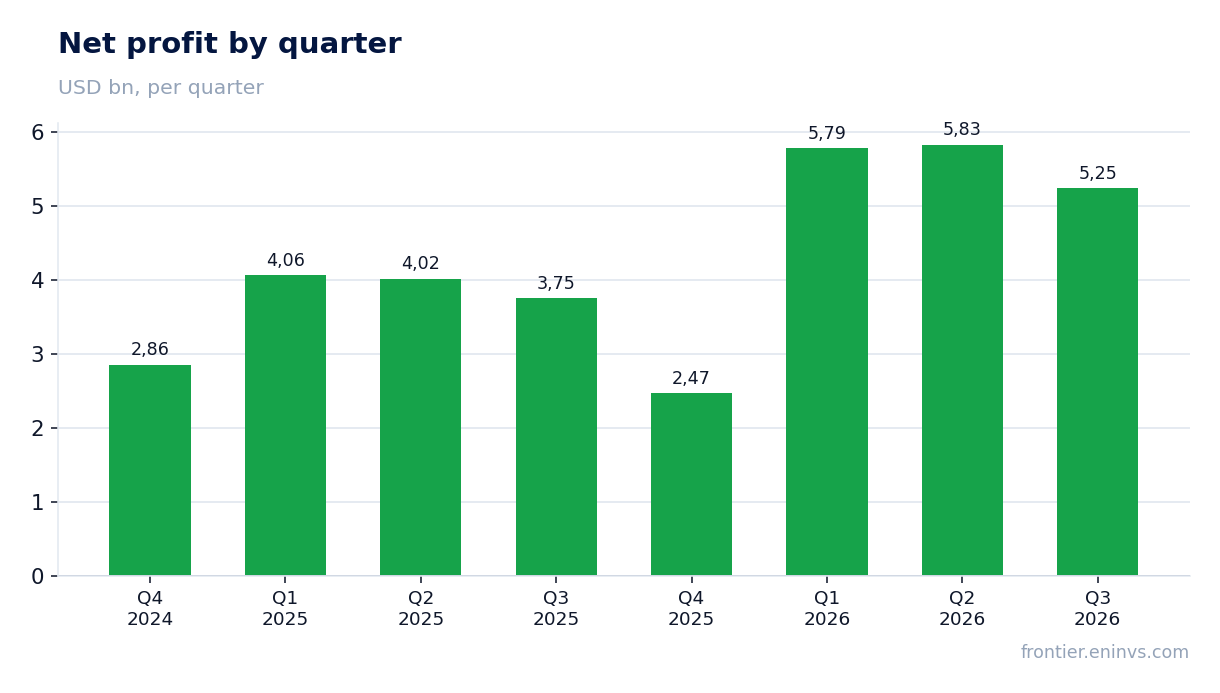
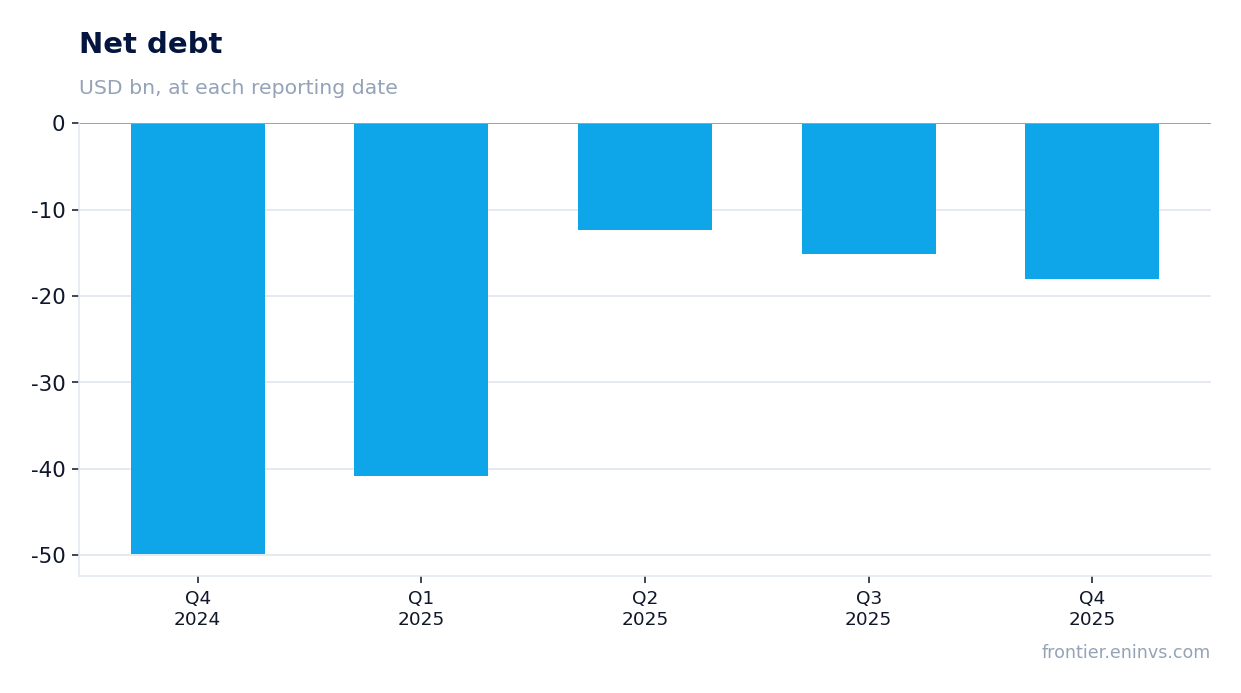
The company maintains a net cash position: net debt at end-2025 stood at minus $18,017 million
As of end-2025, US_C's net debt stood at minus $18,017 million, meaning the company had a net cash position. This indicates that cash and equivalents exceeded debt obligations. For a financial company, such a buffer is particularly important as it provides resilience to market fluctuations.
During 2025, net debt fluctuated: at end-Q4 2024 it was minus $49,917 million, then in Q1 2025 – minus $40,899 million, in Q2 – minus $12,401 million, in Q3 – minus $15,116 million, and by year-end – minus $18,017 million. These swings reflect cash movements typical of banking operations.
The absence of debt burden reduces risks and gives the company flexibility for investments or returning capital to shareholders. However, without data on the current debt level at the end of Q3 2026, it is impossible to assert that this position has persisted.
Return on equity (ROE) is 11.0%, indicating moderate efficiency in using shareholders' funds
US_C's return on equity (ROE) is 11.0%. This is a moderate figure, which may be acceptable for a financial company but does not stand out against higher values in the sector. ROE shows how much profit is generated for each dollar of shareholders' equity.
With net profit for the last 12 months of $5,245 million (for Q3 2026) and an annual ROE of 11.0%, one can estimate shareholders' equity at around $47.7 billion. This is a substantial base, and to improve ROE the company would need either to increase profit or optimise capital.
Moderate ROE combined with high net margin (22.0%) may indicate a conservative capital structure or the presence of significant assets that do not generate rapid returns. For an investor, this means the company is not showing explosive efficiency gains, but it is also not taking excessive risks.
Operating cash flow was negative in the first half of 2026, which for a financial company reflects client fund movements rather than losses
In the first half of 2026, US_C's operating cash flow was negative: minus $21,873 million in Q1 and minus $24,079 million in Q2. For a bank or financial company, such swings are normal as they reflect changes in client balances rather than operating losses. Negative cash flow should not be interpreted as a sign of financial distress.
For comparison, in Q4 2025 operating cash flow was positive at $26,555 million, and in Q4 2024 it was $24,796 million. These figures confirm that cash flow is subject to significant quarterly fluctuations related to the activities of a financial institution.
Investors should focus on net profit and profitability rather than operating cash flow, which is not a performance indicator for banks. In this case, profit remains stable and growing, which is more important for valuation.
The stock is held in the portal's model strategies US Financials (banks), confirming its profile but not constituting a recommendation
US_C is included in the model strategies of the «Усиленные Инвестиции» portal – US Financials (banks). This is a fact reflecting the company's compliance with the strategy's selection criteria, but it is not an argument for an investment decision. Inclusion is based on formal criteria, not on the current attractiveness assessment.
For an investor, this means the stock has passed filters for liquidity, market capitalisation, and industry affiliation. However, the decision to buy or sell should be based on fundamental indicators, not on the fact of inclusion in a strategy.
Currently, no changes regarding US_C in the strategy composition have been announced. If the company ceases to meet the criteria, it may be excluded, but this is not a forecast.
Bottom line
US_C delivered strong net profit growth of 39.8% year-on-year and margin improvement to 22.0%, which is the main positive of the report. However, the deceleration in revenue growth to 7.9% after 14.3% in Q2 raises questions about the sustainability of the momentum. The company maintains a net cash position, but the lack of fresh data on debt and dividends prevents a full assessment of financial flexibility. At the current price, the stock looks neutral: high profitability is offset by decelerating revenue and moderate ROE. A return to double-digit revenue growth or disclosure of dividend policy would be needed to improve the valuation.
Open the company's financial profile C →
See also: market overview · valuation map · stock screeners