Profit up 49.3% on a flat top line – the growth comes from costs, not the business
The report for the third quarter of 2026, ended 30 September, showed net profit of 247.759 million dollars, up 49.3% year on year. Revenue barely moved: in the prior quarter it grew 3.9% year on year against 4.4% a quarter earlier, a deceleration. The profit gain came from costs rather than the business, and with debt at 13,091.7 million dollars at the end of 2025 the share looks neutral on attractiveness at the current price.
Key takeaways
— Net profit rose 49.3% while revenue barely moved
— Revenue growth decelerated to 3.9% in the prior quarter from 4.4% a quarter earlier
— Debt of 13,091.7 million dollars at the end of 2025 absorbs almost all the profit
— A return on equity of 7.9% does not justify the debt load
— The share sits in the US REITs (high yield) model strategy – a fact, not an argument
Attractiveness
Key figures, USD bn
| Metric | Q3 2025 | Q3 2026 | Change |
|---|---|---|---|
| Revenue | 0.86 | — | — |
| EBITDA | 0.46 | — | — |
| Operating profit | 0.28 | — | — |
| Net profit | 0.17 | 0.25 | +49.3% |
| Operating cash flow | 0.46 | — | — |
| Capex | 0.01 | — | — |
| EBITDA margin | 53.2% | — | — |
| Net margin | 19.3% | — | — |
Net profit rose 49.3% while revenue barely moved
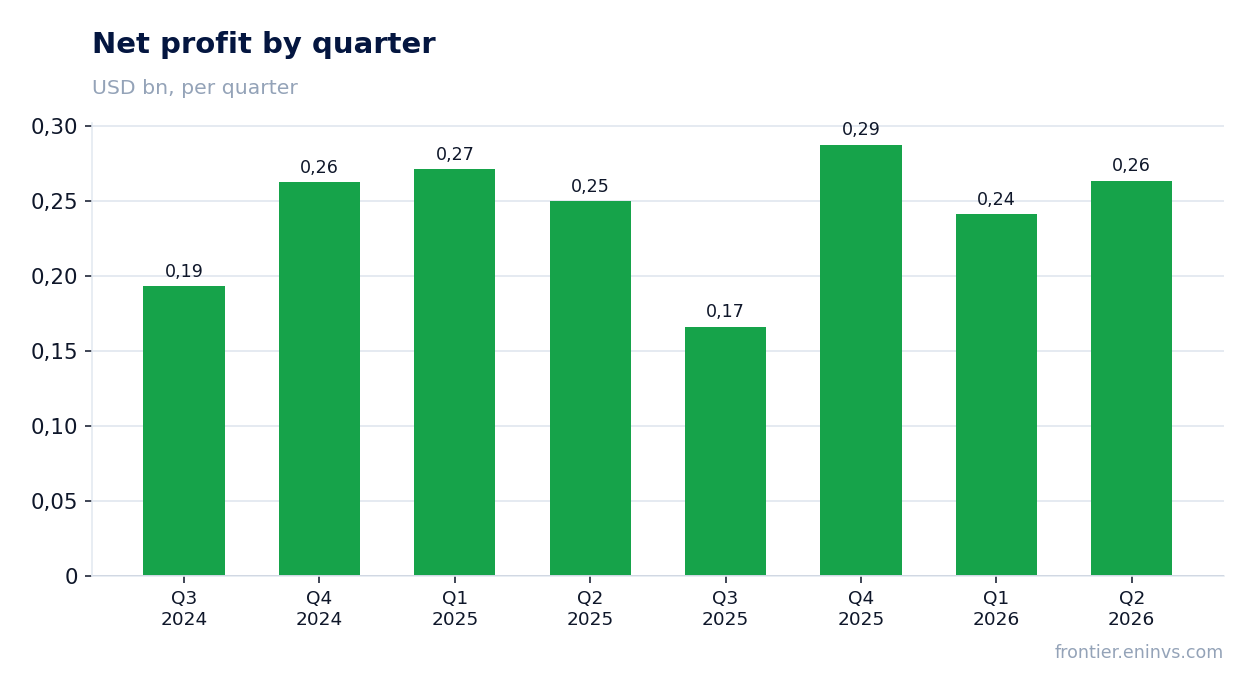
In the third quarter of 2026 net profit was 247.759 million dollars, up 49.3% from the same quarter a year earlier. Revenue for the same period is not disclosed in the facts, but the prior quarters show it growing only a few percent a year.
Such a gap between profit and revenue means profit grew through lower costs, not higher sales. That is a one-off lever: costs can be cut once, but not indefinitely.
For a holder this means the quality of the profit is lower than the headline suggests. Sustainable profit growth requires revenue growth, and that is not there yet.
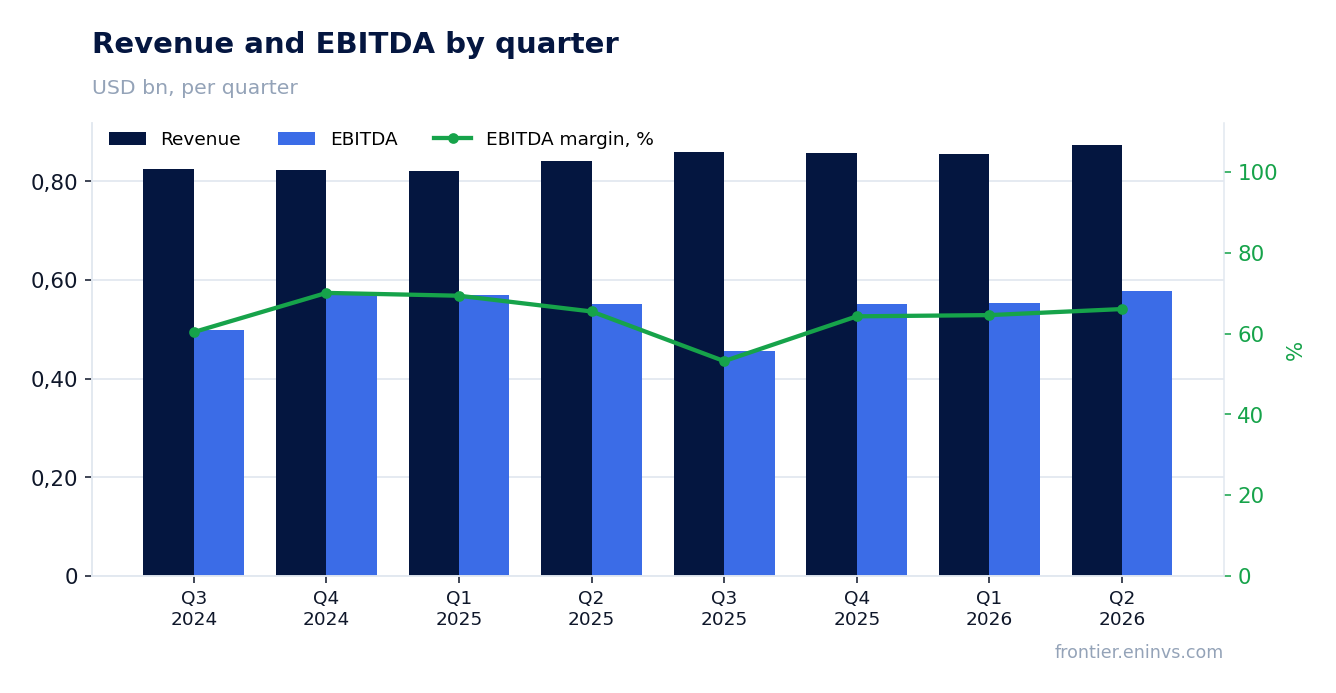
Revenue growth decelerated to 3.9% in the prior quarter from 4.4% a quarter earlier
In the second quarter of 2026 revenue grew 3.9% year on year, while in the first quarter the rate was 4.4%. That is a deceleration, not an acceleration.
The slowdown comes on top of already slow growth: in the third quarter of 2025 the rate was 4.1%, in the fourth 4.3%. The company is not speeding up but losing even the modest rates it had.
If the deceleration continues, next year's profit will hit the absence of revenue growth, and there will be no costs left to cut.
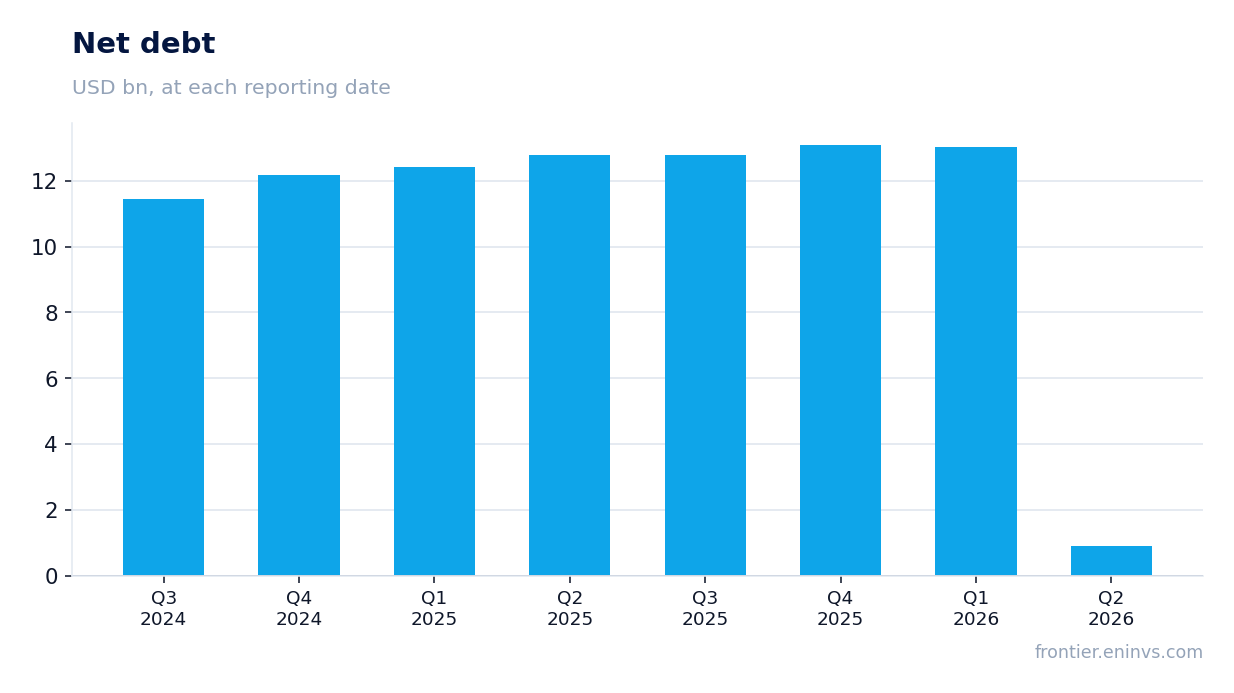
Debt of 13,091.7 million dollars at the end of 2025 absorbs almost all the profit
Net debt at the end of 2025 was 13,091.7 million dollars. That is 53 times the quarterly profit of 247.759 million dollars.
With such a load, interest on the debt absorbs a significant part of operating profit. The company has to direct money to servicing debt rather than development.
Debt reduction is the main factor that could change the assessment of the share. Until debt starts to fall, profit will remain under pressure.
A return on equity of 7.9% does not justify the debt load
Return on equity is 7.9%. That is below the return an investor could get on risk-free instruments and clearly does not compensate for the debt risk.
With debt of 13,091.7 million dollars and a return on equity below 8%, the company is inefficient: each dollar of capital brings less than it costs to service.
To raise the return, either profit must rise or capital must shrink. The first requires revenue growth, and the second is not visible yet.
The share sits in the US REITs (high yield) model strategy – a fact, not an argument
The share is included in the US REITs (high yield) model strategy on the portal. That is a fact, not an argument for the assessment.
Inclusion in the strategy means only that the share passed the strategy's screens, not that it is attractive on fundamentals.
For an investor this is a signal to assess independently whether the current yield and risk match their goals.
Bottom line
The strong side of the report is the 49.3% rise in net profit, but it was achieved through cost cuts, not through the business. Revenue is growing slowly and decelerating: 3.9% in the second quarter against 4.4% in the first. Debt of 13,091.7 million dollars and a return on equity of 7.9% do not make the share attractive. The verdict is neutral: the arguments for and against balance out, but growth needs either a revenue turnaround or debt reduction.
Open the company's financial profile EXR →
See also: market overview · valuation map · stock screeners