JFrog Ltd: revenue accelerated to 30.9%, but profit rests on interest income, not on sales
On 5 November JFrog Ltd reported third-quarter 2026 results: revenue of $179.2 million rose 30.9% year over year, cloud revenue grew 60%, and GAAP net income turned positive at $6.6 million. Operating activities generated $69.3 million of cash flow, the strongest quarter on record for the company. Yet the operating result is still negative at minus $1.8 million, and profit rests on interest income from the accumulated cash pile. At the current price the share looks rather attractive: growth is accelerating and cash is being generated, but the valuation already reflects much of this.
Key takeaways
— Revenue accelerated to 30.9% – cloud grew 60% and produced 57% of sales
— Operating loss narrowed to $1.8 million, but the $6.6 million profit came from interest on cash
— Free cash flow of $66.5 million is the best quarter and three times the year-ago figure
— Large customers grow faster than revenue: 112 customers with ARR above $1 million versus 71 a year ago
— Remaining performance obligations of $812.4 million rose 60% and underpin the $680–682 million full-year guidance
— The share fell 13.7% on the release day even though Q4 guidance implies growth slowing to 26–27%
Attractiveness
Key figures, USD bn
| Metric | Q3 2025 | Q3 2026 | Change |
|---|---|---|---|
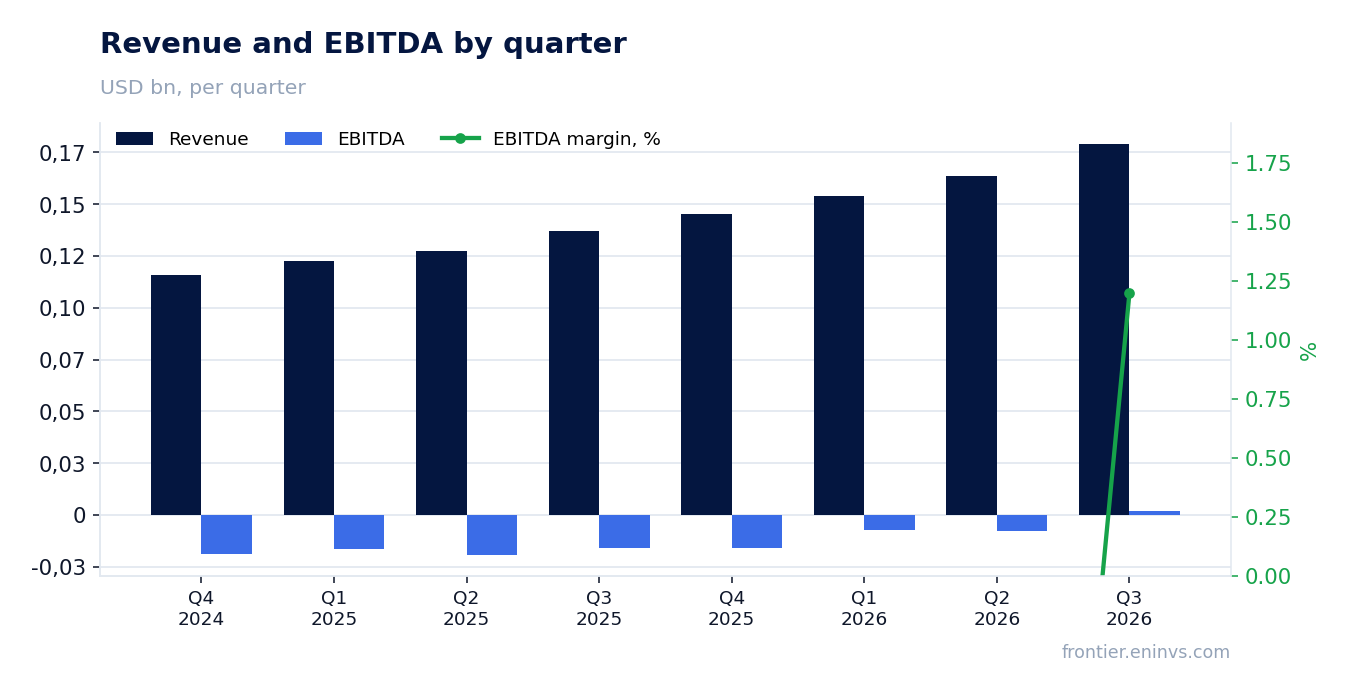
| Revenue | 0.14 | 0.18 | +30.9% |
| EBITDA | -0.02 | 0.00 | to profit |
| Operating profit | -0.02 | -0.00 | — |
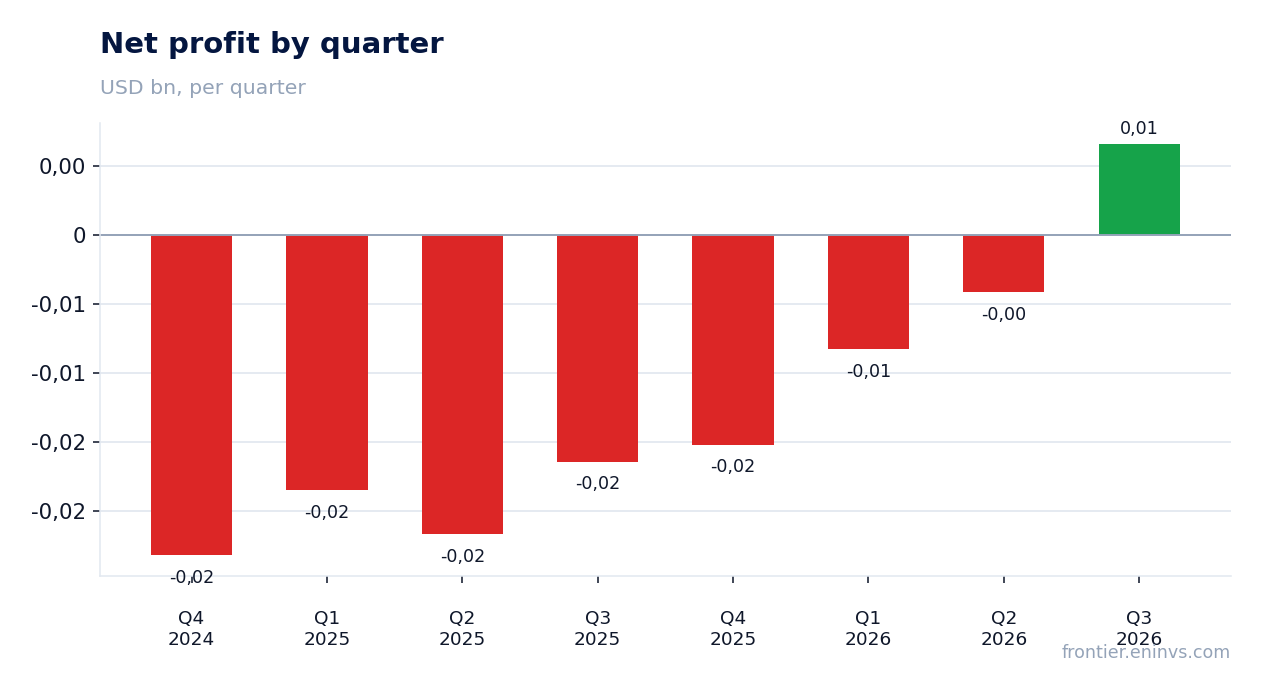
| Net profit | -0.02 | 0.01 | to profit |
| Operating cash flow | 0.03 | 0.07 | +129.8% |
| Capex | 0.00 | 0.00 | +108.0% |
| EBITDA margin | -11.6% | 1.2% | +12.8 pp |
| Net margin | -12.0% | 3.7% | +15.7 pp |
Revenue accelerated to 30.9% – cloud grew 60% and produced 57% of sales
Third-quarter 2026 revenue was $179.2 million, up 30.9% year over year. The prior quarter showed 28.7%, so growth accelerated. Self-managed and cloud subscription revenue brought in $171.6 million, while licences contributed only $7.6 million, and that split explains where the business is heading.
The main driver is cloud: $101.5 million, up 60% year over year. Its share of revenue rose to 57% from 46% a year earlier. As customers move from their own data centres to JFrog's cloud, revenue both accelerates and becomes more predictable, because cloud contracts are consumed rather than bought one-off.
Large customers grow faster than the company overall. The number of customers with annual recurring revenue above $1 million reached 112 versus 71 a year earlier, and those above $100,000 reached 1,357 versus 1,121. Net Dollar Retention rose to 124% from 118%: existing customers are spending noticeably more than a year ago.
Operating loss narrowed to $1.8 million, but the $6.6 million profit came from interest on cash
The operating result remains negative at minus $1.8 million versus minus $21.6 million a year earlier. GAAP gross profit was $142.7 million at a 79.6% margin, while non-GAAP operating income reached $40.7 million at a 22.7% margin. The gap between the two is mainly $41.8 million of share-based compensation.
Net income of $6.6 million did not come from operations: interest and other income brought $8.1 million, and that is what pushed the result into the black. A year earlier the quarter closed with a $16.4 million loss. The net margin was 3.7% versus minus 12.0%, but it rests on interest from $880.9 million of cash and investments.
Costs are growing slower than revenue: research and development added about 10%, sales and marketing about 12%, while revenue grew 30.9%. That is the source of the margin improvement. General and administrative costs, however, rose by a quarter to $25.5 million, largely on higher share-based compensation in that line.
Free cash flow of $66.5 million is the best quarter and three times the year-ago figure
Operating activities generated $69.3 million versus $30.2 million a year earlier. Capital expenditure was small at $2.8 million, so free cash flow reached $66.5 million versus $28.8 million. Over nine months free cash flow was $157.5 million.
That flow is supported by a $36.9 million increase in deferred revenue in the quarter: customers pay in advance, and that is cash already received. Over the trailing twelve months operating cash flow was $215.5 million on revenue of $642.3 million – the company converts sales into cash well.
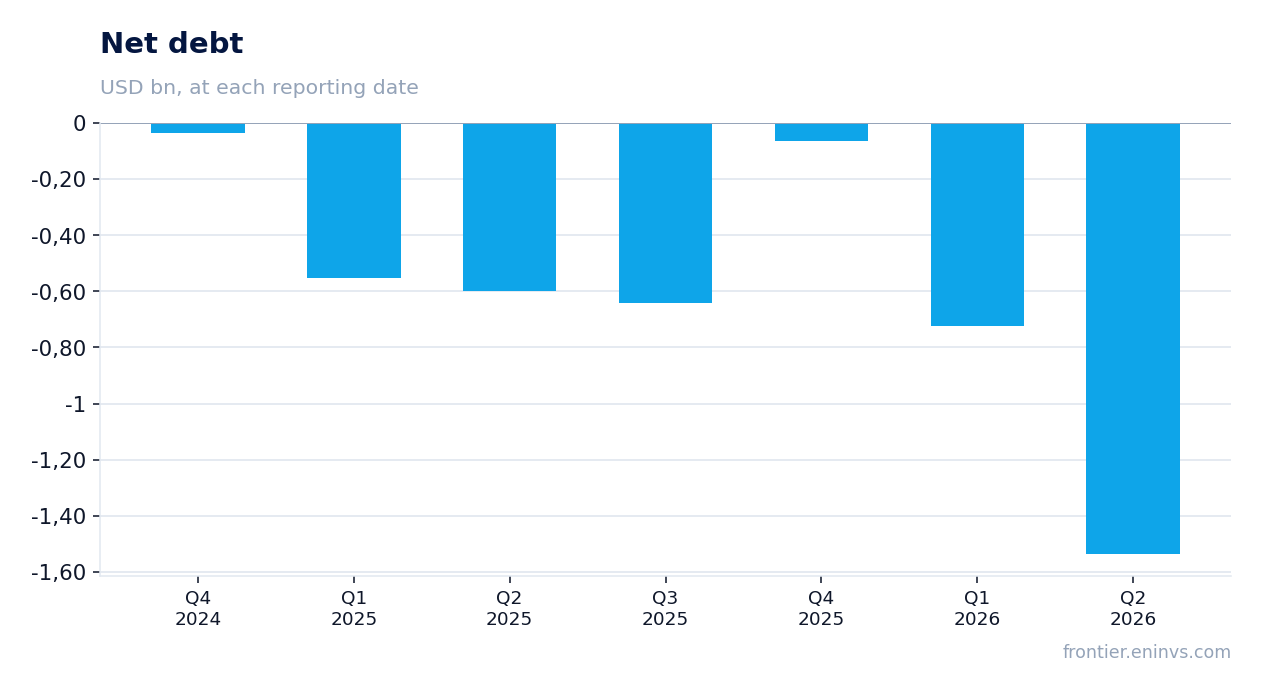
There is no debt load: at the end of 2025 net debt was negative at minus $63.4 million, meaning cash exceeded liabilities. By the end of the third quarter cash and investments had reached $880.9 million. The company funds growth from its own cash flow and does not depend on the capital markets.
Large customers grow faster than revenue: 112 customers with ARR above $1 million versus 71 a year ago
The number of customers with annual recurring revenue above $1 million grew 58% to 112 from 71. That is faster than revenue growth of 30.9%, so large accounts are gaining weight in the portfolio. Customers above $100,000 reached 1,357 versus 1,121, up 21%.
The Enterprise+ subscription, which covers the whole platform, produced 61% of revenue versus 56% a year earlier. Customers are buying the entire software supply chain rather than individual products, which makes revenue more durable: such a subscription is harder to drop.
Retention of 124% means existing customers increase spending by a quarter each year. Together with the growth in large accounts, this gives the company visible growth headroom even without new customer inflow.
Remaining performance obligations of $812.4 million rose 60% and underpin the $680–682 million full-year guidance
Remaining performance obligations reached $812.4 million, up 60% year over year. The metric reflects contracted but not yet recognised revenue, and its growth at twice the rate of revenue suggests the order book is building ahead of sales.
The company reiterated 2026 guidance: revenue of $680–682 million, non-GAAP operating income of $142.5–144.5 million, and earnings per share of $1.14–1.16. For the fourth quarter it expects revenue of $183–185 million – growth of roughly 26–27% year over year, slower than the 30.9% in the third quarter.
The slowdown in guidance is explainable: a year earlier the fourth quarter grew 25.2%, so the comparison gets tougher. Still, the market reacted to the report by marking the share down 13.7% on the release day – expectations were probably higher. Free cash flow and the order book remain strong.
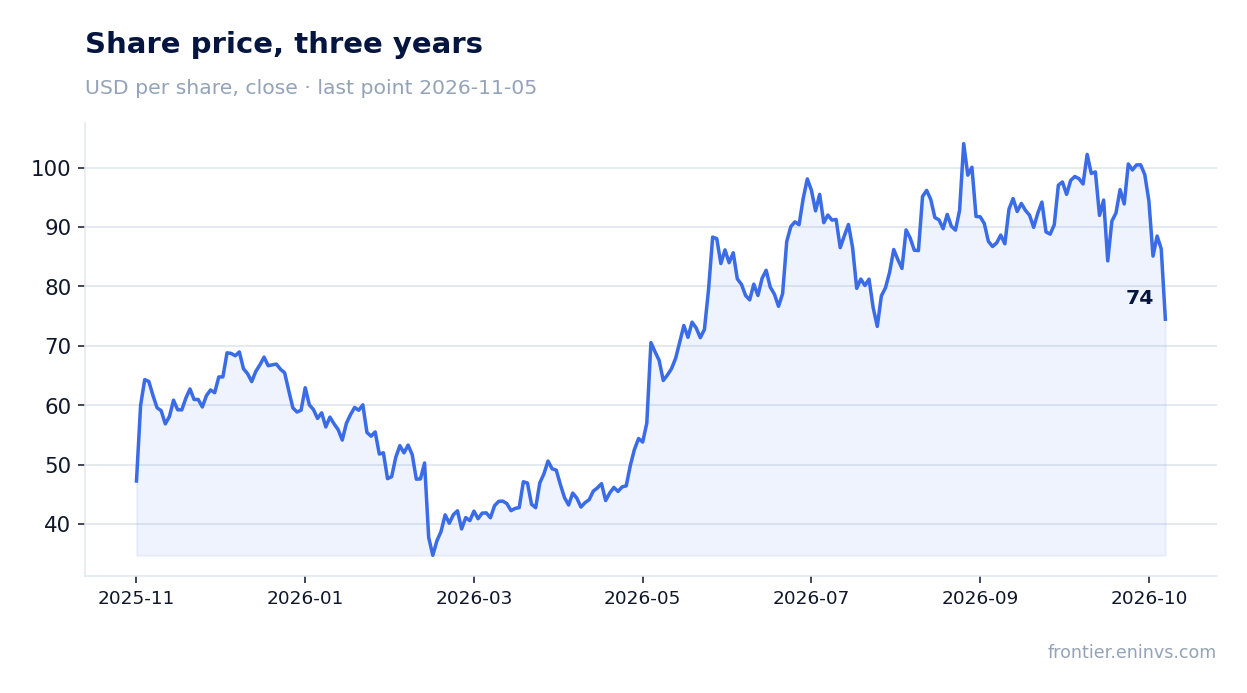
The share fell 13.7% on the release day even though Q4 guidance implies growth slowing to 26–27%
Before the release the share traded at $86.34; on the release day it lost 13.7% and stayed there through 5 November. With a market capitalisation of $9.18 billion and trailing-twelve-month revenue of $642.3 million, the market-cap-to-revenue ratio is about 14 times. For a company growing 30% with acceleration, that does not look stretched.
GAAP earnings per share for the quarter were $0.05, non-GAAP $0.32. Return on equity is 2.7%, low precisely because profit is still thin relative to capital. What creates value for the shareholder now is not accounting profit but revenue growth and cash flow.
The market reaction shows investors expected more from guidance. Yet the company reiterated its annual plan and the order book grew 60%. If the fourth quarter lands near the top of the range, concerns about a slowdown will ease.
Valuation on the latest reported figures
| Metric | Value |
|---|---|
| Market cap | 9.18 bn USD |
| P/B | 10.35 |
| Operating cash flow (LTM) | 0.22 bn |
| ROE | 2.7% |
Bottom line
The strong side of the report is revenue acceleration to 30.9%, cloud growth of 60%, and free cash flow of $66.5 million, the best in the company's history. The weak side is that the operating result is still negative and the $6.6 million profit rests on interest income from cash. The market marked the share down 13.7%, even though the company reiterated its annual guidance and showed an order book of $812.4 million, up 60%. The question for a holder now is whether acceleration holds in the fourth quarter against a tougher comparison base. At the current price the share looks rather attractive: growth and cash are there, the valuation is moderate, but profit does not yet carry its own weight.
Open the company's financial profile FROG →
See also: market overview · valuation map · stock screeners