SITIME Corp: revenue more than tripled, but almost all the profit stayed in non-cash items

On 4 November SITIME Corp reported results for the third quarter of 2026. Revenue was $298.7 million against $83.6 million a year earlier, growth of +257.4%; GAAP operating profit was $8.3 million, net profit $4.3 million at a 1.5% margin versus minus 9.6% a year earlier. Non-GAAP earnings per share were $4.01, but that rests on excluding $61.8 million of amortisation of acquired intangibles and $35.0 million of stock-based compensation. The stock lost 9.4% after the release and has not recovered; with a market cap of $12.1 billion and net debt of $1.0 billion the valuation looks neutral: the growth is real, but the quality of earnings and the leverage taken on with the TPD acquisition need confirmation in the coming quarters.
Key takeaways
— Revenue grew 257.4%, mostly through TPD consolidation, while organic core CED revenue grew 202%
— GAAP gross margin fell to 51.6% because of $53.2 million of amortisation of acquired assets; excluding it the margin is 70.7%
— Of the $4.3 million net profit almost everything was absorbed by non-cash items: $61.8 million of amortisation and $35.0 million of stock-based compensation
— Net debt rose from minus $0.6 billion on 30 June to $1.0 billion on 30 September after a $1.3 billion convertible notes issue
— Interest expense of $5.1 million exceeded interest income of $1.5 million for the first time, and that is a new permanent factor
— The company announced a three-for-one stock split, which does not change value but lowers the price of one share
— A $12.1 billion valuation on annual revenue of about $1 billion assumes growth continues without a margin collapse
Attractiveness
Key figures, USD bn
| Metric | Q3 2025 | Q3 2026 | Change |
|---|---|---|---|
| Revenue | 0.08 | 0.30 | +257.4% |
| EBITDA | -0.01 | — | — |
| Operating profit | -0.02 | 0.01 | to profit |
| Net profit | -0.01 | 0.00 | to profit |
| Operating cash flow | 0.03 | — | — |
| Capex | 0.01 | — | — |
| EBITDA margin | -7.3% | — | — |
| Net margin | -9.6% | 1.5% | +11.1 pp |
Revenue grew 257.4%, mostly through TPD consolidation, while organic core CED revenue grew 202%
Third-quarter 2026 revenue was $298.7 million against $83.6 million a year earlier, growth of +257.4%. That is a marked acceleration from the second quarter, when growth was 126.5%. The company names two reasons directly: the TPD acquisition and organic growth.
The organic part is core CED, whose revenue grew 202% year on year. Management ties this to the buildout of artificial-intelligence infrastructure, which needs precision timing. The rest of the increase came from consolidating TPD, whose integration the CEO says has gone well.
The annualised revenue run rate passed $1 billion. For a company that a year ago was under $350 million a year, that is a step change in scale. But precisely because of the purchase, next year's comparison base will include TPD from day one, and organic growth will be cleaner to see.
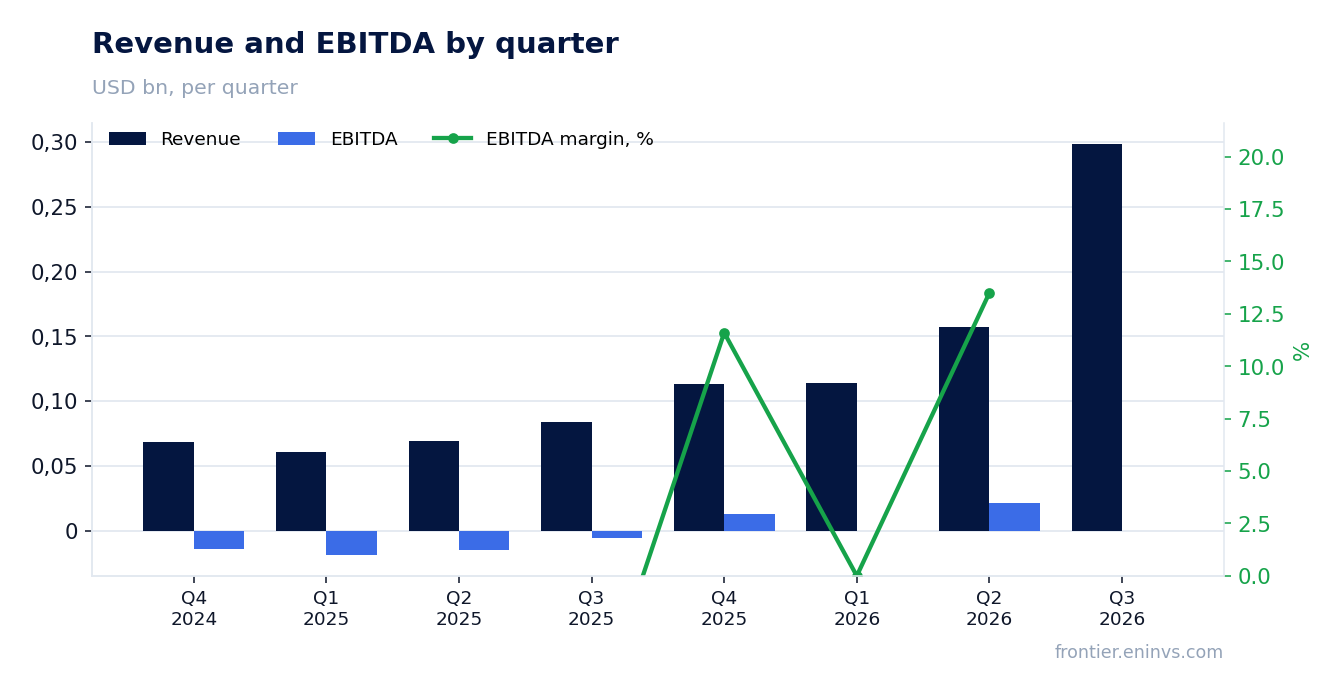
GAAP gross margin fell to 51.6% because of $53.2 million of amortisation of acquired assets; excluding it the margin is 70.7%
GAAP gross profit was $154.1 million, or 51.6% of revenue, against 53.5% a year earlier. The decline comes from one line: amortisation of acquired intangibles in cost of revenue, $53.2 million against $3.6 million a year earlier. Excluding it and $3.0 million of inventory step-up amortisation, the non-GAAP gross margin is 70.7%.
The non-GAAP margin rose from 58.8% a year earlier. That means the operating economics of the business improved rather than deteriorated, and the GAAP margin decline is an accounting effect of the purchase. The gap between 51.6% and 70.7% is the price the company paid for TPD in the form of intangible assets on the balance sheet.
For an investor the important point is that this amortisation is non-cash and does not affect cash flow, but it will weigh on GAAP profit for several years. As long as the market looks at adjusted figures, the gap between them and GAAP will stay wide.
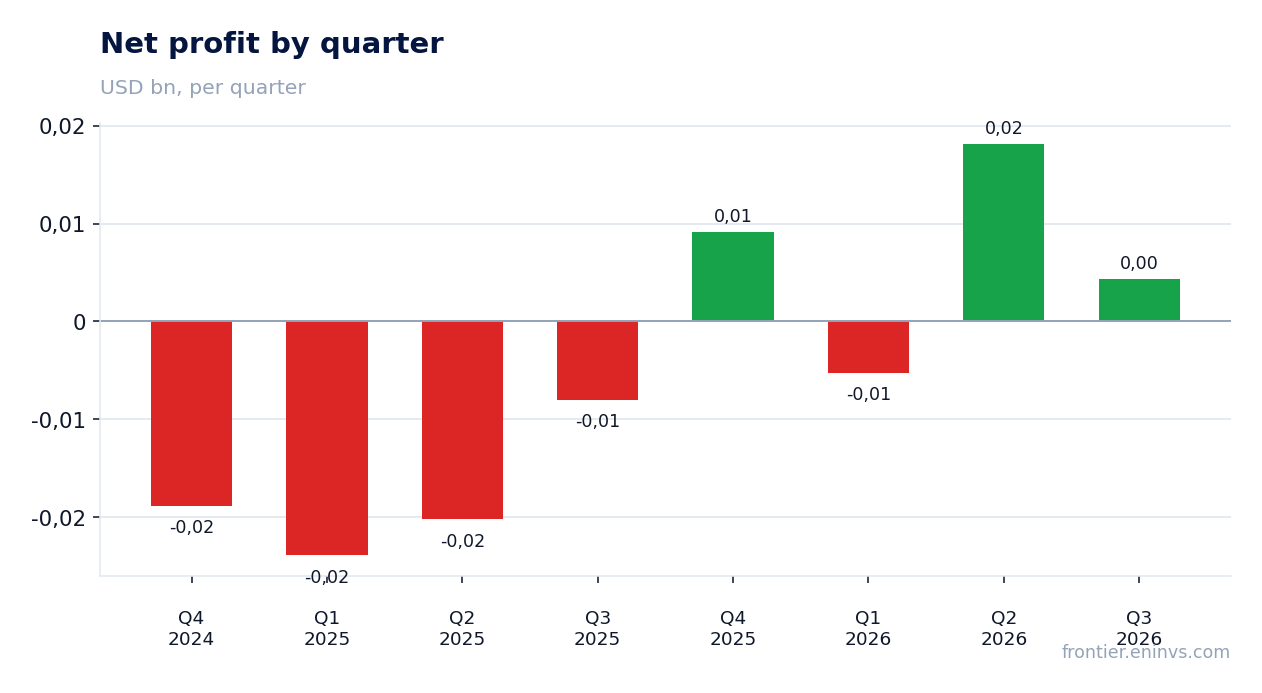
Of the $4.3 million net profit almost everything was absorbed by non-cash items: $61.8 million of amortisation and $35.0 million of stock-based compensation
GAAP net profit was $4.3 million, or $0.14 per diluted share. Non-GAAP net profit was $130.3 million, or $4.01 per share. The $126 million gap is exactly the non-cash items: $61.8 million of amortisation of acquired assets, $35.0 million of stock-based compensation, $21.3 million of acquisition costs and $4.8 million of amortisation of financing costs.
Acquisition costs of $21.3 million are one-off TPD integration expenses that will not recur at that level next quarter. Stock-based compensation of $35.0 million is a regular item, but it dilutes existing shareholders and does not show up in cash flow.
The net margin of 1.5% against minus 9.6% a year earlier looks like an improvement, but in fact it only reflects that the company crossed into token profit. The real earning power is visible in the adjusted operating margin of 43.4%, which is far higher.
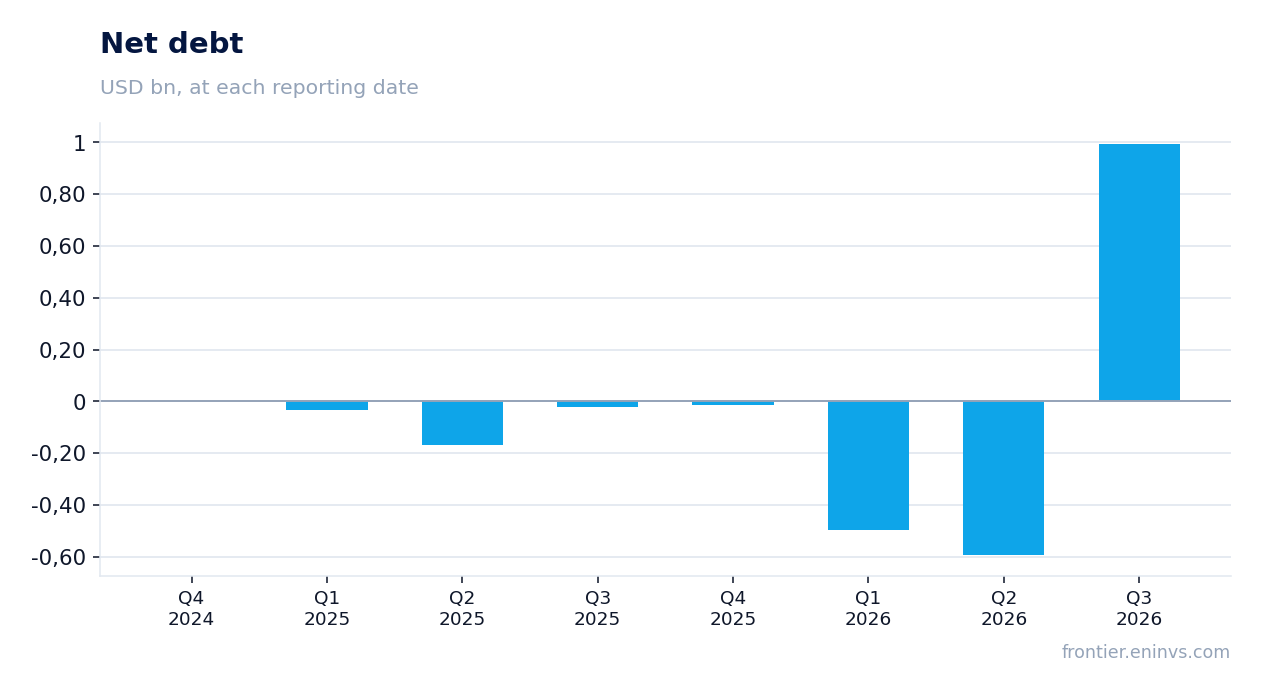
Net debt rose from minus $0.6 billion on 30 June to $1.0 billion on 30 September after a $1.3 billion convertible notes issue
On 30 September net debt was $1.0 billion against minus $0.6 billion on 30 June, a change of +$1.6 billion. A year earlier, on 30 September 2025, net debt was minus $0.0 billion, so over 12 months it rose by $1.0 billion. The reason is a $1.3 billion convertible senior notes issue carried on the balance sheet.
Cash and short-term investments at the end of the quarter were $324.3 million against $791.6 million of investments at the end of 2025. The company spent a large part of its cushion on the TPD purchase and topped up the remaining liquidity with debt. That is a typical way to finance a large deal, but it changes the risk profile.
Interest expense of $5.1 million exceeded interest income of $1.5 million for the first time. Before this the company was a net lender and earned on its cash. Now debt service becomes a permanent line that will absorb part of operating profit.
Interest expense of $5.1 million exceeded interest income of $1.5 million for the first time, and that is a new permanent factor
In the third quarter interest income was $1.5 million and interest expense $5.1 million. The net interest result was minus $3.6 million, whereas in the second quarter income was $12.5 million against $2.2 million of expense. The turn came from the convertible notes issue and from spending the cash cushion on the purchase.
For a company that a year ago lived on interest from deposits, this is a change of model. Interest now comes out of operating profit, and at an annual coupon of roughly 4–5% the expense will run into tens of millions of dollars a year. That is not critical against non-GAAP operating profit of $129.5 million for the quarter, but it reduces free cash flow.
Convertible notes have a dual nature: if the share price rises they convert into equity and the debt disappears, but with dilution. If not, they must be repaid in cash. While the market values the company at $12.1 billion the repayment risk is low, but it is worth watching.
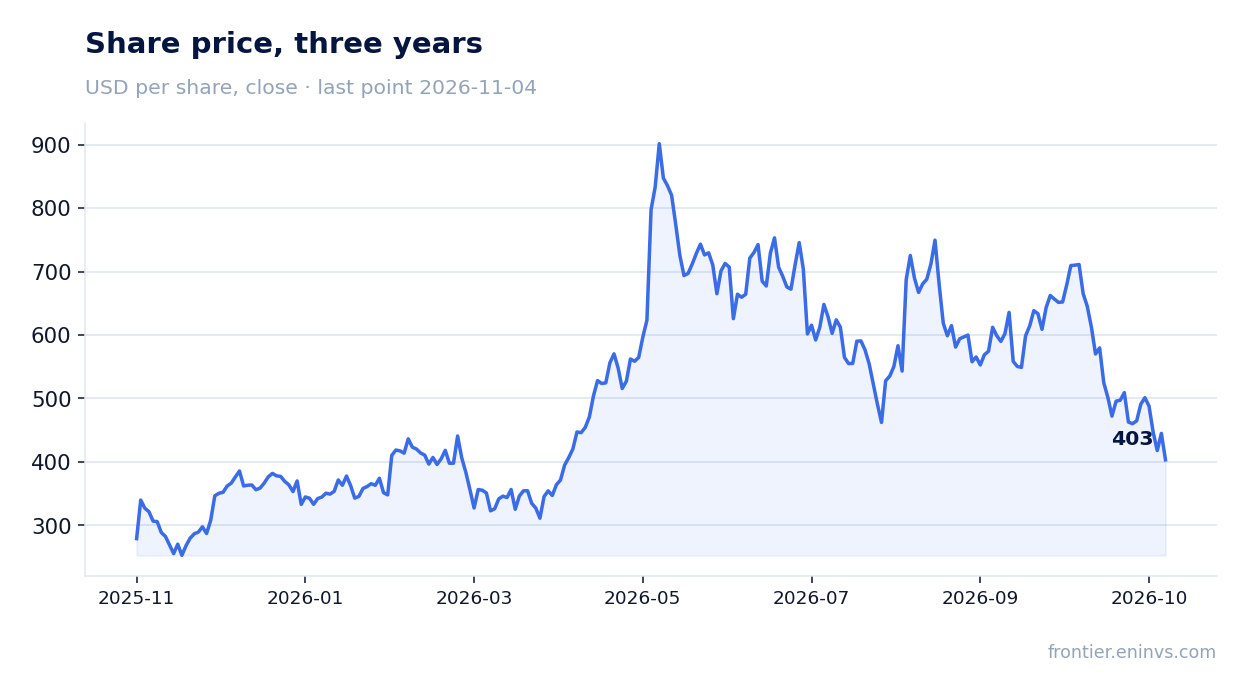
The company announced a three-for-one stock split, which does not change value but lowers the price of one share
SITIME Corp announced a three-for-one stock split. Each holder of record at the close on 3 December 2026 will receive two additional shares for each one held, and trading on a split-adjusted basis begins on 7 December. The split does not change market capitalisation or fundamental value.
The aim is to make the shares more accessible to employees and investors. At about $445 per share before the split, one share is expensive for a retail investor; after the split the price will be roughly $148. This is a cosmetic measure, but it may improve liquidity.
For current shareholders the split is neutral: the number of shares triples, the price falls threefold, the stake does not change. It should not be read as a signal of anything more.
A $12.1 billion valuation on annual revenue of about $1 billion assumes growth continues without a margin collapse
The company's market cap is $12.1 billion, trailing-twelve-month revenue $683.0 million. That is about 17.8 times revenue, which for a growing semiconductor business does not look outrageous, but it requires growth to continue. Trailing-twelve-month adjusted profit is not disclosed, so a P/E judgement is difficult.
Net debt of $1.0 billion adds about $13.1 billion to enterprise value. With quarterly non-GAAP operating profit of $129.5 million in the third quarter, the annual figure might be around $400 million, giving EV/EBIT of about 33. That is not cheap, but not a bubble for a company growing more than 100% a year.
The main valuation risk is that the market has already priced in continued growth. The stock fell 9.4% after the release, which suggests investors expected more or were alarmed by the gap between GAAP and adjusted profit. At the current price the share is fairly valued, but without a margin of safety.
Valuation on the latest reported figures
| Metric | Value |
|---|---|
| Market cap | 12.1 bn USD |
| P/B | 10.49 |
| ROE | 0.3% |
Bottom line
The strong side of the report was revenue growth of 257.4% and organic core CED growth of 202%, which confirms demand from artificial-intelligence infrastructure. The weak side is the quality of earnings: GAAP profit of just $4.3 million against adjusted $130.3 million, with the gap created by amortisation and stock-based compensation. Debt rose to $1.0 billion, and interest expense exceeded income for the first time. A $12.1 billion valuation on $683.0 million of trailing-twelve-month revenue leaves no margin for error. The verdict is neutral: growth is real, but the share is already expensive and the leverage needs confirmation of cash-generation ability.
Open the company's financial profile SITM →
See also: market overview · valuation map · stock screeners