Wells Fargo: profit up 6.5% while revenue stalls – growth rests on margin, not on the business

Wells Fargo's third-quarter 2026 report showed revenue of 21,870 million dollars and net profit of 5,951 million dollars. Year on year revenue added only 2.0%, versus 8.6% growth a quarter earlier – a marked deceleration. Profit still rose 6.5%, and net margin climbed to 27.2% from 26.1% a year earlier. The share looks neutral: profitability rests on margin, but the revenue slowdown and the absence of capital-adequacy data leave no case for a higher rating.
Key takeaways
— Revenue grew just 2.0% year on year after 8.6% a quarter earlier – business growth decelerated sharply
— Net profit added 6.5% year on year even though revenue rose only 2.0% – the gap was closed by margin
— Net margin rose to 27.2% from 26.1% a year earlier – that is the source of profit growth
— Return on equity of 14.3% is moderate for a bank, and it is not rising alongside revenue
— Balance-sheet debt stands at 193,035 million dollars per the latest annual report, a level worth watching
— The share sits in the US Financials (banks) model strategies – a fact, not an argument to buy
Attractiveness
Key figures, USD bn
| Metric | Q3 2025 | Q3 2026 | Change |
|---|---|---|---|
| Revenue | 21.4 | 21.9 | +2.0% |
| EBITDA | 8.73 | — | — |
| Net profit | 5.59 | 5.95 | +6.5% |
| Operating cash flow | -0.87 | — | — |
| EBITDA margin | 40.7% | — | — |
| Net margin | 26.1% | 27.2% | +1.1 pp |
Revenue grew just 2.0% year on year after 8.6% a quarter earlier – business growth decelerated sharply
In the third quarter of 2026 revenue was 21,870 million dollars, up 2.0% year on year. That is a marked deceleration from the second quarter, when growth reached 8.6%. The sequence of quarterly rates – 0.6% in Q2 2025, 5.3% in Q3, 4.5% in Q4, 6.4% in Q1 2026, 8.6% in Q2 and 2.0% in Q3 – shows that after an acceleration in early 2026 growth sharply lost pace.
The reason for the slowdown is not disclosed in the provided data. All that is known is that revenue fell quarter on quarter from 22,622 million dollars in Q2 2026 to 21,870 million dollars in Q3. This could reflect either seasonality or weaker dynamics in key business lines, but there is no confirmation in the facts.
For an investor, what matters is that the slowdown occurred against a still-high base from a year earlier. If growth does not recover next quarter, it will signal that the bank's expansion is hitting a ceiling.
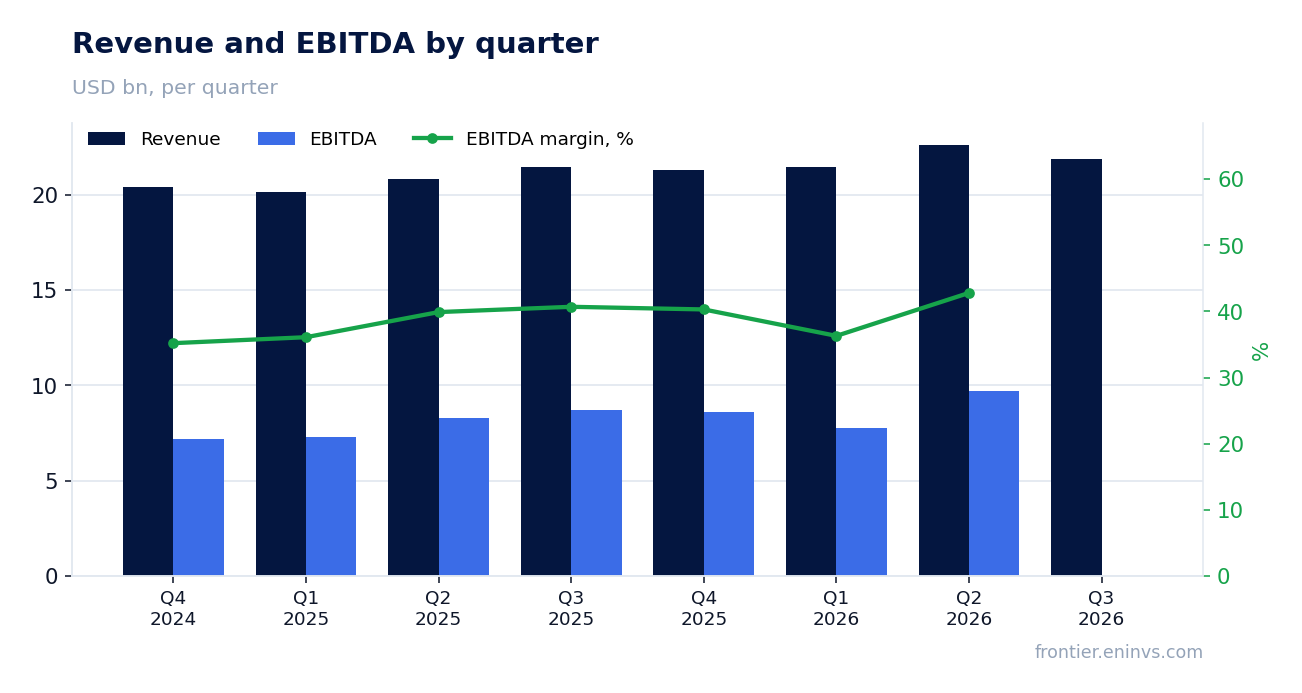
Net profit added 6.5% year on year even though revenue rose only 2.0% – the gap was closed by margin
Net profit in Q3 2026 was 5,951 million dollars, up 6.5% year on year. Revenue over the same period grew only 2.0%. The difference in rates means profit grew faster than revenue, and the source of that outperformance was not operating dynamics but an improvement in profitability.
Quarter on quarter, profit declined: in Q2 2026 it was 6,407 million dollars, in Q3 – 5,951 million dollars. This matches the revenue decline, so one cannot speak of sustained profit growth on a quarterly basis.
Nevertheless, profit is growing year on year, and that is a positive fact. The question is how sustainable it is: if margin stops rising, profit could quickly decelerate along with revenue.
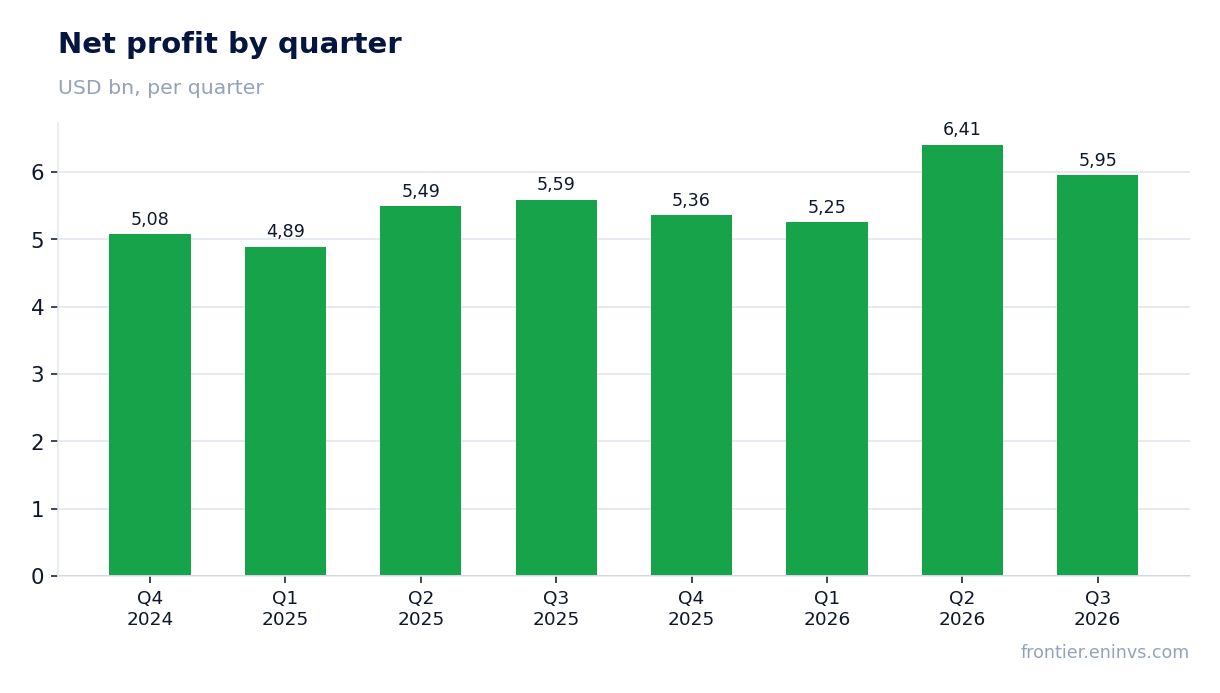
Net margin rose to 27.2% from 26.1% a year earlier – that is the source of profit growth
Net margin in Q3 2026 was 27.2% versus 26.1% a year earlier. A 1.1 percentage point increase in margin on revenue of 21,870 million dollars added roughly 240 million dollars of profit – this explains why profit grew 6.5% while revenue rose only 2.0%.
The margin improvement could be linked to cost cuts or lower provisions, but the provided data lacks detail. We can only state that profitability rose, and this supported profit.
For investors, what matters is that margin is a less sustainable source of growth than revenue. If it stops rising, profit will quickly lose support.
Return on equity of 14.3% is moderate for a bank, and it is not rising alongside revenue
Return on equity (ROE) stands at 14.3%. This is a moderate level for the banking sector: it is above the cost of capital but does not create a large margin of safety. At the same time, ROE is not rising alongside revenue, which indicates stability rather than improvement.
For comparison, the facts contain no historical ROE dynamics, so we cannot say whether it is rising or falling. Only the current value is known. This limits the assessment of earnings quality.
An investor should watch ROE in the coming reports: if it starts to decline against the revenue slowdown, that would be an alarming signal.
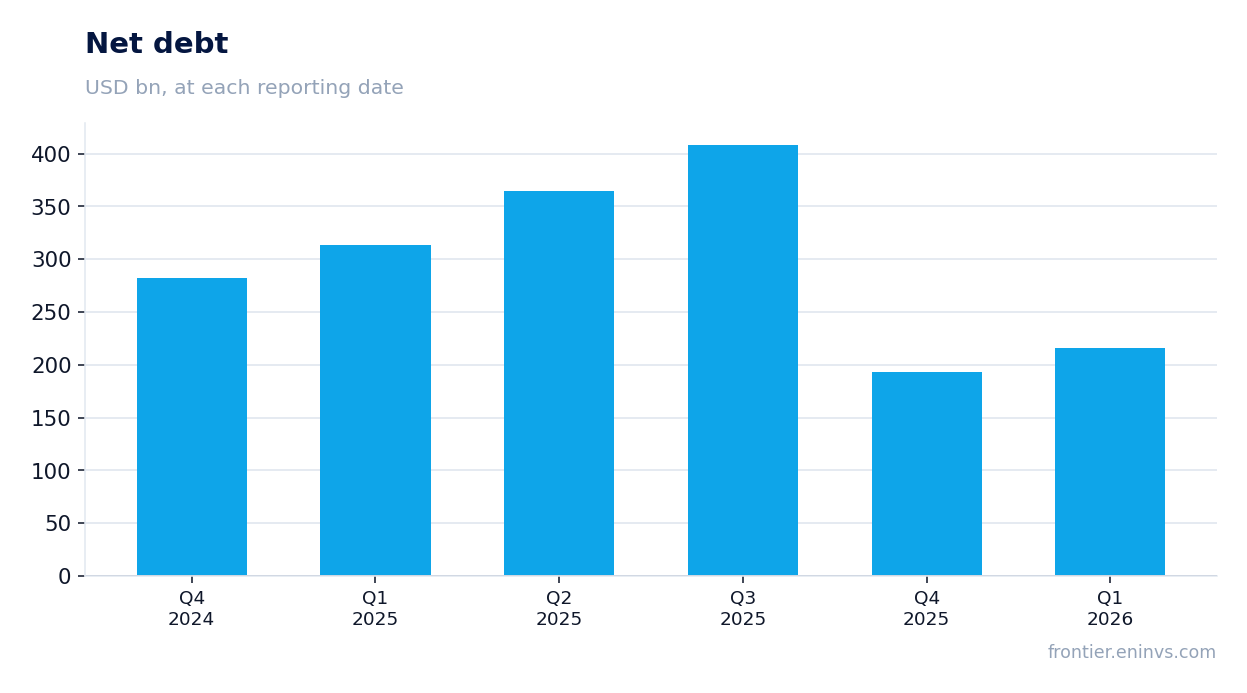
Balance-sheet debt stands at 193,035 million dollars per the latest annual report, a level worth watching
Net debt on the balance sheet per the latest annual report is 193,035 million dollars. This is a significant figure, and it rose from 216,223 million dollars in Q1 2026, but there is no debt data for Q2 and Q3 2026 in the facts. Therefore we cannot judge the current debt dynamics.
For a bank, debt is primarily obligations to clients and creditors, and its level matters in the context of capital adequacy. However, without capital and liquidity data for the reporting period, we cannot assess how safe this debt is.
An investor should pay attention to how debt relates to capital and profit. The facts contain no leverage ratio, so we refrain from judgments about its change.
The share sits in the US Financials (banks) model strategies – a fact, not an argument to buy
Wells Fargo's share is included in the US Financials (banks) model strategies on the portal. This is a fact we note, but it is not an argument in favour of an investment decision. Inclusion in a strategy reflects meeting selection criteria, not an assessment of the attractiveness of the current price.
A buy or sell decision should be based on fundamentals and valuation. In this report we see a revenue slowdown and profit growth driven by margin, which does not provide a clear advantage.
Thus, membership in the strategy is context, not a recommendation.
Bottom line
The strong point of the report was net profit: it rose 6.5% year on year, and margin climbed to 27.2% from 26.1%. However, this growth was driven not by revenue, which added only 2.0%, but by improved profitability. The revenue slowdown after 8.6% a quarter earlier is an alarming signal. Debt of 193,035 million dollars and the absence of capital data prevent an assessment of sustainability. The question for a holder now is whether the bank can resume revenue growth, or profit will start following it down.
Open the company's financial profile WFC →
See also: market overview · valuation map · stock screeners