W&T Offshore: revenue up 31%, but net income turns negative again on derivatives
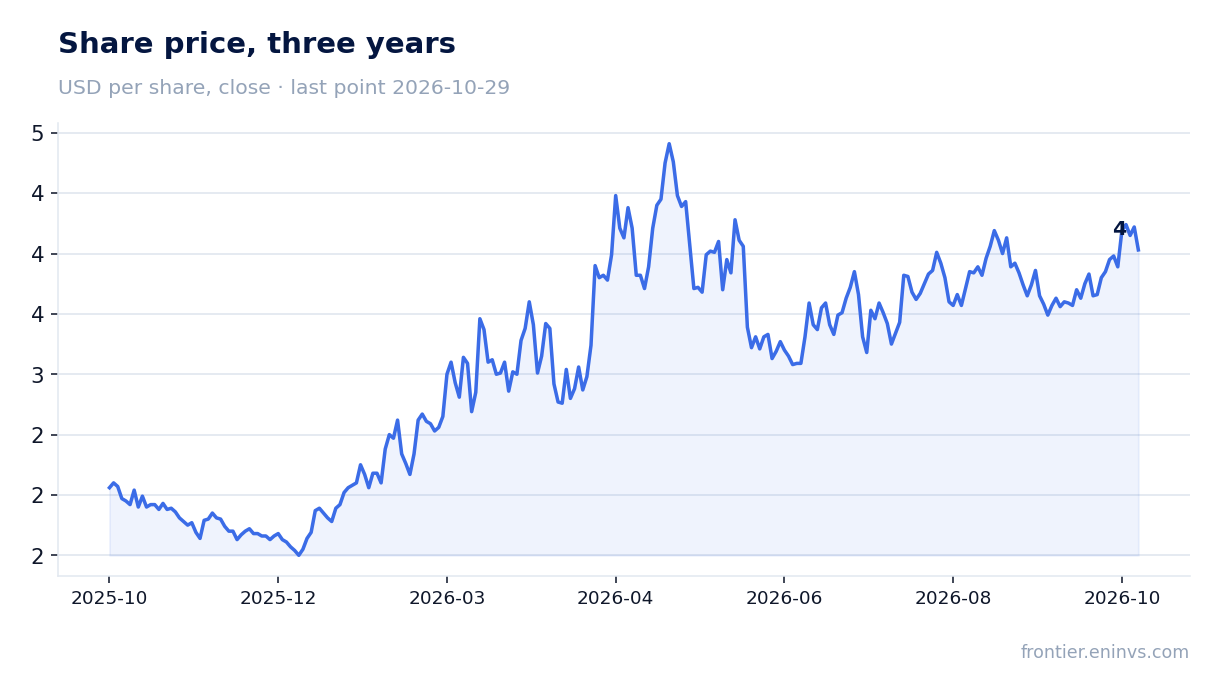
On October 29, W&T Offshore, Inc. reported third-quarter 2026 results. Revenue came in at $167.1 million (+31.0% year on year), EBITDA at $40.1 million (24.0% margin vs 12.5% a year earlier), but net loss reached $13.6 million due to a $15.8 million derivative loss. At the current price the stock looks neutral: operating performance and cash flow are strong, but the 5.7x EV/EBITDA LTM multiple and negative net income limit appeal.
Key takeaways
— Revenue rose 31.0% on 7% production growth and 32% higher oil prices
— EBITDA jumped 151.0%, but the 24.0% margin is still far from peak levels
— The $13.6 million net loss was driven by a $15.8 million derivative loss
— Operating cash flow of $36.6 million covered capital expenditures of $3.1 million
— Net debt fell to $160.7 million, with net debt/EBITDA LTM at 1.12x
— The $0.01 per share dividend remains symbolic, yielding 0.99%
— A 5.7x EV/EBITDA LTM multiple offers no margin of safety, and the portal model points to 69% downside
Attractiveness
Key figures, USD bn
| Metric | Q3 2025 | Q3 2026 | Change |
|---|---|---|---|
| Revenue | 0.13 | 0.17 | +31.0% |
| EBITDA | 0.02 | 0.04 | +151.0% |
| Operating profit | -0.01 | 0.01 | to profit |
| Net profit | -0.07 | -0.01 | — |
| Operating cash flow | 0.03 | 0.04 | +38.1% |
| Capex | 0.00 | — | — |
| EBITDA margin | 12.5% | 24.0% | +11.5 pp |
| Net margin | -56.1% | -8.2% | +47.9 pp |
Revenue rose 31.0% on 7% production growth and 32% higher oil prices
Third-quarter 2026 revenue reached $167.1 million, up 31.0% year on year. The growth was driven by two factors: average daily production rose 7% to 38.2 thousand barrels of oil equivalent per day, and the average realized oil price increased 32% to $85.06 per barrel.
Sequential dynamics show deceleration: while second-quarter revenue growth was 32.9% year on year, third-quarter growth was 31.0%. The slowdown reflects a drop in oil price versus the second quarter ($99.30 per barrel) and an 8% decline in the oil-equivalent price quarter on quarter.
Oil production grew only 1% year on year, while NGLs added 72% and gas 1%. Prices, not volumes, drove the revenue increase. For the fourth quarter the company guides production to 32.0–35.3 thousand barrels of oil equivalent per day, below the current level due to a hurricane and planned maintenance at Mobile Bay.
EBITDA jumped 151.0%, but the 24.0% margin is still far from peak levels
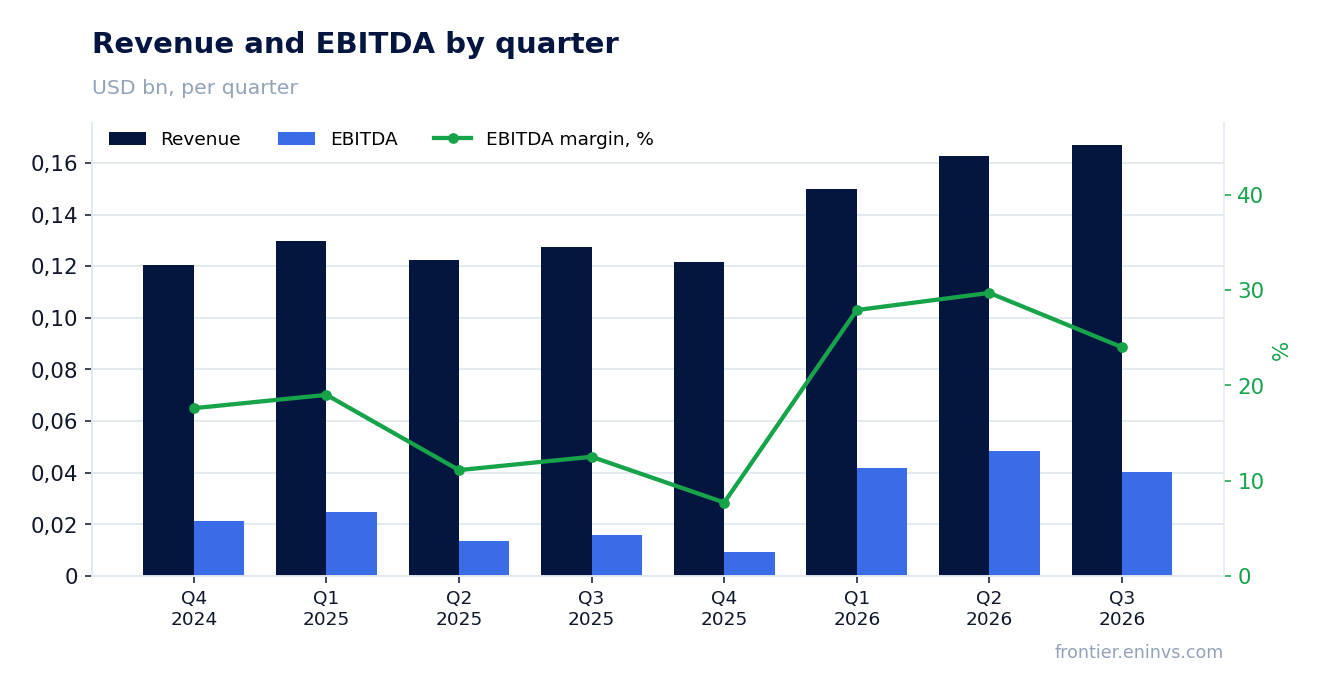
EBITDA in the reported quarter was $40.1 million, up 151.0% year on year. The EBITDA margin rose to 24.0% from 12.5% in the third quarter of 2025. This margin expansion is primarily explained by operating leverage: revenue grew 31% while operating expenses rose only 10.8%.
However, versus the previous quarter EBITDA declined 16.9% (from $48.2 million), and the margin fell from 29.7% to 24.0%. Pressure came from a 7% increase in lease operating expenses and a 15% rise in general and administrative expenses due to non-cash share-based compensation tied to the share price.
Adjusted EBITDA, which the company reports, was $51.1 million, up 30% year on year. The difference between adjusted and reported EBITDA reflects the exclusion of non-cash items, including litigation costs.
The $13.6 million net loss was driven by a $15.8 million derivative loss
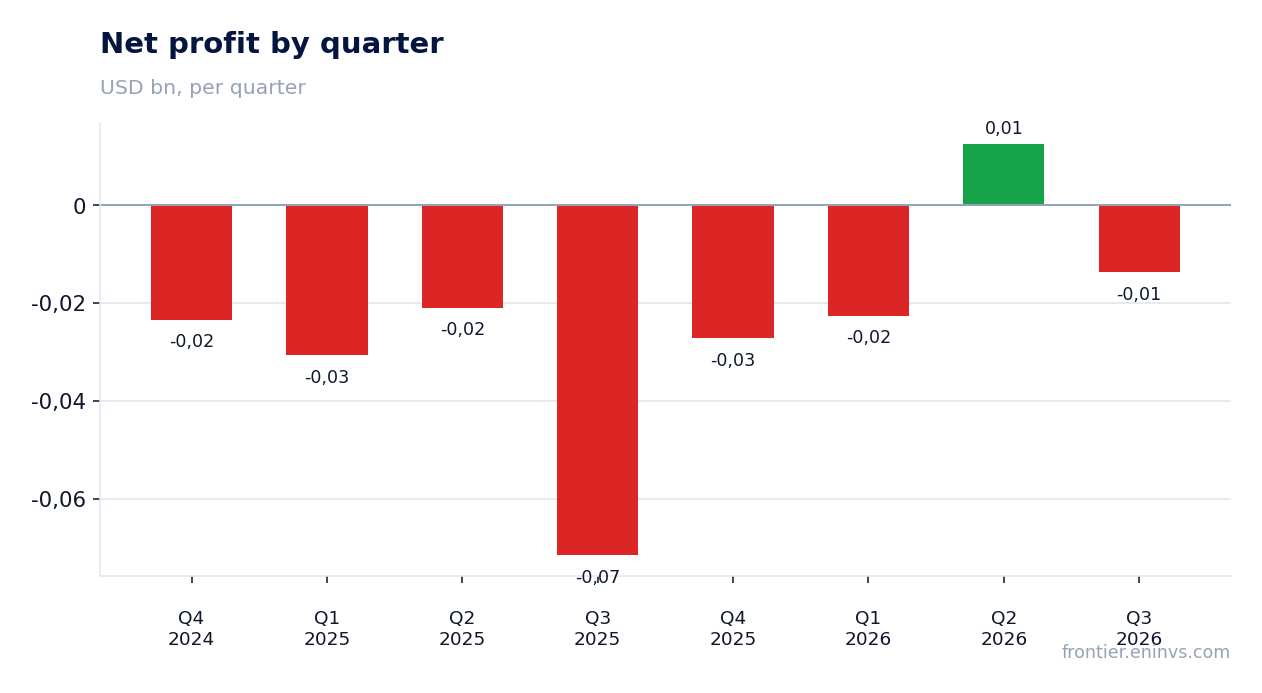
The net loss in the third quarter of 2026 was $13.6 million, compared with a loss of $71.5 million a year earlier. The main driver of the loss was not operations but a $15.8 million derivative loss recorded in the income statement.
Operating income was positive at $11.8 million, versus a loss of $12.6 million a year earlier. However, $9.0 million in interest expense and the $15.8 million derivative loss pushed net income into negative territory.
Adjusted net income, as reported by the company, was $0.9 million, or $0.01 per share. The gap between adjusted and net income reflects the exclusion of non-cash effects, including derivatives and litigation costs.
Operating cash flow of $36.6 million covered capital expenditures of $3.1 million
Operating cash flow in the third quarter of 2026 was $36.6 million, versus $26.5 million a year earlier. The increase was driven by higher revenue and lower capital expenditures: capex on an accrual basis was only $3.1 million, compared with $22.5 million a year earlier.
Free cash flow, which the company defines as operating cash flow minus capex, was $33.2 million. This allowed the company to increase cash to $191.3 million from $150.7 million at the end of the second quarter.
However, capex of $3.1 million looks abnormally low. The company explains that it is pulling forward some capital projects into the fourth quarter to take advantage of high commodity prices. The full-year capex plan is $35–38 million, and its execution could reduce free cash flow in the next quarter.
Net debt fell to $160.7 million, with net debt/EBITDA LTM at 1.12x
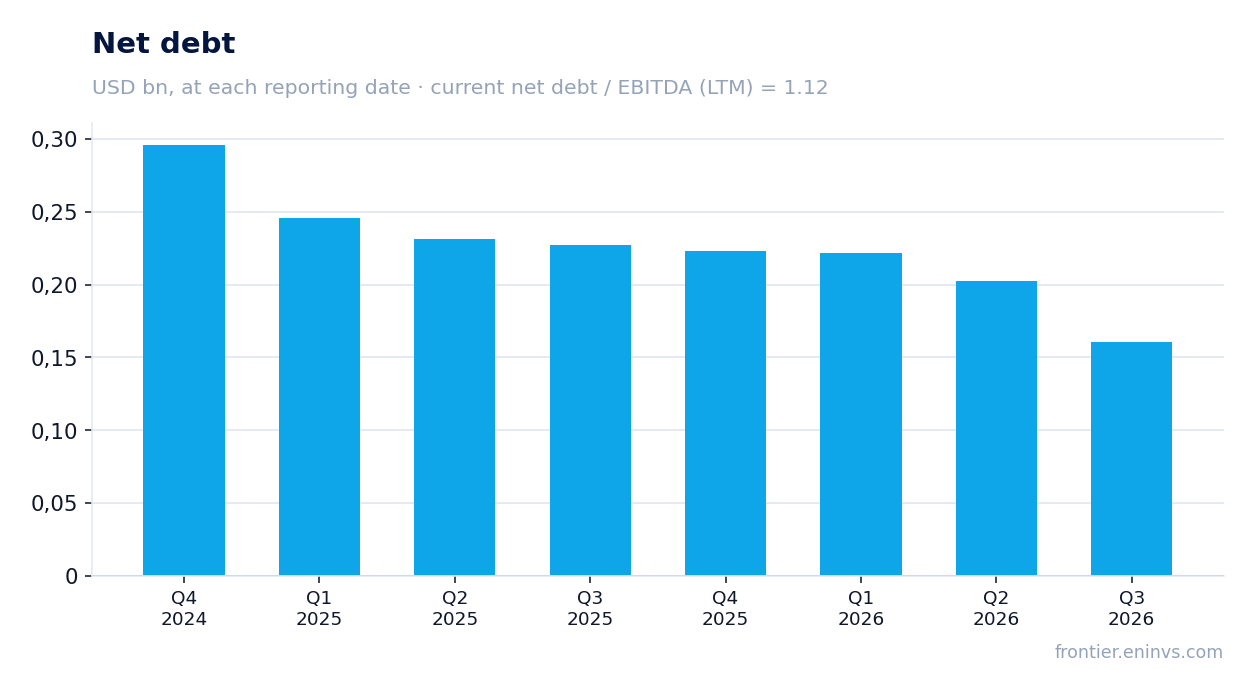
Net debt as of September 30, 2026, was $160.7 million, down from $200.9 million on June 30, 2026. The reduction came from a $40.6 million increase in cash, supported by free cash flow and $14.7 million raised through the ATM program.
The net debt to EBITDA ratio for the trailing twelve months is 1.12x. The company reports 0.9x using adjusted EBITDA LTM. Our figure of 1.12x is calculated on EBITDA LTM of $143.5 million, which includes all quarters from the fourth quarter of 2024.
Total debt is $352.0 million, of which $1.0 million is short-term. Interest expense of $9.0 million per quarter remains significant but is covered by operating income. The company also converted its credit facility to a reserve-based structure with potential expansion to $100 million.
The $0.01 per share dividend remains symbolic, yielding 0.99%
The company paid its next quarterly dividend of $0.01 per share on August 26, 2026, and declared the same dividend for the fourth quarter of 2026, payable on November 19. This is the twelfth consecutive quarterly dividend, meaning the company has paid it for three years.
The trailing twelve-month dividend yield is 0.99%. This is well below the key rate and is not a primary factor of appeal for an investor. Payments amount to about $1.6 million per quarter, which, given a net loss of $13.6 million, means the dividend is funded from cash flow rather than profit.
The company increased its shareholder distribution basket from $10 million to $15 million per year under the new credit agreement. However, at the current share price and a yield below 1%, the dividend cannot serve as an argument for investment. A cut is possible if oil prices fall further or capital expenditures rise.
A 5.7x EV/EBITDA LTM multiple offers no margin of safety, and the portal model points to 69% downside
The EV/EBITDA multiple for the trailing twelve months is 5.68x. For comparison, the company's three-year historical range is not provided in the facts, so we cannot say whether the current level is above or below its own historical average. However, an absolute value of 5.68x does not look low for a company with negative net income and volatile cash flow.
Our portal model, repriced to current commodity prices at the target multiple, points to 69% downside to fair value. This is the portal's own estimate, not a market consensus. Market capitalization is $593.1 million, and enterprise value is about $753.7 million.
The stock trades at a price-to-earnings ratio that is meaningless given negative earnings. Return on equity is 42.8%, but this is a consequence of negative shareholders' equity of $189.9 million, not high profit. With such a balance sheet, EV/EBITDA remains the only reliable valuation reference.
Valuation on the latest reported figures
| Metric | Value |
|---|---|
| Market cap | 0.59 bn USD |
| EV/EBITDA (LTM) | 5.7 |
| Net debt / EBITDA (LTM) | 1.12 |
| Operating cash flow (LTM) | 0.10 bn |
| ROE | 42.8% |
| Dividend yield (12m) | 1.0% |
Bottom line
W&T Offshore's third-quarter 2026 report showed strong revenue and EBITDA, but net income remained negative due to a derivative loss. Operating cash flow and a reduction in net debt to $160.7 million are positive signals, although capital expenditures were abnormally low and are likely to rise in the fourth quarter. The $0.01 per share dividend, yielding 0.99%, is not an argument for investment. A 5.68x EV/EBITDA LTM multiple and 69% downside per the portal model indicate no margin of safety. Verdict: neutral – operational successes are offset by weak earnings and a rich valuation.
Open the company's financial profile WTI →
See also: market overview · valuation map · stock screeners