Cemig: FY 2026 revenue up 49.9%, but Q2 2026 posted a USD 659 million loss

On August 5, 2026, S&P Global Ratings revised its outlook on Cemig to stable from positive, affirming the BB- rating. For FY 2026, the company grew revenue by 49.9% year on year to USD 11.7 billion, but in Q2 2026 it posted a net loss of USD 659 million on revenue of USD 2,111 billion. The loss stems from impairment of hydro assets whose concessions expire in 2026–2027. Leverage is rising: the 2026–2030 capital plan totals BRL 43.7 billion, and free operating cash flow remains negative. At the current price, the shares look unattractive: the loss, growing debt and lack of dividend clarity outweigh the strong top line.
Key takeaways
— FY 2026 revenue grew 49.9%, but a Q2 2026 loss of USD 659 million wiped out profits from earlier periods
— The Q2 2026 loss is an impairment of hydro assets whose concessions expire in 2026–2027
— Debt will rise to BRL 25 billion in 2026 and BRL 29–30 billion in 2027 due to BRL 6.7 billion in capex
— Free operating cash flow remains negative: a deficit of BRL 2.2 billion in 2026 and BRL 1.6 billion in 2027
— Dividends of BRL 2.4 billion for 2026 are paid while free operating cash flow is negative
— The EV/EBITDA multiple of 4.36x does not reflect the loss and rising debt
Attractiveness
Key figures, USD bn
| Metric | FY 2025 | FY 2026 | Change |
|---|---|---|---|
| Revenue | 7.81 | 11.7 | +49.9% |
| EBITDA | 1.52 | — | — |
| Operating profit | 1.23 | — | — |
| Net profit | 0.89 | — | — |
| Operating cash flow | 0.74 | — | — |
| Capex | 0.20 | — | — |
| EBITDA margin | 19.4% | — | — |
| Net margin | 11.5% | — | — |
FY 2026 revenue grew 49.9%, but a Q2 2026 loss of USD 659 million wiped out profits from earlier periods
For FY 2026, Cemig's revenue reached USD 11.7 billion, up 49.9% year on year. This growth looks impressive, but it was driven mainly by one-off factors and was not accompanied by a proportional increase in profit.
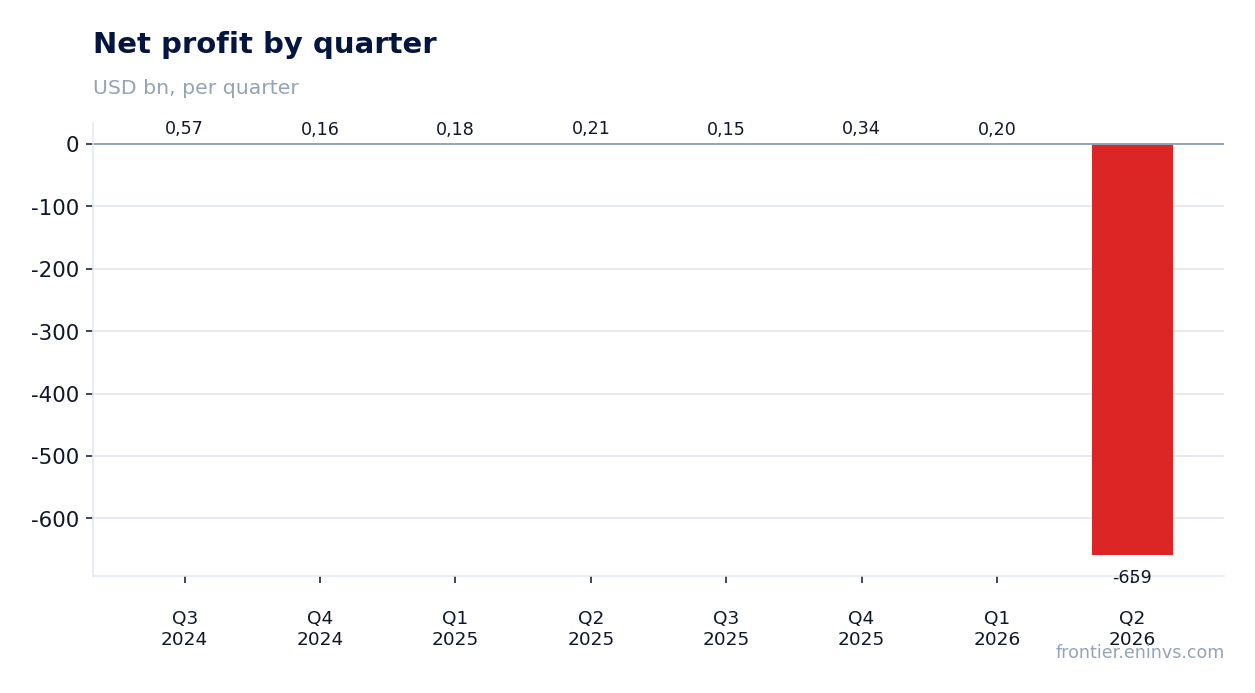
In Q2 2026, the company posted a net loss of USD 659 million on revenue of USD 2,111 billion. This contrasts sharply with profits in previous quarters: for example, Q1 2026 net income was USD 195 million, and Q4 2025 net income was USD 343 million.
The Q2 loss is explained by impairment of hydro assets whose concessions expire in 2026–2027. The company will not be able to renew them on previous terms, which already forces it to recognise losses.
Thus, the annual revenue growth should not be misleading: the Q2 loss cancels out the positive dynamics of previous periods and points to serious problems in the generation segment.
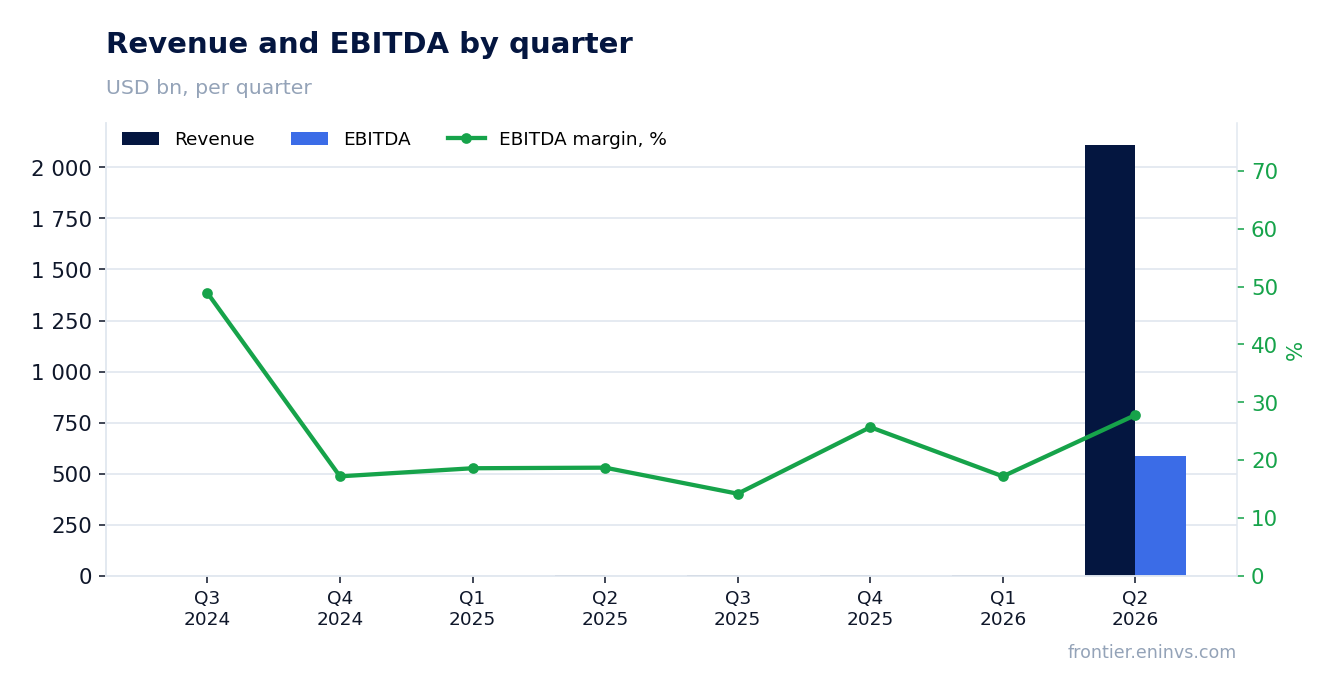
The Q2 2026 loss is an impairment of hydro assets whose concessions expire in 2026–2027
Concessions for the Emborcação, Nova Ponte and Sá Carvalho hydro plants, with total capacity of 1.8 GW, expire in 2026–2027. They account for more than half of Cemig's installed capacity. The impending loss of these assets led to the impairment recognised in Q2 2026.
S&P notes that ANEEL recommended renewing the concessions, but the Ministry of Mines and Energy has not yet approved it. In its base case, the agency does not incorporate the renewal. If the concessions are renewed under the quota regime, Cemig would receive additional EBITDA of BRL 400 million per year, but would not be able to sell energy on the free market and would have to purchase 40–50% of its needs on the spot market.
An alternative is to renew the concessions upon payment of fees under Law 15,269/2025. In that case, the company would have to finance the fees with new debt, further worsening credit metrics and delaying deleveraging.
Thus, uncertainty over the concessions is a key risk that has already led to a loss and will affect results over the next two years.
Debt will rise to BRL 25 billion in 2026 and BRL 29–30 billion in 2027 due to BRL 6.7 billion in capex
Cemig's investment plan for 2026–2030 totals BRL 43.7 billion. For 2026, capital expenditure is planned at BRL 6.7 billion, of which 80% (BRL 5.3 billion) will go to the distribution segment. This requires significant financing, including new debt.
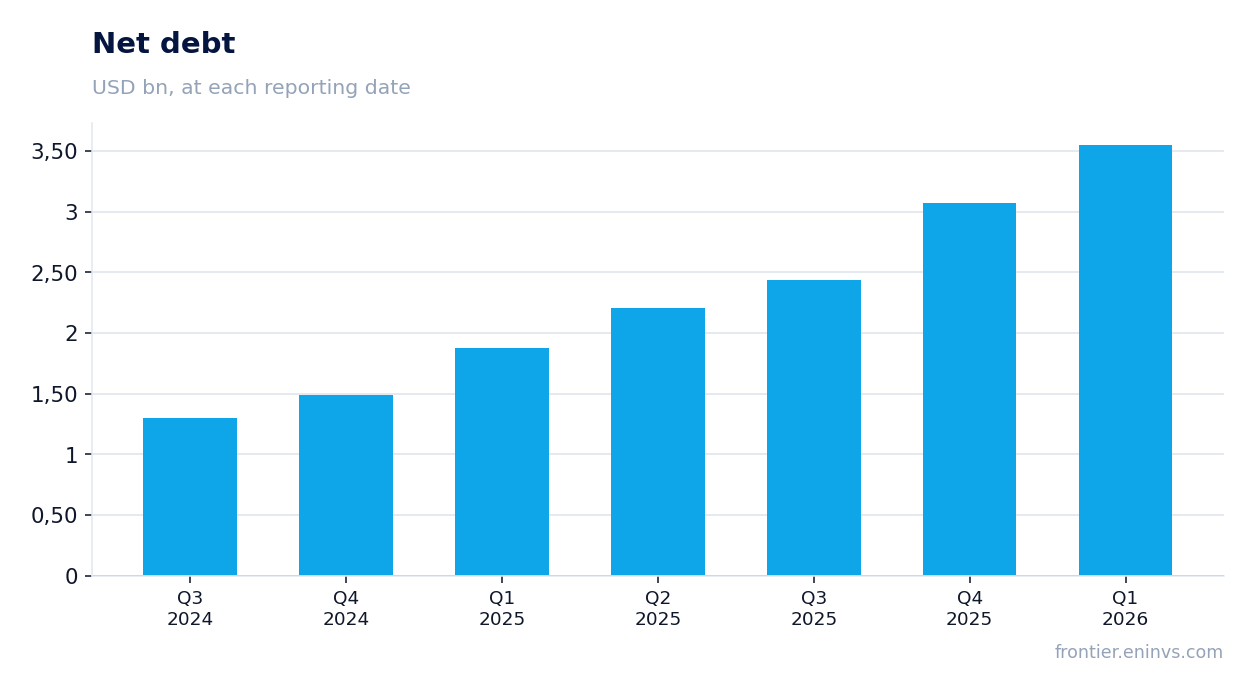
S&P forecasts nominal debt to rise to BRL 25 billion in 2026 and to BRL 29–30 billion in 2027 from BRL 19 billion in 2025. This will increase adjusted debt to EBITDA to 3.5x in 2026–2027 from 2.4x in 2024 and 3.2x in 2025.
Free operating cash flow remains negative: a deficit of BRL 2.2 billion in 2026 and BRL 1.6 billion in 2027. This means the company will not be able to reduce debt until 2028, when the CEMIG-D tariff review is expected to boost EBITDA.
High interest expenses compound the problem: the average interest rate in 2026 is estimated at 14.1%, and 13.3% in 2027. This consumes a significant portion of operating profit.
Free operating cash flow remains negative: a deficit of BRL 2.2 billion in 2026 and BRL 1.6 billion in 2027
Cemig's operating cash flow in 2026 is forecast by S&P at BRL 4.5 billion, but capital expenditure of BRL 6.7 billion and high interest expenses will lead to a free operating cash flow deficit of BRL 2.2 billion. In 2027, the deficit will narrow to BRL 1.6 billion but remain significant.
The company funds the deficit with new debt. In 2026, it is expected to raise BRL 7.6 billion in new debt. This increases leverage and interest expenses, creating a vicious cycle.
Dividend payments also pressure cash flow: BRL 2.4 billion is planned for 2026 and BRL 1.5 billion for 2027. With negative free operating cash flow, this means dividends are funded by debt.
Thus, cash flow remains the weak link, and without improved operational efficiency or asset sales, the company will not generate positive free operating cash flow in the next two years.
Dividends of BRL 2.4 billion for 2026 are paid while free operating cash flow is negative
Cemig follows a dividend policy of paying out 50% of the previous year's net income. For 2026, the company plans to pay dividends of BRL 2.4 billion, corresponding to 50% of 2025 profit. However, free cash flow in 2026 is expected to be negative at minus BRL 2.2 billion.
This means dividends are funded by new debt rather than operating activities. Such a situation is unsustainable and could lead to dividend cuts in the future if cash flow does not improve.
The current trailing 12-month dividend yield is 5.78%. This is above the key rate, but given the risks and unstable cash flow, such a yield does not look attractive.
In 2027, dividends are planned at BRL 1.5 billion, lower than in 2026, due to expected lower profit. This confirms that the current payout level may be unsustainable.
The EV/EBITDA multiple of 4.36x does not reflect the loss and rising debt
Cemig's three-year average EV/EBITDA is 4.36x. This multiple looks low, but it does not account for current problems: the Q2 2026 loss, rising debt and negative free cash flow.
The company's market capitalisation is USD 6.64 billion, and net debt at end-2024 was USD 1.49 billion. However, with debt forecast to rise to BRL 25 billion in 2026, leverage will increase substantially, which could lead to a re-rating of the multiple.
Return on equity (ROE) is 14.2%, which is decent, but this figure is based on data before the loss. Going forward, ROE may decline due to impairment and higher interest expenses.
Thus, the current valuation does not reflect the risks associated with concessions and leverage. The shares may look cheap on the multiple, but fundamentals are deteriorating.
Valuation on the latest reported figures
| Metric | Value |
|---|---|
| Market cap | 6.64 bn USD |
| P/B | 1.50 |
| ROE | 14.2% |
| Dividend yield (12m) | 5.8% |
Bottom line
Cemig reported FY 2026 revenue growth of 49.9%, but this growth is not accompanied by profit: in Q2 2026, the company posted a loss of USD 659 million due to impairment of hydro assets. Leverage is rising, free cash flow is negative, and dividends are funded by new debt. At the current price, the shares look unattractive: risks related to concessions and debt outweigh the potential benefit from a low valuation multiple.
Open the company's financial profile CIG →
See also: market overview · valuation map · stock screeners