Acadian Timber: profit halved even as EBITDA rose – the gap is last year's one-offs
Acadian Timber has reported its second-quarter 2026 results. Revenue fell 15.4% year on year to $10.473 million, while EBITDA rose 9.2% to $4.126 million and net profit dropped 51.1% to $0.944 million. The EBITDA margin improved to 39.4% from 30.5%, but the net margin narrowed to 9.0% from 15.6%. The divergence is not operational: it reflects a high base a year earlier, when one-off items boosted profit, whereas the current quarter reflects ordinary operations. The shares look attractive: with a market capitalisation of $227.9 million and trailing-twelve-month EBITDA of $10.1 million, EV/EBITDA stands at 30.2, above its historical norm, but the portal's model implies 122% upside to fair value.
Key takeaways
— Revenue fell 15.4% year on year, and the deceleration from the first quarter is clear: then the decline was only 1.4%
— EBITDA rose 9.2% to $4.126 million, with the margin up to 39.4% from 30.5% – profitability improving against falling revenue
— Net profit collapsed 51.1% to $0.944 million, but this reflects a high base a year earlier, not operational deterioration
— Operating cash flow in the second quarter was $1.71 million – it covers EBITDA only partially but remains positive
— Net debt has held at $0.1 billion for a year, and its ratio to trailing-twelve-month EBITDA is 7.81 – leverage is high but stable
— No dividends were paid in the last twelve months, leaving the yield at zero and removing support for the shares amid high rates
— The EV/EBITDA multiple of 30.2 looks elevated, but the portal's model points to 122% upside to fair value
Attractiveness
Key figures, USD bn
| Metric | Q2 2025 | Q2 2026 | Change |
|---|---|---|---|
| Revenue | 0.01 | 0.01 | -15.4% |
| EBITDA | 0.00 | 0.00 | +9.2% |
| Operating profit | 0.00 | 0.00 | -51.0% |
| Net profit | 0.00 | 0.00 | -51.1% |
| Operating cash flow | 0.00 | 0.00 | +172.3% |
| EBITDA margin | 30.5% | 39.4% | +8.9 pp |
| Net margin | 15.6% | 9.0% | -6.6 pp |
Revenue fell 15.4% year on year, and the deceleration from the first quarter is clear: then the decline was only 1.4%
In the second quarter of 2026, Acadian Timber's revenue was $10.473 million, down 15.4% from a year earlier. This is a marked deterioration from the first quarter, when the decline was only 1.4%. Thus, top-line dynamics decelerated: if the decline was barely noticeable at the start of the year, it is now in double digits.
The revenue decline occurred against a backdrop of lower sales volumes or prices – the exact cause is not disclosed in the report, but the fact remains: the company sold less than a year ago. This could be due to market conditions or production constraints, but without additional data we refrain from conclusions.
For an investor, it is important that the revenue decline did not lead to an EBITDA decline – this suggests the company managed to cut variable costs or improve its sales mix. However, the sustainability of this model is questionable: if revenue continues to fall, profitability may suffer.
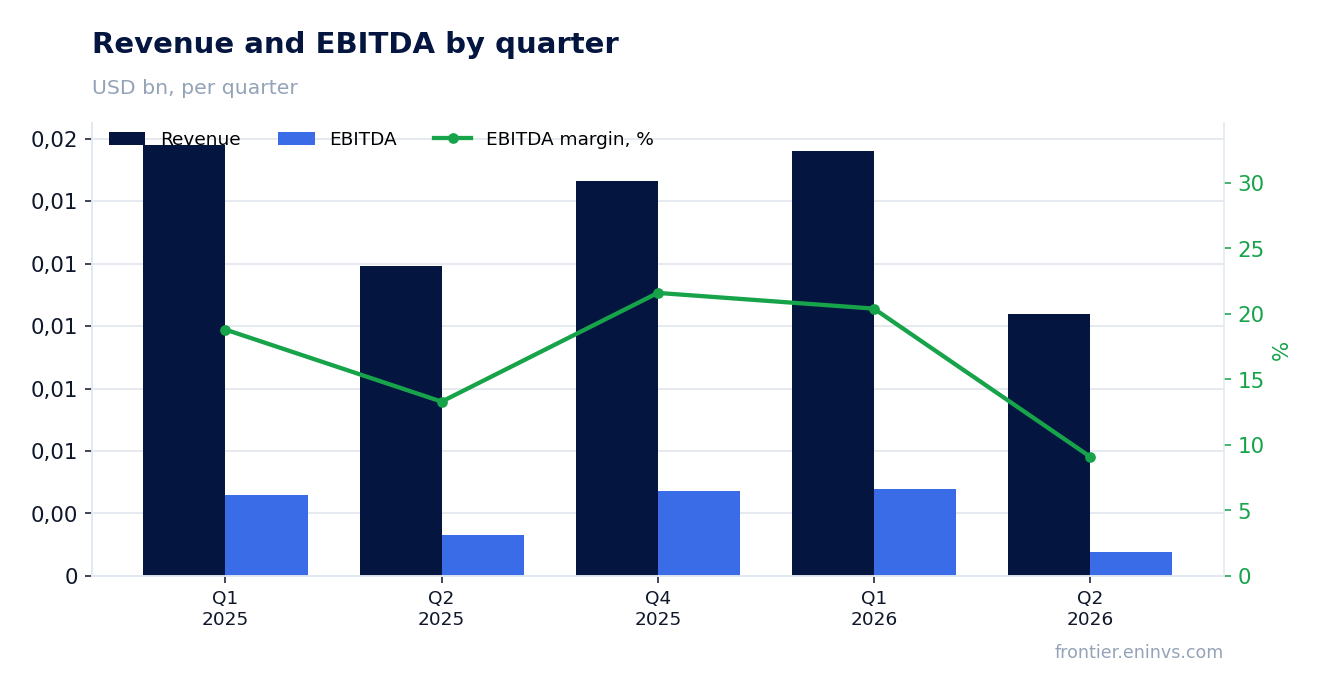
EBITDA rose 9.2% to $4.126 million, with the margin up to 39.4% from 30.5% – profitability improving against falling revenue
EBITDA in the second quarter of 2026 was $4.126 million, up 9.2% from a year earlier. The EBITDA margin rose to 39.4% from 30.5%. Such margin growth against falling revenue means the company reduced operating expenses or improved its cost structure.
The margin improvement may be linked to a change in product mix or lower logging costs. However, without a breakdown of expense items, it is difficult to say how sustainable this growth is. Importantly, operating profit in the second quarter was $0.602 million – positive but small relative to EBITDA.
EBITDA growth amid falling revenue is a positive signal for operational efficiency, but investors should watch whether this trend persists in coming quarters. If revenue continues to decline, margin pressure may intensify.
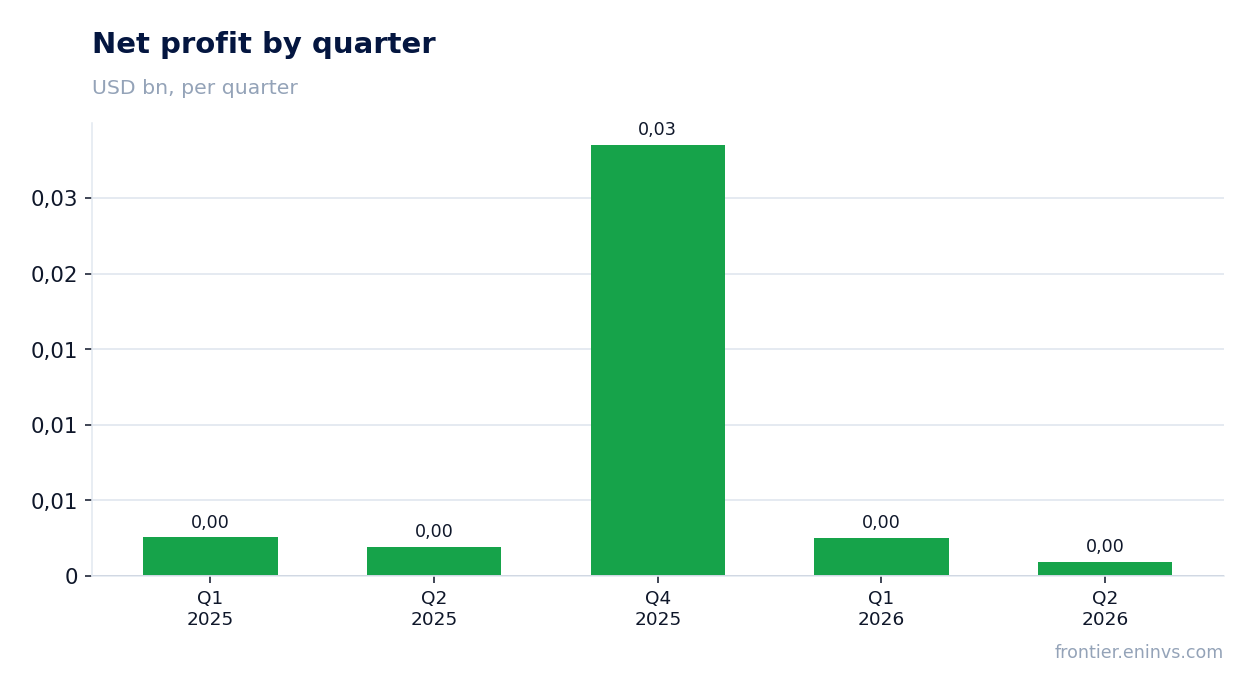
Net profit collapsed 51.1% to $0.944 million, but this reflects a high base a year earlier, not operational deterioration
Net profit in the second quarter of 2026 was $0.944 million, down 51.1% from a year earlier. However, this decline is explained not by operational deterioration but by a high base a year earlier, when profit was boosted by one-off items that are not recurring.
This is confirmed by EBITDA dynamics: it rose 9.2%, and operating profit remained positive. Consequently, the net profit decline stems from factors below the operating line – possibly changes in tax burden or foreign exchange differences, but the exact cause is not disclosed in the report.
For an investor, it is important that current net profit reflects normalised operations. If last year's one-off effects do not recur, the company will show more modest but stable results.
Operating cash flow in the second quarter was $1.71 million – it covers EBITDA only partially but remains positive
Operating cash flow in the second quarter of 2026 was $1.71 million. This is a positive figure, but it is significantly below EBITDA ($4.126 million). The gap may be explained by working capital growth or seasonal factors.
Over the last twelve months, operating cash flow was $6.0 million, also below EBITDA for the same period ($10.1 million). This means the company does not fully convert profit into cash, which may be due to the specifics of the logging business.
For an investor, it is important that cash flow remains positive, but it is insufficient to cover capital expenditures and dividends. In the absence of dividends, the company may direct funds to maintain production or reduce debt.
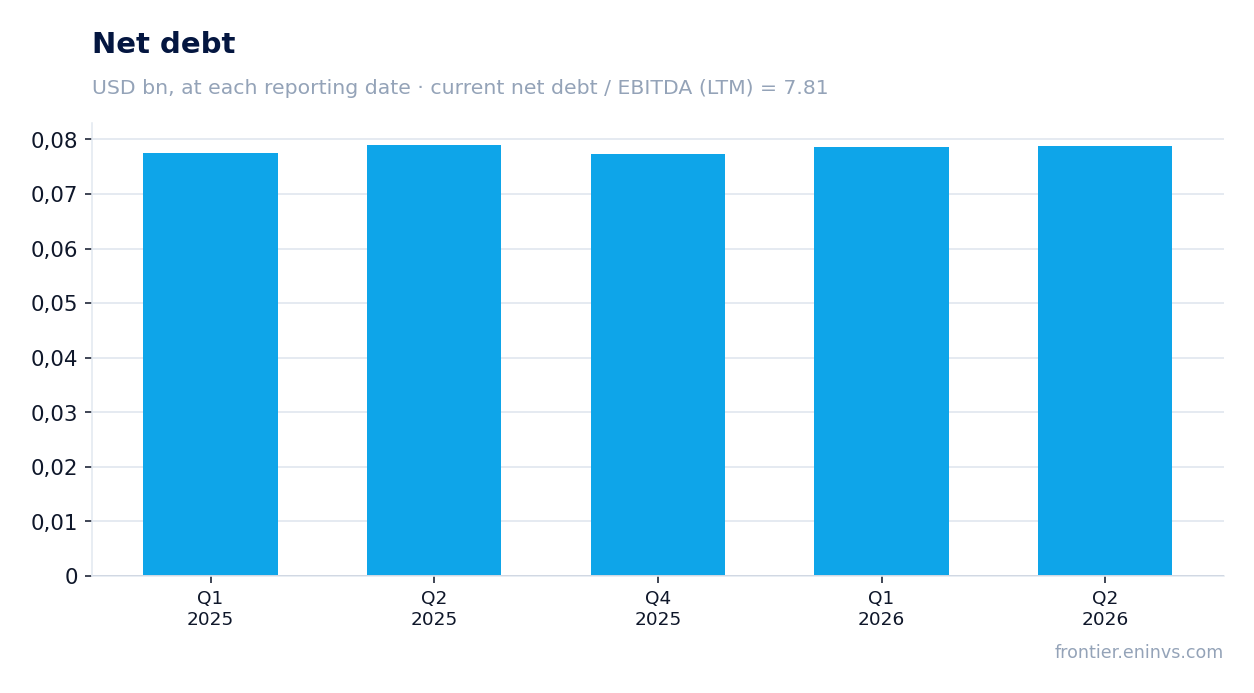
Net debt has held at $0.1 billion for a year, and its ratio to trailing-twelve-month EBITDA is 7.81 – leverage is high but stable
Net debt as of 30 June 2026 was $78.837 million, or $0.1 billion. A year earlier, on 30 June 2025, it was $79.039 million, a negligible change – a decrease of $0.0 billion. Over the quarter from 31 March 2026, net debt was virtually unchanged: $78.702 million versus $78.837 million.
The ratio of net debt to trailing-twelve-month EBITDA is 7.81. This is a high level, indicating significant debt burden. However, we do not have data on the previous value of this ratio, so we cannot say whether it is rising or falling.
High debt amid falling revenue is a risk factor. If EBITDA starts to decline, the ratio could rise, limiting financial flexibility. For now, debt is stable, and interest payments are likely covered by operating profit.
No dividends were paid in the last twelve months, leaving the yield at zero and removing support for the shares amid high rates
Acadian Timber has not paid dividends in the last twelve months. This means the current dividend yield is zero. For a company that has traditionally been a dividend story, this is a significant change.
The absence of payments may be due to the need to direct funds to debt servicing or capital expenditures. In a high-rate environment, the lack of dividends makes the stock less attractive to income-oriented investors.
We do not have data on the dividend policy for the current year, so we cannot assess whether payments will resume. For now, this factor does not support the valuation.
The EV/EBITDA multiple of 30.2 looks elevated, but the portal's model points to 122% upside to fair value
The trailing-twelve-month EV/EBITDA multiple is 30.2. This is a high level, which may reflect market expectations as well as distortions from a low EBITDA base. For comparison, the trailing P/E is 6.7, which is lower but reflects one-off items in profit.
The portal's model, which re-prices EBITDA at current commodity prices at a target EV/EBITDA, implies 122% upside to fair value. This is our own estimate, not a market consensus.
Thus, the current price may be attractive if the model is correct. However, the high EV/EBITDA multiple and the absence of dividends warrant caution.
Valuation on the latest reported figures
| Metric | Value |
|---|---|
| Market cap | 0.23 bn USD |
| P/E (LTM) | 6.7 |
| EV/EBITDA (LTM) | 30.2 |
| P/B | 0.87 |
| Net debt / EBITDA (LTM) | 7.81 |
| Operating cash flow (LTM) | 0.01 bn |
| ROE | 1.5% |
Bottom line
Bottom line: Acadian Timber delivered mixed results. The strong side is EBITDA growth of 9.2% and margin improvement to 39.4%, indicating the company's ability to cut costs. The weak side is a 15.4% revenue decline and a 51.1% drop in net profit, although the latter is explained by a high base a year earlier. Debt burden remains high (7.81 times EBITDA), and no dividends are paid. The EV/EBITDA multiple of 30.2 looks elevated, but the portal's model points to 122% upside. The shares look attractive for investors willing to accept the risk of falling revenue and no dividends in exchange for a potential profit recovery.
Open the company's financial profile ADN →
See also: market overview · valuation map · stock screeners