Marathon Petroleum: profit up 5.4x, but the whole gain rests on refining margin
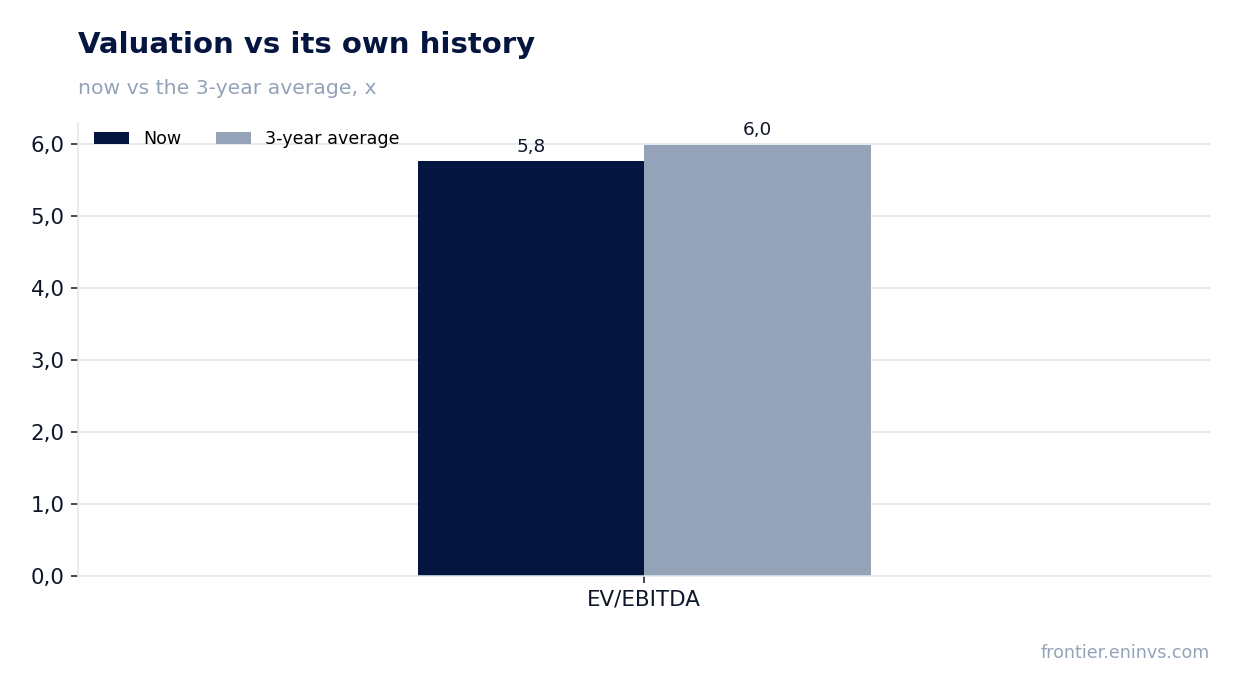
On 3 November Marathon Petroleum reported results for the third quarter of 2026. Revenue rose 61.0% year on year to USD 56.0 bn, EBITDA by 217.6% to USD 11.3 bn and net profit by 443.6% to USD 7.4 bn. The EBITDA margin climbed to 20.1% from 10.2% a year earlier, while leverage at 1.06x EBITDA remains moderate. At an EV/EBITDA of 5.8 against its own three-year average of 6.0 and with the portal model pointing to +130% upside, the share looks attractive, but the main risk is the durability of the refining margin.
Key takeaways
— Revenue rose 61.0% year on year, and the acceleration from 53.8% in the second quarter came entirely from prices and refining margin
— EBITDA added 217.6% on 61.0% revenue growth – the margin climbed to 20.1% from 10.2%
— Net profit of USD 7.4 bn rose 5.4x, and almost all of it is operating rather than one-off
— Leverage at 1.06x EBITDA is moderate, and net debt fell from USD 38.3 bn to 28.3 bn over the year
— Free cash flow of USD 9.6 bn in the quarter on capital spending of just USD 1.1 bn
— The 0.94% dividend yield is modest, and the payout is not the main argument in this story
— EV/EBITDA of 5.8 sits in line with its own three-year average of 6.0, while the portal model points to +130% upside
Attractiveness
Key figures, USD bn
| Metric | Q3 2025 | Q3 2026 | Change |
|---|---|---|---|
| Revenue | 34.8 | 56.0 | +61.0% |
| EBITDA | 3.55 | 11.3 | +217.6% |
| Operating profit | 2.71 | 10.4 | +285.2% |
| Net profit | 1.37 | 7.45 | +443.6% |
| Operating cash flow | 2.61 | 10.7 | +311.3% |
| Capex | 0.95 | 1.13 | +19.0% |
| EBITDA margin | 10.2% | 20.1% | +9.9 pp |
| Net margin | 3.9% | 13.3% | +9.4 pp |
Revenue rose 61.0% year on year, and the acceleration from 53.8% in the second quarter came entirely from prices and refining margin
Revenue in the third quarter of 2026 was USD 56.0 bn, 61.0% more than a year earlier. In the second quarter growth was 53.8%, so the pace accelerated. The acceleration comes off a low base: in the third quarter of 2025 revenue fell 0.8% year on year, and in the fourth by 1.7%.
Revenue growth is almost double the growth in physical volumes, which are not in the facts, so the main contribution came from oil and product prices and the refining margin. The company does not break out segments in the facts, but it is the refining margin that explains why revenue rose 61.0% while EBITDA rose 217.6%.
For a holder this means the quarter is strong, but its nature is price-driven. The next report will show whether the margin held; if refining spreads narrow, revenue and profit will fall back with them.
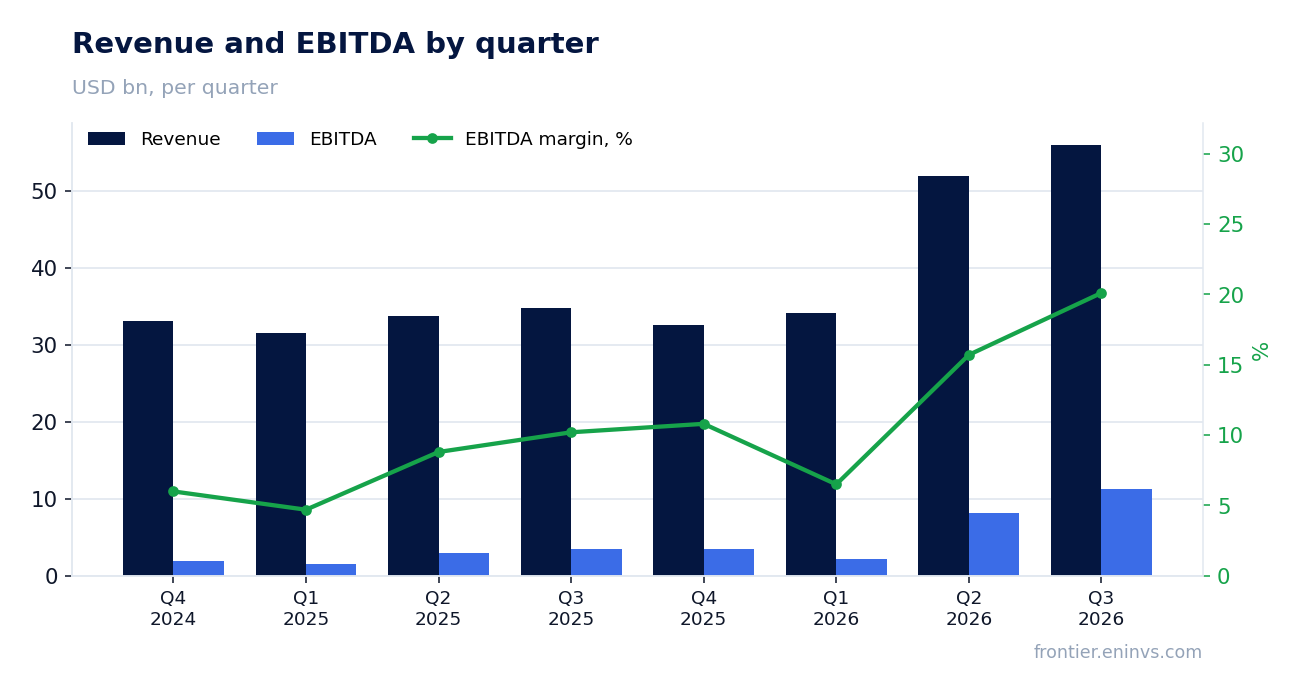
EBITDA added 217.6% on 61.0% revenue growth – the margin climbed to 20.1% from 10.2%
EBITDA in the third quarter of 2026 was USD 11.3 bn against USD 3.6 bn a year earlier, up 217.6%. The EBITDA margin climbed to 20.1% from 10.2% in the third quarter of 2025 – almost double.
Operating profit rose to USD 10.5 bn from USD 2.7 bn a year earlier. The gap between revenue growth and EBITDA growth shows that costs barely increased: with revenue up 61.0%, expenses grew far more slowly, and the whole difference went into the margin.
Such a margin for a refiner is a cycle peak, not the norm. In the third quarter of 2025 it was 10.2%, and a return to that level with revenue unchanged would roughly halve EBITDA. That is the main risk a holder should keep in mind.
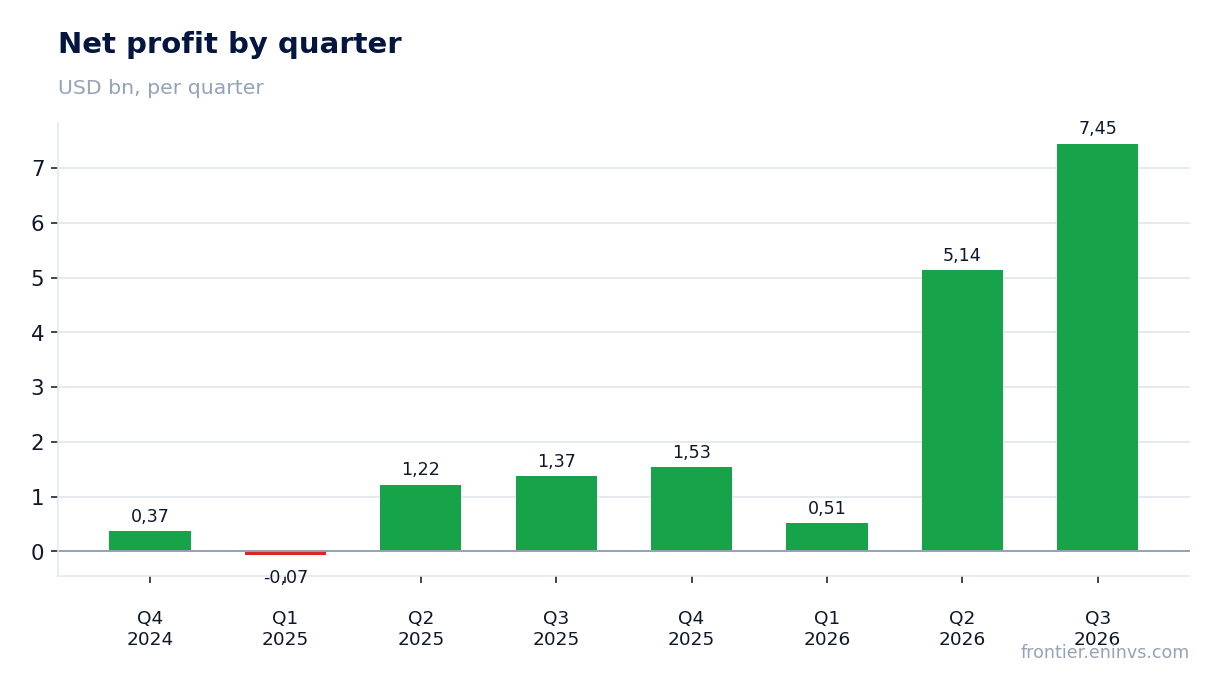
Net profit of USD 7.4 bn rose 5.4x, and almost all of it is operating rather than one-off
Net profit in the third quarter of 2026 was USD 7.4 bn against USD 1.4 bn a year earlier, up 443.6%. The net margin rose to 13.3% from 3.9%.
Profit is almost entirely operating: operating profit of USD 10.5 bn against EBITDA of USD 11.3 bn, so depreciation and interest absorbed less than USD 1 bn. There are no one-off items in the facts that would explain the jump – the growth comes from the refining margin.
A return on equity of 121.8% reflects not so much profitability as a low equity base after years of buybacks. For judging earnings quality the figure says little, but it explains why the market pays a modest multiple to earnings.
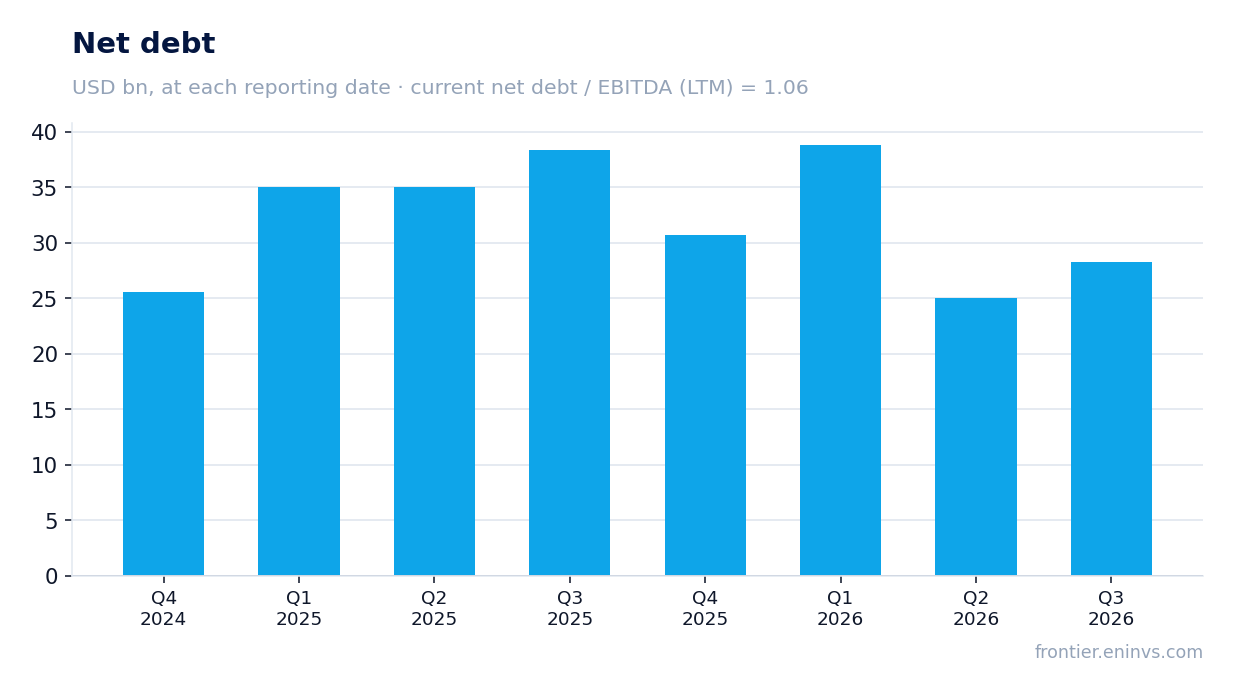
Leverage at 1.06x EBITDA is moderate, and net debt fell from USD 38.3 bn to 28.3 bn over the year
Net debt at 30 September 2026 was USD 28.3 bn, or 1.06x trailing twelve-month EBITDA. That is a moderate level for a refiner with this cash flow.
Over the quarter net debt rose from USD 25.0 bn at 30 June to USD 28.3 bn at 30 September, up USD 3.2 bn. Over the year it fell from USD 38.3 bn at 30 September 2025 to USD 28.3 bn, down USD 10.0 bn: the quarter's profit covered both shareholder payouts and the seasonal build in working capital.
Interest is not broken out in the facts, but with operating profit of USD 10.5 bn and EBITDA of USD 11.3 bn, leverage is not a constraint on either the dividend or buybacks.
Free cash flow of USD 9.6 bn in the quarter on capital spending of just USD 1.1 bn
Operating cash flow in the third quarter of 2026 was USD 10.7 bn, capital expenditure USD 1.1 bn. Free cash flow, the difference between them, is about USD 9.6 bn.
Over the last twelve months operating cash flow was USD 25.2 bn, with capital expenditure of USD 1.1 bn in the quarter; the quarter delivered almost half the annual flow. That is a direct consequence of the high refining margin, not of business growth.
Capital expenditure of USD 1.1 bn is small for a company with USD 56.0 bn of revenue. A refiner is not building new capacity, and the entire surplus goes to dividends and buybacks. That supports shareholder returns but creates no base for profit growth outside the cycle.
The 0.94% dividend yield is modest, and the payout is not the main argument in this story
The trailing twelve-month dividend yield is 0.94% on a market capitalisation of USD 116.8 bn. For a company that returns almost all of its free cash flow to shareholders, that is a low yield: most of the return comes through buybacks rather than the dividend.
Our estimate for the 2026 dividend rests on the current profit base: over the last twelve months net profit was USD 14.6 bn, and on the current policy the payout should stay within 1% of the price. Everything hinges on whether the refining margin holds in the fourth quarter.
A yield of 0.94% is below the key rate, and for an investor who needs current income the share is not suitable. The dividend here is a pleasant addition to the capital-gains story, not its foundation. A fall in the margin could cut the payout: if EBITDA returned to its third-quarter 2025 level, free cash flow would shrink threefold.
EV/EBITDA of 5.8 sits in line with its own three-year average of 6.0, while the portal model points to +130% upside
EV/EBITDA over the last twelve months is 5.8 against its own three-year average of 6.0, so the multiple is in line with its history. The trailing P/E is 8.0. The market is not paying a premium for peak earnings, and rightly so: a refiner's profit is cyclical.
The portal model re-prices EBITDA at current commodity prices at the target EV/EBITDA and, against the market capitalisation, points to +130% upside to fair value. That is our own estimate, not a market consensus.
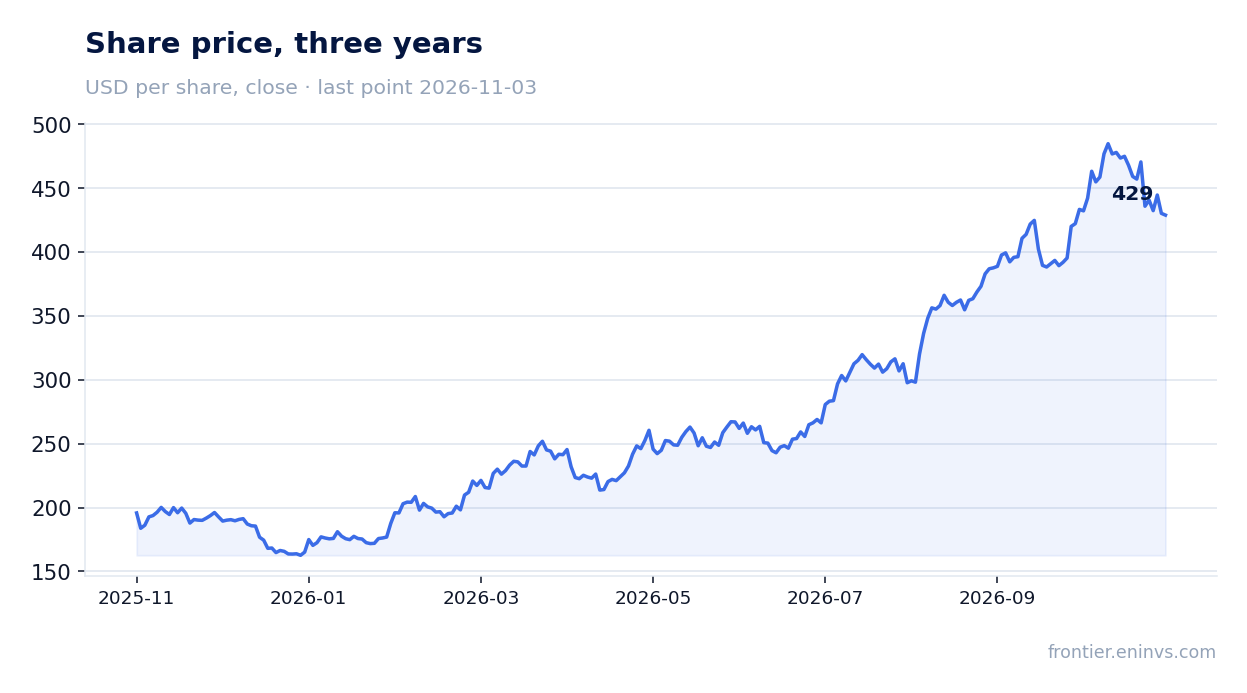
The price reaction was muted: the share lost 0.3% on the day of the report and another 0.3% from the report to 3 November. The market has already priced in a high margin and is waiting for confirmation in the next quarter. If the margin holds, the multiple will stay low against rising profit, and the model's upside can materialise.
Valuation on the latest reported figures
| Metric | Value |
|---|---|
| Market cap | 117 bn USD |
| P/E (LTM) | 8.0 |
| EV/EBITDA (LTM) | 5.8 |
| P/B | 4.85 |
| Net debt / EBITDA (LTM) | 1.06 |
| Operating cash flow (LTM) | 25.2 bn |
| ROE | 121.8% |
| Dividend yield (12m) | 0.9% |
| EV/EBITDA, 3-year average | 6.0 |
Bottom line
The quarter is genuinely strong: revenue up 61.0%, EBITDA up 217.6%, net profit of USD 7.4 bn, free cash flow of USD 9.6 bn. But the strength is price-driven – the refining margin rose to 20.1% from 10.2%, and that, not volume growth, delivered almost the entire result. Leverage at 1.06x EBITDA is moderate, capital spending is small, and the whole surplus goes to shareholders. The holder has one question: will the margin hold in the fourth quarter? With EV/EBITDA at 5.8 in line with its own history and the portal model pointing to +130% upside, the share looks attractive, but this is a bet on the refining cycle continuing, not on business growth.
Open the company's financial profile MPC →
See also: market overview · valuation map · stock screeners