Phillips 66: profit up 42-fold, almost all of it from refining at record utilisation

On 28 October Phillips 66 reported third-quarter 2026 results. Revenue came to $50.54 bn (+46.4% year on year), net profit to $5.62 bn against $0.13 bn a year earlier, and operating cash flow to $7.28 bn. Refining made almost all of the profit: $6.03 bn pre-tax on a realised margin of $38.00 per barrel and 98% utilisation. The stock trades above its own history on EV/EBITDA (16.5 versus 13.2), and at that multiple the share looks neutral: the strong quarter is already in the price.
Key takeaways
— Revenue rose 46.4%, but growth decelerated from 53.1% a quarter earlier
— Of the $5.62 bn profit, $6.03 bn pre-tax came from refining at a $38.00 per barrel margin
— Net margin climbed to 11.1% from 0.4% a year earlier
— Net debt fell to $12.7 bn from $16.5 bn at the end of June
— Operating cash flow of $7.28 bn funded $2.78 bn of shareholder returns
— A 1.83% dividend yield is modest for the history and below the risk-free rate
— EV/EBITDA of 16.5 is 25% above its own three-year average of 13.2
Attractiveness
Key figures, USD bn
| Metric | Q3 2025 | Q3 2026 | Change |
|---|---|---|---|
| Revenue | 34.5 | 50.5 | +46.4% |
| EBITDA | 2.74 | — | — |
| Operating profit | 0.96 | — | — |
| Net profit | 0.13 | 5.62 | +4122.6% |
| Operating cash flow | 1.18 | 7.28 | +518.1% |
| Capex | 0.54 | — | — |
| EBITDA margin | 7.9% | — | — |
| Net margin | 0.4% | 11.1% | +10.7 pp |
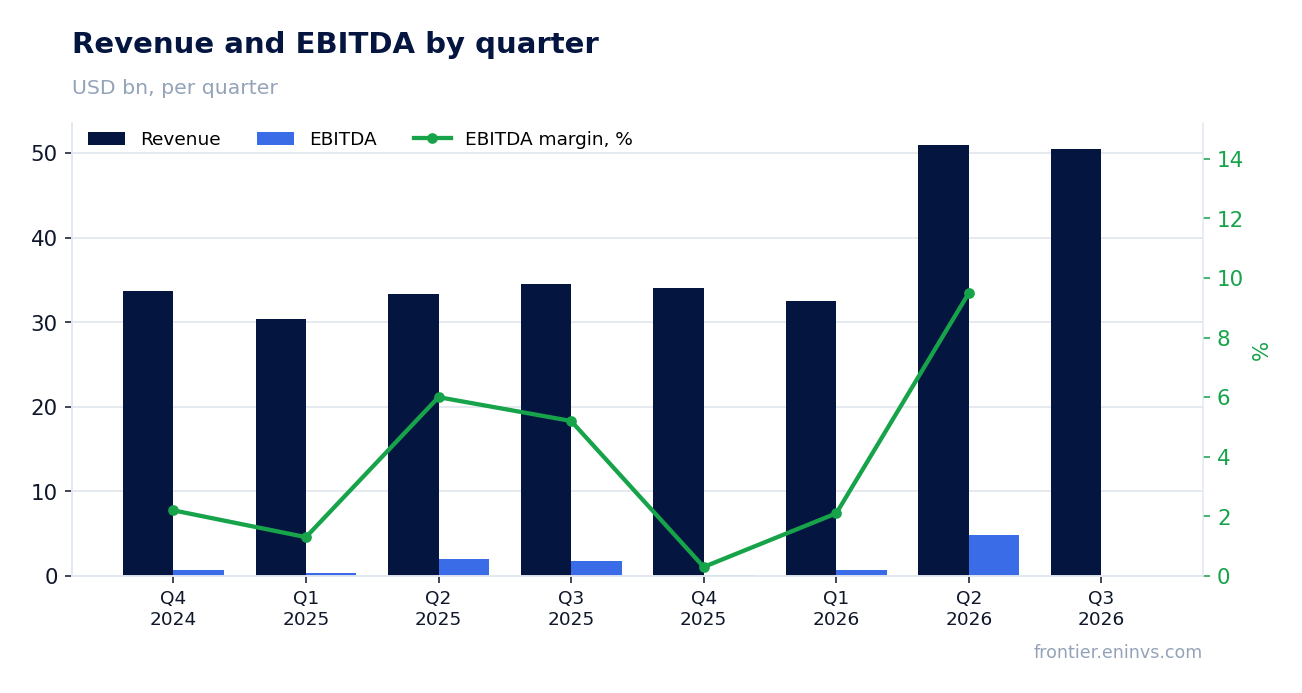
Revenue rose 46.4%, but growth decelerated from 53.1% a quarter earlier
Third-quarter 2026 revenue came to $50.54 bn, 46.4% more than a year earlier. This is the second consecutive quarter of roughly 50% growth: revenue rose 53.1% in the second quarter. Against that, the pace decelerated, although the absolute level stayed almost flat – $51.0 bn in the second quarter versus $50.5 bn in the third.
The year-earlier base was low: third-quarter 2025 revenue was $34.5 bn and was falling 2.9% year on year. Since then the company has consolidated 100% of the Borger and Wood River refineries after buying the remaining half of WRB Refining on 1 October 2025 – that changes both the base and the sales volume.
The seven-point deceleration does not point to weak demand: revenue was almost unchanged quarter on quarter, and the annual jump rests on the low base and consolidation. For the next report, holding the refining margin matters more than the revenue growth rate.
Of the $5.62 bn profit, $6.03 bn pre-tax came from refining at a $38.00 per barrel margin
Quarterly profit was $5.62 bn, or $14.08 per diluted share. Almost all of it was made in refining: the Refining segment earned $6.03 bn pre-tax against $3.06 bn in the second quarter. The realised margin rose to $38.00 per barrel from $24.08 a quarter earlier, and capacity utilisation to 98% from 96%.
The driver is named plainly in the release: wider market crack spreads. Volumes helped too – 196.1 mn barrels processed against 186.9 mn in the second quarter, with a record 848 thousand barrels per day of Central Corridor inputs. Distillate yield was also a record at 41%, and clean product yield was 86%.
The other segments weakened. Midstream earned $702 mn against $785 mn, Chemicals $311 mn against $404 mn, Marketing and Specialties $245 mn against $583 mn, and Renewable Fuels $191 mn against $544 mn. The quarter's profit rests on refining alone, and that is the main risk to its durability.
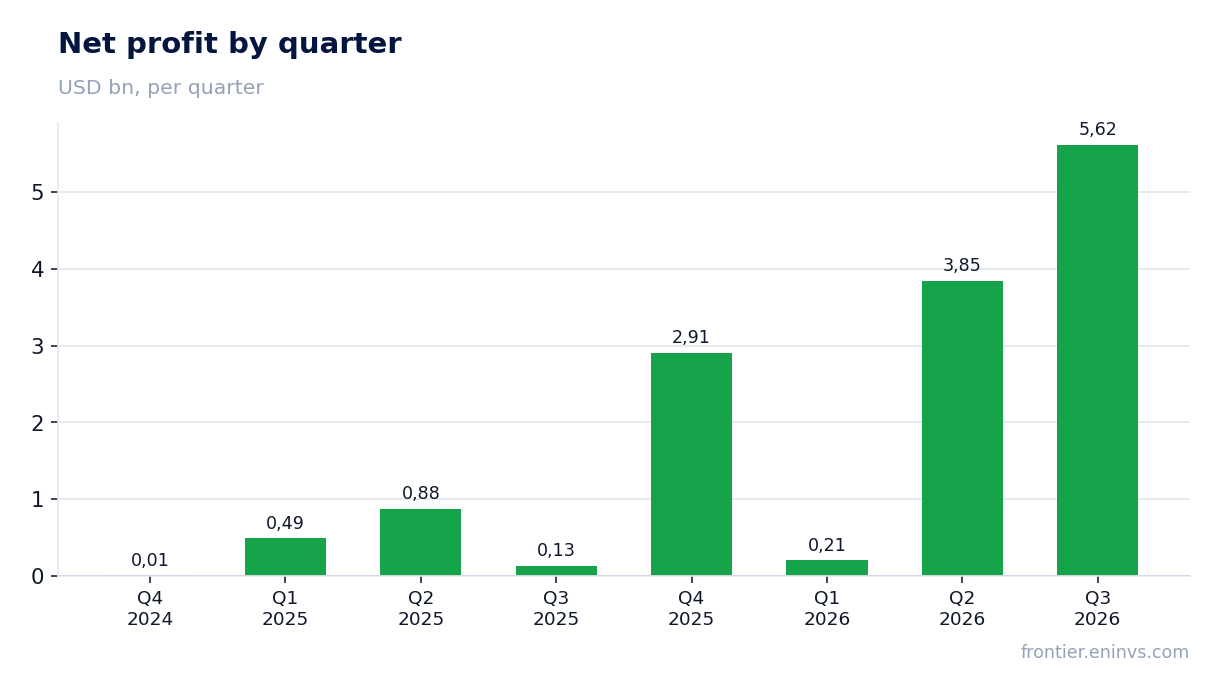
Net margin climbed to 11.1% from 0.4% a year earlier
Net margin in the third quarter was 11.1% against 0.4% in third-quarter 2025. The gap is not purely operational: a year earlier profit was almost wiped out by $948 mn of impairments on the 50% stake in WRB Refining before the buy-in.
There are almost no one-offs this quarter. Adjusted earnings were $5.62 bn against $5.62 bn reported, with a refining adjustment of just $29 mn pre-tax. The quarter's profit is therefore clean, without asset sales or tax effects that inflated some periods.
For comparison, nine-month 2026 profit was $9.67 bn, and the third quarter delivered more than half of it. That concentration means the full-year figure will depend on whether the refining margin holds in the fourth quarter.
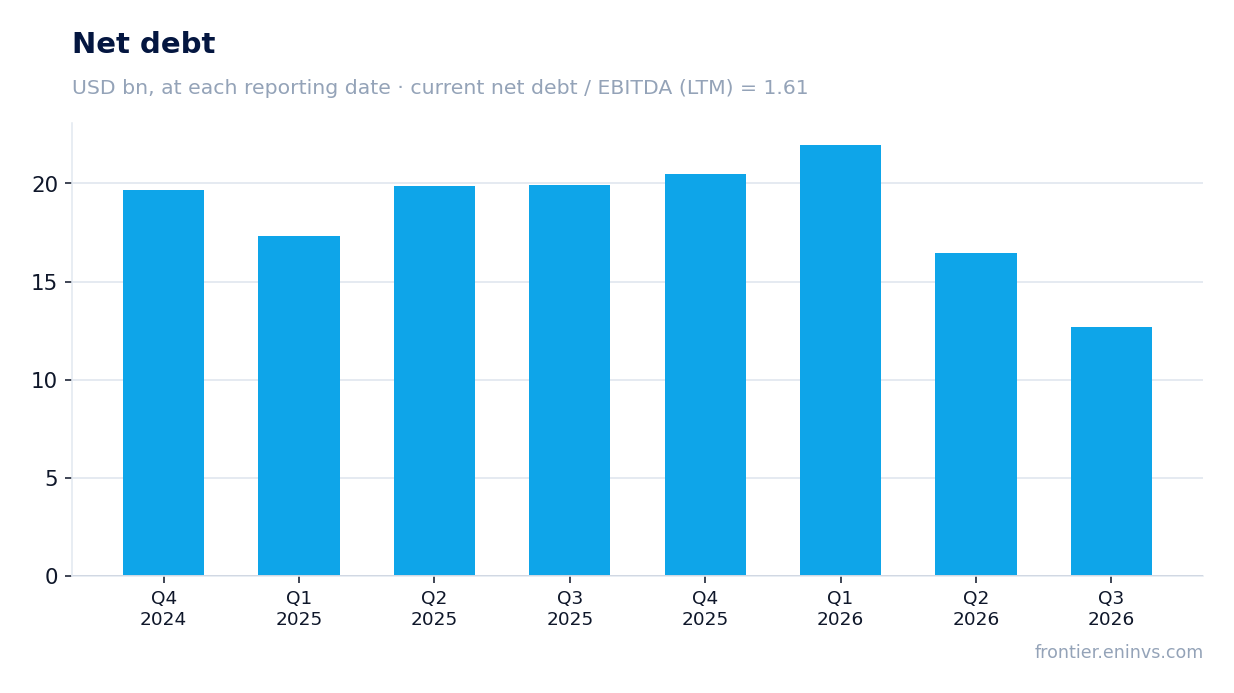
Net debt fell to $12.7 bn from $16.5 bn at the end of June
Net debt at 30 September 2026 was $12.7 bn, $3.8 bn less than at 30 June ($16.5 bn). Over twelve months, from 30 September 2025, it fell by $7.2 bn from $19.9 bn. The reduction was funded by cash flow: cash rose to $5.85 bn from $4.10 bn.
Net debt to trailing-twelve-month EBITDA is 1.61. That is a level at which debt does not pressure payouts, but it cannot be compared with an earlier value: no earlier ratio is disclosed. Total balance-sheet debt is $18.53 bn, and debt to capital is 34%.
Interest expense fell to $187 mn from $233 mn in the second quarter, one reason for the smaller corporate-centre loss. With that load and $5.85 bn of cash, the company keeps room for payouts and capital spending.
Operating cash flow of $7.28 bn funded $2.78 bn of shareholder returns
Quarterly operating cash flow was $7.28 bn, almost the same as in the second quarter ($7.26 bn). Excluding working capital, flow was $6.19 bn against $4.32 bn a quarter earlier: the operating part is markedly stronger than a year ago.
Capital expenditure and investments were $680 mn, below $726 mn in the second quarter. Against the flow that is a small sum, leaving about $6.5 bn of free cash. Of that, $504 mn went to dividends and $2.27 bn to buybacks, for $2.78 bn returned to shareholders in total.
The $2.27 bn buyback is the largest return item and supported earnings per share. The company targets returning more than 50% of operating cash flow to shareholders; this quarter the share was about 38% of flow and above 40% of flow excluding working capital. The quarter's flow is one-off in nature – it rests on a high refining margin.
A 1.83% dividend yield is modest for the history and below the risk-free rate
Trailing-twelve-month dividend yield is 1.83%. Dividends absorbed $504 mn in the quarter against $5.62 bn of profit: the payout is covered more than tenfold, and the payout ratio on quarterly profit is very low. The company raised the dividend for the second time in 2026, as the release states, though the size of the increase is not disclosed.
Our estimate for the 2026 dividend is about $2.0 per share, based on the current quarterly payment and the announced increase; it rests on profit that this year leans on the refining margin. If the margin returns to first-half levels, profit will fall, but coverage of the payment stays many times over – the risk of a cut is small.
A 1.83% yield is below what the stock has historically offered and well below the risk-free rate. For a dividend story that is a weak argument: the investor gets little current income and pays a high multiple for it. Only a prolonged fall in refining margin and cash flow could shrink the payout, not debt – that sits at 1.61 EBITDA.
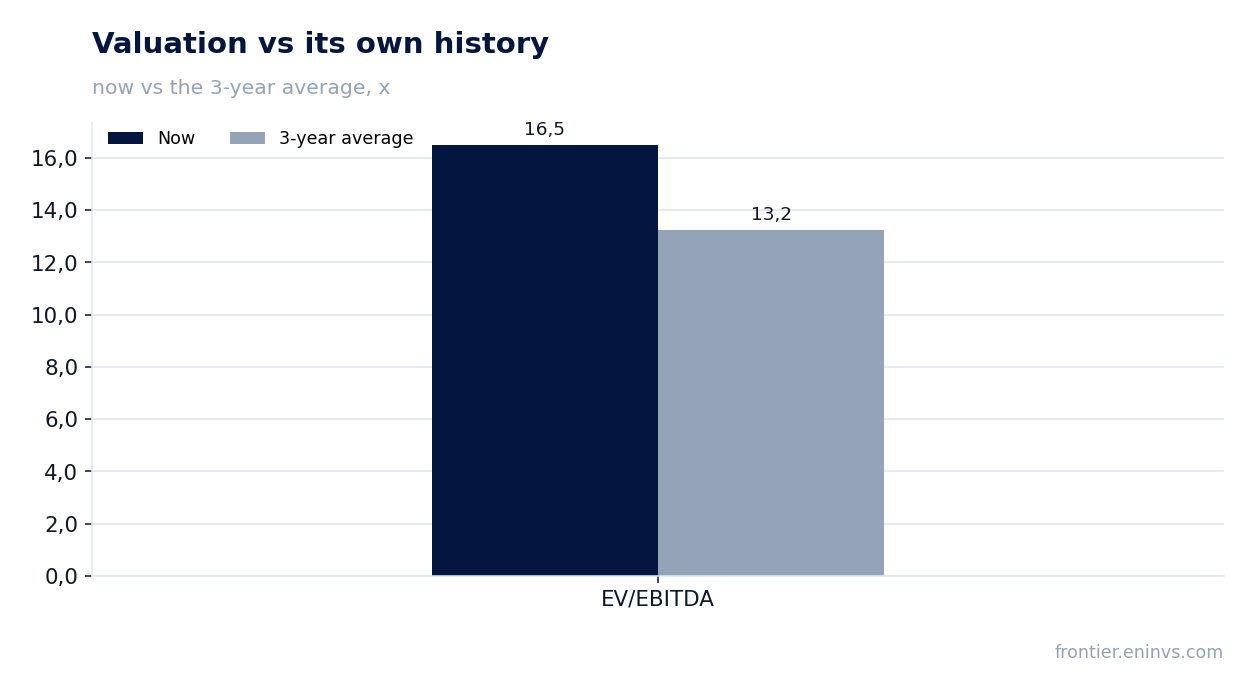
EV/EBITDA of 16.5 is 25% above its own three-year average of 13.2
On trailing-twelve-month EV/EBITDA of 16.5, the stock is more expensive than its own history: the three-year average is 13.2, so the current level is 25% above it. Trailing P/E is 8.7, which looks cheap, but the last twelve months include a record third quarter, and on a sustainable margin the multiple would be higher.
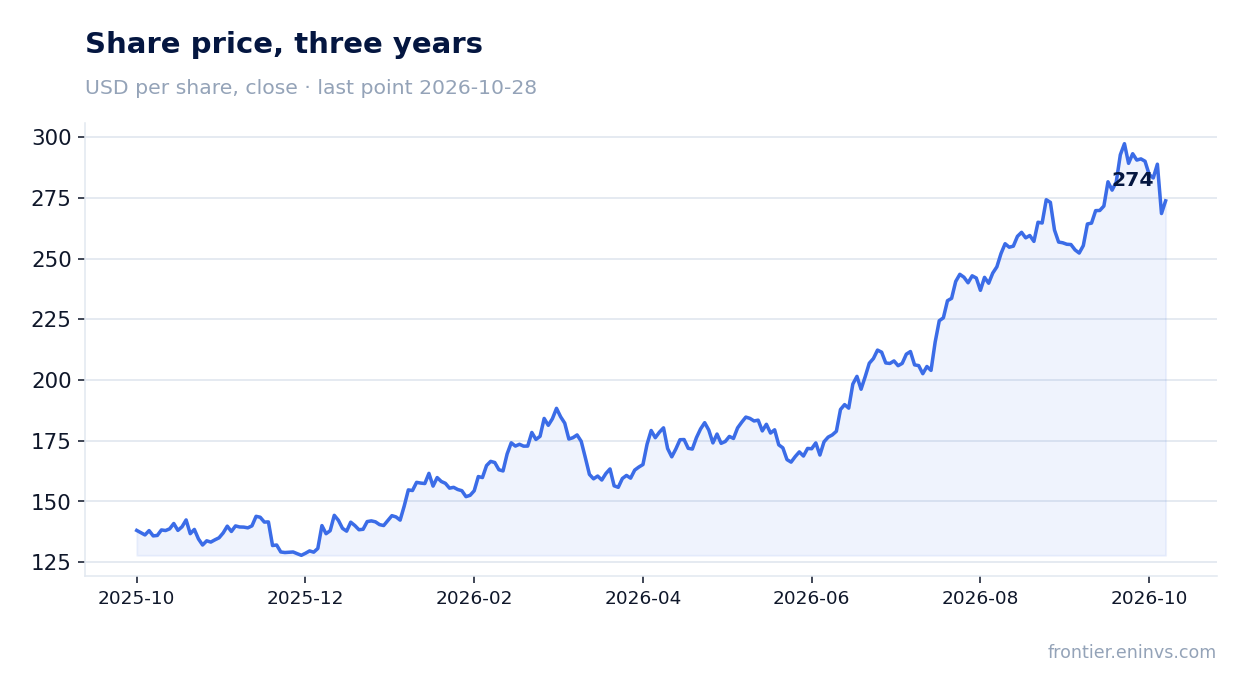
The market reaction was restrained: the share added 1.9% on the release day and the same from the release to 28 October. At $268.53 before the release, market capitalisation is about $109.8 bn. The reaction says the strong quarter was expected, and the 42-fold profit jump is the effect of a low base a year earlier.
A valuation above history, on profit that rests on refining alone, leaves little room for error. For the multiple to be justified, the $38.00 per barrel margin must hold for more than one quarter. If it returns to $24 in the fourth quarter, profit and EBITDA will fall markedly, and the current price will look expensive.
Valuation on the latest reported figures
| Metric | Value |
|---|---|
| Market cap | 110 bn USD |
| P/E (LTM) | 8.7 |
| EV/EBITDA (LTM) | 16.5 |
| P/B | 3.77 |
| Net debt / EBITDA (LTM) | 1.61 |
| Operating cash flow (LTM) | 15.0 bn |
| ROE | 68.2% |
| Dividend yield (12m) | 1.8% |
| EV/EBITDA, 3-year average | 13.2 |
Bottom line
The quarter is genuinely strong: $5.62 bn of profit, an 11.1% net margin, $7.28 bn of cash flow and $12.7 bn of net debt at 1.61 EBITDA. But refining did almost all of it, at record utilisation and a $38.00 per barrel margin, while the other segments weakened. There are almost no one-offs in profit, which is a plus, yet the durability of the result rests on one factor – crack spreads. At EV/EBITDA of 16.5 against its own 13.2 average the stock is priced above history, and the 1.83% dividend yield is weak. The verdict is neutral: the strong report is already in the price, and a second strong margin quarter is needed to improve the rating.
Open the company's financial profile PSX →
See also: market overview · valuation map · stock screeners