ICICI Bank: profit rose 22.3%, but net interest income grew faster
In its Q3 2026 report, ICICI Bank posted net profit of 163,331.8 million rupees and net interest income of 401,531.7 million rupees. Profit rose 22.3% year on year, while net interest income growth accelerated from 7.7% in Q1 to 16.0% in Q2. The bank trades at a P/E of 16.9 with a return on equity of 16.9%, and the portal model implies about +7% upside to fair value – the stock looks rather attractive, though profit growth lags net interest income growth.
Key takeaways
— Net profit rose 22.3% year on year, but net interest income grew faster – profit lags the core revenue line
— Net interest income accelerated from 7.7% growth in Q1 to 16.0% in Q2 – the main driver of the report
— Return on equity of 16.9% against a P/E of 16.9 – the bank earns in line with its valuation, with no re-rating cushion
— A dividend yield of 0.86% is too small to support the share price against a high policy rate
— The portal model implies +7% upside to fair value – a moderate but positive signal
Attractiveness
Key figures, INR bn
| Metric | Q3 2025 | Q3 2026 | Change |
|---|---|---|---|
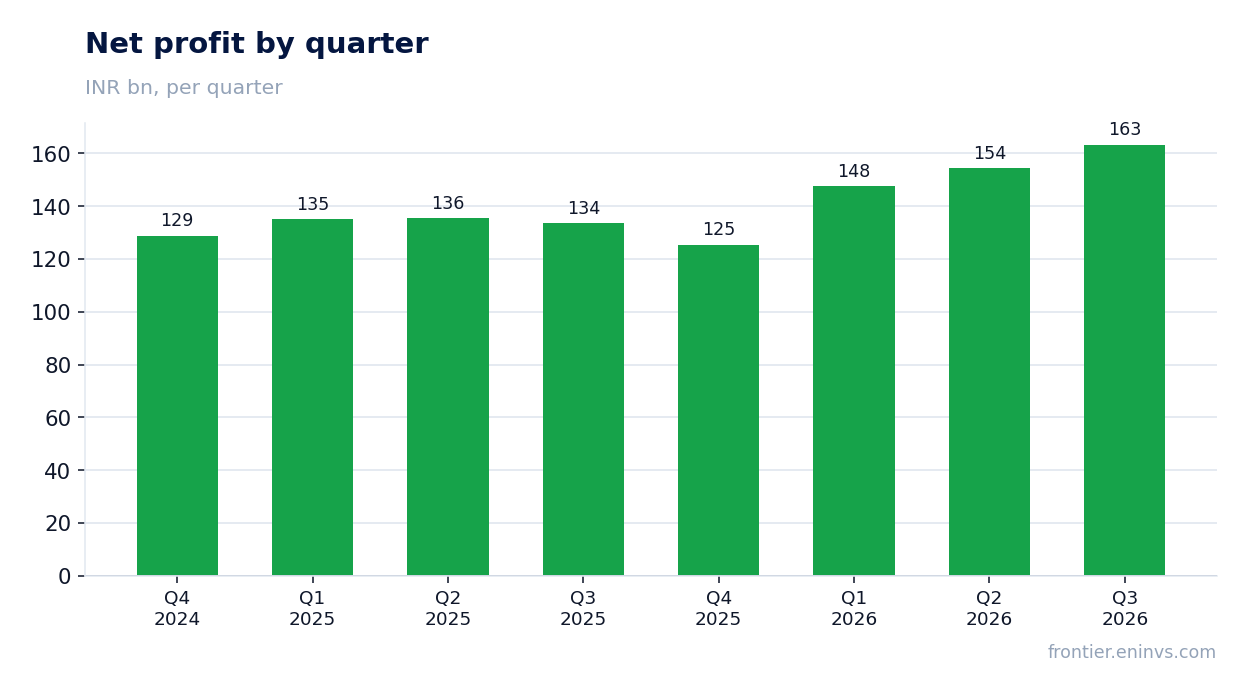
| Net profit | 134 | 163 | +22.3% |
Net profit rose 22.3% year on year, but net interest income grew faster – profit lags the core revenue line
Net profit for Q3 2026 came in at 163,331.8 million rupees, up 22.3% year on year. That is a strong result, but it is slower than the growth in net interest income, which reached 401,531.7 million rupees in the same quarter.
The gap means profit is growing more slowly than core revenue: part of net interest income is absorbed by costs and provisions. The report does not break down which cost line caused the lag, but the fact itself matters – the bank is growing net interest income faster than it converts it into profit.
For a holder, this means the quality of growth is not yet confirmed: revenue is accelerating, profit is not. The next report will show whether profit catches up with net interest income or the gap persists.
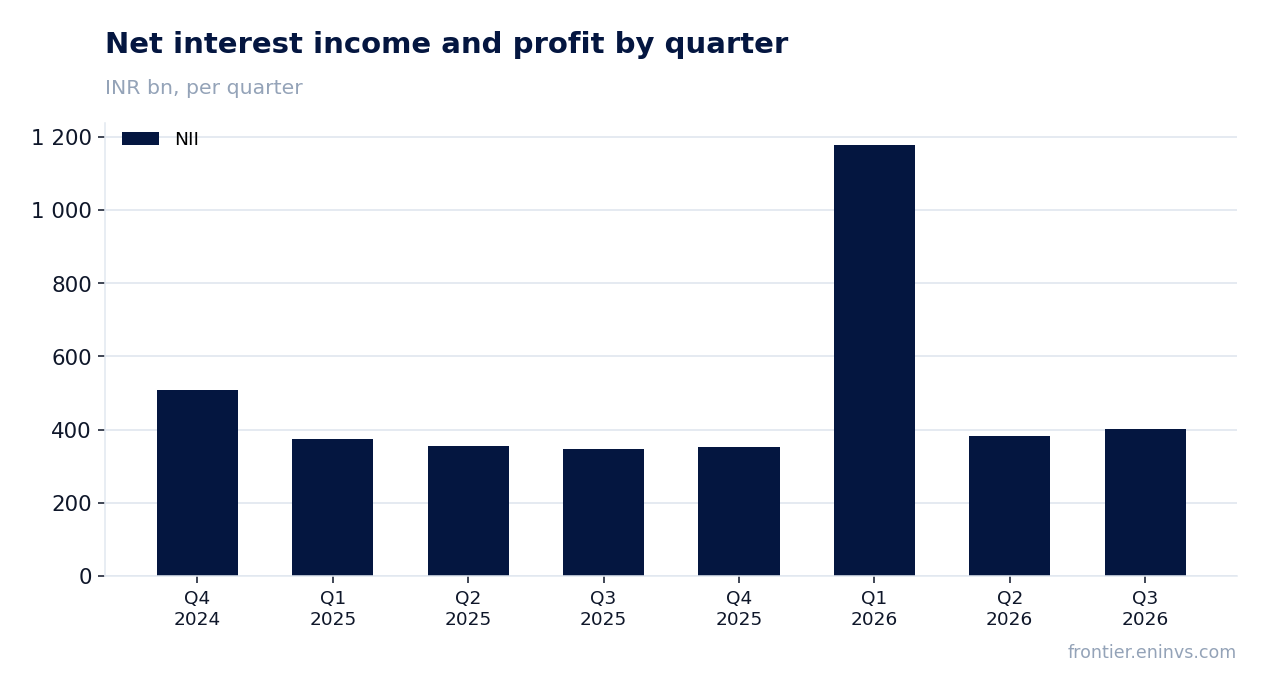
Net interest income accelerated from 7.7% growth in Q1 to 16.0% in Q2 – the main driver of the report
Net interest income growth accelerated: in Q1 2026 it was 7.7% year on year, in Q2 it reached 16.0%. This acceleration is the key positive of the report, because net interest income remains the bank's main revenue source.
The acceleration is visible in absolute terms too: Q3 2026 net interest income was 401,531.7 million rupees versus 383,657.4 million a quarter earlier. The quarter-on-quarter gain is modest, but it comes on top of an already high year-on-year rate.
The report does not disclose the cause of the acceleration. What matters is that it is steady: growth has increased for two consecutive quarters rather than fluctuating. If Q3 confirms the trend, it will strengthen the profit base.
Return on equity of 16.9% against a P/E of 16.9 – the bank earns in line with its valuation, with no re-rating cushion
ICICI Bank trades at a P/E of 16.9 on trailing twelve-month earnings and reports a return on equity of 16.9%. The ratio is almost one-to-one: the investor pays roughly as much per rupee of profit as the bank earns per rupee of capital.
For a bank, this is a neutral valuation. On one hand, a 16.9% return on equity is a respectable level that justifies the multiple. On the other, there is no re-rating cushion: for the share to rise further, either profit must grow or the discount rate must fall.
The portal model puts fair value 7% above the current price. That is moderate upside – not a large safety margin, but not a sign of overvaluation either.
A dividend yield of 0.86% is too small to support the share price against a high policy rate
ICICI Bank's trailing twelve-month dividend yield is 0.86%. That is a low level that does not compete with risk-free instruments and does not support the share price during a market correction.
With a return on equity of 16.9% and a P/E of 16.9, the bank could pay more, but the actual payout is modest. The reason is that profit is directed into capital growth rather than dividends – typical for a bank expanding its net interest income.
For a holder, the dividend here is not an income source but rather a stability signal. Do not expect payout growth in the coming quarters: while profit lags net interest income, there is little free capital to raise the dividend.
The portal model implies +7% upside to fair value – a moderate but positive signal
The portal model puts ICICI Bank's fair value 7% above the current market price. This is our own calculation based on return on equity and the P/B multiple, not a market consensus.
Upside of 7% is moderate. It does not create a large margin of safety, but it does not indicate overvaluation either. With a P/E of 16.9 and a return on equity of 16.9%, the market values the bank almost at fair value, and the model confirms this.
The signal would be stronger if profit grew faster than net interest income. While the gap between them persists, the upside remains modest.
Valuation on the latest reported figures
| Metric | Value |
|---|---|
| Market cap | 10 002 bn INR |
| P/E (LTM) | 16.9 |
| P/B | 2.75 |
| ROE | 16.9% |
| Dividend yield (12m) | 0.9% |
Bottom line
The strong side of the report is the acceleration in net interest income from 7.7% to 16.0% year on year and profit of 163,331.8 million rupees, up 22.3%. The weak side is that profit grows more slowly than revenue, and a dividend yield of 0.86% provides no support. Valuation is neutral: a P/E of 16.9 against a return on equity of 16.9% leaves no cushion, and the portal model implies only +7% upside. The verdict is rather attractive, but without a large margin of safety: growth requires either faster profit growth or a lower policy rate.
Open the company's financial profile ICICIBANK →
See also: market overview · valuation map · stock screeners