Bashneft: profit halved on an unchanged margin, and the 2026 dividend is already half of last year's
On 13 April Bashneft released its condensed consolidated financial statements for 2025. In the fourth quarter revenue was RUB 250.5 bn (–13.7% YoY), EBITDA – RUB 38.1 bn (–13.4%), net profit – RUB 11.7 bn (–54.1%). The EBITDA margin held at 15.2%, but the net margin compressed from 8.7% to 4.7%, and the 2026 dividend already stands at RUB 69.29 per share versus RUB 147.31 a year earlier. With EV/EBITDA at 2.2, in line with its own three-year average, and a 5.6% yield against the 10.5% we consider fair, the share looks neutral: a cheap valuation is offset by weak cash flow and a cut payout.
Key takeaways
— Fourth-quarter revenue fell 13.7% YoY to RUB 250.5 bn, the second consecutive quarterly decline after –4.5% in Q4 2024
— EBITDA shrank 13.4% to RUB 38.1 bn, but the margin held at 15.2% – costs contracted along with revenue
— Net profit dropped 54.1% to RUB 11.7 bn because the net margin compressed from 8.7% to 4.7% while operating profitability was unchanged
— For the year other expenses reached RUB 40.2 bn versus RUB 1.1 bn a year earlier, and they, not operations, ate the profit
— Operating cash flow for the year was RUB 110.2 bn, capex RUB 42.4 bn, and after dividends and interest free cash flow turned negative
— The 2026 dividend is RUB 69.29 per share, half of RUB 147.31 for 2025, and the 5.6% yield is half the 10.5% we consider fair
— EV/EBITDA of 2.2 matches its own three-year average of 2.2, so the share is neither cheaper nor dearer than its history
Attractiveness
Key figures, RUB bn
| Metric | Q4 2024 | Q4 2025 | Change |
|---|---|---|---|
| Revenue | 290 | 250 | -13.7% |
| EBITDA | 44.0 | 38.1 | -13.4% |
| Operating profit | 29.9 | 24.2 | -18.9% |
| Net profit | 25.4 | 11.7 | -54.1% |
| Operating cash flow | 53.5 | 27.6 | -48.5% |
| Capex | 20.7 | 10.6 | -48.8% |
| EBITDA margin | 15.2% | 15.2% | +0.0 pp |
| Net margin | 8.7% | 4.7% | -4.0 pp |
Fourth-quarter revenue fell 13.7% YoY to RUB 250.5 bn, the second consecutive quarterly decline after –4.5% in Q4 2024
In the fourth quarter of 2025 revenue was RUB 250.5 bn, 13.7% less than a year earlier. A year earlier, in Q4 2024, the decline was more modest at 4.5%, so the pace of contraction accelerated. For the full year 2025 revenue was RUB 1,001.8 bn versus RUB 1,142.8 bn in 2024 per the income statement.
The contraction runs through both lines. Sales of oil, gas, petroleum products and petrochemicals fell for the year to RUB 989.1 bn from RUB 1,135.6 bn, while auxiliary services and other sales rose to RUB 12.7 bn from RUB 7.2 bn. The core business is shrinking, and the growth comes from a small line that barely moves the overall picture.
For a shareholder this means the company is operating in a lower-price environment and, judging by the report, is not growing physical volumes enough to offset the price factor. While revenue falls at a double-digit pace, a recovery in profit without a price reversal is unlikely.
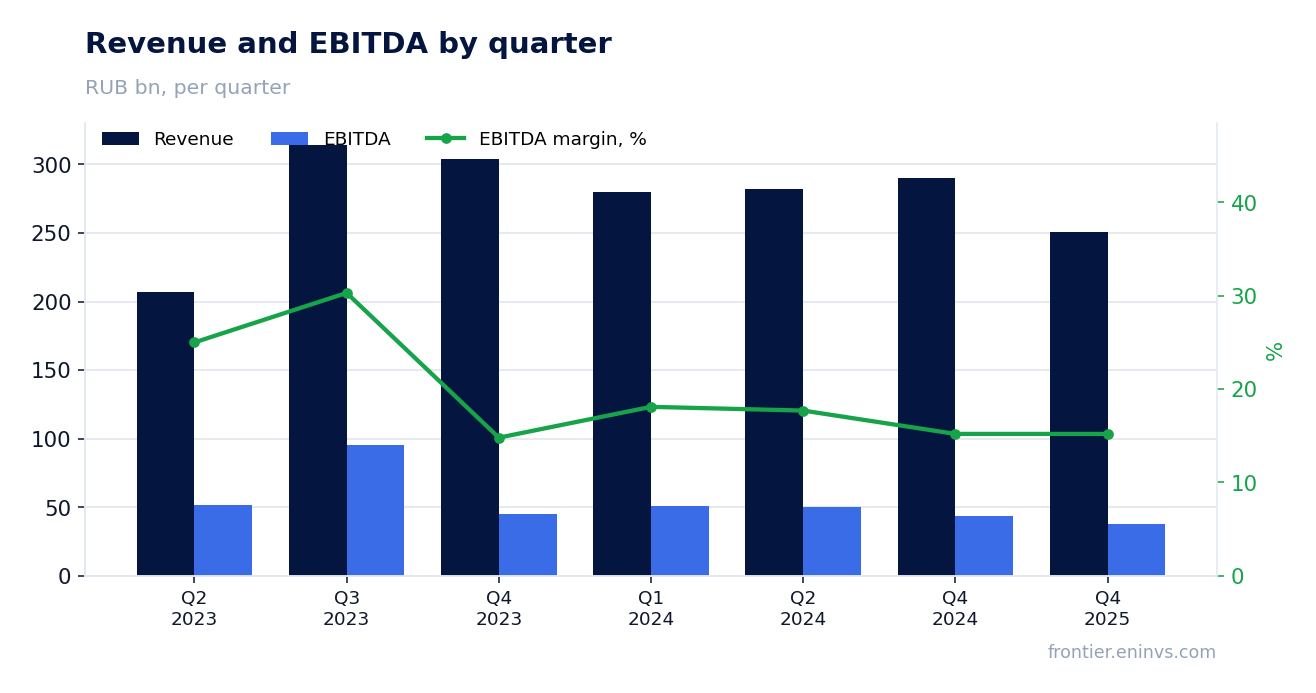
EBITDA shrank 13.4% to RUB 38.1 bn, but the margin held at 15.2% – costs contracted along with revenue
Fourth-quarter EBITDA was RUB 38.1 bn, 13.4% less than a year earlier. The EBITDA margin held at 15.2%, exactly the same as in Q4 2024. This means operating efficiency did not suffer: the company cut costs almost proportionally to the revenue decline.
Operating profit for the quarter was RUB 24.2 bn, also down but more slowly than revenue. For the year operating profit per the report was RUB 96.8 bn versus RUB 137.2 bn in 2024. Depreciation, depletion, amortisation and impairment rose for the year to RUB 55.7 bn from RUB 51.4 bn, which partly explains the deeper fall in operating profit relative to EBITDA.
The stable margin is the main argument that the business is managed carefully. But it does not offset the fact that absolute EBITDA has been falling for a second year, and the dividend base falls with it.
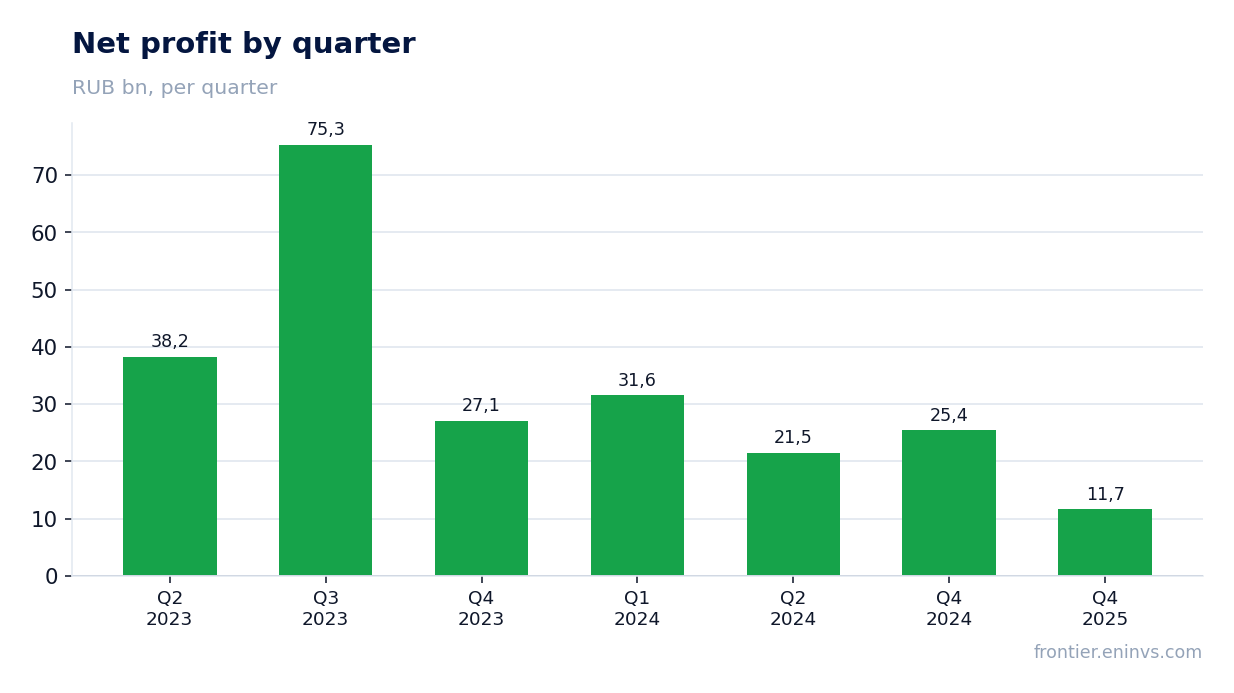
Net profit dropped 54.1% to RUB 11.7 bn because the net margin compressed from 8.7% to 4.7% while operating profitability was unchanged
Fourth-quarter net profit was RUB 11.7 bn, 54.1% less than a year earlier. The EBITDA margin was unchanged, while the net margin fell from 8.7% to 4.7%. The gap between operating and net profit is what happened below the operating line.
For the full year 2025 net profit was RUB 46.6 bn versus RUB 103.9 bn in 2024. Profit attributable to shareholders was RUB 49.2 bn versus RUB 104.7 bn. A more than twofold decline for the year against a relatively stable operating picture points to one-off items in the lower part of the statement.
For a shareholder it matters that the dividend base is formed from net profit. If its fall is driven by non-operating items rather than one-off write-offs, next year could be better. If the cause is persistent, the current profit level is the new normal.
For the year other expenses reached RUB 40.2 bn versus RUB 1.1 bn a year earlier, and they, not operations, ate the profit
In the 2025 income statement the 'Other expenses' line was RUB 40.2 bn versus RUB 1.1 bn in 2024. That is almost the entire gap between pre-tax profit of RUB 56.6 bn in 2025 and RUB 136.1 bn in 2024. Operating profit fell by RUB 40.4 bn for the year, and other expenses added another RUB 39.0 bn of decline.
The condensed statements do not break this line down: the note says it includes financial income and expenses, other income and expenses and exchange differences, but the detail is excluded from the publication. So the specific cause of the rise in other expenses cannot be named from the document – one can only record that this is where the main hit to profit is concentrated.
For valuing the share this is the key question. If the RUB 40.2 bn is a one-off write-off or an FX effect, next year's profit could recover. If it is persistent financial expense, pressure on the dividend will remain.
Operating cash flow for the year was RUB 110.2 bn, capex RUB 42.4 bn, and after dividends and interest free cash flow turned negative
In 2025 operating activities generated RUB 110.2 bn versus RUB 163.0 bn in 2024. Capital expenditure was RUB 42.4 bn versus RUB 74.1 bn a year earlier – the company noticeably cut investment. In the fourth quarter operating cash flow was RUB 27.6 bn and capex RUB 10.6 bn.
After investment about RUB 67.8 bn remains. But financial payments for the year were RUB 32.0 bn, and repayment of loans and borrowings another RUB 20.0 bn. Together that is RUB 52.0 bn of outflow, and cash fell by RUB 1.3 bn over the year. Free cash flow after dividends and interest turned out negative.
Halving capex is a way to keep cash flow up amid falling revenue. But it also means the company is deferring investment, so future growth in production and refining is in question. For the dividend story this is a warning: payouts are funded not so much from free cash flow as from the balance sheet.
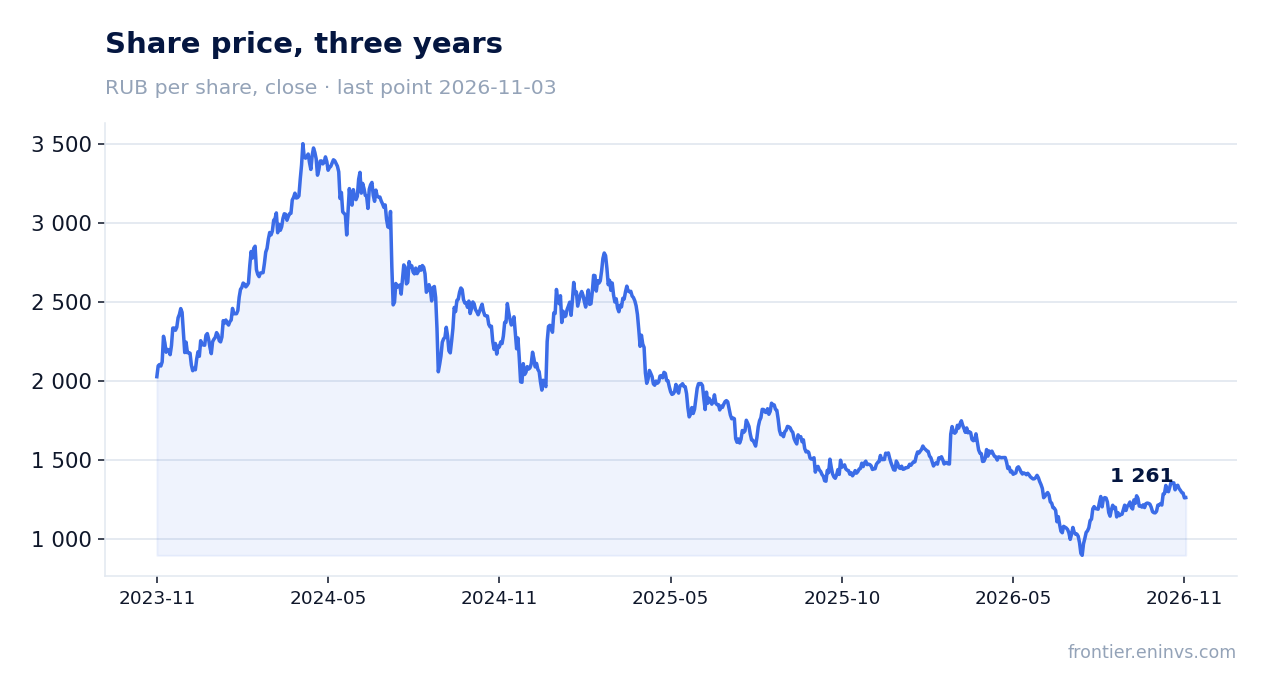
The 2026 dividend is RUB 69.29 per share, half of RUB 147.31 for 2025, and the 5.6% yield is half the 10.5% we consider fair
Over the last 12 months Bashneft paid RUB 69.29 per share, and in our model this is the annual estimate – the amount is already paid and no further payments for this period are assumed. A year earlier, for 2025, the payment was RUB 147.31 per share at a yield of 8.4% on the ex-date. A cut of more than half.
The payment history shows the company used to pay substantially more: RUB 249.69 for 2024, RUB 199.89 for 2023, RUB 117.29 for 2022. The current RUB 69.29 is the lowest since 2020, when RUB 107.81 was paid. The fall follows the fall in net profit: the model assumes a payout of 0.19 of profit.
A 5.6% yield against a 14.0% key rate does not compensate for the risk. Our estimate of the fair yield for this name is 10.5%, meaning the market pays half of what we consider adequate for the dividend. For the yield to reach fair value at the current price, the payment would have to be almost twice as high.
What could make the payment even smaller: a further fall in net profit, growth in other expenses, the need to direct cash to debt repayment. What could increase it: a recovery in oil prices, a reversal of one-off items, a return to a higher payout. None of these is confirmed by the report yet.
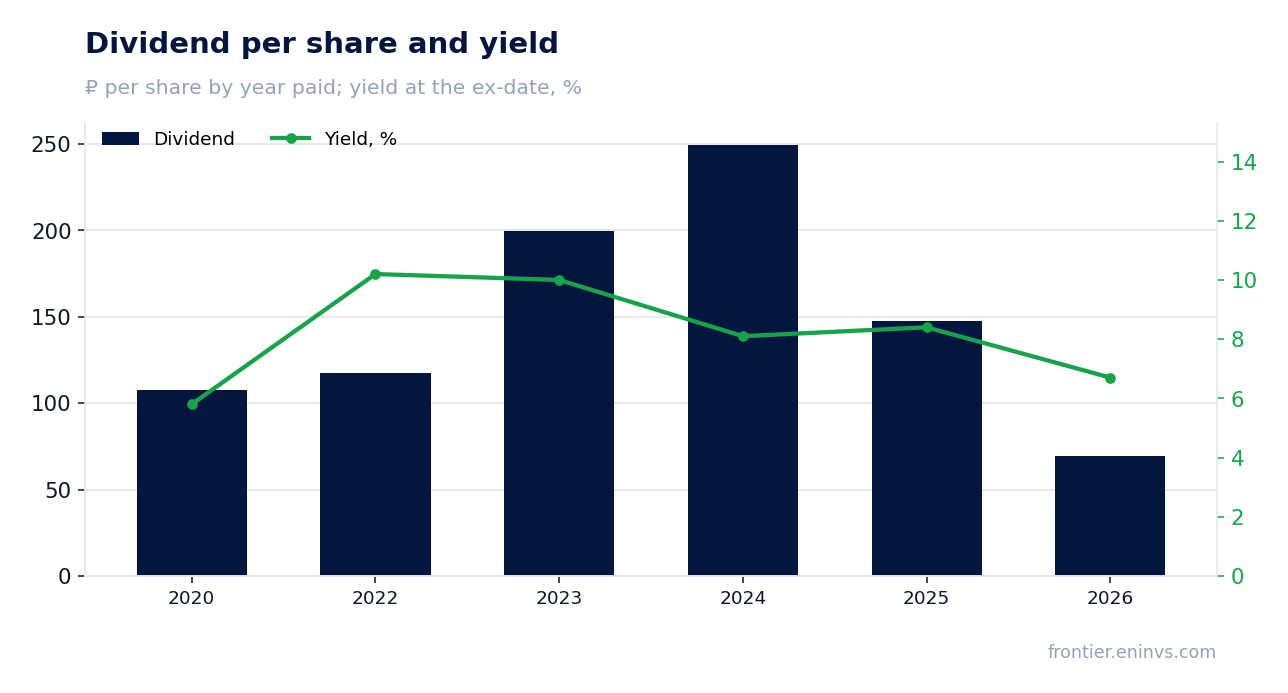
EV/EBITDA of 2.2 matches its own three-year average of 2.2, so the share is neither cheaper nor dearer than its history
On the trailing-twelve-month EV/EBITDA the share trades at 2.2, within 5% of its own three-year average of 2.2. The market values the company exactly as it has over the past three years. There is no discount to its own history.
The trailing P/E is 4.4, reflecting the low profit base. With LTM net profit of RUB 46.6 bn and a market cap of RUB 207.3 bn, the share looks cheap in absolute terms, but that cheapness is a consequence of falling profit, not of undervaluation.
Our portal model, which reprices EBITDA at current commodity prices at the target EV/EBITDA, implies upside to fair value of +233%. This is our own estimate, not a market consensus and not a target price. It shows how far the current price lags what it would be if prices normalised.
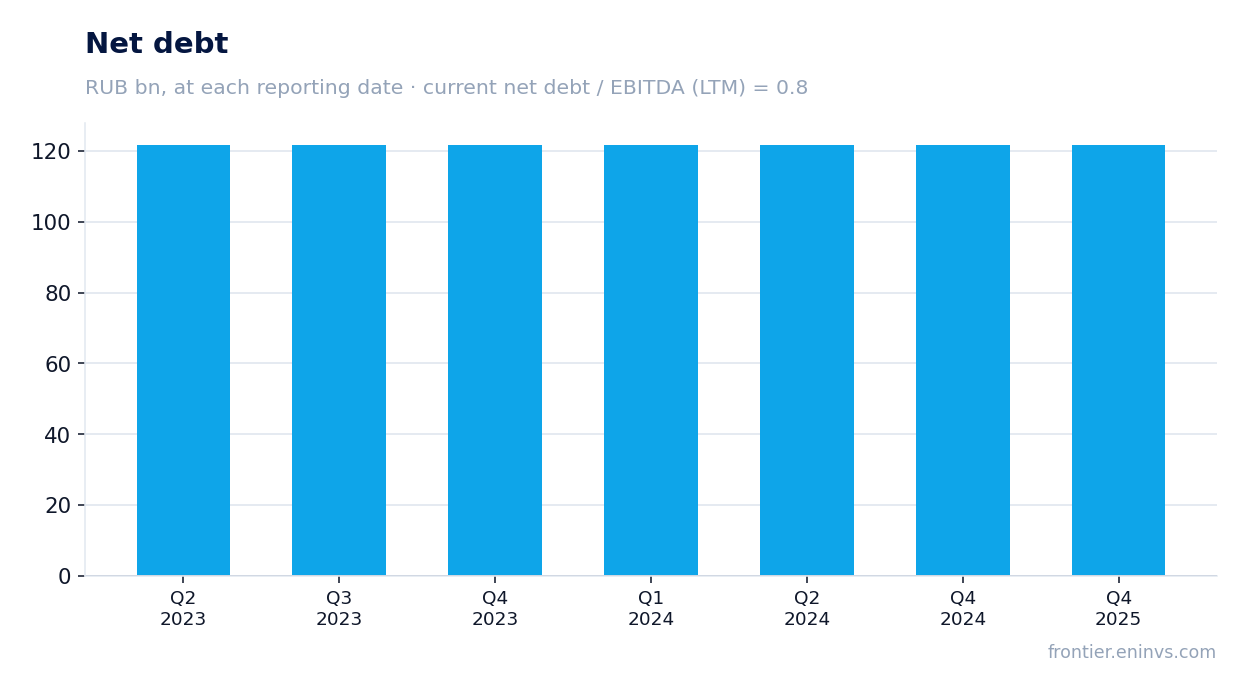
The net debt to LTM EBITDA ratio is 0.8, a moderate debt burden. Net debt at 31 December 2025 was RUB 121.8 bn, exactly the same as at 31 December 2024. This gives the company room to manoeuvre but does not solve the problem of falling profit.
Valuation on the latest reported figures
| Metric | Value |
|---|---|
| Market cap | 207 bn ₽ |
| P/E (LTM) | 4.4 |
| EV/EBITDA (LTM) | 2.2 |
| P/B | 0.23 |
| Net debt / EBITDA (LTM) | 0.80 |
| ROE | 5.1% |
| Dividend yield (12m) | 5.5% |
| EV/EBITDA, 3-year average | 2.2 |
Dividend per share, ₽, and yield at the ex-date
| Year paid | Dividend | Yield |
|---|---|---|
| 2020 | 107.81 | 5.8% |
| 2022 | 117.29 | 10.2% |
| 2023 | 199.89 | 10.0% |
| 2024 | 249.69 | 8.1% |
| 2025 | 147.31 | 8.4% |
| 2026 | 69.29 | 6.7% |
Bottom line
The report's strengths remain a stable EBITDA margin of 15.2% and a moderate debt burden of 0.8. But profit halved because of RUB 40.2 bn of other expenses, free cash flow after dividends and interest is negative, and the 2026 dividend has already been cut to RUB 69.29 per share – half of last year's and half the fair yield. The EV/EBITDA of 2.2 matches its own three-year history, so the market gives neither a discount nor a premium. The question for a holder now is whether the other expenses are one-off: if so, the dividend could recover; if not, the current payout level becomes the new benchmark. Verdict – neutral.
Open the company's financial profile BANE →
See also: market overview · valuation map · stock screeners