DOM.RF: 1H2026 results, raised guidance and outlook
A review of DOM.RF based on its results for the six months of 2026. Sources: the summary consolidated IFRS statements and presentation, the press release of 30 July 2026, the monthly IFRS releases for January–June, the management conference call of 30 July 2026, and data from the Bank of Russia and the Moscow Exchange. Prepared by Enhanced Investments (t.me/eninv).
*The text separates four types of information: reported results, management guidance, the authors' estimates and scenario assumptions. Each section follows the pattern "conclusion – supporting figures – what it means for the investor".*
1. Bottom line: results are strong and the full-year guidance is achievable, but by our estimates profit growth may slow after 2026
The half-year report confirms high profitability and better operating efficiency. The raised 2026 guidance looks realistic: a significant part of second-half income is already contracted. Two factors need attention: the shrinking capital adequacy buffer above the target level and the quality of the project finance portfolio. Our view of the stock is moderately positive, with a target of RUB 2,900 per share over 12 months.
Facts for 6 months of 2026
- Net profit RUB 57.2bn, up 46% on 1H2025
- Return on equity (ROE) 23.8% versus 21.6% for full-year 2025
- Net interest income RUB 100.8bn under IFRS (+32.8%); excluding securitisation deals, as the company discloses it, RUB 89.1bn (+30%)
- Fee and commission and equivalent income RUB 23.7bn (+47%)
- Assets RUB 6,829bn, up 6.3% year to date; loan portfolio RUB 5,525bn (+3.9%)
- Equity RUB 481.2bn, already net of the 2025 dividend (RUB 44.4bn, record date 20 July 2026)
- Cost-to-income ratio 23.7% versus 28.3% a year earlier; cost of risk 0.7%
- The effective income tax rate rose from 18.9% to 21.4%: pre-tax profit grew 51%, net profit 46%
Management guidance for 2026, raised on 30 July 2026
- Net profit RUB 117bn, up 31.8% on 2025; the guidance was raised by 12.5% from the February one
- Assets RUB 7.6tn (+18.8%), equity RUB 541bn (+15.1%)
- ROE 23.4%, cost of risk 0.7%, cost-to-income ratio 27.0%
- Earnings per share RUB 650, book value per share RUB 3,007
What it means for the investor. The company reports IFRS results monthly, so delivery against the annual guidance can be checked every month rather than once a quarter. This noticeably reduces uncertainty compared with most issuers in the sector.
2. The 2026 guidance looks achievable: part of second-half income is already contracted
Meeting the guidance requires a moderate increase on the first half, and the main sources of second-half income are fixed by agreements with counterparties.
Supporting figures
- Authors' estimate. Guidance of RUB 117bn against RUB 57.2bn reported for the half-year implies RUB 59.8bn in the second half, an increase of 4.5% on the first. In 2025 the second half exceeded the first by 27%.
- Management view. The second half of the year is traditionally stronger than the first. The reasons are structural: most securitisation deals fall in the third and fourth quarters, while portfolio repayments are even through the year, and business activity in housing construction finance is higher in the second half. In 2023 and 2025 almost the entire annual increase in assets came in the third and fourth quarters.
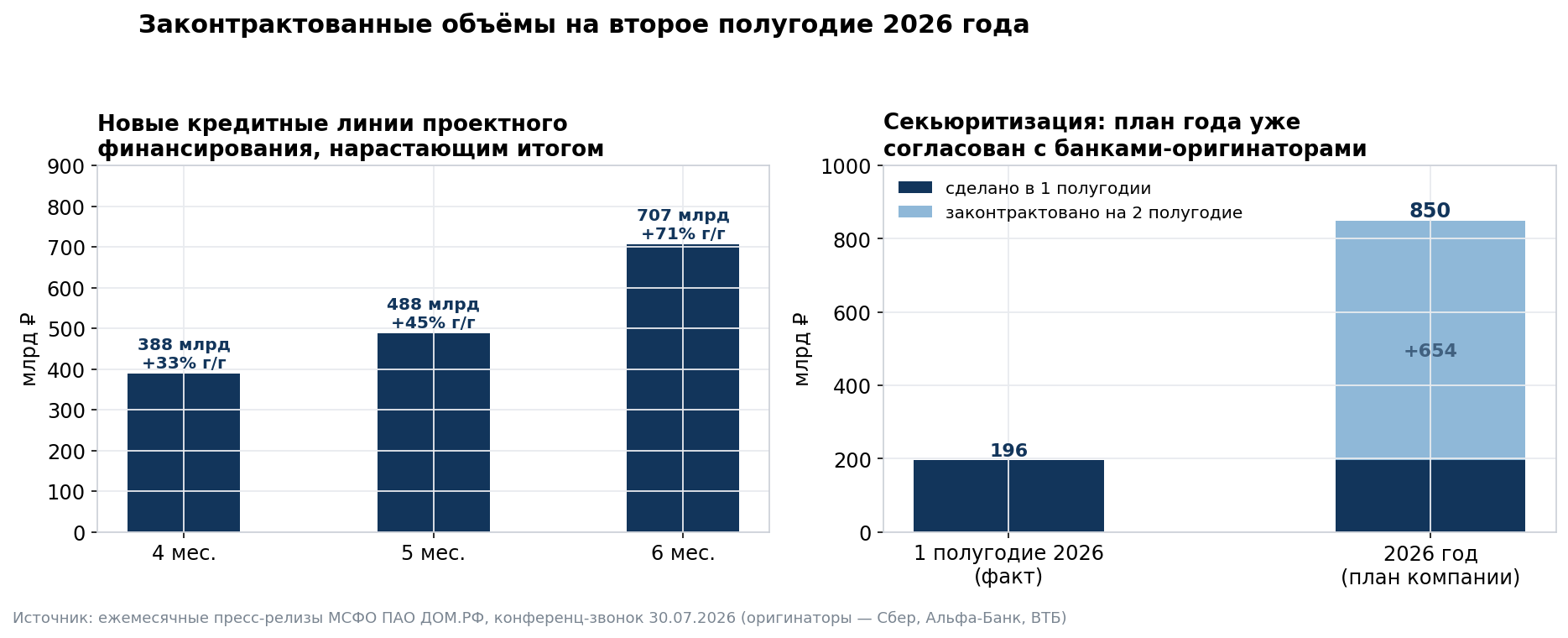
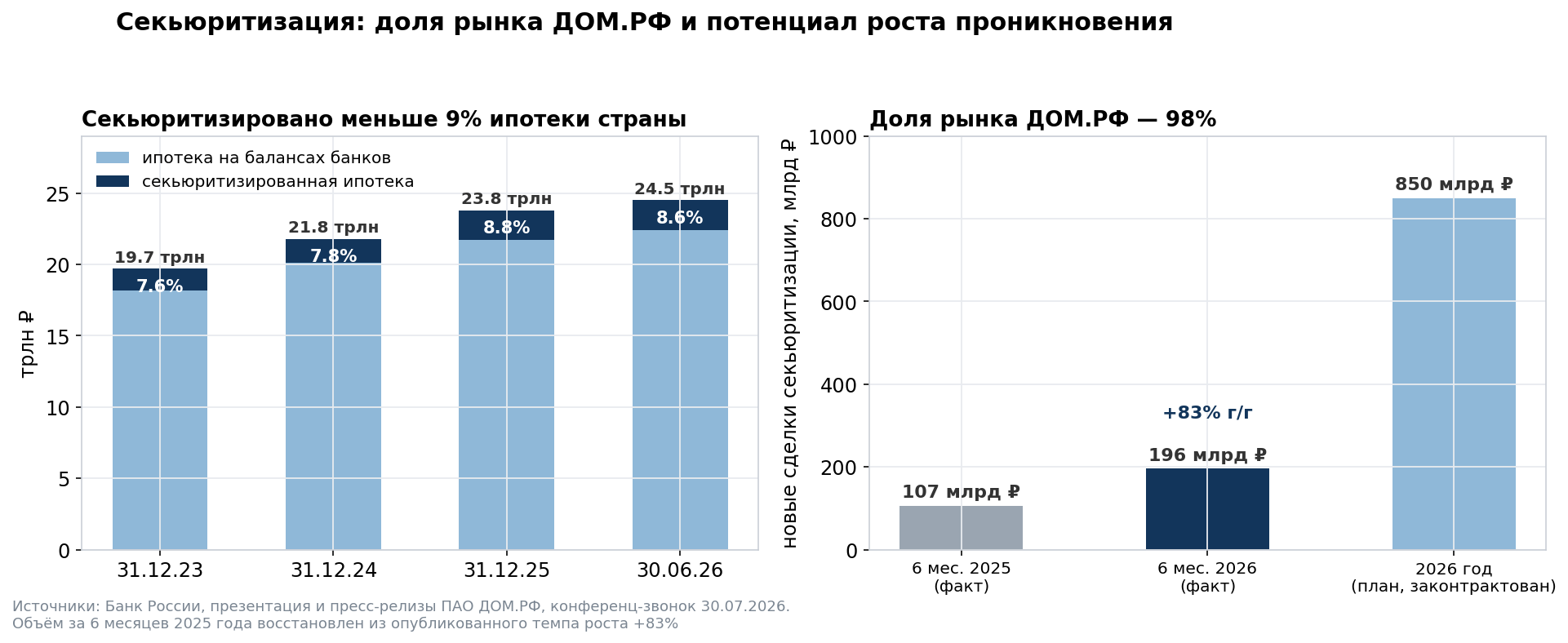
- Fact. In the half-year the company completed 6 securitisation deals worth RUB 196.2bn, up 83% year on year.
- Management view. The 2026 plan is RUB 850bn of securitisation deals. Deals are prepared about a year before issuance, and the third- and fourth-quarter volumes were agreed with originating banks back in December 2025. The main counterparties are Sber, Alfa-Bank and VTB.
- Fact. New project finance credit lines, cumulative: RUB 388bn over 4 months (+33% year on year), RUB 488bn over 5 months (+45%), RUB 707bn over the half-year (+71%). Drawdowns on the lines occur in subsequent quarters.
- Fact. Inflows to escrow accounts were RUB 243.9bn over 5 months (+20%). Mortgages account for 57% of sales, the rest being buyers' own funds.
What it means for the investor. The probability of meeting the guidance is high, and the risk is skewed towards beating rather than missing it: the required increase on the first half is well below the actual 2025 increase, and the seasonally stronger second period is backed by volumes that have already been agreed.
3. Sources of profit growth: project finance, securitisation and lower funding costs
Profit is not generated by bank lending alone. About a fifth of the result comes from lines of business that need little capital and do not depend on the level of the key rate.
Profit structure for the half-year (fact)
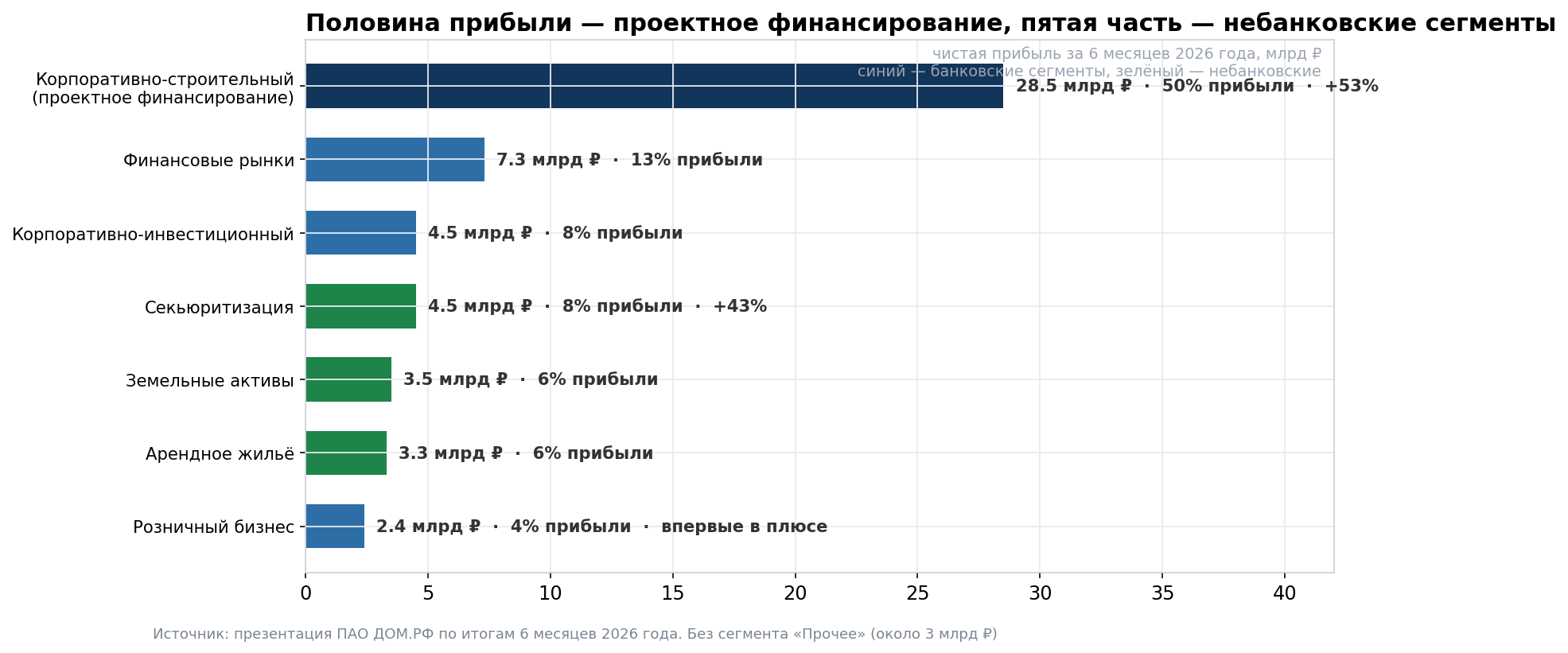
- Corporate construction business – RUB 28.5bn, 50% of group profit, up 53%. Portfolio RUB 2.2tn. Market share 30% by open project finance limits and 16% by loans outstanding, against a strategic target of 20%.
- Financial markets – RUB 7.3bn, 13%. Own securities portfolio, issue arrangement, brokerage.
- Corporate and investment business – RUB 4.5bn, 8%. Portfolio RUB 557bn. According to management, the main result is expected in 2027–2028.
- Securitisation – RUB 4.5bn, 8%, up 43%.
- Land assets – RUB 3.5bn, 6%. An agency function on behalf of the state: 415 ha of land plots and 167 thousand sq m of real estate were sold in the half-year.
- Rental housing – RUB 3.3bn, 6%. A portfolio of 23 thousand apartments, 99% occupancy.
- Retail business – RUB 2.4bn, 4%, against RUB 0.2bn a year earlier. The segment reached sustainable positive profitability for the first time, driven by economies of scale with 748.6 thousand active clients (+35%).
Securitisation: a stable fee base
How it works: an originating bank transfers a pool of mortgage loans, and DOM.RF issues single-tranche mortgage-backed securities against it with its own guarantee, receiving a guarantee fee, similar to an insurance premium.
- Fact. Market share 98%. The deal portfolio is RUB 2.0tn, and mortgage-backed bonds outstanding total RUB 2.1tn at nominal value.
- Management view. The position is held thanks to a regulatory regime that is unavailable to the alternative two-tranche structure: preferential calculation of capital adequacy and the short-term liquidity ratio for the bank holding the securities, and the ability to repo with the Bank of Russia, the central counterparty and the Federal Treasury.
- Management view. Since 2025 the guarantee price has been raised by 0.2–0.3 percentage points on average. As deals concluded on the old terms are repaid, the segment margin will rise; the expected cumulative effect is about 30%.
- Fact. The country's mortgage portfolio is RUB 24.5tn, of which RUB 2.1tn is securitised, or 8.6%. The share is growing slowly: 7.6% at end-2023, 8.8% at end-2025.
- Fact. The credit quality of the pool is improving: the default rate fell to 0.63% a year in February 2026 against about 0.9% in 2H2025.
- Authors' estimate. Segment income of RUB 11.7bn for the half-year on an average portfolio of about RUB 1.95tn is roughly 1.2% a year of the portfolio. On that base, raising the guarantee price by 0.2–0.3 pp arithmetically gives the stated margin increase. Repayments are about 18% of the portfolio a year, so most of the repricing effect will fall in 2027–2028.
- Authors' assumption. If the RUB 850bn plan is met, the portfolio will reach about RUB 2.4tn by the end of 2026. Segment income could grow from about RUB 23bn in 2026 to RUB 34–37bn by 2028, and its share of group profit from 8% to 12–14%.
Funding: the margin is growing regardless of the key rate
- Management view. An immediate 4 percentage point cut in the key rate adds RUB 4–5bn a year to the group, or about 3% of profit. Sensitivity to the rate is low.
- Fact. The spread of the all-in cost of liabilities to the key rate narrowed from 3.5% in 2024 to 1.0%. Retail deposits grew 20% year to date against about 1% for the sector; their share of funding is 18.3%, up 1.4 pp year to date.
- Fact. Asset yield fell from 16.2% to 14.7% and funding cost from 13.0% to 11.3%; the spread widened from 3.2 to 3.4 pp and the net interest margin from 4.0% to 4.3%.
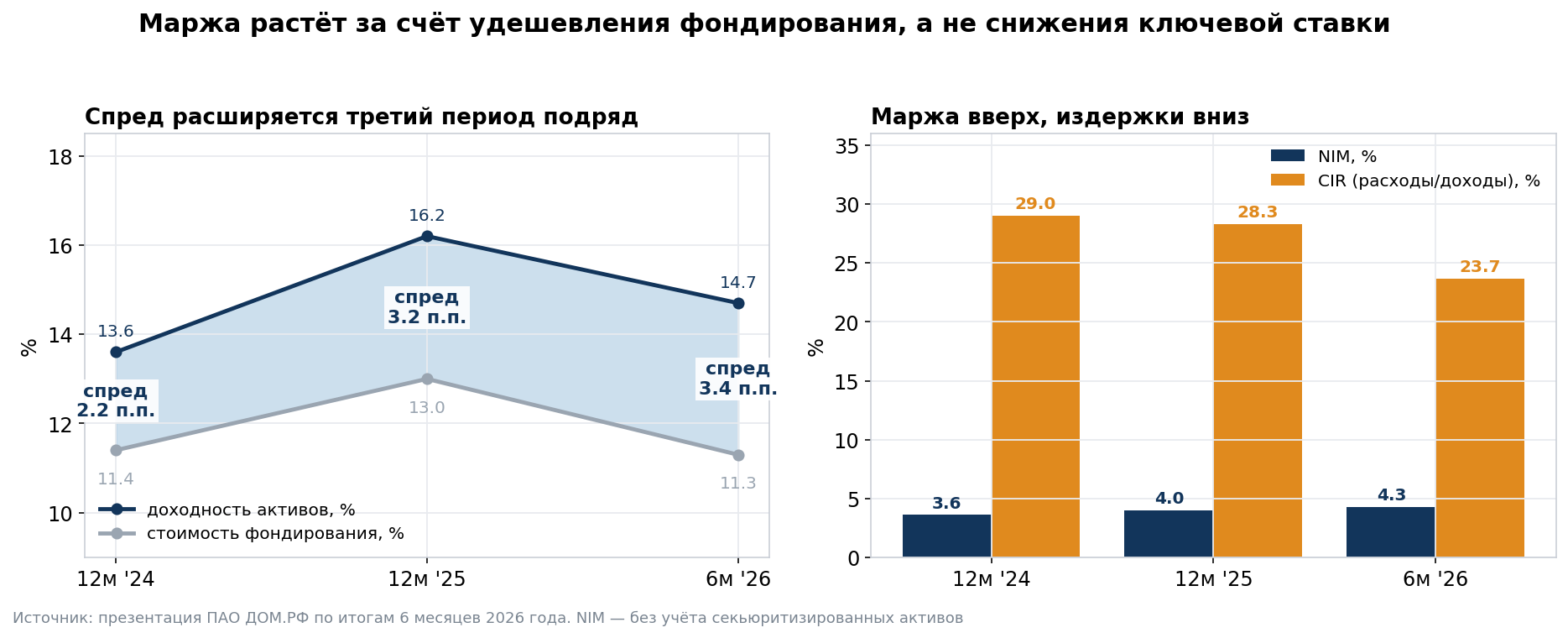
What it means for the investor. The result depends less on the monetary policy cycle than that of banks whose profit recovers as rates fall. A pause in easing does not undermine the base case.
4. After 2026, by our estimates, profit growth may slow to about 14% a year
The acceleration of profit in 2024–2026 was driven largely by higher financial leverage. The capital adequacy buffer above the target has shrunk, so the scope to accelerate growth through leverage alone is more limited. The company still has tools to support further growth, including building up Tier 2 capital.
Supporting figures
- Management view. The N1 capital adequacy ratio historically stood at 20–25%, fell to 14% by end-2025 and is 13.0% at 30 June 2026 against a minimum of 11.5%. The target level is set at 12.5–13% and, in management's view, has been reached.
- Fact. Tier 2 capital is 3.7% of regulatory capital (RUB 489bn at 30 June 2026) against about 9% on average for the banking sector. In the second quarter the company placed RUB 18bn of subordinated bonds and will continue to build up this share.
- Fact. Risk-weighted asset density is 55% against 75% for the sector, a result of the high share of mortgages and escrow-backed project finance. Over a year and a half it has risen from 50%, so the asset structure is gradually becoming more capital-intensive. The advantage in risk-weighted asset density allows DOM.RF to create more assets per unit of regulatory capital.
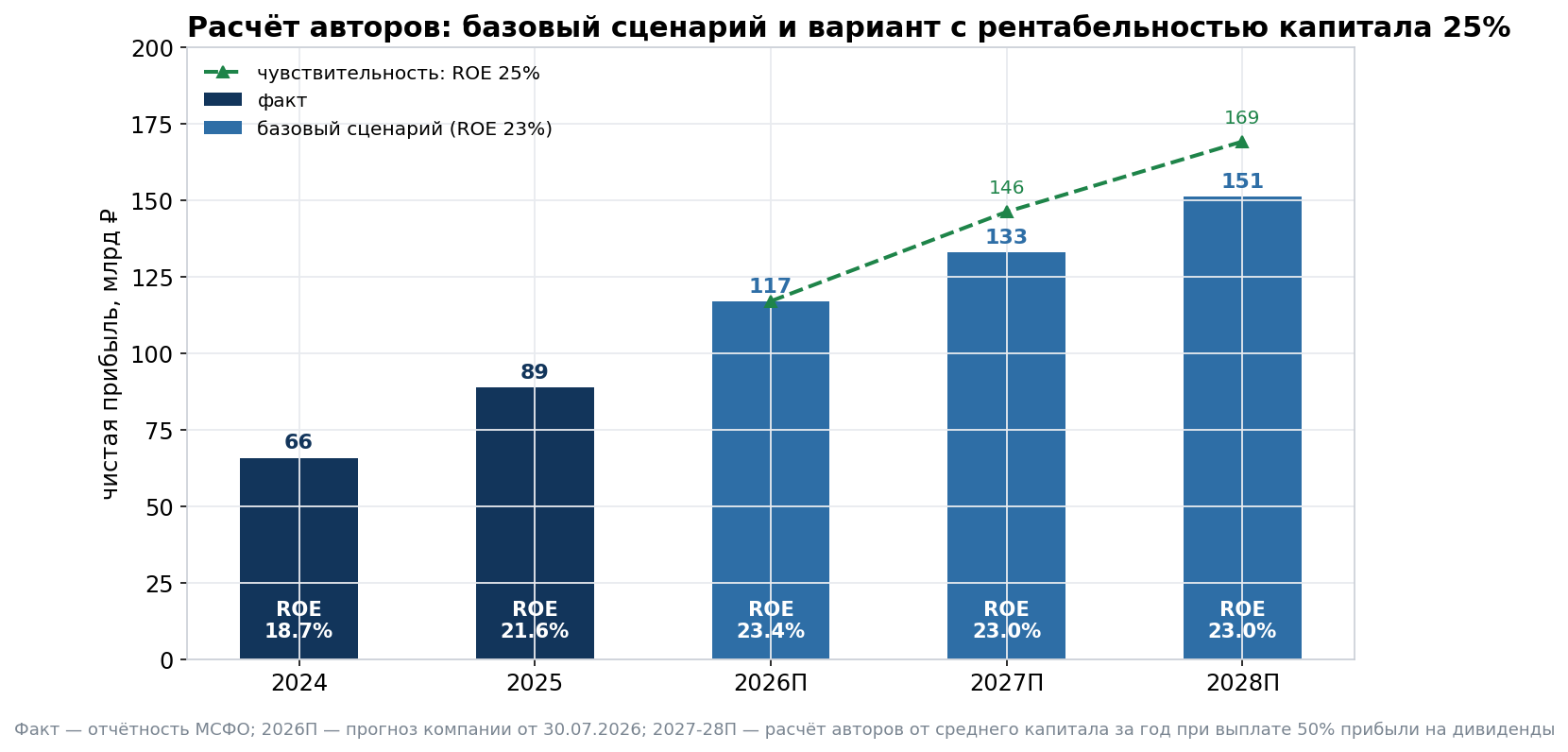
- Authors' estimate. With a return on equity of 23% and a 50% dividend payout, capital grows by about 11.5% a year from retained earnings. Because profit is calculated on average capital for the year, this translates into profit growth of about 14% in 2027–2028. Tier 2 capital does not directly affect this rate: it widens the ceiling on balance sheet size rather than the speed of capital accumulation.
- Authors' estimate. Raising the Tier 2 share from 3.7% to 9% with Tier 1 capital unchanged (RUB 471bn) adds about RUB 28bn of regulatory capital. At a 13% ratio and 55% asset density, this raises the ceiling on balance sheet size by about RUB 400bn once, or about 6% of current assets.
Scenarios for 2027–2028 (authors' assumptions)
Calculation method, the same for all scenarios. Profit for the year = the assumed ROE multiplied by average capital for the year. Capital at the start of 2027 is RUB 541bn per the company's guidance; during the year the 2026 dividend is deducted (50% of RUB 117bn, i.e. RUB 58.5bn) and the current year's profit is added. Average capital is the mean of the opening and closing values. No other assumptions (share issues, changes in dividend policy, one-off items) are made.
- Base case, ROE 23% – net profit of RUB 133bn in 2027 and RUB 151bn in 2028; earnings per share RUB 739 and 841; book value per share RUB 3,422 and 3,893.
- ROE 25% – with further cheaper liabilities, growth in the bank's fee margin from the current 0.5%, and the corporate and investment block reaching design capacity: RUB 146bn and 169bn.
The base case remains the scenario with ROE of 23%.
What it means for the investor. The 2026 growth rates should not be carried over to later periods. The right frame is a company with double-digit, but not thirty-percent, profit growth and a high dividend yield.
5. Main risks: project finance portfolio quality and the terms of subsidised mortgages
A cost of risk of 0.7% and the confirmed annual target look calm, but the trend in problem loans and in provision coverage is less favourable.
Supporting figures
- Fact. The share of problem loans (Stage 3 and purchased or originated credit-impaired) rose from 1.4% at end-2024 to 2.1% at end-2025 and 2.5% at 30 June 2026.
- Fact. Provision coverage of problem loans fell from 123.3% to 93.1%, and including escrow balances from 135.9% to 106.4%.
- Management view. The company gives no precise Stage 3 forecast but expects growth; provisioning plans for the second half are substantially above last year's. All problem debt is secured by escrow and pledges of apartments and properties, and pledged real estate is not counted in the coverage calculation.
- Fact (Bank of Russia). Projects with a loan life coverage ratio (LLCR) below 1.1 account for 6.5% of all project finance debt; escrow coverage of debt across the market is about 70%; the weighted average project finance rate has dropped below 10%.
- Fact. Mortgage market: RUB 2.2tn was issued in the half-year (+48% year on year), and June was the year's peak at RUB 488bn. The surge is linked to expectations of changes to the Family Mortgage terms: in July issuance under the programme was RUB 29.3bn, 25% below the May weekly average. Differentiation of rates by number of children is being discussed from 1 October.
- Fact. The state holds 89.9% of the capital and the free float is about 10%. Actual trading volumes are nonetheless growing: average daily turnover rose from RUB 317mn in December 2025 to RUB 748–767mn in June–July 2026. A secondary placement depends on the decisions and needs of the principal shareholder, market conditions and other factors.
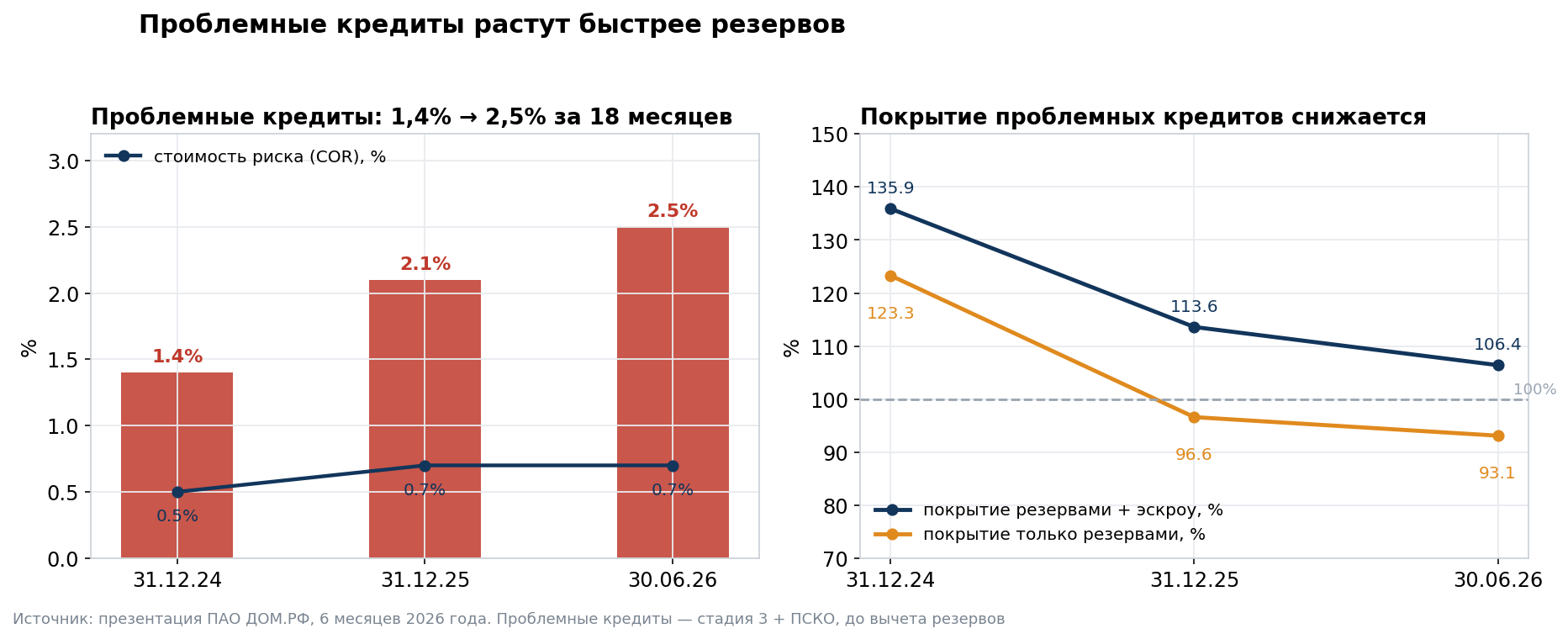
What it means for the investor. The collateralisation of the problem portfolio lowers the probability of large losses, but if the current trend continues, the cost of risk in 2027 may exceed 0.7%.
Mitigating factor: new housing construction project launches in the first half rose to 19.4mn sq m from 17.3mn a year earlier, and about half of escrow inflows come from buyers' own funds without a mortgage, so the dependence of project finance on subsidised programmes is lower than is commonly assumed.
6. Valuation: target of RUB 2,900 over 12 months
At a price of RUB 2,247 and 179.9mn shares, market capitalisation is about RUB 404.2bn.
Current multiples
- Fact. Book value per share is RUB 2,675 (equity of RUB 481.2bn at 30 June 2026, after the dividend payment), giving P/B of 0.84x.
- Authors' estimate. Trailing 12-month profit of RUB 106.9bn gives P/E of 3.8x.
- Company forecast for 2026. P/E 3.5x, P/B 0.75x, and a dividend under the current 50% payout policy of about RUB 325 per share, 14.5% of the current price.
- Authors' estimate for 2027. P/E 3.0x, P/B 0.66x, dividend of about RUB 370, 16.5% of the current price.
How the target is derived (authors' estimate)
- From required return on equity. Fair P/B = (ROE − growth) / (required return − growth). With ROE of 23%, sustainable growth of 14% and a required return of 24% a year, this gives 0.90x. A required return of 24% implies a premium of about 8 pp to the long-dated OFZ yield, which was about 15.7–16.1% on 30 July 2026 (Moscow Exchange zero-coupon yield curve: 15.7% at ten years, 15.8% at fifteen, 15.9% at twenty). Applied to the forecast mid-2027 book value (RUB 3,215), this gives about RUB 2,900.
- From earnings. Holding the current multiple of 3.8x on 2027 earnings per share of RUB 739 gives RUB 2,810. In other words, even without a re-rating, earnings growth lifts the price.
- From dividends. A required dividend yield of 13.0–13.5%, below the OFZ yield because the payout grows with profit, gives RUB 2,500 on the 2026 payout and RUB 2,740 on the 2027 payout.
On a comparable 12-month horizon the approaches give a range of about RUB 2,740–2,900 per share. The separate valuation from the 2026 dividend, RUB 2,500, is excluded from this range: the payment will fall in mid-2027, so on a 12-month horizon it is the least representative. The target is RUB 2,900 over 12 months, about 29% above the current price of RUB 2,247. Including the 2026 dividend of about RUB 325, the total return is about 44%. Following the raised management guidance, the 12-month target has been raised from RUB 2,800 to RUB 2,900.
Key valuation parameter. The upside is determined not by the current cheapness of the multiples but by the company's ability to keep return on equity above 22–23%.
Overall investment conclusion
Our view is moderately positive. Strengths: high profitability, an income structure that is resilient to the rate, a significant share of fee-based lines and high predictability of the second half. Constraints: the shrinking capital buffer above target, the expected slowdown in profit growth after 2026, and the trend in problem debt in project finance. The target is RUB 2,900 over 12 months against the current RUB 2,247; the key parameter for revising it is the actual cost of risk in the second half of 2026 and in 2027.
What to watch next
- Monthly IFRS releases: delivery against the RUB 117bn guidance can be checked every month
- Actual securitisation volume against the RUB 850bn plan
- Cost of risk and the share of problem loans in the 9-month report
- Final terms of the Family Mortgage from 1 October
- Subordinated bond placements as an indicator of the company's plans to build up capital and support further asset growth
Issuers mentioned: DOMRF, SBER, VTBR. Extended company cards are on the portal frontier.eninvs.com.
Analysis and issuer reviews are in the Telegram channel "Enhanced Investments" @eninv.
See also: market overview · valuation map · stock screeners