Cherkizovo: profit doubled on 3.5% revenue growth, and the gain came from margin, not volume
On 26 August Cherkizovo reported second-quarter 2026 results: revenue of RUB 70.8 bn (+3.5% YoY), EBITDA of RUB 15.7 bn (+23.5%) and net profit of RUB 7.0 bn (+102.6%). With revenue almost flat, profit doubled on cost of sales and interest expense rather than on sales. The stock trades below its own history on the multiple and the dividend yield is double-digit, so the share looks rather attractive, but the growth rests on a margin that still has to be held.
Key takeaways
— Revenue added only 3.5%, and the profit growth did not come from sales
— EBITDA margin rose to 22.2% on lower cost of sales
— Net profit also doubled because interest expense fell
— Debt at 1.9x LTM EBITDA is a moderate level alongside RUB 9.3 bn of half-year interest expense
— Quarterly operating cash flow of RUB 9.9 bn covers RUB 4.6 bn of capex with room to spare
— The 10.0% dividend yield is well above the 7.0% we consider fair for the name
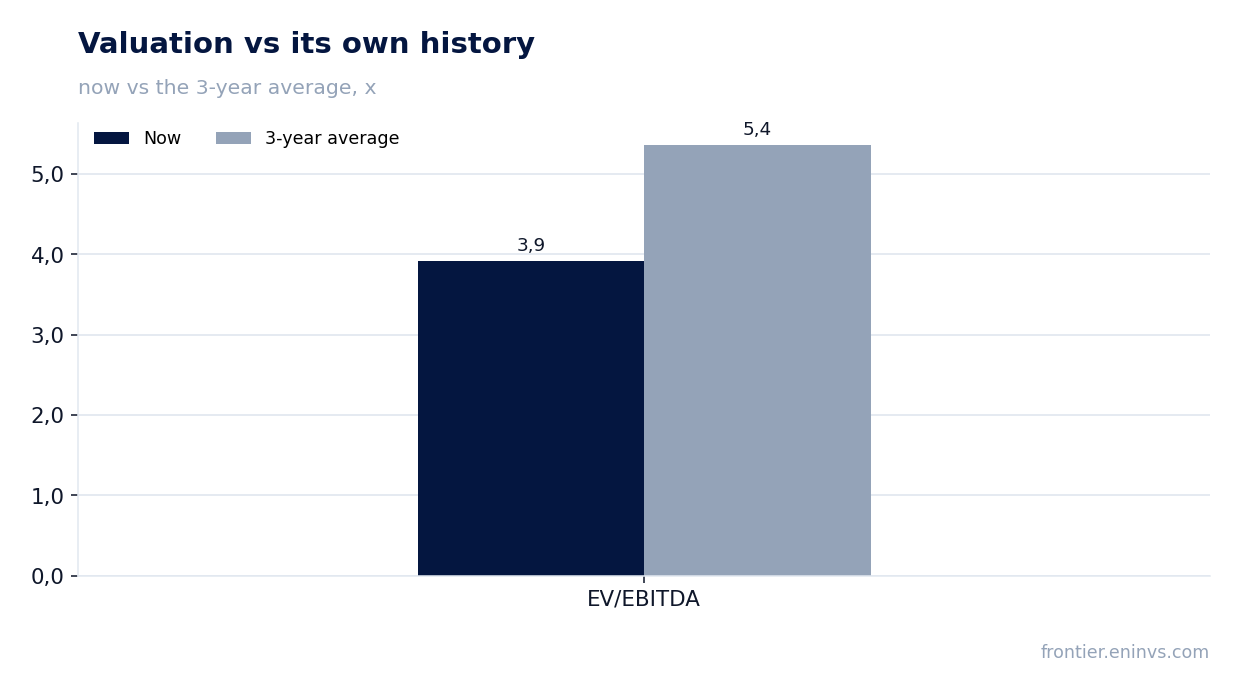
— EV/EBITDA of 3.9 against its own three-year average of 5.4 leaves the stock cheaper than its history
Attractiveness
Key figures, RUB bn
| Metric | Q2 2025 | Q2 2026 | Change |
|---|---|---|---|
| Revenue | 68.4 | 70.8 | +3.5% |
| EBITDA | 12.7 | 15.7 | +23.5% |
| Operating profit | 8.72 | 11.5 | +31.8% |
| Net profit | 3.48 | 7.04 | +102.6% |
| Operating cash flow | 3.86 | 9.91 | +156.4% |
| Capex | 5.35 | 4.61 | -13.9% |
| EBITDA margin | 18.6% | 22.2% | +3.6 pp |
| Net margin | 5.1% | 9.9% | +4.8 pp |
Revenue added only 3.5%, and the profit growth did not come from sales
Second-quarter 2026 revenue came to RUB 70.8 bn, 3.5% more than a year earlier. For a vertically integrated company that pace is more modest than in prior years, and it caps operating leverage: with sales volume almost unchanged, profit can grow only through price and costs.
First-half revenue reached RUB 141.6 bn against RUB 136.9 bn a year earlier. By segment, chicken remains the largest at RUB 89.3 bn of external sales in the half, followed by meat processing at RUB 31.5 bn and pork at RUB 10.8 bn. Crop farming contributed only RUB 1.0 bn of external revenue, since most of its sales fall in the second half.
The weak top line means all of the profit gain in this report is a margin and financial-expense story. For a holder that distinction matters: if poultry and pork prices do not rise, the next quarter will rest on the same cost savings rather than on new volume.
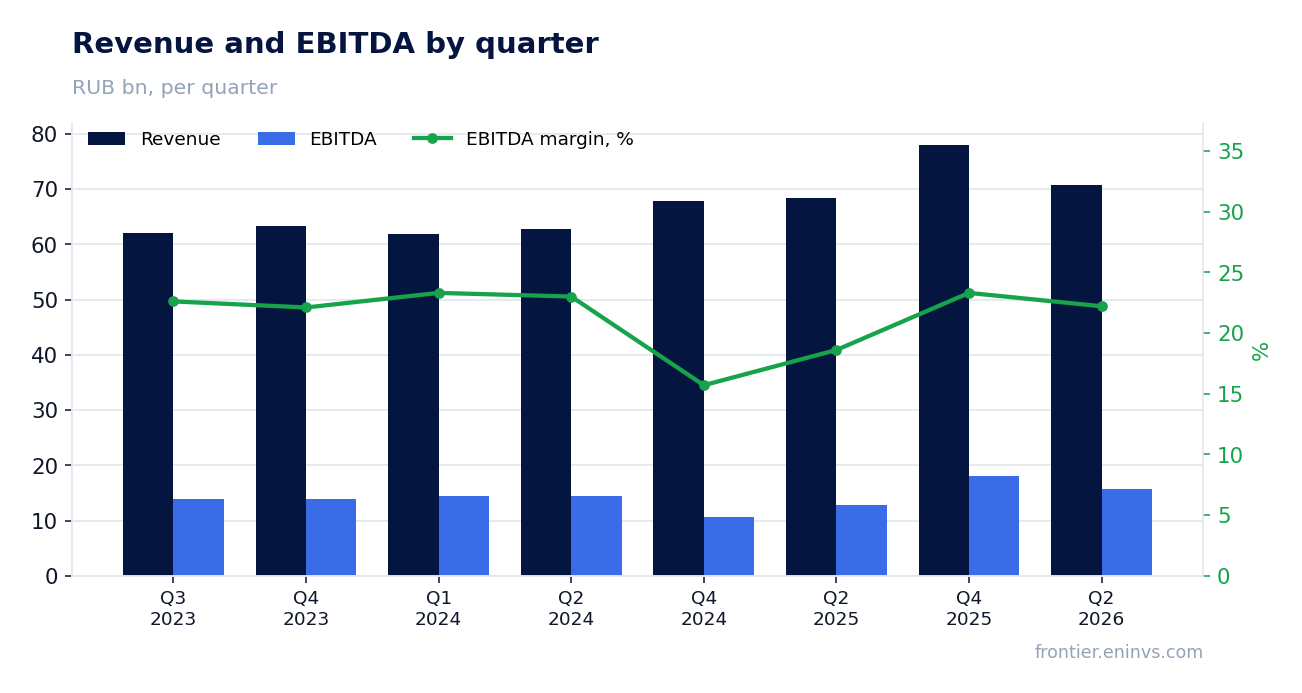
EBITDA margin rose to 22.2% on lower cost of sales
Second-quarter EBITDA came to RUB 15.7 bn, 23.5% more than a year earlier, and the margin rose to 22.2% from 18.6%. With revenue up only 3.5%, that margin jump delivered almost all of the EBITDA gain.
The source is visible in the income statement: first-half cost of sales fell to RUB 100.9 bn from RUB 102.2 bn a year earlier, declining in absolute terms while revenue grew. First-half gross profit rose to RUB 43.1 bn from RUB 37.7 bn. Selling, general and administrative costs were almost unchanged at RUB 20.5 bn against RUB 20.3 bn.
Part of gross profit is an accounting estimate: the net change in fair value of biological assets added RUB 4.1 bn in the half, while the net revaluation of unsold crops subtracted RUB 1.7 bn. These are revaluations, not cash, and they make the quarterly margin less durable than it looks.
First-half operating profit reached RUB 23.0 bn against RUB 17.4 bn a year earlier. Whether that margin holds is the main question for the next report: cost of sales is already low, and repeating such a decline quarter after quarter will be harder.
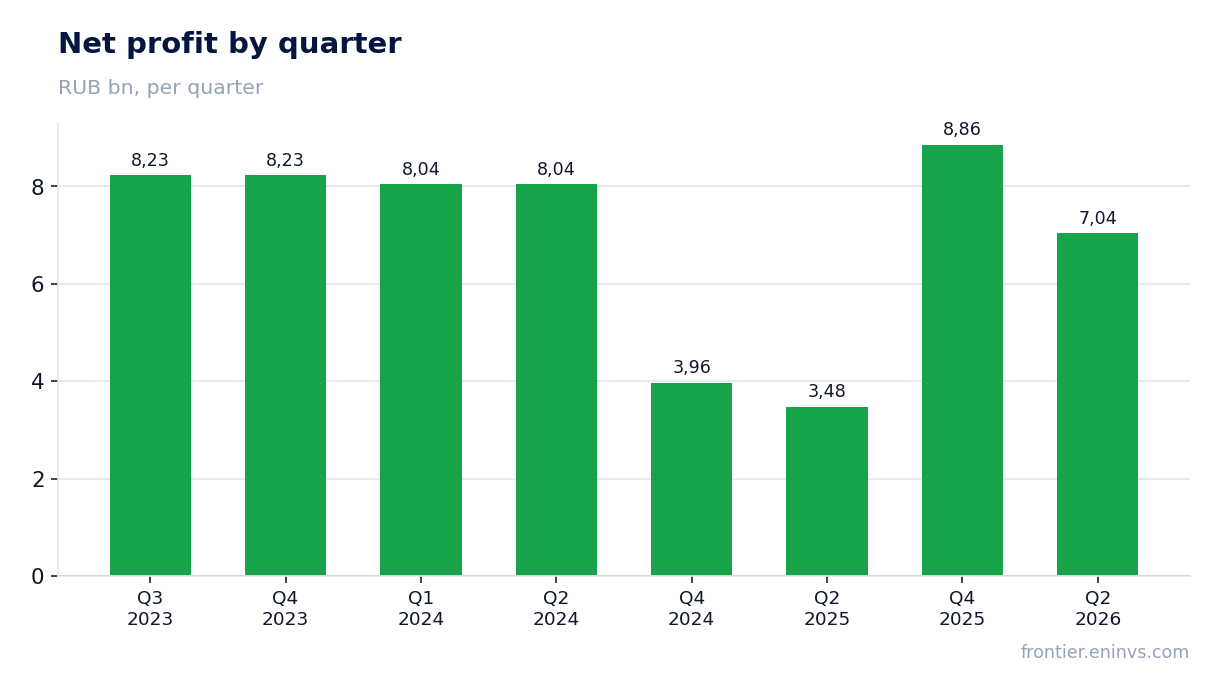
Net profit also doubled because interest expense fell
Second-quarter net profit came to RUB 7.0 bn against RUB 3.5 bn a year earlier, up 102.6%. The net margin rose to 9.9% from 5.1%. Half of that doubling is operational, the other half is financial expense.
In the first half, interest expense net of government subsidies fell to RUB 9.3 bn from RUB 11.2 bn a year earlier, while interest income rose to RUB 1.1 bn from RUB 0.9 bn. First-half pre-tax profit reached RUB 14.8 bn against RUB 7.2 bn a year earlier.
Lower interest expense with the key rate at 14.0% reflects both cheaper debt and its structure: long-term loans and borrowings stood at RUB 77.5 bn on 30 June 2026 against RUB 85.0 bn at end-2025, short-term at RUB 71.7 bn against RUB 71.5 bn. That is not a one-off, but it is not endless either: further rate cuts will support profit, and a rise would weigh on it.
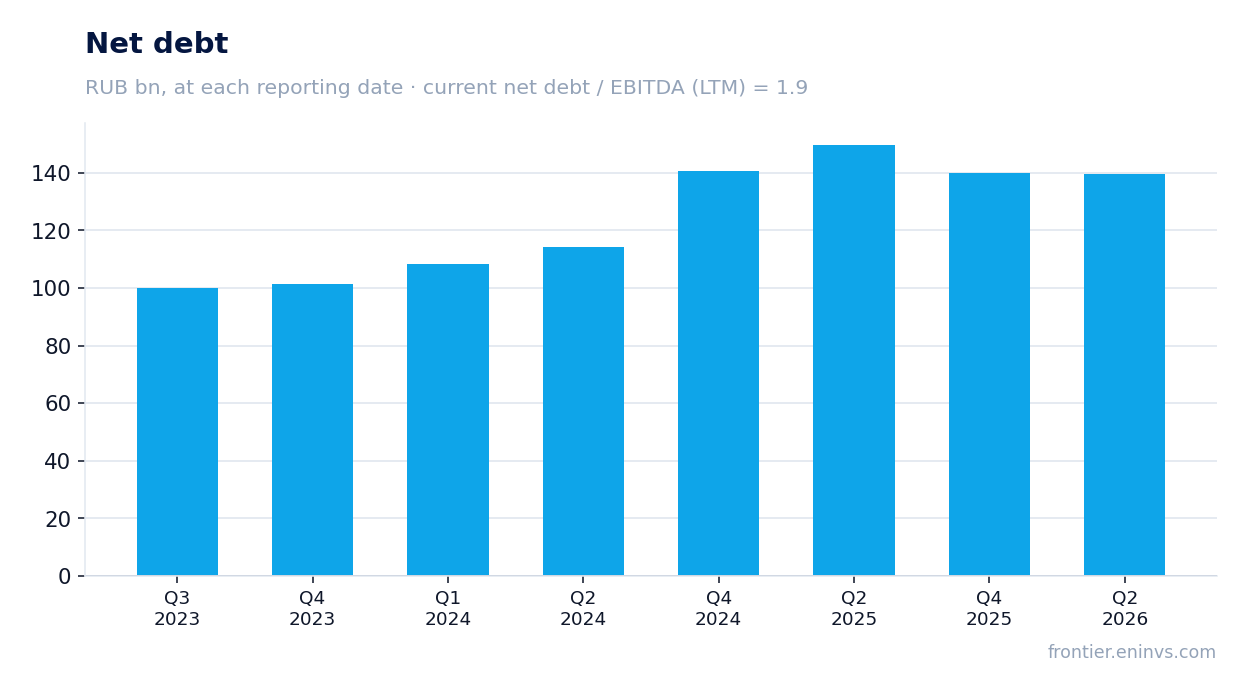
Debt at 1.9x LTM EBITDA is a moderate level alongside RUB 9.3 bn of half-year interest expense
Net debt on 30 June 2026 stood at RUB 139.5 bn, or 1.9x trailing-twelve-month EBITDA. That is a moderate level for an agribusiness and leaves room to pay shareholders without adding borrowings.
The half-year change in debt is small: from RUB 139.9 bn on 31 December 2025 to RUB 139.5 bn on 30 June 2026, a decrease of RUB 0.4 bn. Over twelve months debt fell from RUB 149.8 bn on 30 June 2025 to RUB 139.5 bn on 30 June 2026, a decrease of RUB 10.2 bn.
Servicing the debt is expensive: RUB 9.3 bn of half-year interest expense is comparable to 40% of operating profit for the same period. With the key rate at 14.0%, refinancing remains sensitive, which is why the RUB 7.5 bn reduction in long-term debt in the half matters as much as the profit itself.
Quarterly operating cash flow of RUB 9.9 bn covers RUB 4.6 bn of capex with room to spare
Second-quarter operating cash flow came to RUB 9.9 bn, capital expenditure to RUB 4.6 bn. The RUB 5.3 bn difference is free cash flow, which funds dividends and debt reduction.
The first half is even stronger: net cash from operating activities reached RUB 19.8 bn against RUB 7.7 bn a year earlier. Purchases of property, plant and equipment in the half were RUB 8.3 bn and of intangibles RUB 1.0 bn, so investment remains moderate relative to the flow.
The gap between profit and cash flow is explained by RUB 8.5 bn of half-year depreciation and by working-capital movements that worked in the company's favour this period. Free cash flow of this size is the main argument for the dividend: it covers the payout without new debt.
The 10.0% dividend yield is well above the 7.0% we consider fair for the name
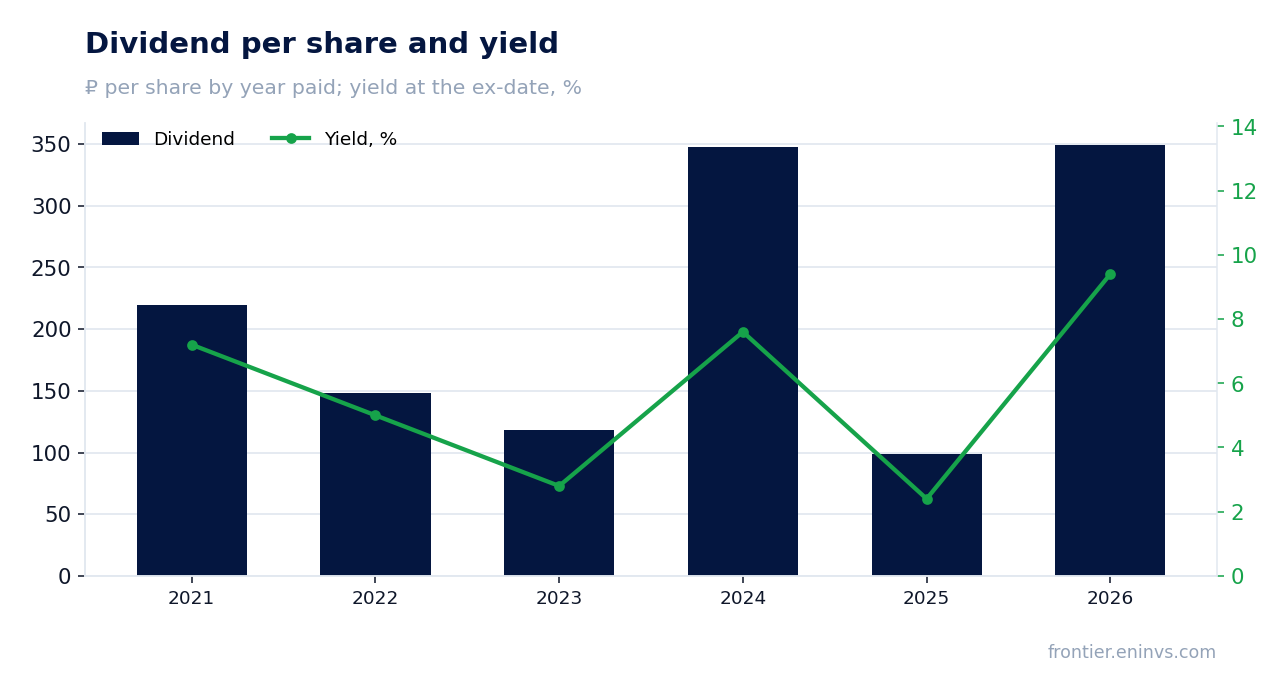
Over the last twelve months Cherkizovo paid RUB 349.56 per share, a 10.0% yield on the current price. Calendar-year payments are uneven: RUB 347.49 per share in 2024, RUB 98.92 in 2025 and RUB 349.56 in 2026. That amplitude is a feature of the policy, not a one-off failure.
Our estimate of the annual dividend is the same RUB 349.56 per share, or 10.0% forward on the current price. It rests on the dividend-potential model with a payout ratio of 0.38 of profit and a profit base of RUB 30.0 bn. Free cash flow does not constrain the payout. The estimate is ours, not the company's forecast, and the board decides.
A 10.0% yield is well above the 7.0% we consider fair for the name and above the 14.0% key rate adjusted for risk: the spread is positive but not huge. The yield history shows the market does not always pay for the dividend: the yield at the ex-date was 2.8% in 2023 and 2.4% in 2025.
The payout would shrink if profit fell below the RUB 30.0 bn base or the board cut the payout ratio. Given that half of the profit gain came from lower interest expense rather than operations, the risk of a downward revision to the base is real, and the dividend yield is a consequence of current profit, not a guarantee.
EV/EBITDA of 3.9 against its own three-year average of 5.4 leaves the stock cheaper than its history
On the trailing-twelve-month EV/EBITDA multiple the stock trades at 3.9 against its own three-year average of 5.4, 27% below its history. P/E LTM is 4.0 and ROE 18.1%. That is a cheap valuation for a company with such a return on equity.
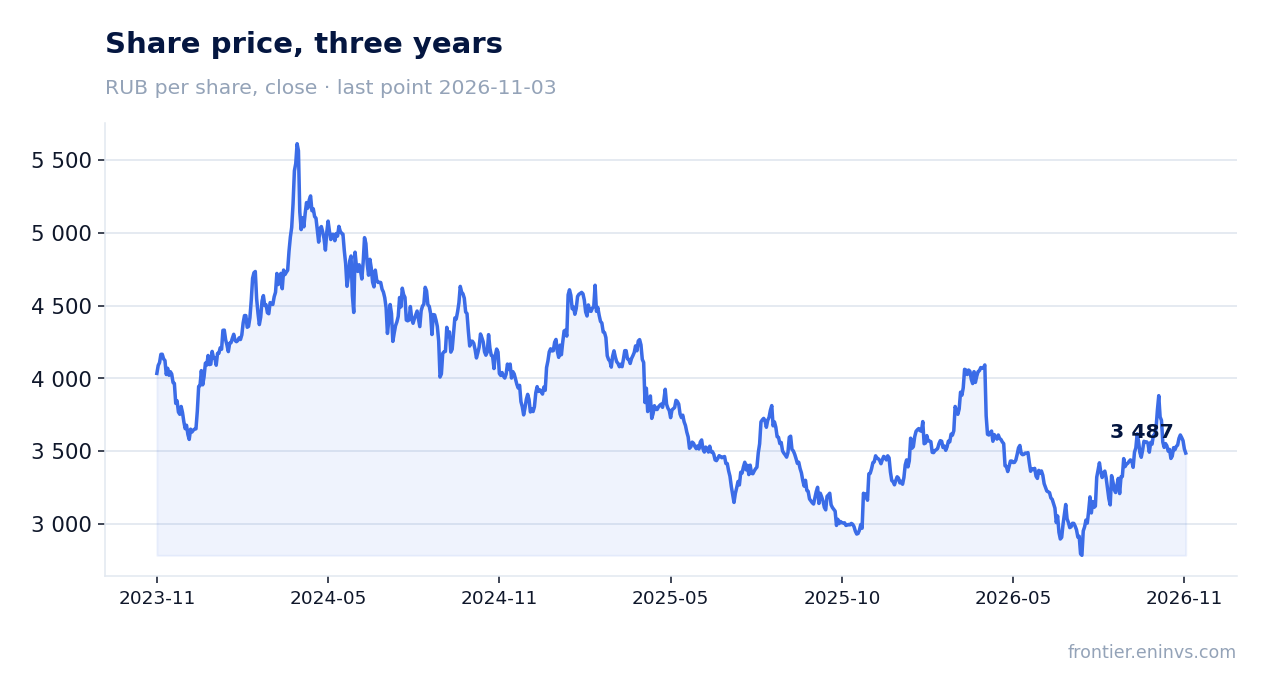
The market's reaction to the report was restrained: the share fell 3.1% on the publication day but has gained 5.3% from the report date to 3 November 2026. The price before publication was RUB 3,313.0. That pattern suggests investors expected more from revenue but appreciated the profit and the dividend.
On the portal's model, which reprices EBITDA at current commodity prices against the target EV/EBITDA, the upside of the share to fair value is -1%. The market is therefore already close to our estimate, and further gains depend on whether the margin holds and the dividend is maintained.
Valuation on the latest reported figures
| Metric | Value |
|---|---|
| Market cap | 147 bn ₽ |
| P/E (LTM) | 4.0 |
| EV/EBITDA (LTM) | 3.9 |
| P/B | 0.98 |
| Net debt / EBITDA (LTM) | 1.90 |
| Operating cash flow (LTM) | 43.9 bn |
| ROE | 18.1% |
| Dividend yield (12m) | 10.0% |
| EV/EBITDA, 3-year average | 5.4 |
Dividend per share, ₽, and yield at the ex-date
| Year paid | Dividend | Yield |
|---|---|---|
| 2021 | 219.27 | 7.2% |
| 2022 | 148.05 | 5.0% |
| 2023 | 118.43 | 2.8% |
| 2024 | 347.49 | 7.6% |
| 2025 | 98.92 | 2.4% |
| 2026 | 349.56 | 9.4% |
Bottom line
What was strong in the report sits below the top line: a 22.2% EBITDA margin, a 9.9% net margin, RUB 19.8 bn of half-year operating cash flow and debt reduced to RUB 139.5 bn at 1.9x EBITDA. The doubling of profit is neither a one-off nor purely operational: half came from lower interest expense, and part of gross profit is a revaluation of biological assets. For a holder the main question is now not valuation – EV/EBITDA of 3.9 against a 5.4 historical average – but whether the margin holds with revenue growing only 3.5%. A 10.0% dividend yield against the 7.0% we consider fair, plus free cash flow that covers the payout, makes the share rather attractive, but the verdict rests on the margin and the dividend, not on sales growth.
Open the company's financial profile GCHE →
See also: market overview · valuation map · stock screeners