Grids after 9 months: dividends on a single formula, Lenenergo prefs and Centre and Volga Region lead
Contents
We are updating our September grid review after the 9-month reports and recalculating the dividends of all Rosseti subsidiaries with one dividend policy formula: half of net income minus profit from transmission invested under the investment programme (IP). For 2025 the formula reproduces the actual payouts of Centre and Volga Region, Ural and Volga to within 2%. The main news is not in the reports but in the draft IP adjustments: at Centre and Volga Region, Ural and Volga they roughly double the deduction from the 2027 dividend base. We put the drafts into our base case, because past adjustments were approved. On that basis the 2026 dividend of the paying grids yields 10-14% on the price and the 2027 dividend 8-15%, against a 14% key rate. The best on the two-year total and reliability are Lenenergo prefs (27%, the IP does not affect the payout) and Rosseti Centre and Volga Region (27%, up to 36% if the deduction stays unchanged).
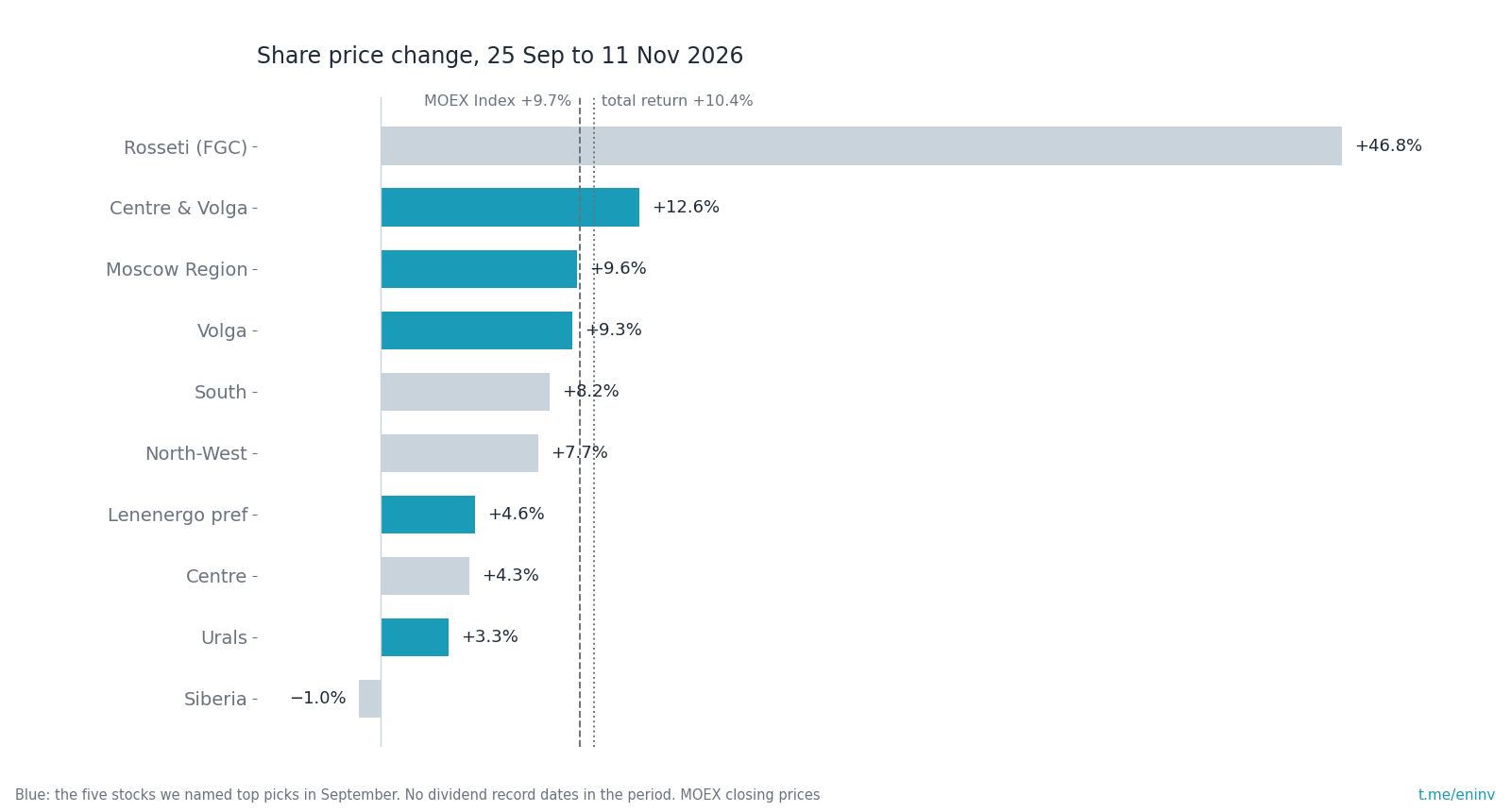
- Since 25 September the five September favourites rose by 7.9% on average, the MOEX Index by 9.7%. Centre and Volga Region did best, +12.6%, Ural worst, +3.3%.
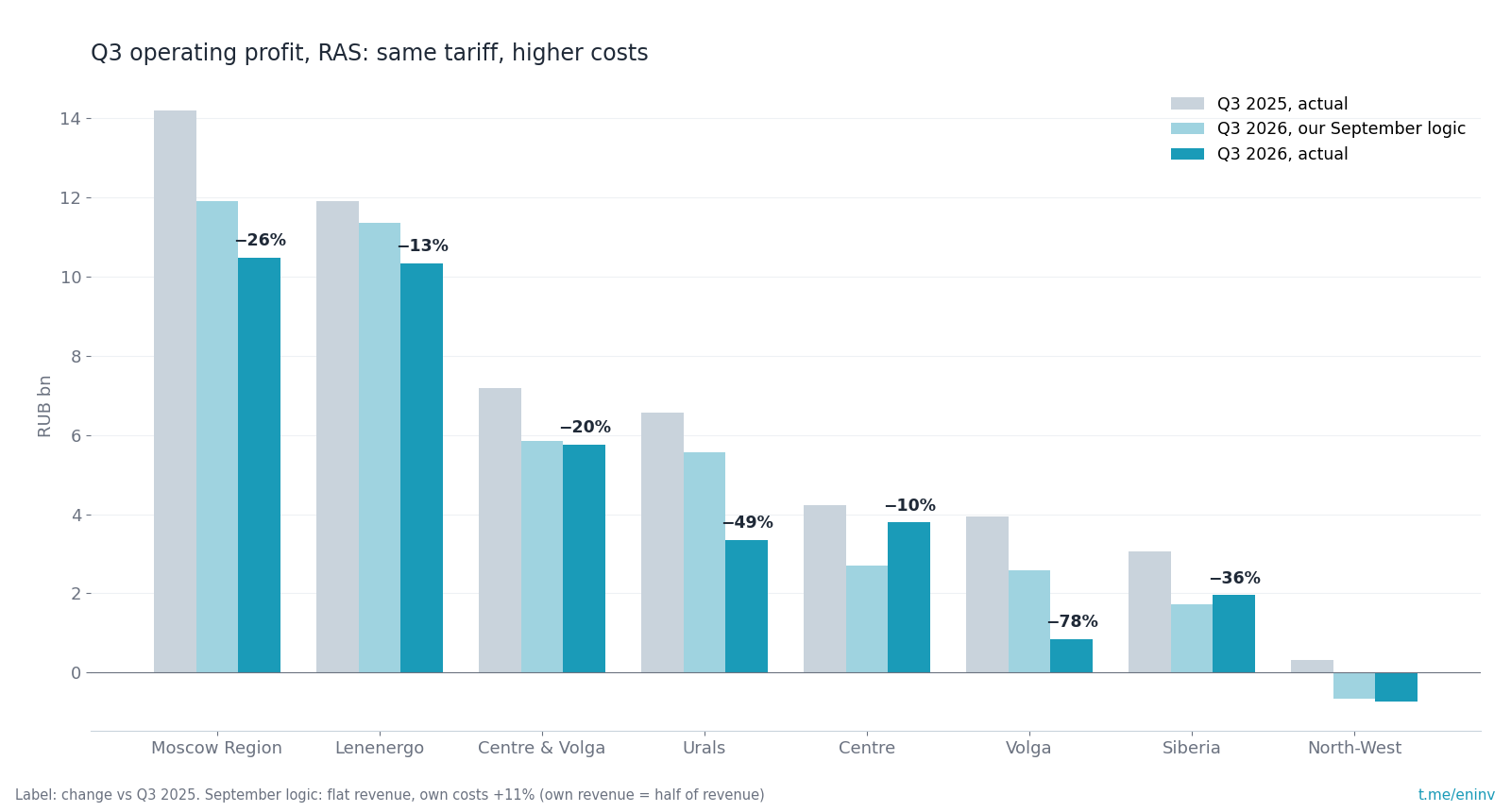
- Third-quarter RAS results were weak as expected: the tariff did not change until 1 October. Operating profit fell by 13% at Lenenergo, 20% at Centre and Volga Region, 26% at Moscow Region, 49% at Ural and 78% at Volga. At Ural, Volga and Moscow Region costs grew faster than we had assumed.
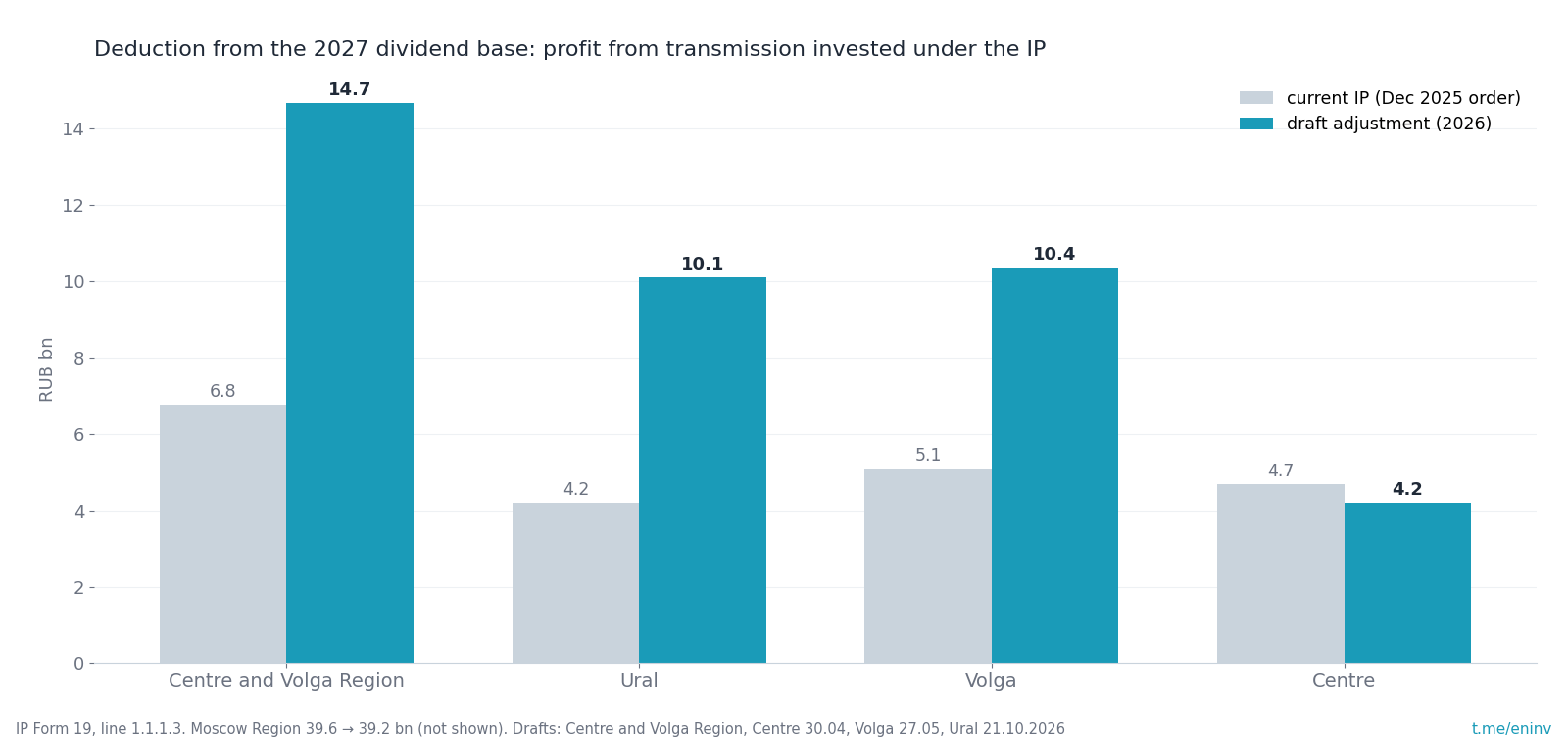
- The 2026 draft IP adjustments raise the 2027 deduction at Centre and Volga Region from RUB 6.8 bn to 14.7 bn, at Ural from 4.2 bn to 10.1 bn, at Volga from 5.1 bn to 10.4 bn. At Moscow Region the deduction almost doubles already under the current programme: RUB 21.8 bn for 2026 and 39.6 bn for 2027.
- Base case, % of price for 2026 / 2027: Lenenergo prefs 12.1 / 15.3, Centre and Volga Region 12.3 / 14.4, Centre 11.8 / 15.3, Moscow Region 13.7 / 11.9, Ural 11.5 / 11.9, Volga 10.1 / 8.5. If the drafts are not approved: Centre and Volga Region 15.4 / 20.3, Ural 10.9 / 17.1, Volga 9.8 / 14.9.
- The Bank of Russia kept the key rate at 14% on 23 October, seven-year OFZs yield 16.4%. A 10-14% dividend for 2026 loses to bonds, so new purchases only where the two-year total is above 25% and depends less on the December IP decision.
- We are not taking part in the Rosseti Siberia buyback: before the 22 October record date the price did not fall below RUB 0.47, while we had called the trade interesting only at an entry no higher than RUB 0.445.
| Company | Price 11 Nov | Since 25 Sep | Div. 2026e, % base (current IP) | Div. 2027e, % base (current IP) | 2026+27, % base | 2027 IP deduction, RUB bn: current → draft | View |
|---|---|---|---|---|---|---|---|
| Lenenergo pref (LSNGP) | 350.5 | +4.6% | 12.1 | 15.3 | 27.4 | not applicable | buy |
| Centre and Volga Region (MRKP) | 0.588 | +12.6% | 12.3 (15.4) | 14.4 (20.3) | 26.7 | 6.8 → 14.7 | buy |
| Centre (MRKC) | 0.742 | +4.3% | 11.8 (6.7) | 15.3 (14.6) | 27.2 | 4.7 → 4.2 | on a dip |
| Moscow Region (MSRS) | 1.762 | +9.6% | 13.7 | 11.9 (11.7) | 25.6 | 39.6 → 39.2 | hold |
| Ural (MRKU) | 0.653 | +3.3% | 11.5 (10.9) | 11.9 (17.1) | 23.5 | 4.2 → 10.1 | hold |
| Volga (MRKV) | 0.218 | +9.3% | 10.1 (9.8) | 8.5 (14.9) | 18.6 | 5.1 → 10.4 | do not add |
| South (MRKY) | 0.0769 | +8.2% | 12.8 | 9.0 | 21.7 | - | not for dividends |
| North-West (MRKZ) | 0.138 | +7.7% | - | - | - | - | bet on payouts |
| Siberia (MRKS) | 0.474 | −1.0% | - | - | - | - | buyback: not entered |
*Yield: dividend for the year to the 11.11.2026 price. Base: dividend policy formula with the deduction from the draft IP adjustment, in brackets under the current IP (where different). Lenenergo prefs: 10% of RAS net income under the charter. South: September estimate at the new price. Authors' estimate*
The market outpaced the grids, Centre and Volga Region led
From 25 September to 11 November the MOEX Index rose by 9.7% and the total return index by 10.4%. The five stocks we named top picks in September rose by 7.9% on average. There were no dividend record dates in the period, so this is the full result.
The spread inside the basket was wide. Centre and Volga Region gained 12.6%, Moscow Region and Volga 9-10% each, Lenenergo prefs 4.6%, Ural 3.3%. Parent Rosseti rose the most, by 47%. There were no dividend decisions in the period. On 14 October the Ministry of Energy said there is no decision yet on extending the dividend moratorium. We still see the stock as a bet on a political decision, not a dividend story.
The third quarter was weak as expected, but three companies missed our model
The 2026 indexation took effect on 1 October, so in July-September the grids worked on last year's tariff. Third-quarter RAS revenue barely changed year on year, and at Volga and Centre and Volga Region it even fell by 2-4%. Costs kept rising: by 1-2% at Centre and Centre and Volga Region, 7-8% at Volga, Moscow Region and Lenenergo, 14% at Ural. Hence the drop in operating profit, from 10% at Centre to 78% at Volga.
In September our model for the third quarter assumed flat revenue and 11% growth in own costs (own costs are everything except FGC services and loss purchases, which rise together with the tariff). Comparison with actual results:
- Centre and Volga Region – in line with the model. Operating profit RUB 5.8 bn against a modelled RUB 5.9 bn. Net income RUB 6.2 bn, of which RUB 2.6 bn pre-tax is a one-off from amended property tax returns. Without it, about RUB 3.6 bn against our expected RUB 3.5 bn.
- Lenenergo – slightly worse, operating profit RUB 10.3 bn against a modelled RUB 11.4 bn.
- Moscow Region – RUB 1.4 bn of operating profit below the model. Net income almost halved, to RUB 6.6 bn, also because the third quarter a year earlier included RUB 2.4 bn of other income.
- Ural – RUB 2.2 bn below the model. Cost of sales rose by 14% with flat revenue, net income RUB 1.3 bn versus RUB 4.5 bn a year earlier.
- Volga – RUB 1.7 bn below the model. Revenue fell by 4%, costs rose by 7%, net income RUB 0.5 bn versus RUB 2.9 bn.
- Centre – operationally better than the model, but other expenses ate net income (RUB 1.7 bn, half of last year).
Over 9 months the picture is better thanks to a strong first half: RAS net income rose by 25% at Centre and Volga Region, 28% at Ural, 15% at Centre, 11% at Lenenergo, 8% at Moscow Region and 5% at Volga.
One formula for all: half of net income minus investments from profit
In September we calculated dividends in different ways: the dividend policy formula at Centre and Volga Region and Centre, and the share of profit paid for 2025 at Ural, Volga and Moscow Region. That hid the main risk: all Rosseti subsidiaries share one dividend policy, and the IP investment deduction applies to each of them. Now we treat all companies the same way.
The dividend policy formula: dividend = 50% x (net income – profit from electricity transmission invested under the IP – other deductions). Net income is the larger of RAS and IFRS. The deduction is line 1.1.1.3 of the investment programme financial plan (Form 19), approved by the Ministry of Energy.
Check on 2025, authors' calculation from Ministry of Energy orders and IFRS:
- Centre and Volga Region: RUB 23.56 bn of net income minus a 7.21 bn deduction, half is 8.17 bn, actually paid 8.17 bn.
- Ural: 13.30 minus 2.59, half is 5.36 bn, paid 5.35 bn.
- Volga: 11.33 minus 3.50, half is 3.91 bn, paid 3.99 bn.
- Moscow Region: 41.78 minus 22.02, half is 9.88 bn, paid 9.08 bn. The 1.6 bn gap in the base is other deductions, we keep them going forward.
- Centre: the formula gives 3.92 bn, 1.63 bn was paid. The rest went to a special reserve, and the base case assumes this continues.
2026 earnings are the September model with the actual third quarter (RAS statements; 9-month IFRS results come out at the end of November). Where third-quarter costs grew faster than the assumed 11%, we assume half of the overrun persists in the fourth quarter and in 2027. This is the authors' assumption, part of the growth may turn out to be repairs shifted between quarters.
IP drafts double the 2027 deduction at three companies
The investment programme is adjusted every year. The company publishes a draft in spring (Ural in October), and the Ministry of Energy approves it at year-end. The 2026 drafts are already public, and at three companies they sharply raise profit allocated to investment in 2027:
- Centre and Volga Region: 6.8 → 14.7 bn for 2027, 6.9 → 11.1 bn for 2026;
- Ural: 4.2 → 10.1 bn for 2027, for 2026 5.0 → 4.3 bn;
- Volga: 5.1 → 10.4 bn for 2027, for 2026 4.5 → 4.2 bn;
- Centre: the deduction falls, 5.3 → 2.1 bn for 2026 and 4.7 → 4.2 bn for 2027;
- Moscow Region: the draft barely changes the deduction, but it already rises from 21.8 bn for 2026 to 39.6 bn for 2027.
We put the drafts into the base case. The precedent is Centre and Volga Region: in December 2025 the adjustment raised the 2025 deduction from RUB 3.4 bn to 7.2 bn, and the 2025 dividend was calculated on the new figure. The 2026 actuals also point to the draft: in the first half the company invested RUB 4.3 bn of transmission profit, almost two thirds of the full-year deduction under the current programme.
Each billion of deduction cuts the dividend by RUB 0.5 bn. For Volga, with a market cap of RUB 41 bn, the 2027 draft costs 6.4 pp of yield, for Ural 5.2 pp, for Centre and Volga Region 6.0 pp.
New estimates: 10-14% for 2026, 8-15% for 2027
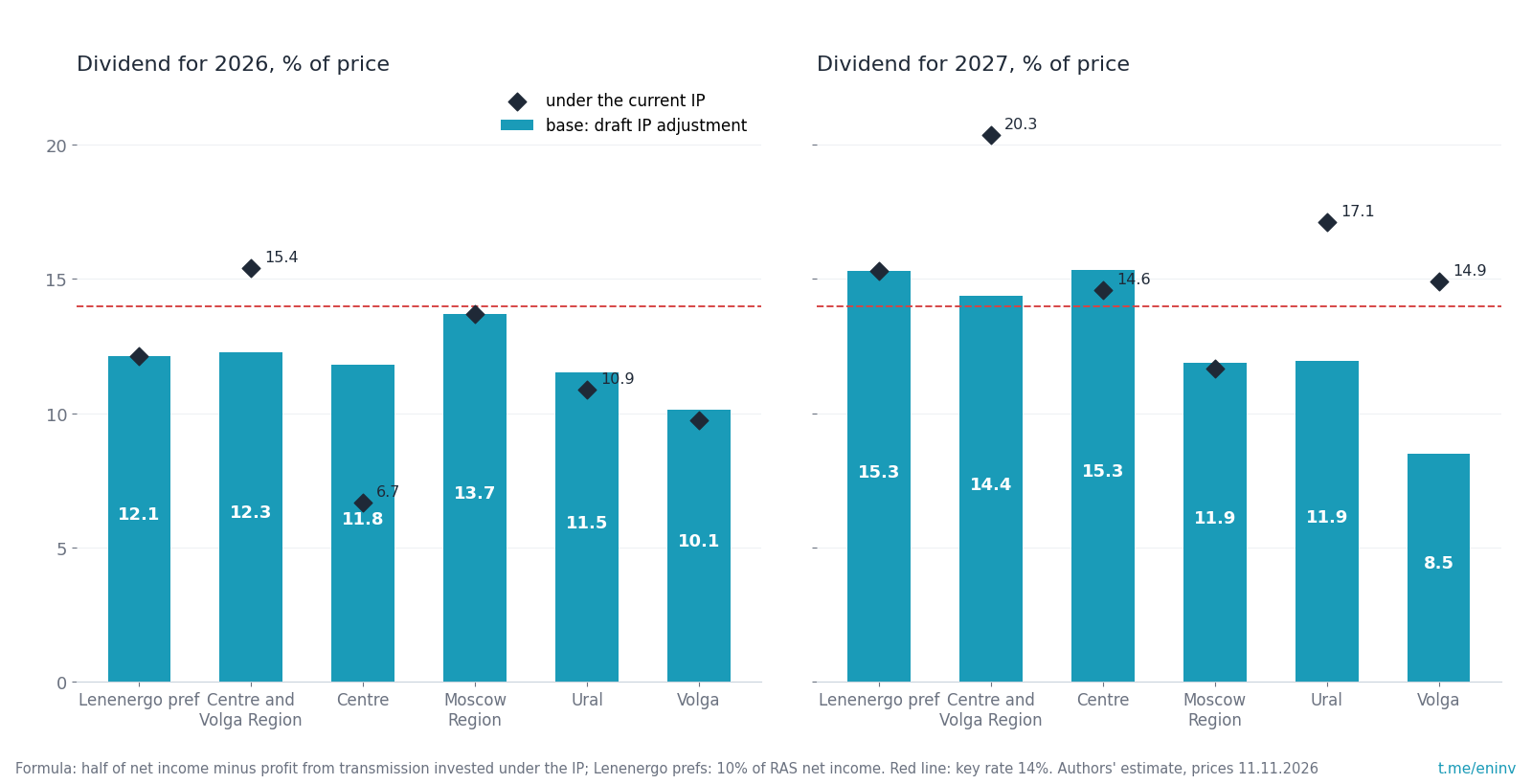
- Lenenergo prefs: RUB 42.5 for 2026 (12.1%) and RUB 53.6 for 2027 (15.3%). The only stock whose payout does not depend on the IP: 10% of total RAS net income under the charter. 9-month net income RUB 32.2 bn (+11%).
- Centre and Volga Region: RUB 0.072 (12.3%) and RUB 0.085 (14.4%) in the base case. If the deduction stays under the current programme, RUB 0.091 (15.4%) and RUB 0.120 (20.3%). The 2026 estimate includes the RUB 2.6 bn one-off from a property tax recalculation, without it the payout would be RUB 0.01 lower.
- Centre: RUB 0.088 (11.8%) and RUB 0.114 (15.3%) with a special reserve as for 2025. The draft lowers the 2026 deduction, so the estimate is above September's. Under the current programme it would be RUB 0.049 (6.7%).
- Moscow Region: RUB 0.242 (13.7%) and RUB 0.209 (11.9%). The 2027 dividend is below 2026 because the deduction grows faster than profit.
- Ural: RUB 0.075 (11.5%) and RUB 0.078 (11.9%). Under the current programme the 2027 dividend would be RUB 0.112 (17.1%).
- Volga: RUB 0.022 (10.1%) and RUB 0.019 (8.5%). Under the current programme RUB 0.033 (14.9%) for 2027.
In September we used a three-year dividend model with 7% growth after 2028. With the IP drafts it loses meaning: Volga's 2028 deduction rises to RUB 16.2 bn, Ural's to 13.3 bn, Centre and Volga Region's to 16.2 bn, Moscow Region's to 52.8 bn, and the 2028 dividend depends on a decision that does not exist yet. So we compare stocks on the sum of 2026-2027 dividends.
What to buy: Lenenergo prefs and Centre and Volga Region
- Lenenergo prefs – 27% over two years with no IP risk. The weak third quarter barely affected them: operating profit −13%, costs +8%.
- Centre and Volga Region – 27% over two years already with the worse deduction, and up to 36% if the draft is not approved. The company came through the third quarter better than others: costs rose by only 2%, and excluding the one-off, profit matched our model.
- Centre gives the same 27% on paper, but rests on two assumptions: that the draft with a lower deduction is approved and that the special reserve does not grow. For 2025 the company paid out 14% of profit. Buy only on a noticeable dip.
- Moscow Region – hold: 13.7% for 2026, but the 2027 deduction is almost twice as large, and the 2027 yield falls to 12%.
- Ural – hold: 11.5% for 2026, 12% to 17% for 2027 depending on the IP. Third-quarter cost growth needs to be confirmed in IFRS.
- Volga – do not add: 19% over two years in the base case, the worst among payers. Third-quarter revenue fell by 4%, and the IP draft takes more than half of 2027 profit for investment.
North-West, Siberia and South – no change in view
- North-West: a RUB 0.6 bn loss in the third quarter. The company placed RUB 5 bn of bonds at the key rate plus 1.5 pp. 2026 dividends remain in question, the stock is a bet on a change in payout practice.
- Siberia: the meeting on merging Rosseti Tomsk, Tyvaenergo and RES takes place on 19 November, the RUB 0.5253 buyback is available only to holders as of 22 October. We did not enter: the price never fell to RUB 0.445, at which participation gave an expected 20% annualised. 9-month net income RUB 9.4 bn versus RUB 0.3 bn a year earlier, but the company has not paid dividends since 2020.
- South: the base is not comparable because of the Kuban merger, the 2026 dividend is about 13% of the price, but our 2027 estimate is 9%. Not for a dividend portfolio.
What comes next
The tariff backdrop has not changed. The 1 October indexation went through in full: +15.2% for distribution grids, +16% for UNEG. The Ministry of Economic Development forecast for 2027 is also unchanged: from 1 July 2027, +17.5% for households and +15.2% for other consumers. In October the FAS prepared a draft UNEG tariff for 2027-2029 with the same steps, +16.7% from July 2027. October-December will be the first quarter with the indexation, and the fourth quarter should show year-on-year earnings growth.
Upcoming events:
- 19 November: Rosseti Siberia meeting on the merger;
- end of November: 9-month IFRS results, around 26 November at Centre and Volga Region. We will check whether cost growth persists at Ural, Volga and Moscow Region;
- December: approval of IP adjustments. If deductions are approved below the drafts, 2027 estimates at Centre and Volga Region, Ural and Volga rise by 5-6 pp;
- 18 December: Bank of Russia rate meeting;
- March 2027: full-year IFRS results and the first dividend recommendations for 2026.
Key risks
- IP deductions. We have already built in the draft adjustments, but the Ministry of Energy may approve an even larger deduction. This is a risk for all except Lenenergo prefs.
- Profit below the IP plan. Our 2027 net income is 20% below the financial plan at Ural and 32% below at Volga. If the company still invests the planned amount, the dividend will be lower still.
- Costs. The third quarter showed costs growing faster than the assumed 11% at three of five payers. If this is not one-off, 2027 estimates will have to be cut by another 1-2 pp.
- Rates. With a 14% key rate and OFZs at 16.4%, a 10-14% dividend for 2026 loses to bonds. The Bank of Russia expects an average key rate of 12.5-13.5% in 2027.
- Tariffs. The 2027 indexation is a forecast, not a decision. The 2026 indexation has already been postponed once.
The September review with IP execution history and the Siberia buyback calculation: Grids ahead of 2027. Cards for all companies with financials, investment programmes and dividend calculations are on Frontier.