Grids ahead of 2027: how the upside has changed and what to buy
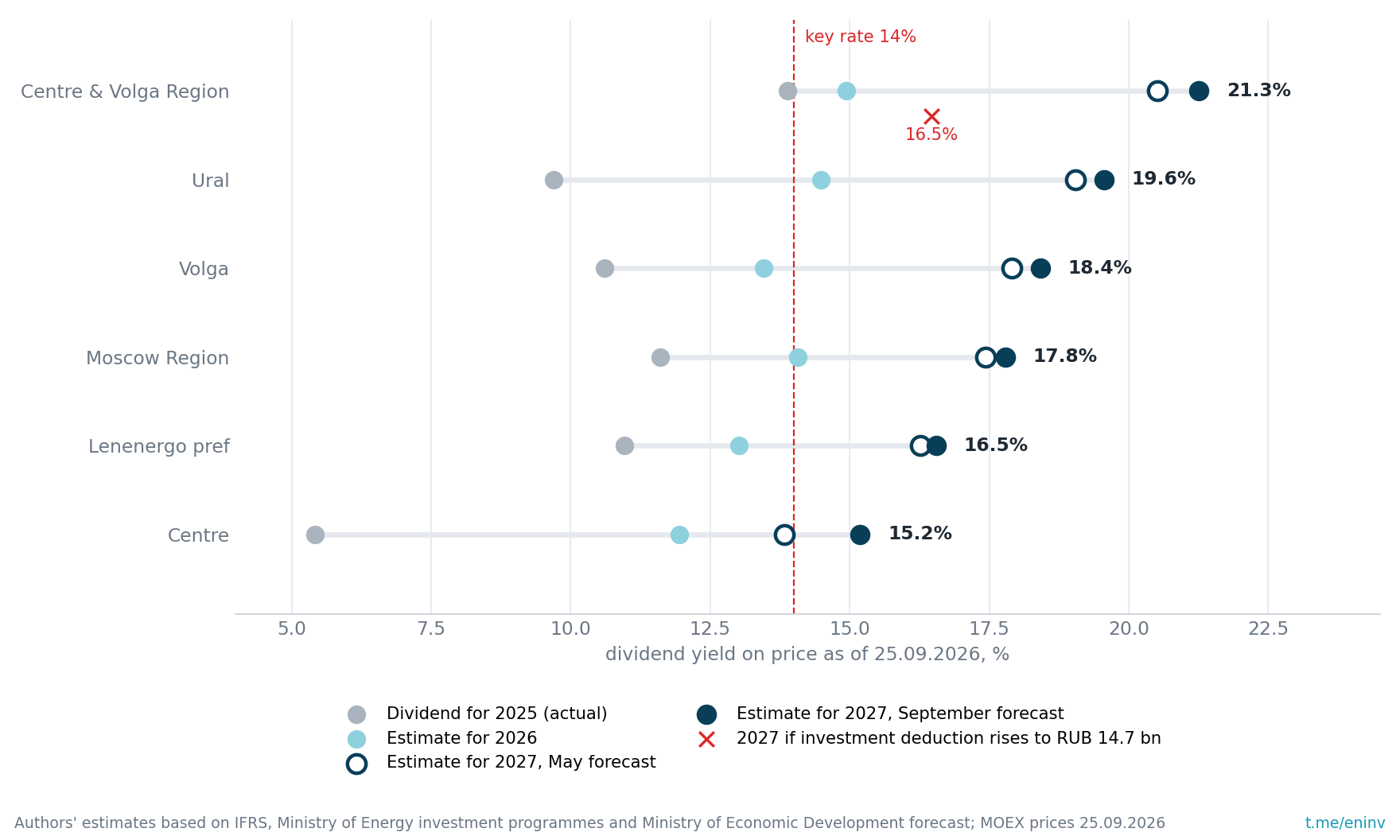
Grid companies are worth buying for their 2026-2027 dividends. The main driver is the large tariff indexations themselves: +15.2% from 1 October 2026 and +15.2-17.5% from 1 July 2027. The September forecast revision added little to this. Top picks: Rosseti Centre and Volga Region, Rosseti Ural, Rosseti Volga, Rosseti Moscow Region and Lenenergo preferred shares. By our estimate, their dividend for 2026 yields 13-15% on the current price and the dividend for 2027 16-21%, against a key rate of 14%.
- The September forecast of the Ministry of Economic Development added only 0.2-0.8 pp to the 2027 dividend yield, and 1.4 pp at Rosseti Centre. Three-year dividend model upside rose by 4-11 pp, and by 19 pp at Centre: +52% at Centre and Volga Region, +39% at Ural, +31% at Volga, +26% at Moscow Region, +17% at Lenenergo prefs.
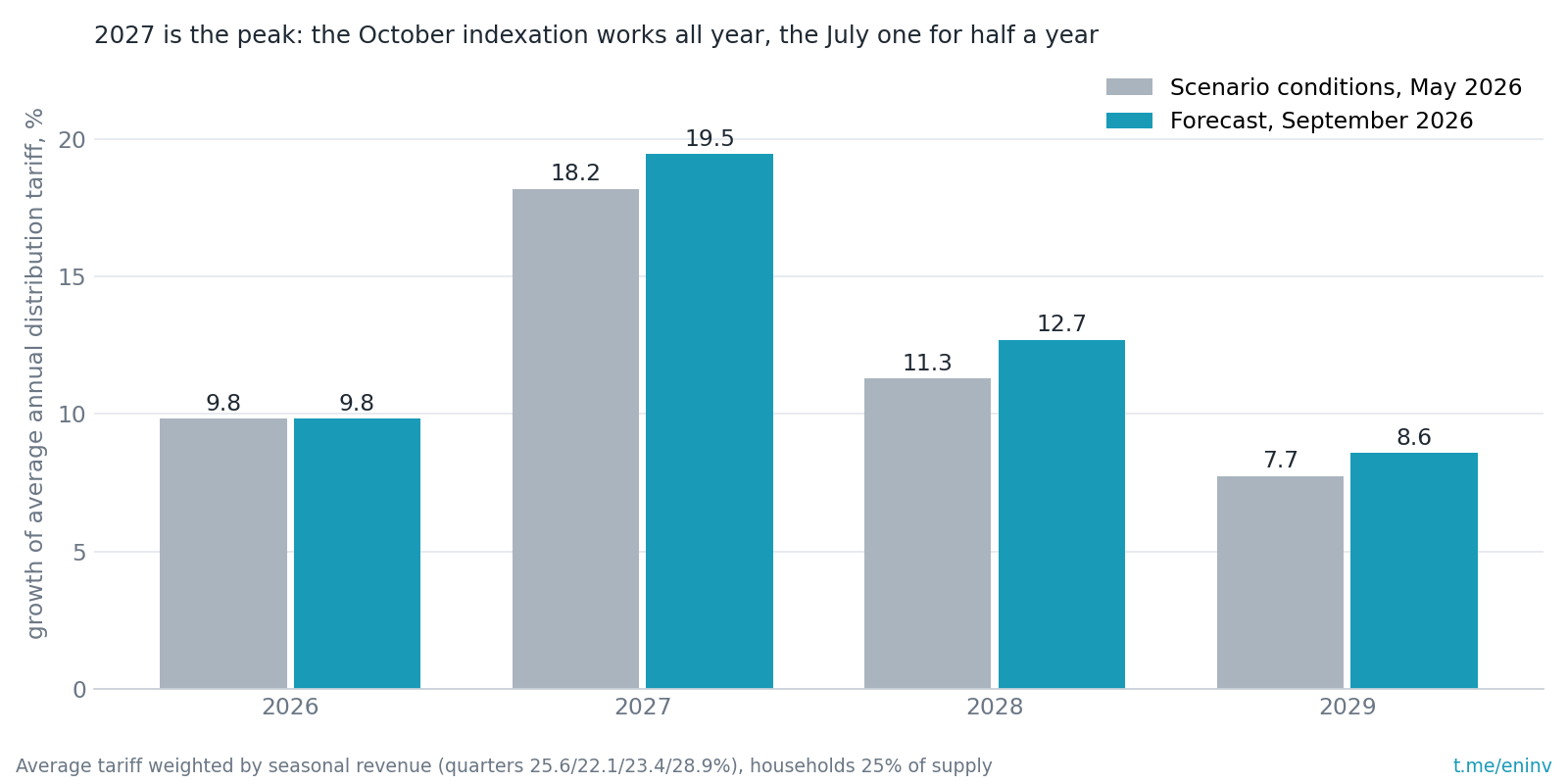
- The main driver is two large indexations in a row: 15.2% in October 2026 and 15.2-17.5% in July 2027. Moving the first one from July to October did not add growth but shifted it: the average 2026 tariff rises by only 9.8%, the 2027 tariff by 19.5%.
- The dividend is calculated as half of net income after deducting investments financed from profit under the investment programme (IP). So the key event before year-end is the Ministry of Energy's December adjustment of investment programmes.
- The next reports will be weak: July-September passed without indexation. We expect 3Q net income at Centre and Volga Region of around RUB 3.5 bn versus RUB 4.9 bn a year earlier. A dip on the reports is a reasonable buying opportunity.
- Our dividend estimates are not the IP plan but expectations grounded in actual results: our earnings model and the actual payout ratio. The IP dividend plan is delivered by Centre and Volga Region, Volga, Moscow Region and Lenenergo, and not delivered by Centre and North-West.
- North-West, South, Siberia and parent Rosseti are not dividend stories. The Rosseti Siberia buyback at RUB 0.5253 yields around 30% annualised only if tenders are accepted in full. With a likely acceptance of 30-50% and a purchase at RUB 0.48, the expected IRR is about zero; it becomes interesting at an entry no higher than RUB 0.445.
| Company | P/E 2026e | EV/EBITDA | Div. 2025, % | 2026e, % | 2027e, % | 2026+27, % | 3 years, disc., % | Upside May → Sep | Paid 2020-25 | Verdict |
|---|---|---|---|---|---|---|---|---|---|---|
| Centre and Volga Region (MRKP) | 2.3 | 1.0 | 13.9 | 14.9 | 21.3 | 36.2 | 41.6 | +41% → +52% | 6 of 6 | buy |
| Ural (MRKU) | 2.8 | 1.8 | 9.7 | 14.5 | 19.6 | 34.0 | 38.8 | +32% → +39% | 5 of 6 | buy |
| Volga (MRKV) | 2.6 | 1.5 | 10.6 | 13.5 | 18.4 | 31.9 | 36.4 | +24% → +31% | 4 of 6 | buy |
| Moscow Region (MSRS) | 1.5 | 1.4 | 11.6 | 14.1 | 17.8 | 31.9 | 36.0 | +21% → +26% | 6 of 6 | buy |
| Lenenergo pref (LSNGP) | 3.6 | 2.0 | 11.0 | 13.0 | 16.5 | 29.6 | 33.3 | +13% → +17% | 6 of 6 | buy |
| Centre (MRKC) | 2.0 | 1.6 | 5.4 | 11.9 | 15.2 | 27.1 | 31.5 | −3% → +16% | 6 of 6 | on a dip |
| South (MRKY) | 3.3 | 2.1 | 5.3 | 13.8 | 9.7 | 23.4 | - | - | 1 of 6 | not for dividends |
| North-West (MRKZ) | 2.0 | 0.8 | 0.0 | - | - | - | - | - | 0 of 6 | bet on payouts |
| Siberia (MRKS) | 6.6 | 4.2 | 0.0 | - | - | - | - | - | 0 of 6 | buyback from 0.445 |
Summary as of 25.09.2026. Yield is the dividend for the year divided by the current price. 2026+27 is the sum of dividends for two years; 3 years is 2026-2028 dividends discounted at 20%. Upside is the dividend discount model under the May and September tariff forecasts
Growth comes from two large indexations in a row; the postponement only shifted it from 2026 to 2027
The government moved the 2026 indexation from 1 July to 1 October. From that date distribution grid tariffs rise by 15.2% on average and trunk grid (UNEG) tariffs by 16%. July-September 2026 passed on last year's tariff, so the average 2026 tariff is only 9.8% above the previous year.
In 2027 the October increase works all 12 months, and the next indexation is added from 1 July. Under the Ministry of Economic Development forecast of 24 September it will be 17.5% for households and 15.2% for other consumers. The May scenario conditions had 15.3% and 13%. Adjusted for revenue seasonality (consumption is higher in winter), the average 2027 tariff will rise by 19.5% instead of 18.2% under the May forecast.
The postponement itself did not add profit; quite the opposite. The grids went through July-September 2026 without a tariff increase. For Centre and Volga Region this means about RUB 3 bn of operating profit and about RUB 0.01 of dividend for 2026, almost 2 pp of yield. The postponement merely shifts growth into 2027: the 2026 base is depressed, which is why 2027 looks so strong. Had indexation taken place on 1 July as usual, the increase would have been spread more evenly over two years and would have been higher in total.
The new forecast added 2-5% to 2027 earnings and 0.2-1.4 pp to dividend yield
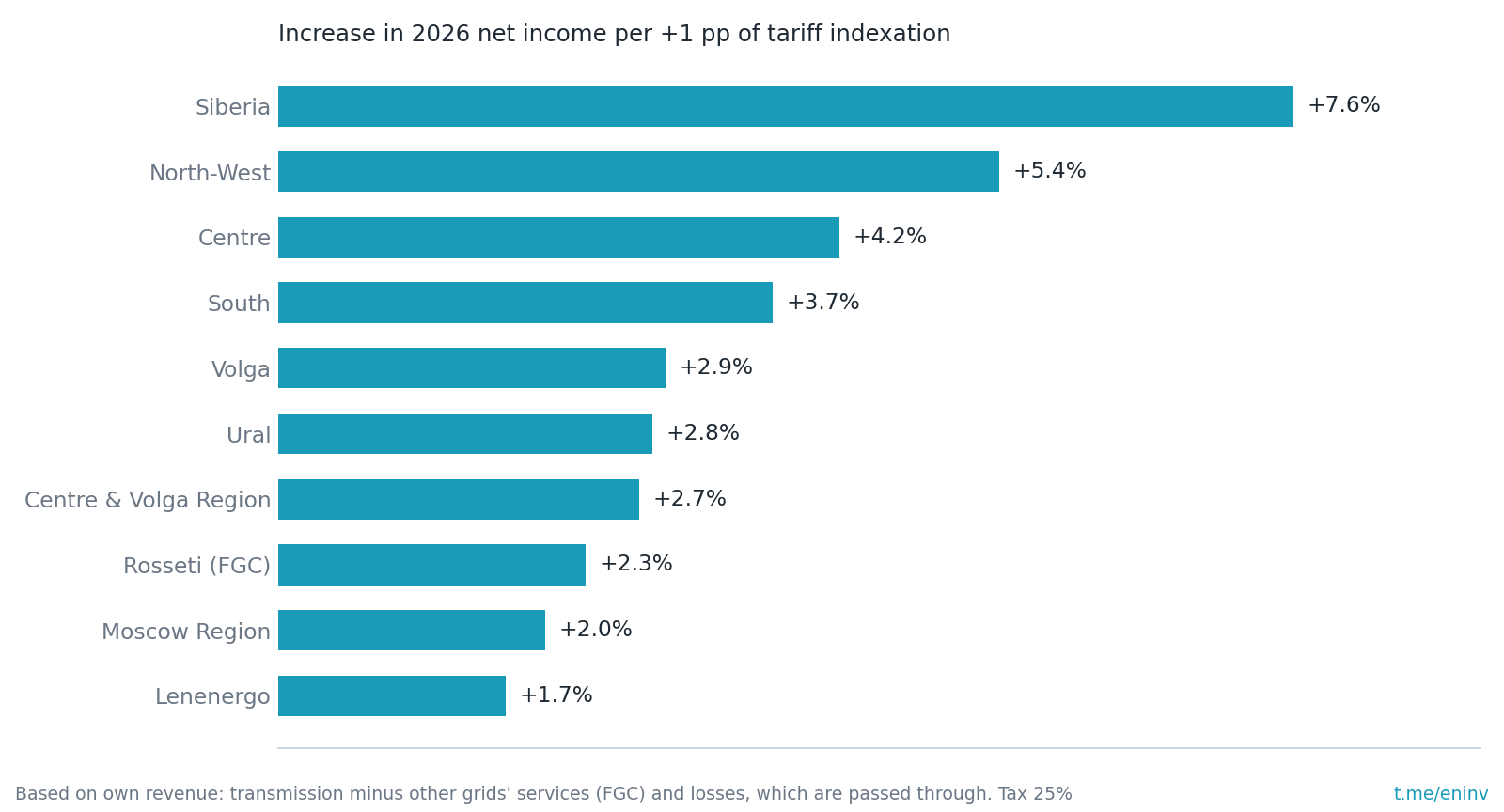
Indexation does not raise all of a grid's revenue. Trunk grid services of FGC and purchases of electricity to cover losses become more expensive together with the tariff and pass straight through the company. Only own revenue works for profit: transmission minus other grids' services minus losses. For companies that disclose their cost structure, this is 41-55% of transmission revenue.
Hence the sensitivity. Each additional 1 pp of indexation adds from 1.7% at Lenenergo to 7.6% at Siberia to 2026 net income. The lower the margin, the stronger the leverage, and the harder a below-forecast tariff will hit such a company.
The September revision raised the average 2027 tariff by 1.1% versus the May forecast. For 2027 earnings this means plus RUB 0.4-1.3 bn, or 2-5% depending on the company. Part of this profit reaches the dividend: half under the policy formula at Centre and Volga Region and Centre, and roughly the share they paid out for 2025 at the others.
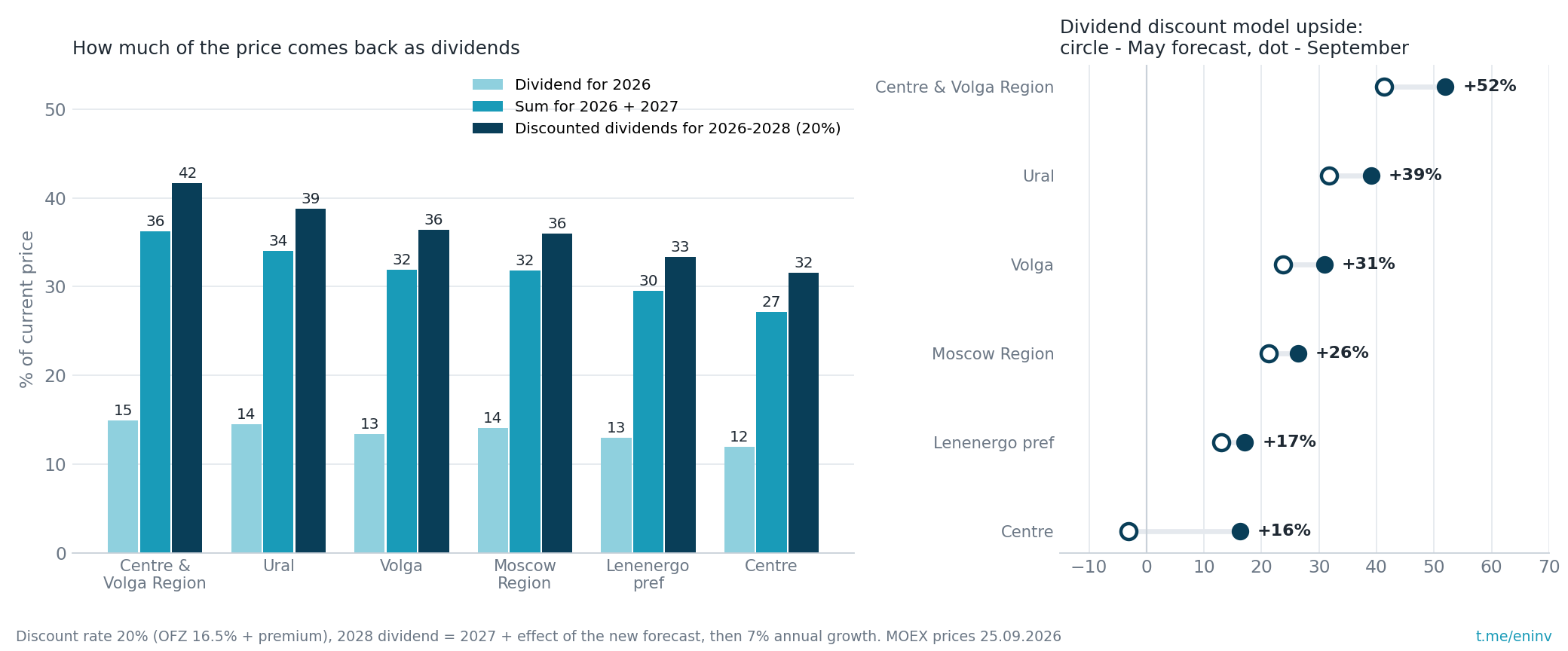
We measure upside over several years of dividends, not one. We show three measures and one valuation:
- dividend for 2026 to the current price – the next payout, in summer 2027;
- sum of dividends for 2026 and 2027 – how much of the price comes back over two years, 32-36% for the best names;
- discounted dividends for 2026-2028 – the same three-year sum in today's money, at 20% a year (OFZ 16.5% plus an equity risk premium). This is 42% of the price at Centre and Volga Region, 39% at Ural, 36% each at Volga and Moscow Region;
- dividend discount model upside – fair value as discounted 2026-2028 dividends plus their continuation after 2028 with 7% annual growth (2029 indexation forecast at 7.2%). We set the 2028 dividend equal to 2027 and add only the effect of the new tariff forecast.
Under this model the September revision added 4-11 pp to upside: Centre and Volga Region went from +41% to +52%, Ural from +32% to +39%, Volga from +24% to +31%, Moscow Region from +21% to +26%, Lenenergo prefs from +13% to +17%. This is more than the addition to the 2027 yield alone, because the 2028 tariff increase carries into all subsequent years. The revision helped Centre most: -3% became +16%. Its profit increase is large relative to its RUB 30 bn market capitalisation, and half of it goes to the dividend under the formula. If Centre and Volga Region gets a RUB 14.7 bn deduction approved, its upside falls to +16%.
The bulk of the upside still lies in the 2026-2027 payouts themselves, that is, in the October 2026 and July 2027 indexations, which were known before the September forecast.
The dividend is decided by the IP investment deduction, which is approved in December
The dividend policies of all Rosseti subsidiaries follow the same 2018 template. At least 50% of net income goes to the payout, but after deductions: investments financed from profit under the investment programme (IP), profit from grid connection of new consumers, and the excess of RAS depreciation over IFRS depreciation. The larger of two bases, RAS or IFRS, is used.
Example of Centre and Volga Region for 2025, with the calculation disclosed on the company's website: IFRS net income of RUB 23.56 bn minus investments from profit of RUB 7.21 bn minus RUB 0.02 bn of excess depreciation, for a total of RUB 16.34 bn. Half of this amount, RUB 8.17 bn, is the dividend paid. So a payout ratio of about 35% of net income is not underpayment but the arithmetic of the policy.
Each billion of investments from profit under the IP reduces the dividend by RUB 0.5 bn. The amount is set by the investment programme, which the Ministry of Energy approves on the group's proposal. Draft IP adjustments are approved in December, and for the dividend thesis this is the key event before year-end.
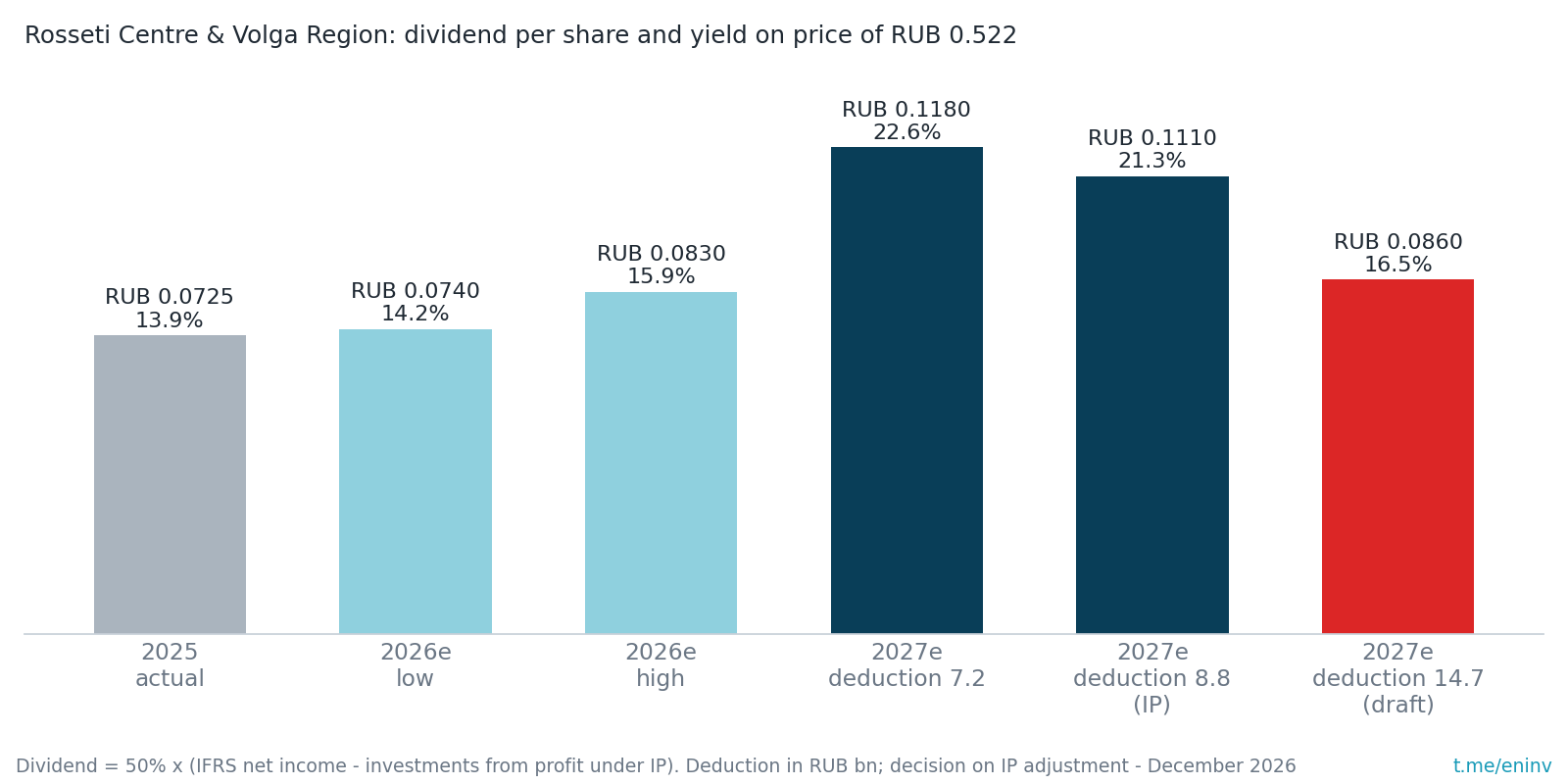
At Centre and Volga Region, the draft adjustment raises the 2027 deduction to RUB 14.7 bn versus RUB 8.8 bn in the current programme. The 2027 dividend would then be RUB 0.086 instead of RUB 0.111. Even in this case the yield is 16.5%, above the key rate. Meanwhile the company beats its IP every year: in 2024-2025 net income exceeded the plan by 19-50% and the dividend by 37-43%.
Our dividends are expectations grounded in actual results, not the IP plan
Each company's investment programme contains a financial plan (Form 19) with net income and dividends for years ahead. We do not take these figures into the table directly. The plan is drawn up by the company itself, and it is delivered unevenly: Centre and Volga Region beats its dividend plan, Centre paid 36% of plan for 2025, and North-West paid nothing against a plan of RUB 1.2 bn.
How the estimates in the table are calculated:
- 2026 net income – actual first half plus our model for the second (third quarter without indexation, October indexation in the fourth, cost growth of 11% a year). 2027 net income – 2026 net income plus growth in own revenue from indexation minus cost growth. We do not use net income from the IP plan.
- Centre and Volga Region, Centre – the dividend policy formula: 50% of net income minus investments from profit. The 2026 deduction is taken as the actual 2025 one, the 2027 deduction from the current IP. For Centre we also deduct the RUB 2.3 bn special reserve, as was done for 2025.
- Ural, Volga, Moscow Region – our net income multiplied by the share the company actually paid out for 2025: 40%, 35% and 22% of IFRS net income.
- Lenenergo prefs – the charter, 10% of our estimate of RAS net income.
- South – our net income and the payout ratio from the IP plan: the company has almost no payout history of its own.
- North-West and Siberia – zero until the companies start paying, although payouts are included in the IP.
From the IP plan we take only the deduction of investments from profit: it enters the dividend formula directly.
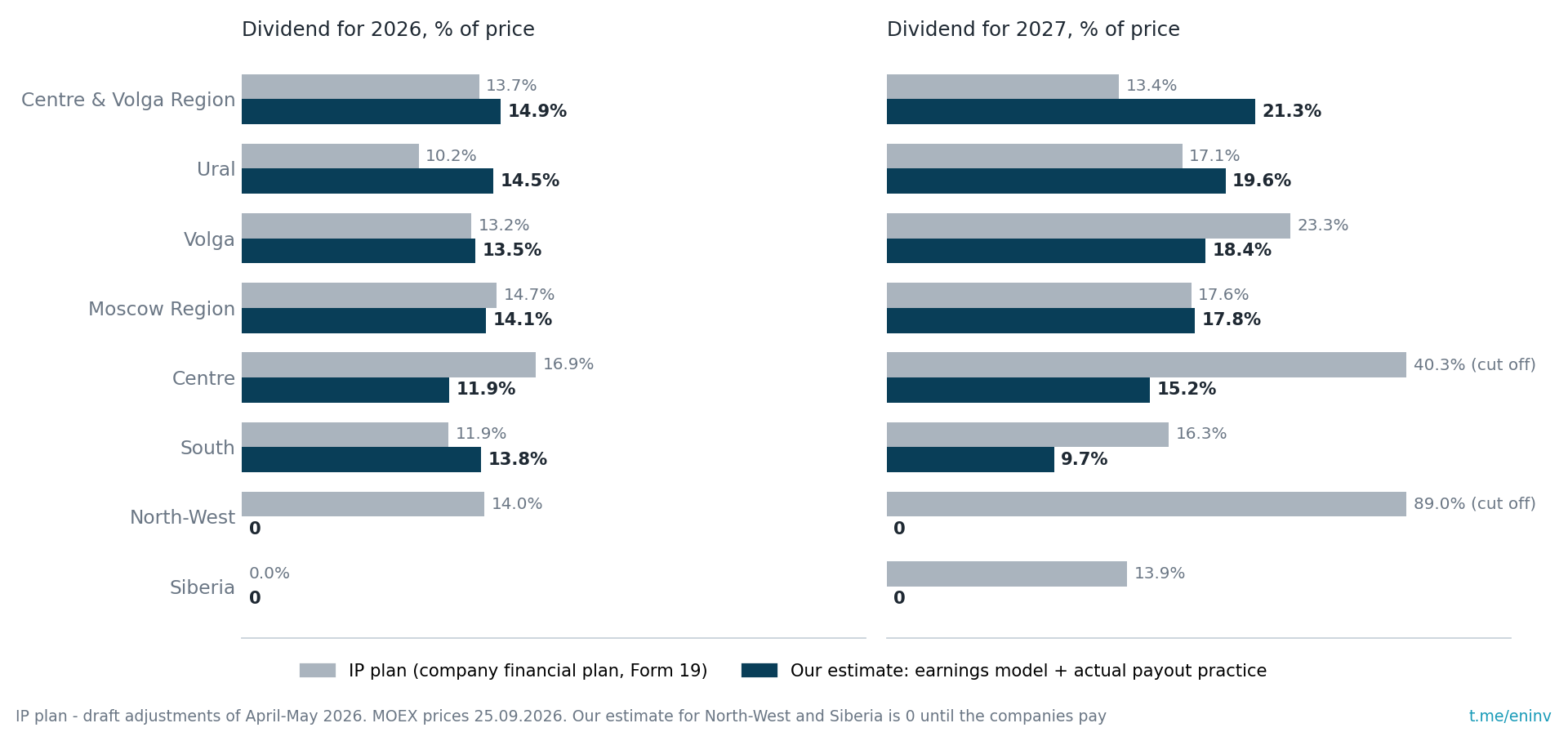
Where our estimates diverge most from the plan:
- Centre and Volga Region, 2027: 21% in our estimate, 13% in the IP plan. The company plans earnings conservatively and in 2024-2025 beat its plan by 19-50% on net income and 37-43% on the dividend.
- Volga, 2027: 18% in our estimate, 23% in the plan. Net income in the plan is 28% above ours.
- Centre, 2027: 15% in our estimate, 40% in the plan. The plan rests on one-off grid connection revenue at the Tver branch (RUB 10.5 bn versus the usual RUB 1.2 bn). In 2028 the plan returns to the normal level, so we do not include this revenue.
- North-West: the IP plan promises 89% of market capitalisation for 2027, RUB 19.2 bn of it from grid connection revenue. We assume zero.
Who has historically delivered on the IP: payers spend no less than planned and still pay
We compared the investment programmes approved by the Ministry of Energy with actual results for 2022-2025. Each year's plan is taken from the programme approved at the end of the previous year, not from later adjustments that already incorporate actual figures. Actual means capex paid under IFRS.
| Company | Capex 2022 | Capex 2023 | Capex 2024 | Capex 2025 | Average | Dividend for 2025: actual vs plan |
|---|---|---|---|---|---|---|
| Centre and Volga Region | 84% | 111% | 111% | 120% | 106% | 139% |
| Volga | n/a | 100% | 101% | 138% | 113% | 100% |
| Ural | n/a | 166% | 128% | 99% | 131% | plan 0, paid RUB 5.4 bn |
| Moscow Region | n/a | 94% | 118% | 87% | 100% | 101% |
| Lenenergo | 81% | 95% | 97% | 97% | 92% | 105% |
| Centre | n/a | 126% | n/a | 117% | 121% | 36% |
| South | 95% | 134% | 129% | 100% | 115% | plan 0.3, paid RUB 2.6 bn |
| North-West | 104% | 101% | 92% | 66% | 91% | plan RUB 1.2 bn, paid 0 |
| Siberia | 66% | 82% | 98% | 85% | 83% | plan 0, paid 0 |
Investment programme execution: capex versus plan by year and dividends for 2025 versus the IP financial plan. Dividend payers spend no less than planned; Siberia and North-West systematically fall short
- Centre and Volga Region, Volga, Moscow Region and Lenenergo deliver 92-113% of the programme on average and still pay no less than planned: 139%, 100%, 101% and 105% of the planned dividend for 2025. At Centre and Volga Region net income exceeded plan by 19-50% in 2024-2025. For these four companies the IP plan is a floor, not a ceiling.
- Ural and South spend more than planned (131% and 115% on average) and pay more than the financial plan says: Ural RUB 5.4 bn against a plan of zero, South RUB 2.6 bn against a plan of RUB 0.3 bn.
- Centre overdelivers on construction (121%), but paid 36% of its planned dividend for 2025. It is the only payer that has missed its dividend plan.
- North-West and Siberia fall short on both construction (91% and 83%) and dividends. North-West executed 66% of its programme in 2025, and the promised RUB 1.2 bn of dividends was not paid. Underdelivery here signals a shortage of cash, not savings.
Conclusion for valuation: IP dividend plans can be trusted at Centre and Volga Region, Volga, Moscow Region and Lenenergo, but not at Centre, North-West and Siberia.
Centre and Volga Region, Ural and Volga offer 18-21% for 2027
Rosseti Centre and Volga Region (MRKP) is first on the list. It is the cheapest of the paying companies at 1x annual EBITDA and 2.3x 2026 net income, with more cash than debt. It has paid every year since 2018 and beats its payout plan. Our dividend estimate for 2026 is RUB 0.074-0.083 (14-16%), for 2027 RUB 0.111 (21%) or RUB 0.086 (16.5%) if a larger deduction is approved. The risk for the coming months is a weak 3Q and 4Q write-offs: every year the company books RUB 2.0-3.2 bn of provisions for disputes.
Rosseti Ural (MRKU) doubled its first-half net income to RUB 11.5 bn. At the 2025 payout ratio (40% of IFRS net income), the 2026 dividend will be about RUB 0.092 (14.5%) and the 2027 dividend about RUB 0.124 (19.6%). Drawbacks: the company did not pay in 2021, and we have seen its first-half IFRS results only in a press release. The group plans to decide on a merger with the grids nationalised in the region (SUENKO, Oblkommunenergo) no earlier than in a year.
Rosseti Volga (MRKV) has almost no debt and tripled its payout for 2025 to RUB 0.0212. Our estimate for 2026 is RUB 0.027 (13.5%), for 2027 RUB 0.037 (18.4%), and the IP plan for 2027 is even higher, 23%. The drawback is a short track record: the company is paying for the third year in a row.
Over the year Ural and Volga rose 57-60%, Centre and Volga Region 2%.
Moscow Region and Lenenergo prefs are reliable but have less upside
Rosseti Moscow Region (MSRS) is the most reliable payer, paying every year, at a P/E of 1.5x 2026 net income. But shareholders receive only a fifth of net income; the rest goes into the investment programme. Our estimate of RUB 0.226 for 2026 (14.1%) and RUB 0.286 for 2027 (17.8%) almost matches the IP plan. The drawback is that the investment programme is growing. Under the programme approved in December 2025, capex will be RUB 121 bn in 2026 and RUB 161 bn in 2027, and profit allocated to investment RUB 51 bn and RUB 90 bn. The financial plan of the same programme still includes a dividend of RUB 13.8 bn for 2027, and our estimate matches it. But the risk of a larger deduction from the dividend base is higher at Moscow Region than at other payers.
For Lenenergo preferred shares (LSNGP), the dividend is set in the charter: 10% of total RAS net income without deductions, divided by 93.3 mn preferred shares. This is the only security whose payout is not affected by the December IP decision. Our estimate is RUB 43.6 for 2026 (13%) and RUB 55.4 for 2027 (16.5%). If the IP plan with RUB 30 bn of grid connection revenue in 2027 materialises, it will be about RUB 66 (19.7%). Lenenergo ordinary shares yield 4-5% and are not suitable for a dividend portfolio.
Centre: buy only on a dip
Rosseti Centre (MRKC) paid RUB 0.0385 for 2025, only 14% of net income: a further RUB 2.3 bn was deducted from the dividend base into a special reserve. If the same is done for 2026-2027, the yield will be 12% and 15%. Without the reserve deduction it would be 19.7% and 23%. 2027 net income grows fastest among the payers, by 52%. But until the company shows the reserve was a one-off, the stock should be bought only on a significant decline.
North-West, South and Rosseti are not for dividends
Rosseti North-West (MRKZ) is the cheapest at 0.8x annual EBITDA, and its first-half net income doubled. The IP plan promises dividends of RUB 1.7 bn for 2026 and RUB 10.9 bn for 2027, which is 89% of market capitalisation. But the company refused to pay for 2025, even though the 2025 IP included a payout of RUB 1.2 bn. Reasons from the meeting materials: preferential grid connection without a funding source (RUB 10.1 bn), a 23% rise in debt and a loss on transmission. The stock is interesting as a bet that large 2027 grid connection contracts will reach the bottom line and the board will change its practice. It should not be chosen for the dividend.
Rosseti South (MRKY) absorbed Kuban on 1 December 2025, and its share count rose by 357%. For 2025 the company paid a dividend for the first time since 2019, 5.3% of the price, but that is about 95% of RAS net income; the payout could not have been higher. The IP plan for 2027 has a payout ratio of 21%; our estimate of the 2027 dividend is 9.7%. A separate risk is loss-making Volgogradenergo.
Parent Rosseti (FEES) last paid for 2020, a dividend moratorium is in effect through 2026, and the Ministry of Energy proposes continuing to direct dividends to investment. In June the shareholder meeting approved an additional issue of about 903 bn shares in favour of the state at RUB 0.5, 10 times the market price. This is a bet on a political decision, not on dividends.
Siberia: the buyback gives 30% annualised only with full acceptance; at RUB 0.48 the expected IRR is about zero
Rosseti Siberia (MRKS) has not paid dividends since 2020 and refused again in June. But on 19 November shareholders vote by absentee ballot on the merger with Rosseti Tomsk, Tyvaenergo and Regional Electric Networks. Those who vote against or do not vote may tender their shares for buyback at RUB 0.5253. The shareholder register will be fixed as of 22 October, so the shares must be bought no later than 21 October.
Deal timeline. After the meeting, shareholders have 45 days to submit buyback demands (until 3 January 2027) and the company has 30 days to pay. The money will arrive around 2 February 2027, so the deal takes about four months. Shares tendered for buyback are blocked throughout this period.
The main variable is the acceptance ratio. The law allows no more than 10% of net assets to be spent on the buyback. Under RAS, the company's equity as of 30 June was RUB 26.5 bn, so the limit is about RUB 2.65 bn, or 5.05 bn shares, 5.3% of all ordinary shares. Rosseti holds a controlling stake and will not tender, but everything minorities tender above 5.3% of the capital will be accepted pro rata. If 10.6% of shares are tendered, half of each tender will be bought; if 17.7%, 30%.
The second variable is the price of the remaining shares. Before the buyback announcement, on 1-6 September, the stock traded at about RUB 0.40; after the announcement it rose to RUB 0.48. Once the buyback is over, the buyback premium will leave the price.
Calculation for a purchase at RUB 0.4795 (price on 25 September):
- with full acceptance, the return is 9.6% over four months, about 30% annualised;
- if half is bought and we sell the rest at RUB 0.44 (half the premium gone) – about 2% annualised; at RUB 0.40 – minus 9% annualised;
- if 30% is bought – from plus 8% to minus 22% annualised depending on the price of the remainder;
- breakeven: at a remainder price of RUB 0.44 acceptance must be at least 46%, at RUB 0.40 at least 63%.
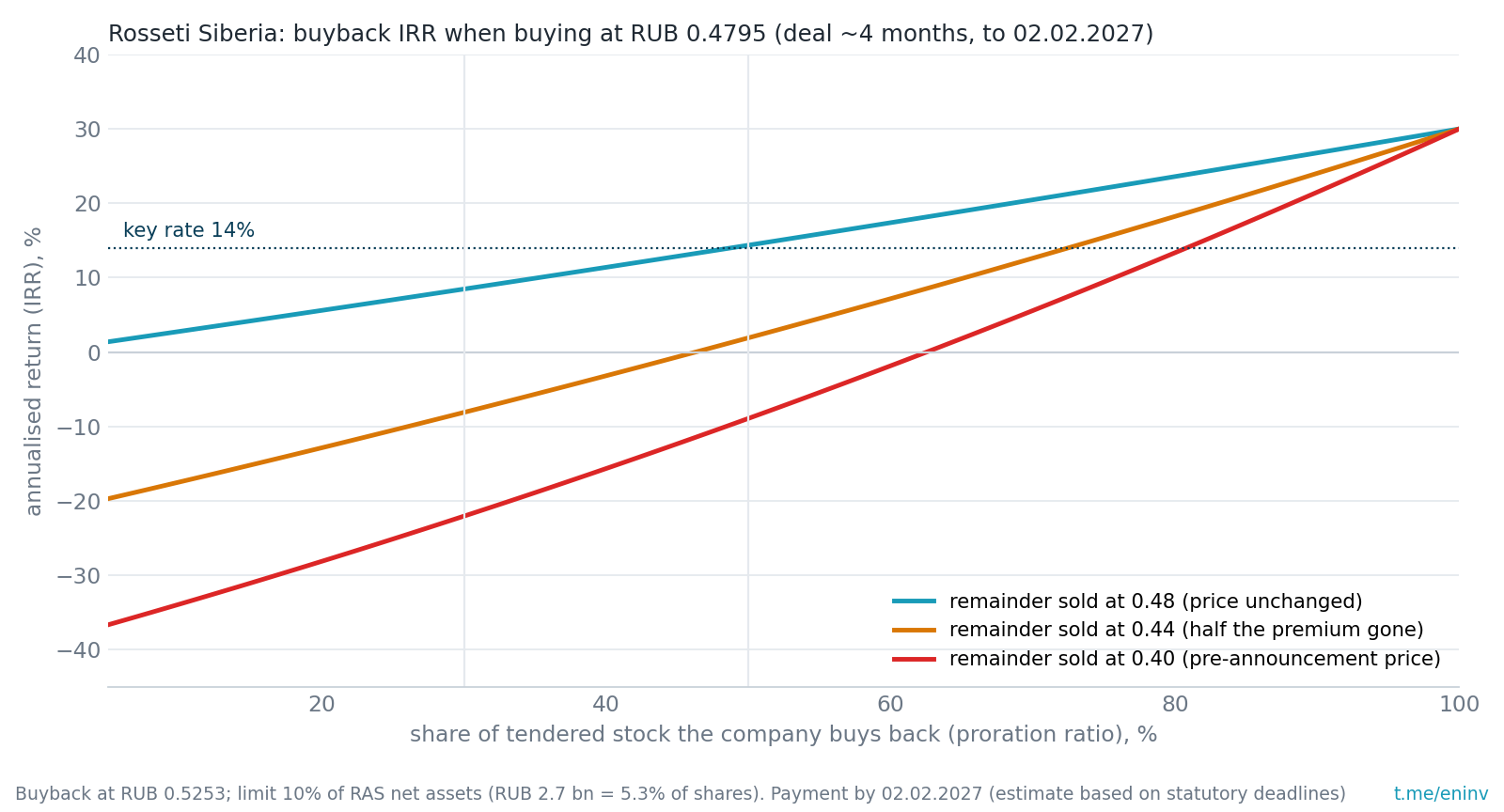
Authors' estimate: with a premium of almost 10%, noticeably more than 5.3% of the capital will be tendered, and acceptance is more likely to be around 30-50%. Then the expected IRR at the current price is about zero, worse than the key rate. The idea becomes interesting at a lower entry price: with 40% acceptance and a remainder price of RUB 0.44, a 20% annualised return requires an entry no higher than RUB 0.445. If the market offers that price before 21 October, we go in. At the current price we do not participate.
Siberia also has a fundamental positive. By our estimate, its 2027 net income will grow by 84%, the most among the grids, and for the first time the IP plan includes a dividend for 2027, RUB 6.3 bn (13.9% of the price). But until the first actual payout we do not include this plan in our estimate.
When to buy: indexation day is noise; enter on weak reports
We checked how grid stocks behaved around the 2021-2025 indexations. On indexation day itself, the grid basket underperformed the MOEX Index by 0.3 pp on average; in the week after, it underperformed in 4 cases out of 5, by 0.8 pp on average. This is within the normal range. The 1 October news does not move prices by itself.
Upcoming checkpoints for the thesis:
- end of October: 9M RAS results will show the first year-on-year decline in net income, with 3Q without indexation;
- 22 October: record date for Siberia's shareholder register for the buyback;
- end of November: 9M IFRS results;
- November-December: regional tariff decisions for 2027;
- December: approval of IP adjustments and deductions of investments from profit;
- March 2027: full-year IFRS results and the first dividend recommendations for 2026.
If the market reacts to a weak 3Q with a decline, it is a good entry point into Centre and Volga Region, Ural and Volga. Positions in Moscow Region and Lenenergo prefs can be built without regard to reports: their dividend depends less on quarterly earnings and IP decisions.
Key risks
- IP deductions. December adjustments may increase investments from profit, as in the Centre and Volga Region draft. This is the main risk for all except Lenenergo prefs.
- Tariffs. The 2027 forecast is not a decision, and the 2026 indexation has already been postponed. Low-margin grids would suffer most from a below-forecast tariff.
- Costs. We assume 11% annual growth in controllable costs, while personnel costs at Centre and Volga Region rose by 19.5% in the first half.
- Rates. Seven-year OFZs yield 16.5%. If key rate cuts are delayed, a 13-15% yield for 2026 will lose to bonds, and the rerating will shift to 2027.
- Corporate governance. Decisions on dividends and the IP are made by the group; minorities have no leverage.
Industry context and the payout history for 2018-2026 are covered [in our open review](https://telegra.ph/RU-Grids-Tariffs-Sep-2026-09-25). Profiles of all companies with financials, investment programmes and dividend calculations are on Frontier.
See also: market overview · valuation map · stock screeners