Grids after the new tariff forecast: which Rosseti subsidiaries to buy
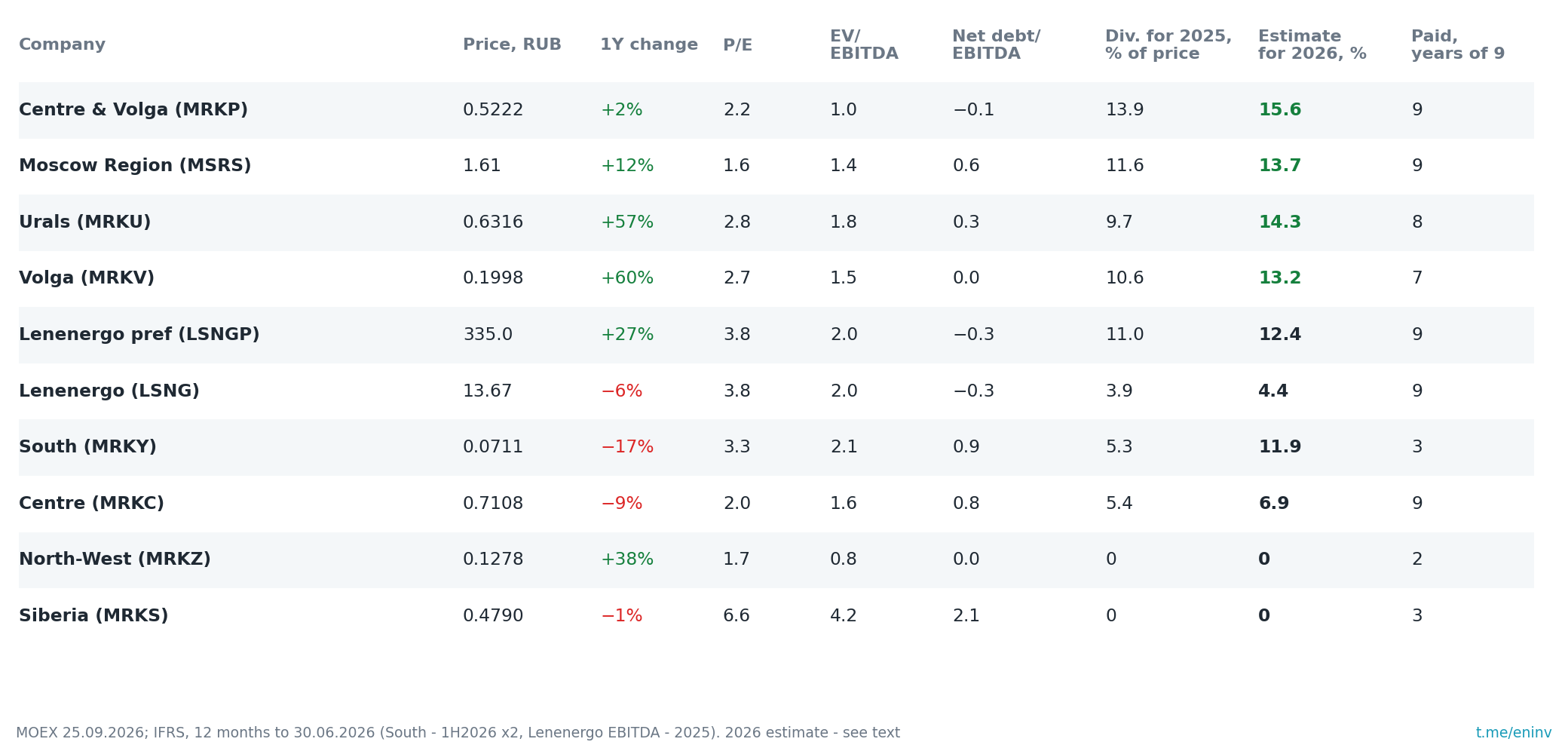
Regional grid companies are worth holding. Rosseti subsidiaries trade at 1-2 years of EBITDA and 2-3 years of earnings, and the expected dividend yield for 2026 at the best of them is 13-16%. The new Ministry of Economy forecast adds about 3.5% to 2027-2029 tariffs on top of the previous plan. The best combination of dividend, balance sheet and payout history is at Rosseti Centre and Volga Region, Rosseti Moscow Region and Lenenergo preferred shares. Urals and Volga pay comparably, but have already risen 57-60% over the year. North-West remains the cheapest stock in the sector, but it is a bet on dividends resuming, not a payout today.
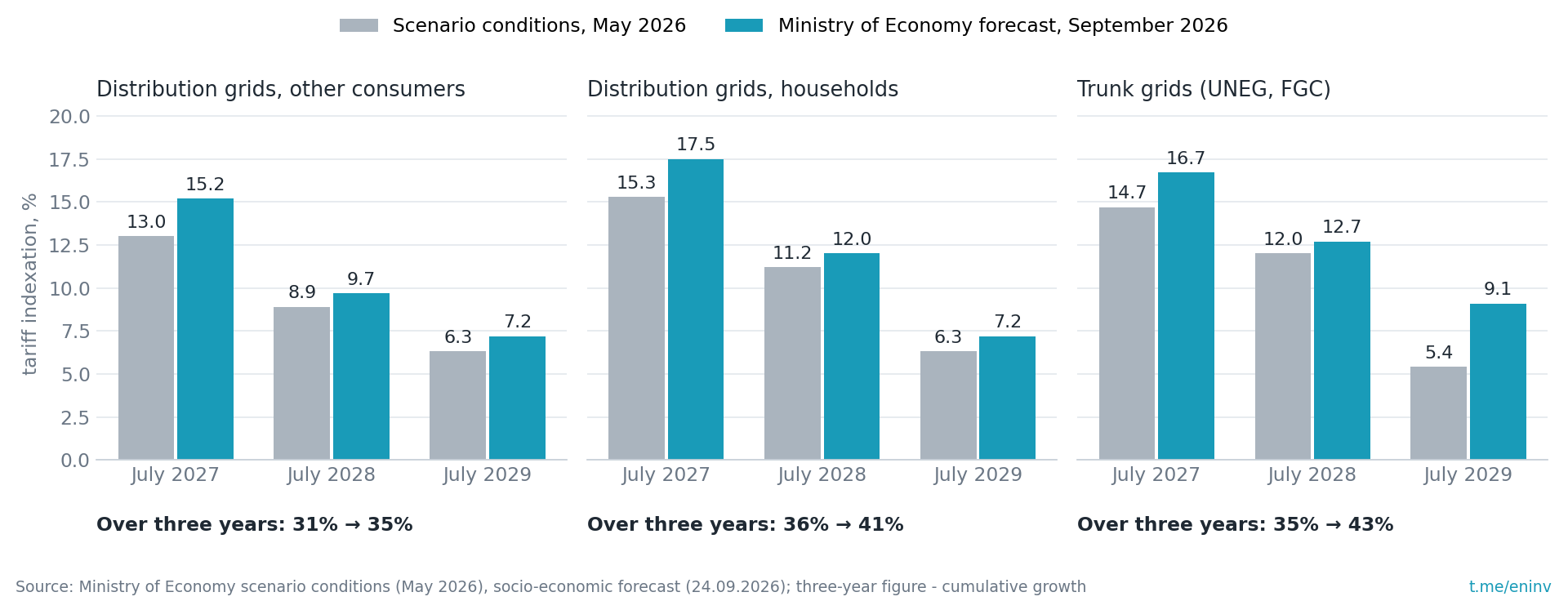
- The forecast indexation of distribution tariffs for July 2027 was raised from 13-15.3% to 15.2-17.5%, and for 2028-2029 by another 0.8-0.9 pp a year.
- This matters more for earnings than for revenue: at margins of 8-16%, an extra 2.3% of revenue in 2028 adds 7-22% to net profit. Realistically, expect about half of that.
- A dividend yield of 13-16% is below OFZ (16.5%), but grid dividends grow with the tariff, while a bond coupon is fixed.
- Payout history separates the companies more than multiples do: Centre cut its 2025 dividend to 14% of profit, North-West and Siberia have not paid since 2020.
- Investment programmes were executed close to plan in 2025, and Centre and Volga Region, Lenenergo, Moscow Region and Volga beat the dividend plan.
The Ministry of Economy raised the grid tariff forecast for 2027-2029 by 0.8-2.2 pp a year
On 24 September the Ministry of Economy published its socio-economic forecast for 2027-2029. Electricity transmission tariffs for distribution grids (the fee consumers pay a grid company for delivering electricity, the bulk of regional Rosseti companies' revenue) are indexed more in it than in the May 2026 scenario conditions.
- Distribution grids, other consumers: 15.2% from July 2027 (previously 13%), 9.7% in 2028 (previously 8.9%), 7.2% in 2029 (previously 6.3%).
- Distribution grids, households: 17.5% (previously 15.3%), 12% (previously 11.2%), 7.2% (previously 6.3%).
- UNEG trunk grids owned by FGC: 16.7% (previously 14.7%), 12.7% (previously 12%), 9.1% (previously 5.4%).
The ministry explains the revision by higher inflation, faster-than-inflation gas price indexation and large investment projects: trunk grids for the Moscow power system, energy storage in the South and "financing of the distribution grid sector". The end-user electricity price for households will rise by 14.4% from July 2027.
The nearest indexation is unchanged. From 1 October 2026 distribution tariffs rise by 15.2% and UNEG tariffs by 16%, after 15 months without an increase (the previous indexation was on 1 July 2025). The grid companies will show the effect of this indexation in their fourth-quarter reports.
For earnings the revision weighs several times more than for revenue
The tariff is indexed on 1 July, so in 2027 the increase works for half a year. The annual average distribution tariff is above the previous path by 1% in 2027, 2.3% in 2028 and 3.1% in 2029.
A grid company's costs barely depend on this decision: wages, repairs and depreciation grow with inflation. So extra revenue strongly lifts earnings. If the whole increase reaches pre-tax profit (25% tax), each 1% of revenue adds 0.75% divided by the net margin to net profit. At a 15% margin that is 5% of profit, at an 8% margin already 9%.
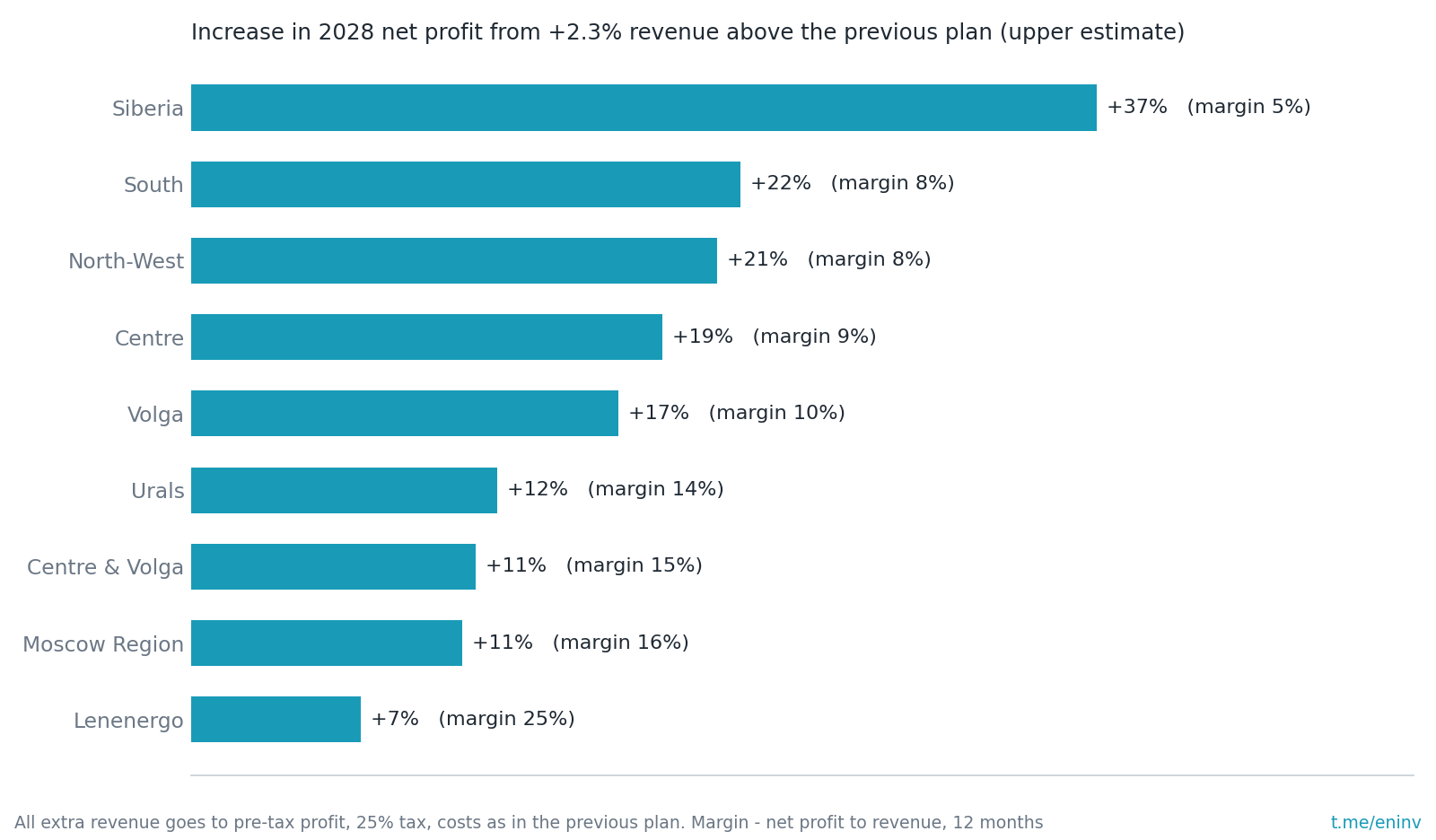
This estimate is overstated for three reasons.
- The FGC tariff was raised just as sharply, and payments to FGC for trunk grids are part of regional companies' costs.
- Companies buy grid losses at the wholesale price, and gas for power plants will be indexed 3 pp above inflation.
- The regulator earmarks part of the increase for larger investment programmes, meaning the money will go into construction.
Realistically, count on about half: plus 3-11% to 2028 profit depending on the company. This is additional growth on top of what the 15.2% October indexation already builds in.
The sector trades at 1-2 years of EBITDA and yields 13-16% with OFZ at 16.5%
EBITDA is operating profit before depreciation, roughly the cash flow from core operations. EV/EBITDA shows how many years of such earnings the whole business, including debt, is worth. For most Rosseti subsidiaries the ratio is between 1 and 2. P/E, price to annual earnings, ranges from 1.6 to 3.8. Almost all have net debt below one year of EBITDA, and Centre and Volga Region and Lenenergo hold more cash than debt.
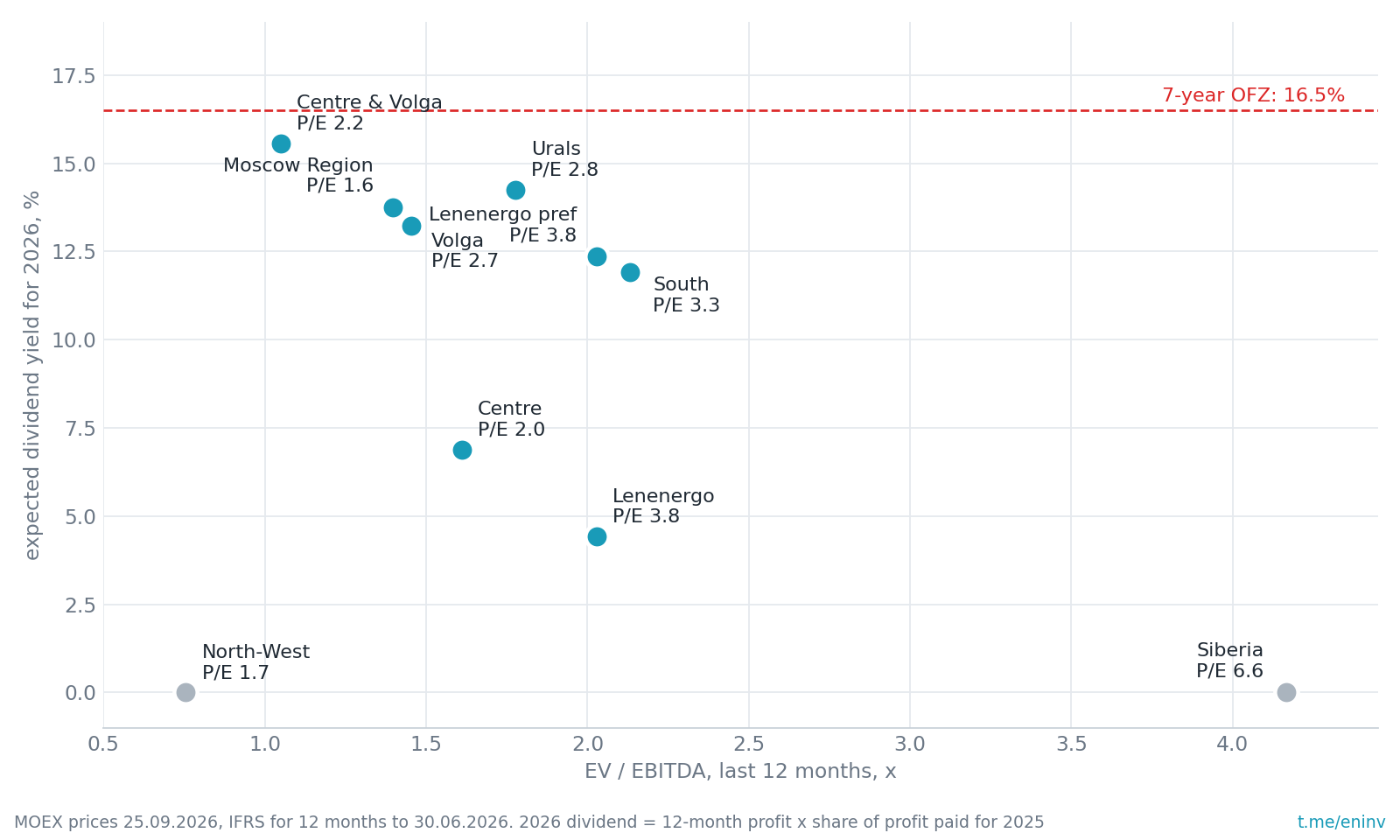
The Bank of Russia key rate is 14%, decided on 11 September, with the next meeting on 23 October. Seven-year OFZ yield 16.5%, so the market does not expect a fast rate cut. The expected dividend yield of the best grid companies is below the OFZ yield. The difference is that a bond coupon is fixed, while a grid company's dividend depends on profit, which grows with the tariff: 15.2% in October 2026 and 15.2-17.5% in July 2027. The average 2027 tariff will be about 19% above the 2026 average. Authors' estimate: allowing for cost growth, the 2027 dividend at an unchanged payout ratio could be 10-20% higher than the 2026 dividend. Then the best companies' yield on the current price would match or exceed OFZ.
The 2026 dividend estimate is calculated as follows: IFRS profit for the last 12 months (July 2025 - June 2026) multiplied by the share of profit the company paid out as dividends for 2025. The October indexation is not yet in this profit, so the estimate is rather conservative.
Payout history matters more than multiples: Centre cut its dividend, North-West and Siberia have not paid since 2020
Formally, Rosseti subsidiaries look alike: one parent, one regulator, tariffs set by one formula. But the dividend decision is taken by each company's board of directors, and here the spread is wide. For 2025 the companies paid out between 14% and 47% of IFRS profit. Centre and Volga Region and Volga paid out 35%, Urals 40%, South 47%, Moscow Region 22%, Centre 14%.
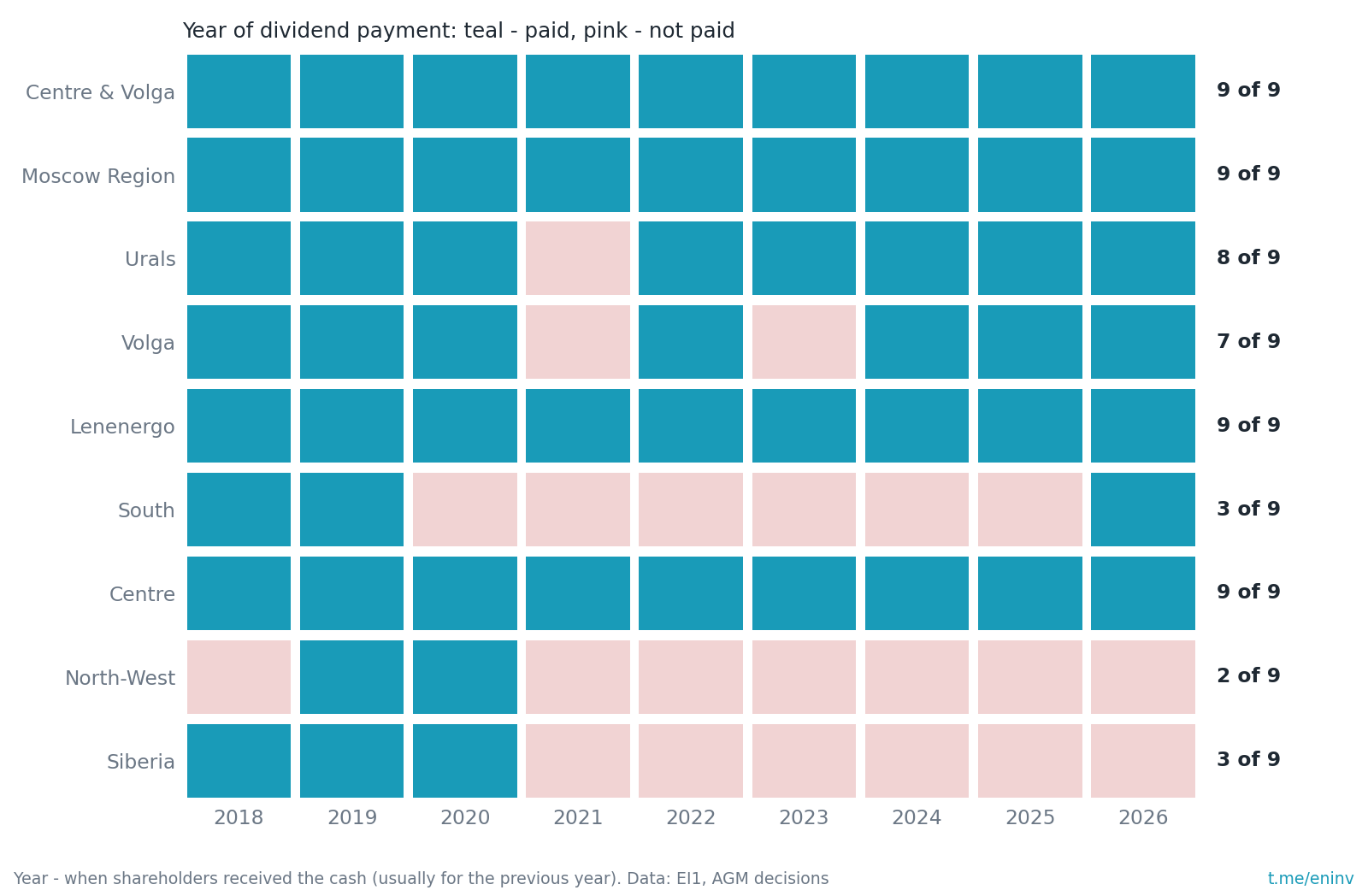
The main lesson of 2026 came from Centre. Profit for 2025 rose to RUB 11.6 bn, and the investment programme's financial plan provided for RUB 4.5 bn in dividends. The board recommended RUB 0.0385 per share, RUB 1.6 bn in total (a year earlier the company paid out 44% of profit), and the shareholders' meeting approved it on 18 June. On the day of the recommendation the stock fell 17%. The stock trades at 2 years of earnings, but until the company shows that last year's decision was a one-off, a high payout cannot be counted on.
Investment programmes were executed close to plan, four of five paying companies met the dividend plan
Each grid company's investment programme is approved by the Ministry of Energy. It sets out capex five years ahead and its funding sources, and its financial plan (Form 19) forecasts profit and dividends. This is the only official dividend forecast, so it is useful to check how closely companies follow it.
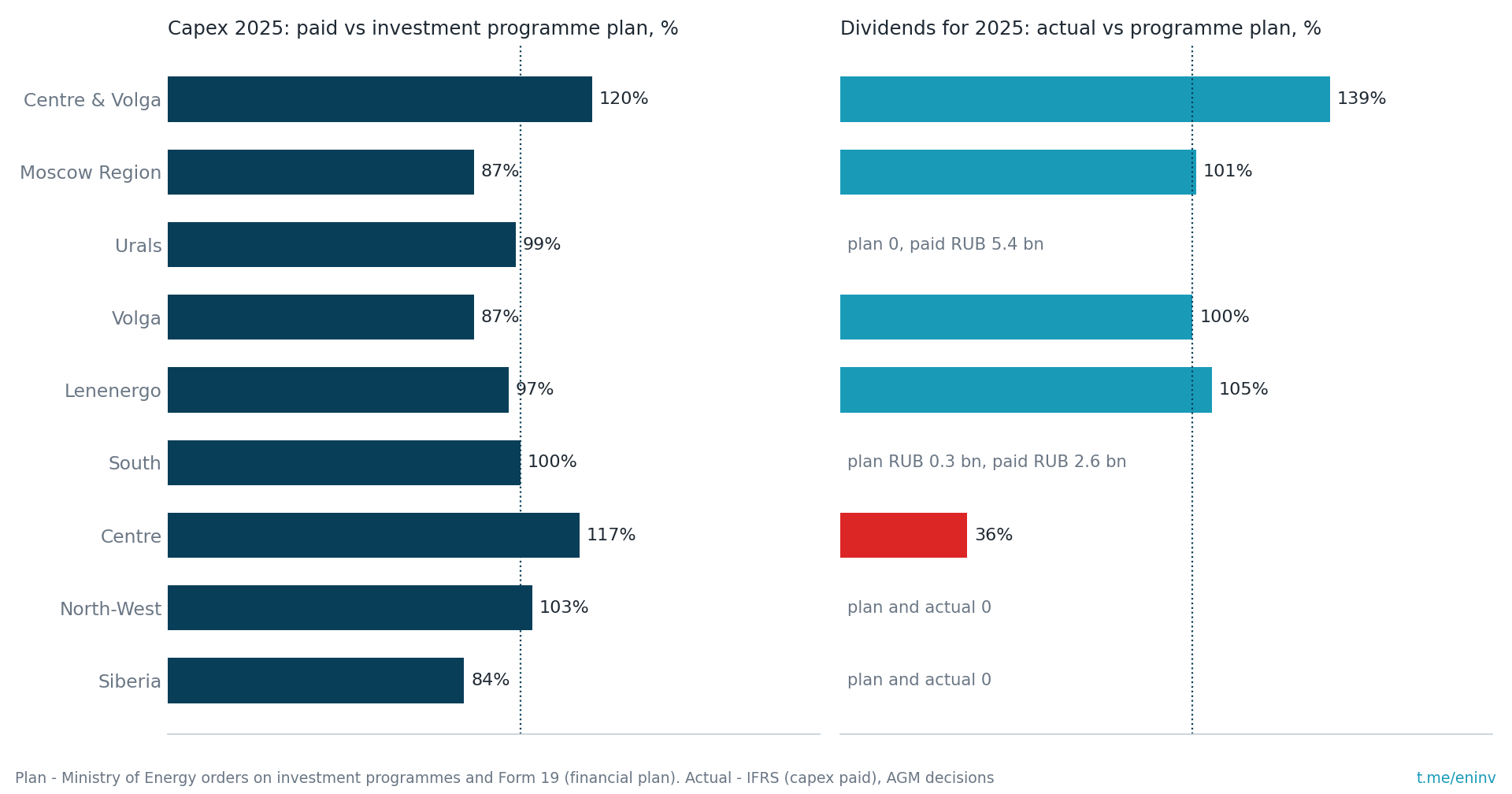
On capex, most companies came in at 85-120% of plan. Centre and Volga Region spent 20% more than planned and still paid 39% more in dividends than the programme envisaged. Moscow Region, Volga and Siberia executed 84-87% of plan. For a shareholder, capex underexecution is not bad in itself: it leaves money in the company.
What matters more is where the investment programmes go next.
- Moscow Region is ramping up construction. Under the programme approved in December 2025, capex will be RUB 121 bn in 2026 and RUB 161 bn in 2027, with profit allocated to investment of RUB 51 bn and RUB 90 bn. The financial plan of the same programme still assumes a RUB 13.8 bn dividend for 2027.
- North-West is doubling construction. The 2026 plan is RUB 22.4 bn against RUB 10.4 bn in 2025, RUB 19.6 bn in 2027, then a drop to RUB 8.8 bn and RUB 6.3 bn. This is exactly why the board declined to pay a dividend for 2025.
- Siberia is expanding its programme: RUB 16.5 bn in 2025, RUB 27.4 bn in 2029. With debt at 2.1 years of EBITDA, this leaves no money for dividends.
- For Centre and Urals, under programmes updated at the end of 2025, capex peaks in 2026 and declines afterwards. At Centre and Volga Region construction stays at around RUB 29-31 bn a year. In December the Ministry of Energy will approve new adjustments, and higher investment from profit is the main risk to dividends.
Centre and Volga Region – the best balance of dividend and reliability
Rosseti Centre and Volga Region (MRKP) operates grids in nine regions, from the Nizhny Novgorod region to Udmurtia. The company has no debt: as of 30 June its cash exceeded its loans by RUB 4.9 bn. Profit for 1H2026 rose 24% to RUB 14.8 bn. Dividends are paid every year; for 2025 it paid RUB 0.0725 per share (RUB 8.2 bn, 39% above the investment programme plan). At the same payout ratio the 2026 dividend would be about RUB 0.081, or 15.6% of the price. The stock is up 2% over the year, so earnings growth is barely reflected in the price.
Moscow Region – the lowest price of earnings, but a growing investment programme
Rosseti Moscow Region (MSRS) owns the country's largest distribution grid in Moscow and the Moscow region. Its P/E of 1.6 is the lowest in the sector, and half-year profit rose 46% to RUB 24.4 bn. The company pays out only 22% of profit: RUB 0.1865 for 2025, 11.6% of the current price. At the same ratio the 2026 dividend would be about RUB 0.22, 13.7%. Raising the payout ratio will be hard: under the new programme capex will grow to RUB 161 bn in 2027. Net debt of RUB 67 bn, 0.6 years of EBITDA, is not a constraint. The ministry has explicitly linked part of the new tariff forecast to the development of the Moscow power system.
Lenenergo prefs – a dividend set by formula, not by the board
For Rosseti Lenenergo preferred shares (LSNGP) the dividend is written into the charter: 10% of RAS net profit divided by the number of prefs. This protects against decisions like the one Centre took. For 2025 the company paid RUB 36.72 (11% of the price). RAS profit for 1H2026 rose 21.5% to RUB 24.2 bn. Based on last-12-month profit (RUB 38.6 bn), the 2026 dividend would be RUB 41.4, 12.4%. If the second half grows as much as the first, it would be about RUB 45, 13.3%. The dividend on Lenenergo ordinary shares (LSNG) is set by the board; for 2025 it was RUB 0.5379, 3.9% of the price. They are of no interest for a dividend portfolio.
Urals and Volga – strong reports, but the rerating has already happened
Rosseti Urals (MRKU) doubled its half-year profit from RUB 5.25 bn to RUB 11.5 bn. At the 2025 payout ratio the 2026 dividend would be about RUB 0.09, 14.3%. The stock is up 57% over the year. Rosseti plans to decide on a merger with grid assets nationalised in the region (SUENCO, Oblkommunenergo) no earlier than in a year; until then it is impossible to say whether such a deal would benefit Urals shareholders.
Rosseti Volga (MRKV) grew half-year profit by 62% to RUB 7.3 bn. The 2026 dividend estimate is about RUB 0.026, 13.2%, and it matches the investment programme plan (RUB 5.0 bn). The downside is that the company paid no dividends in 2021 and 2023, and the stock is up 60% over the year.
South – the yield depends on the new perimeter
Rosseti South (MRKY) absorbed Rosseti Kuban on 1 December 2025, so results cannot be compared with last year. Profit for 1H2026 was RUB 7.4 bn and EBITDA RUB 20.8 bn; the annual run-rate is twice that. For 2025 the company paid a dividend for the first time since 2019, RUB 0.00377 (5.3%). The investment programme plan for 2026 is RUB 5.9 bn, which is RUB 0.0085 and 11.9% of the price. So far, whether the company follows it can only be checked against a single payment.
Centre – cheap, but with undermined confidence in the payout
Rosseti Centre (MRKC) trades at 2 years of earnings, and half-year profit rose 58%. If the company again pays out 14% of profit, the 2026 yield will be 6.9%. If it returns to the investment programme plan (RUB 5.1 bn for 2026), the dividend will be RUB 0.12, 17%. The board chooses between these scenarios, and it is better to bet on the second after the first signals, for example after 9M results.
North-West – the cheapest stock and a bet on dividends resuming
Rosseti North-West (MRKZ) trades at 0.8 years of EBITDA and 1.7 years of earnings, with almost no debt. This is the lowest multiple among Rosseti subsidiaries, and the company has the highest sensitivity to the tariff: at an 8% margin, an extra 2.3% of revenue in 2028 adds 21% to profit in the upper estimate. Profit for 1H2026 doubled to RUB 3.8 bn. The company has not paid dividends since 2020 and declined to pay for 2025 too: investment programme capex doubles in 2026. The programme's financial plan assumes dividends of RUB 1.7 bn for 2026 and RUB 10.9 bn for 2027, which is 14% and 89% of the current market capitalisation. The plan looks ambitious, but even partial execution offers large upside for a stock with a market capitalisation of RUB 12 bn. The stock is up 38% over the year.
Siberia – expensive, indebted and without dividends
Rosseti Siberia (MRKS) returned to profit (RUB 5.4 bn for the half-year against a loss a year earlier), and in July the Supreme Court returned about RUB 5 bn to the group in an old dispute. But net debt equals 2.1 years of EBITDA, P/E is 6.6, the shareholders' meeting in June declined to pay dividends, and the investment programme grows until 2029. On every metric the company is worse than its peers.
The parent company Rosseti (FEES) is structured differently. The UNEG tariff was raised more than any other, but there are no dividends: a moratorium runs through 2026 inclusive, the 2026 investment programme is RUB 900 bn, and in June shareholders approved an additional issue of about 903 bn shares at RUB 0.5 in favour of the state. Minority shareholders get almost nothing from tariff growth here.
The main risks are the key rate, a postponed indexation and board decisions
- The tariff forecast is not yet an order. The 2026 indexation was already moved from July to October, and the next one could be postponed too.
- With OFZ yielding 16.5%, stocks with a 13-15% dividend yield are vulnerable if rate cuts are delayed.
- The Ministry of Energy may expand investment programmes to match the new tariffs, and then more profit will go into construction, as at North-West.
- The board may cut the payout, as at Centre. Only Lenenergo prefs are protected from this.
Conclusion: grid stocks are worth buying, with priority to companies with a payout track record
The new tariff forecast improves an already cheap sector: a 13-16% dividend yield for 2026 and, by our estimate, another 10-20% growth in the payout for 2027. The order in which to look at the stocks:
- Centre and Volga Region: 15.6% for 2026, more cash than debt, pays every year.
- Moscow Region: 13.7%, the lowest P/E, but the investment programme grows until 2027.
- Lenenergo pref: 12.4-13.3%, dividend under the charter.
- Urals and Volga: 13-14%, but much of the growth is already priced in.
- North-West: for those willing to wait for payouts to resume in exchange for the lowest multiple.
- South and Centre: only after dividends are confirmed. Siberia and Lenenergo ordinary shares do not suit a dividend investor.
First-half results for all grid companies are covered in detail [in the 31 August review](https://telegra.ph/RU-Grid-Utilities-H1-2026-08-31). Cards for all companies with financials, investment programmes and dividend calculations are available on the Frontier portal.
See also: market overview · valuation map · stock screeners