KLVZ Kristall: bonds yielding 50% a year that we would not buy
According to Moscow Exchange data, the bonds of the Obninsk vodka plant KLVZ Kristall yield 47-55% a year to maturity. We consider this yield inadequate compensation for the risk, and we would not buy these bonds at any of the current prices. The company is not in default, and coupons are being paid. But over six months too many warning signs have accumulated, and most of them are visible directly in the issuer's own reporting.
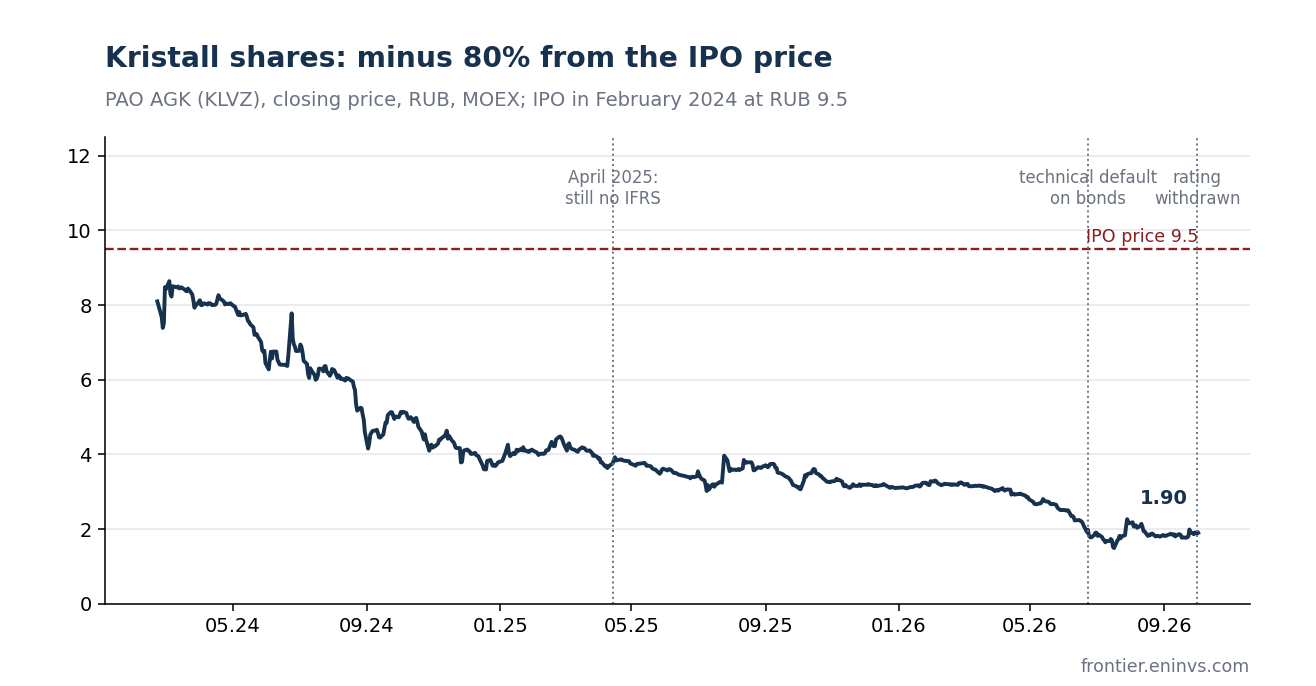
We have had objections to this group for a long time. In November 2023, before the IPO, we called the Kristall share offering a scam and advised staying away (channel post). The company was sold to investors at 117 times annual earnings, with stories of multiple-fold growth. Since the IPO price the share has fallen 80%. Now the same questions about the business and about the relationship with the owner have surfaced in the bonds, and our advice is the same: stay away.
The issuer card with financials by period and all issues: KLVZ Kristall. Below are Enhanced Investments' calculations based on the accounting statements (RAS) for 2025 and 1H2026, e-disclosure filings, NCR data and Moscow Exchange data. Where a figure is our estimate, it is marked as such.
The main points in seven theses:
- In June there was a one-day technical default, and on 1 October NCR withdrew a rating that had been under review with a possible downgrade.
- Profit from sales is not enough to cover interest, factoring and penalties. Net profit is held up by resales of trademarks.
- Trademarks are sold to and bought from companies of the beneficiary and of the CEO, for hundreds of millions of roubles. This is the most negative point in the whole story.
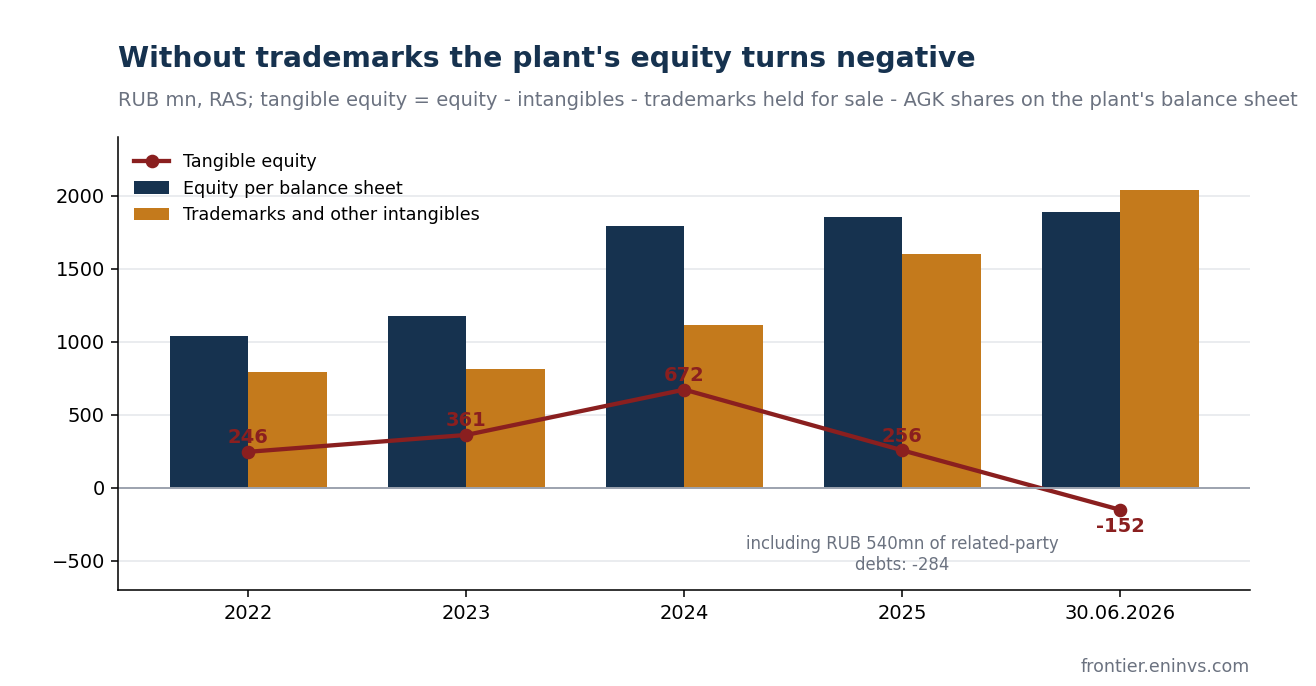
- If trademarks are removed from the balance sheet, the plant's own equity is negative.
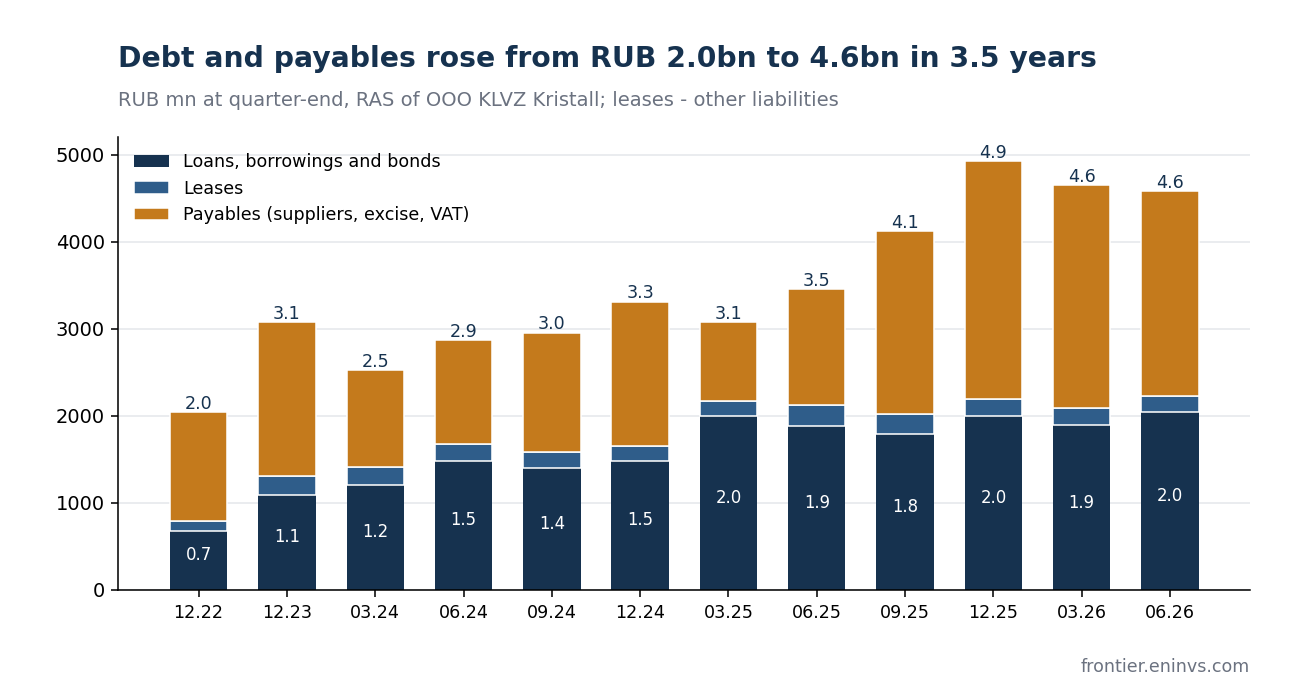
- Debt and payables rose from RUB 2.0bn to 4.6bn in three and a half years.
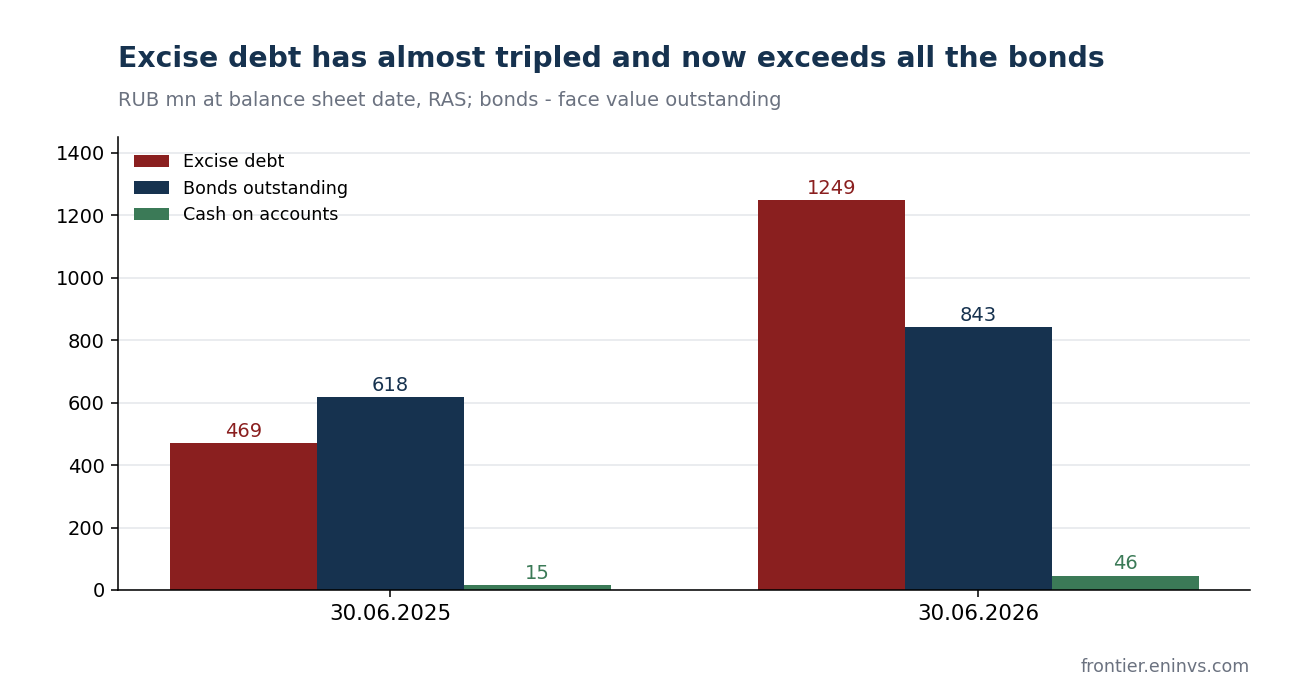
- Excise debt to the budget has almost tripled in a year and now exceeds all of the company's bonds.
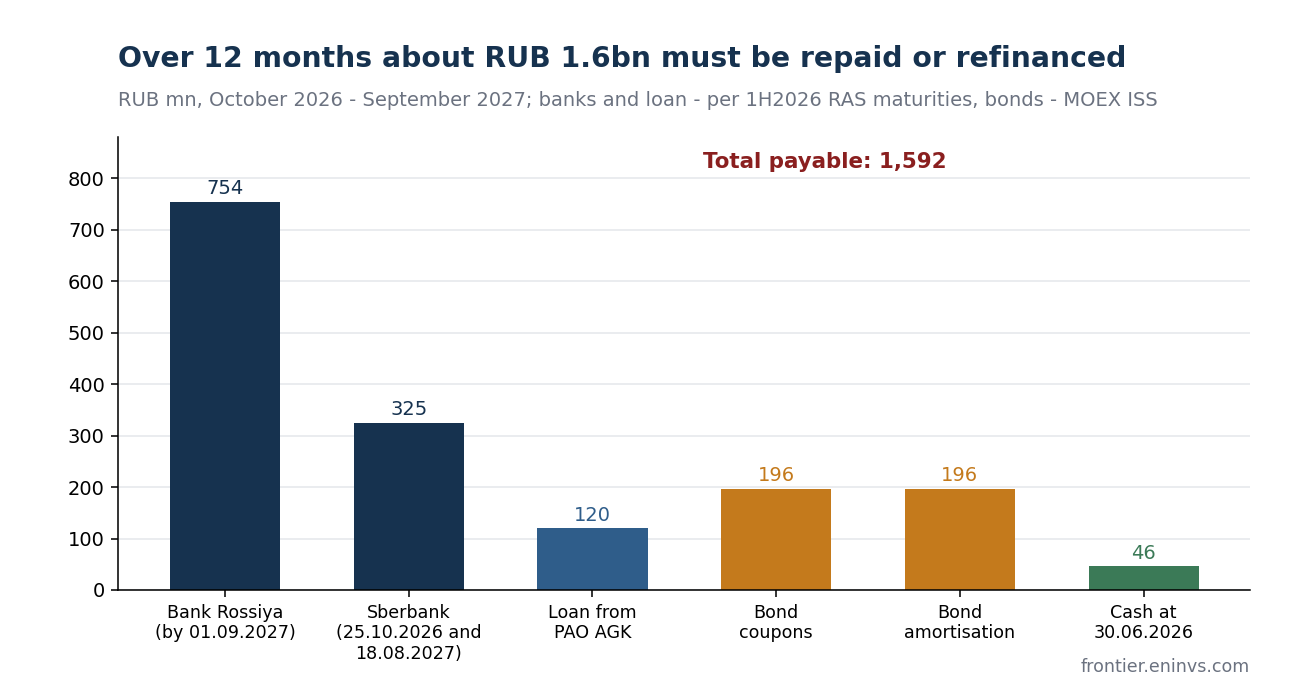
- By September 2027 about RUB 1.6bn must be repaid or refinanced against RUB 46mn in the accounts.
A vodka plant with listed shares and four bond issues
Fact. OOO Kaluzhsky Likero-Vodochny Zavod Kristall produces vodka, tinctures, liqueurs, gin and soju in Obninsk. According to NCR, vodka accounts for about 70% of revenue. 99.9% of the plant is owned by PAO Alcohol Group Kristall (AGK), whose shares trade on the Moscow Exchange under the ticker KLVZ. The beneficiary is Pavel Pobedkin.
In February 2024 AGK held an IPO at RUB 9.5 per share and raised about RUB 1.15bn for 13.1% of the capital. On 5 October 2026 the share was worth RUB 1.85.
The bonds are issued by the plant itself. Four issues with a face value of RUB 843mn are outstanding, all available to non-qualified investors:
- 1P02 (RU000A10AZG2): RUB 350mn, coupon 28% monthly, amortisation of 25% from May 2027 to February 2028. Price 90.6%.
- 1P03 (RU000A10AZF4): RUB 42.7mn, floating coupon "key rate + 7%", same redemption schedule. Price 85%.
- 1P04 (RU000A10DSU2): RUB 250mn, coupon 23.5% quarterly, redeemed in parts in 2028. Price 73.3%.
- 1P05 (RU000A10FBR9): RUB 200mn, coupon 21%, placed in June 2026, redeemed in parts in 2028-2029. Price 68.4%.
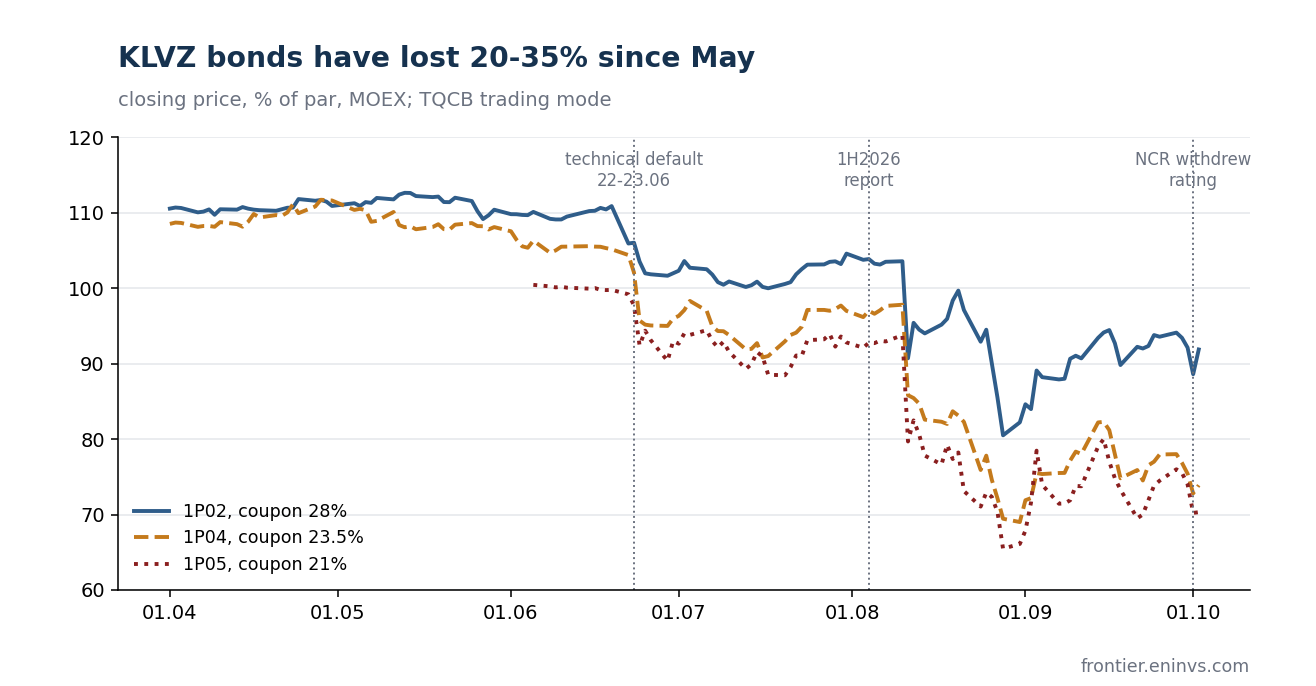
Authors' estimate. The effective yield of 47-55% on the Moscow Exchange assumes that every coupon is reinvested at the same rate. The simple yield without reinvestment (the coupon plus the discount to par spread over the average time to maturity) is lower: 37.6% on 1P02, 38.3% on 1P04 and 34.9% on 1P05. This is still 2.5-2.7 times the key rate of 14%, and the market has had such a premium only since this summer. In May, 1P02 and 1P04 traded at 112% and 108% of par.
At the IPO the company was sold at 117 times earnings and stories of multiple-fold growth. The numbers did not confirm the stories
How it was sold. Before the IPO the owner, Pavel Pobedkin, spoke at conferences and in the investor community and promised rapid growth, including through the Korean vodka soju, which the plant had started to produce. By his account (Financial One, 15.02.2024), revenue was to grow 5 times over three years and EBITDA 10 times. The IPO proceeds were promised for expanding production, logistics and new products.
What it cost. AGK placed at the top of the range, RUB 9.5 per share, and raised RUB 1.15bn. Market capitalisation after the placement was RUB 8.75bn. The authors' estimate based on the plant's 2023 statements, the last full year before the IPO:
- P/E of about 117: net profit of RUB 74.5mn;
- market capitalisation to revenue of 2.4: revenue of RUB 3.7bn;
- enterprise value with debt to profit from sales of about 41: profit from sales of RUB 238mn, debt of RUB 1.1bn.
For a vodka plant with a 2% net profit margin this is the price of a company taken on trust. Even then it was clear the offering was expensive. In November 2023 we wrote that the company discloses only RAS, the latest statements on its website were for 1H2022 with revenue of RUB 760mn and profit of about RUB 30mn, while it valued itself at RUB 6-9bn. We called the IPO a scam and advised against participating.
What the numbers showed. Revenue for the 12 months to mid-2026 is about RUB 5.0bn, up 35% on 2023 instead of the promised five-fold growth. Profit from sales rose in 2024, but net profit fell from 74 to RUB 66mn in the restated statements (the company originally showed 78mn): interest on debt consumed the growth. Over the last 12 months net profit is RUB 39mn, and in 1H2026 even profit from sales fell, by 9%. In two and a half years as a public company it has still not published IFRS (we reminded them of this in April 2025, post). By the balance sheet, the IPO money turned not into capacity but into trademarks, more on this below.
Conclusion. In our estimate, buyers in the IPO were sold a story that the numbers did not confirm, and they lost 80% of their investment. This is the standard market lesson: look at the reporting, not at the owner's speeches. If profit and disclosure do not match the promises, the promises are worth nothing. The bonds are issued by the same plant with the same owner, and there is no reason to expect a different attitude toward debt holders.
A one-day technical default, and three months later the rating was withdrawn instead of downgraded
Fact. On 22 June 2026 the company did not pay the coupons on 1P02 and 1P03 of RUB 8.8mn. The money reached holders the next day. In the disclosure the reason is given as a "technical error in sending payment documents", and the issuer stated that it had enough money. A curious detail: on 22 June the plant first published notices of payment, and on 23 June corrected the date in them and added the reason for the delay.
On 6 July NCR moved the BB-.ru rating to "under review with a possible downgrade". The agency wrote that it would monitor payment discipline and liquidity and might change the rating within three months. After three months, on 1 October, NCR withdrew the rating "due to expiry of the contract". The company did not renew the contract with the agency, and the market never saw the rating decision.
Why it matters. A BB- rating was low anyway, but without a rating the issues drop out of the view of many funds, and it becomes harder to place new issues for refinancing. Prices reacted in three waves: to the technical default, to the half-year report on 4 August, and to the rating withdrawal.
Profit from sales is not enough to cover interest, factoring and penalties
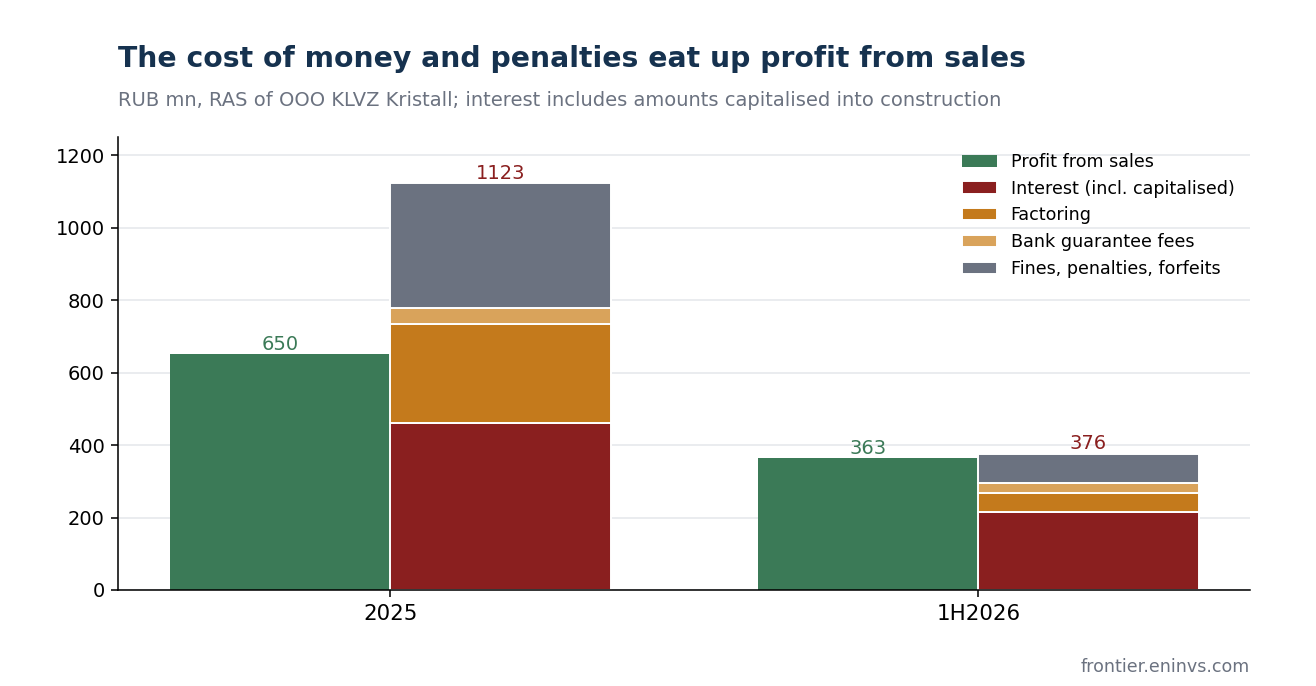
Fact. In 2025 profit from sales was RUB 651mn on revenue of RUB 4.78bn. Out of it the company must pay:
- interest – RUB 398mn in the income statement and another RUB 62mn that the company attributed to the cost of workshops under construction;
- factoring (selling customers' receivables to a bank at a discount) – RUB 275mn;
- fees to banks for guarantees – RUB 44mn;
- fines, penalties and forfeits under commercial contracts – RUB 345mn. To whom they were paid, the statements do not disclose.
In total RUB 1.12bn against RUB 651mn of profit from sales. In 1H2026 the picture is milder: RUB 376mn of costs against RUB 363mn of profit from sales, but there is still no cushion.
Where profit comes from, then. Net profit for 2025 is RUB 67mn, and for 1H2026 RUB 30mn. It is largely made by one-off income. In 1H2025 the company earned RUB 129mn from the sale of trademark rights against pre-tax profit of RUB 82mn. Without these deals the half-year would have been loss-making.
Authors' estimate. Counted the way banks do, net debt to EBITDA looks tolerable: about 2.7x at the end of 2025 (debt including leases of RUB 2.19bn, EBITDA as profit from sales plus depreciation of about RUB 0.79bn). But this metric does not see factoring and penalties, and for KLVZ it is exactly these that turn profit into zero.
Trademarks are sold to and bought from companies of the owner and the director
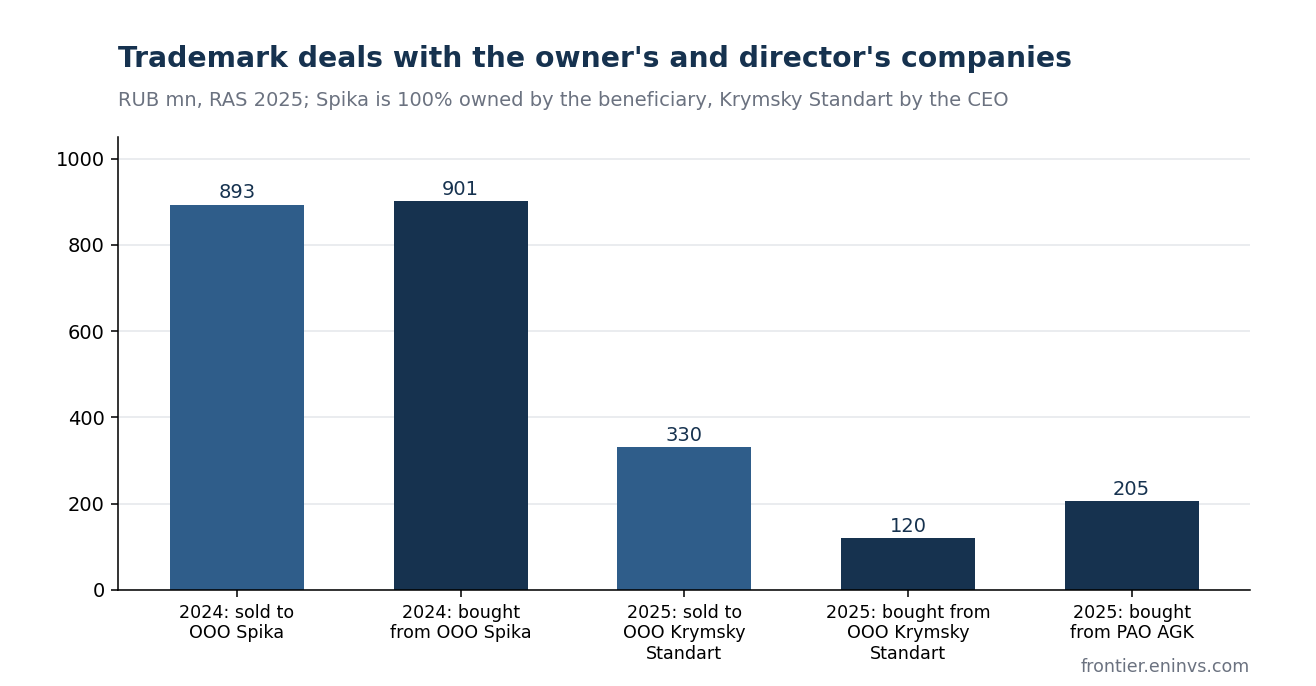
Fact. Related-party disclosure in the 2025 annual report:
- in 2024 the plant sold trademarks to OOO Spika for RUB 893mn and bought trademarks and recipes from the same Spika for RUB 901mn. Spika is 100% owned by Pavel Pobedkin;
- in 2025 the plant sold trademarks to OOO Krymsky Standart for RUB 330mn and bought from it for RUB 120mn. Krymsky Standart is 100% owned by Artem Chubukin, who was the plant's CEO until 26 August 2026. At the end of 2025 all RUB 330mn remained unpaid;
- another RUB 205mn of trademarks were bought from the parent AGK.
Related parties' debts to the plant rose from RUB 46mn at the end of 2023 to RUB 540mn at the end of 2025. Of this, RUB 44mn is owed personally by the beneficiary. The company writes that everything will be repaid in cash during 2026.
Fact. In 1H2026 intangible assets on the balance sheet rose from RUB 0.95bn to 1.44bn. Another RUB 0.54bn of trademarks are recorded as assets held for sale. Yet only RUB 37mn in cash went on buying all non-current assets during the half-year. Authors' assumption: the trademarks were paid for by offsetting mutual debts, not with cash. Receivables over the same half-year fell by RUB 0.83bn.
Fact. The auditor OOO Rusaudit gave a qualified opinion on the 2025 statements: trademarks worth RUB 108mn show signs of impairment, but the company did not carry out a test, and the auditor could not assess what amount of loss is not reflected. The annual statements themselves were signed on 31 March 2026 and re-signed on 27 April "due to the introduction of material adjustments". Which figures exactly changed cannot be understood from the report.
This is the most negative signal in the whole story. Deals in which the plant sells and buys assets from the companies of its beneficiary and of its own CEO cannot be verified by an outside investor. Nobody from outside has confirmed the price of the trademarks, the plant had not received payment for the RUB 330mn sale by year-end, and the profit from these deals goes into the reporting and improves it. There is no direct evidence of cash extraction in the reporting. But the structure allows value to be moved between the plant and the owner's companies at any price, while the risk lies with creditors. For us this is enough not to lend the company money at any interest rate.
Why it matters for a bondholder. Trademarks make up about a third of the plant's assets, and their price is set by deals within one group of related persons. If under stress they have to be sold to outside buyers, what they would fetch cannot be predicted. What the balance sheet looks like without them is shown in the next section.
Without trademarks the plant's equity is negative
Authors' estimate. On the balance sheet the plant has RUB 1.89bn of equity at 30 June 2026. Against RUB 2.0bn of debt this looks solid. But of RUB 6.6bn of assets, almost RUB 2.0bn are intangible: trademarks and other intangibles of RUB 1.44bn, trademarks put up for sale of RUB 0.54bn, and another RUB 52mn of shares in its own parent AGK. If these are deducted, the plant's tangible equity is negative: minus RUB 152mn.
It was not always so. In 2022-2023 tangible equity was positive, RUB 0.25-0.36bn. In 2024, after the IPO, participants contributed RUB 0.66bn in cash to the plant's capital, and it rose to RUB 0.67bn. But in the same year trademarks bought from the beneficiary's company came onto the balance sheet, and by mid-2026 intangible assets together with trademarks for sale had risen from 0.8 to RUB 2.0bn. On the balance sheet, the money raised in the IPO turned into trademarks whose price was set by deals within the group.
At the end of 2025 the plant was also waiting for RUB 540mn from related parties. If these debts are not counted either, tangible equity at that date is minus RUB 284mn.
What this means. The plant's creditors are protected from losses mainly by trademarks. In ordinary life trademarks bring revenue, and that is normal. But in a bankruptcy, mid-tier vodka brands are usually sold for much less than book value, and bondholders stand in line behind banks with collateral. Some of the trademarks ("Bionika", "Vomsa") are already pledged against loans of RUB 412mn.
The plant borrows from the budget and from suppliers
Fact. At 30 June 2026 the plant's excise debt is RUB 1.25bn against RUB 0.47bn a year earlier. This is more than all the bonds outstanding (RUB 0.84bn). Over the half-year the company accrued RUB 1.88bn of excise, so about four months of payments hang on the balance sheet. Debt to suppliers rose from RUB 0.36bn to 0.55bn.
What we checked. According to Federal Tax Service open data at 1 September 2026, the plant and AGK have no arrears, penalties or fines. There are no decisions suspending account operations as of 5 October 2026 (Federal Tax Service data via checko.ru). So the growth of excise debt is not a delay in payment to the tax authority, but the use of deferrals and payment deadlines.
Authors' estimate. Operating cash flow for 1H2026 is plus RUB 41mn against minus RUB 252mn a year earlier. The improvement is almost entirely explained by excise being paid later. If the deferral ends, the company will need money that is not in the accounts.
Fact. Adding up loans, bonds, leases and payables, the plant's total debt rose from RUB 2.0bn at the end of 2022 to RUB 4.6bn in mid-2026. Loans and bonds tripled, from 0.7 to RUB 2.0bn, and payables almost doubled, from 1.25 to RUB 2.35bn. Revenue over the same time rose by about 35%.
Over 12 months RUB 1.6bn must be found against RUB 46mn in the accounts
Fact. According to the schedule from the half-year statements and Moscow Exchange data, from October 2026 to September 2027 the plant has to pay:
- Sberbank – RUB 325mn, due 25 October 2026 and 18 August 2027;
- Bank Rossiya – RUB 754.5mn under a credit line until 1 September 2027;
- the parent AGK – a loan of RUB 120mn, whose contractual maturity expired in March 2026 but which was still outstanding at 30 June;
- bondholders – RUB 196mn of coupons and RUB 196mn of amortisation on 1P02 and 1P03 in May and August 2027.
In total about RUB 1.6bn. Cash at 30 June is RUB 46mn. In addition, the plant has guaranteed third-party obligations of RUB 470mn.
How this is usually handled. The loans of Bank Rossiya and Sberbank are revolving lines, and they are renewed. At 30 June 2026 the plant was in compliance with covenants (in 2025 one covenant was breached, and the bank did not demand early repayment). So the base case is refinancing, not a break. But the whole structure rests on the willingness of two banks to renew the lines and on excise deferrals. Authors' assumption: after the technical default and the rating withdrawal, a new bond issue is unlikely to be placed for less than 25-30%.
The vodka market is shrinking while excise is rising
Fact. According to Rosalkogoltabakkontrol (via TASS), vodka production in Russia in January-August 2026 fell 12.1%, to 39.6mn decalitres. For the first half the decline was about 4%, that is, it accelerated in summer. The excise rate on strong alcohol in 2026 is RUB 824 per litre of alcohol against RUB 740 in 2025.
What this means for KLVZ. So far the plant is growing against the market: revenue for 1H2026 is up 13% year on year. This is a strength. But in a shrinking market growth is usually bought with discounts to retail chains, and margins are under pressure. Profit from sales for the half-year fell 9% while revenue grew, and selling expenses rose 25%.
The owners took out money, and in court their right to a stake is being challenged
- Dividends above profit. In 2024 the plant paid participants RUB 117mn of dividends against net profit of RUB 66mn and operating cash flow of minus RUB 429mn. A year later the company was looking for refinancing money at 28%.
- Dispute over the stake. In April 2026 the plant disclosed that in the bankruptcy case of Nikolay Konovalov the financial manager is claiming RUB 110mn and RUB 37.9mn of interest from Pavel Pobedkin. The same case challenges the transaction under which Pobedkin bought a stake in the plant. The plant itself is a third party, and the company believes the outcome will not affect it.
- Change of management. From 26 August 2026 Pobedkin himself became the plant's CEO in place of Chubukin, and from 10 September of AGK as well. We did not find a separate notice on e-disclosure about this; the fact is visible in the Unified State Register of Legal Entities.
- Parent company. According to AGK's 2025 accounting statements (Federal Tax Service data), net loss was RUB 2.1bn on revenue of RUB 28mn. We found no reasons in the public domain.
Taxes and courts: no arrears or blocks, no enforcement proceedings
- Federal Tax Service. There are no arrears or debts on penalties and fines at 01.09.2026 either at the plant or at AGK. There are no suspensions of account operations: at the plant as of 05.10.2026, at AGK as of 25.08.2026.
- Arbitration. According to the arbitration case file, the plant has 57 cases as plaintiff for RUB 625mn and 16 cases as defendant for RUB 156mn, and no enforcement proceedings. We found no large claims against the plant that threaten liquidity, but we have not reviewed every case.
What could go better than it looks
- Coupons have been paid on time since June, and 1P01 was redeemed on schedule in March 2026.
- Revenue is growing faster than the market, and operating cash flow for the half-year turned positive.
- Banks continue to lend: in 2026 the plant received new tranches from Bank Rossiya, and with VTB an additional agreement on bank guarantees for RUB 4.6bn was signed.
- If the trademarks of RUB 0.54bn put up for sale are indeed sold for cash to outside buyers, this would cover a noticeable part of the near-term payments.
What to take from this story into your own practice
- A high yield without default is already the price of risk, not a gift. When a bond with no serious delay trades at 50%, the market sees the same thing you do and prices in a noticeable probability of losses. First find out why, then look at the coupon.
- Read the related-party section before everything else. Purchases and sales of assets from the companies of the owner, the director and their relatives are the most common sign that the interests of the owner and creditors diverge. If such deals run to hundreds of millions against profit in the tens, that is enough to walk away.
- Deduct intangible assets from equity. Trademarks, licences and goodwill stand on the balance sheet at what was paid for them, often inside the group. Tangible equity shows what is left to creditors if the brands turn out to be of no use to anyone.
- Count the full cost of money, not just interest. Factoring, bank guarantees and interest attributed to construction are not visible in the "interest payable" line. At KLVZ they almost double the burden.
- Look at payables and debts to the budget. A company can show moderate debt while financing itself with deferrals from suppliers and the tax authority. There is no interest on such debt, but it can be demanded all at once.
- A rating withdrawal during a review is a bad sign. If an agency put a rating under review for a downgrade and the company did not renew the contract, the market never learns what the new assessment would have been. Good news is usually not hidden by a company.
- An auditor's qualification and re-signed statements are a reason to recheck everything. Each on its own may be a technical trifle. Together with the other signs it means the issuer's figures need additional verification.
- Look at the numbers, not at the owner's words. Stories of multiple-fold growth and new products are worth nothing if the reporting does not confirm them. At the IPO, Kristall cost 117 years of earnings, and two years later profit was half as large.
- The share story is the best forecast for the bonds. If at the IPO a company promised growth of several times, did not keep the promises and did not disclose IFRS, its bonds need a large discount. The owner and the attitude to investors are the same for shares and debt.
Bottom line: at a yield of about 50% the risk is still not paid for, we are not buying the bonds
KLVZ is a real plant with growing revenue, but its financial structure is fragile. Profit from sales is not enough for the cost of money, the difference is covered by trademark deals inside the group, without those trademarks equity is negative, and liquidity rests on excise deferrals and the renewal of bank lines. Over six months a technical default, a refusal of the rating in the middle of a review, an auditor's qualification and re-signed statements have been added. Each point on its own is explainable, but together they give a picture in which the bondholder is the last to learn about problems.
What to watch next: repayment to Sberbank on 25 October 2026; coupons on 1P02 and 1P03 on 20 October and monthly thereafter; the 9-month statements in November (excise debt, settlements with related parties, sale of trademarks); whether a new rating appears.
Sources and caveats
- Accounting statements of OOO KLVZ Kristall for 2025 with the audit opinion of OOO Rusaudit (re-signed 27.04.2026) and the interim statements for 1H2026 with notes – issuer disclosure.
- Issuer notices on e-disclosure: technical default and payment of 22-23.06.2026, court dispute of 20.04.2026, placement of 1P05 in June 2026, redemption of 1P01 on 10.03.2026.
- NCR: press releases of 20.10.2025, 06.07.2026 and 01.10.2026.
- Issue terms, amortisation schedules, prices and yields at 05.10.2026, KLVZ share price – MOEX ISS.
- Arrears – Federal Tax Service open data at 01.09.2026; account blocks, Unified State Register of Legal Entities, arbitration, AGK statements – Federal Tax Service and arbitration case file data via checko.ru at 05.10.2026.
- RAS balance sheets at the end of each quarter from 31.12.2022 to 30.06.2026 – the issuer's quarterly statements. Posts of the Enhanced Investments channel of 21.11.2023 and 14.04.2025. The owner's plans – Financial One, 15.02.2024; IPO results (RUB 9.5, RUB 1.15bn, capitalisation RUB 8.75bn) – company statement via retail.ru; share prices – MOEX ISS.
- Vodka production – Rosalkogoltabakkontrol via TASS (January-August and 1H2026); excise rates – the Tax Code as amended in 2023.
- Simple yield, EBITDA, net debt, tangible equity and 12-month obligations – the authors' estimate.
We made this review at the request of commenters.
Reviews of other issuers are in the Telegram channel Enhanced Investments, and issuer cards with financials by period are on the portal.
See also: market overview · valuation map · stock screeners