Lenta: revenue up a quarter, but profit fell on the O'Key acquisition and interest costs
On 3 August Lenta reported results for the first half of 2026. Revenue rose 26.2% year on year to RUB 648.5 bn, EBITDA added 11.9% to RUB 58.3 bn, while net profit fell 25.5% to RUB 10.7 bn. The revenue growth was driven by the acquisition of the O'Key chain, closed in June, but the same deal brought a loss and increased debt, pushing interest expenses up to RUB 19.2 bn. At the current price the shares look rather attractive: EV/EBITDA LTM is 2.62 versus a three-year average of 2.36, and the portal's model puts the upside to fair value at +5%.
Key takeaways
— Revenue rose 26.2% on the O'Key acquisition, but organic growth is more modest
— EBITDA added 11.9%, yet the margin fell to 9.0% on one-off costs
— Net profit dropped 25.5% on interest expenses and a loss at the acquired chain
— Debt rose to RUB 117.4 bn as of 30 June 2026, but the debt/EBITDA ratio remains moderate
— Operating cash flow for the half-year was RUB 20.0 bn, capital expenditure RUB 22.2 bn
— EV/EBITDA LTM of 2.62 versus a three-year average of 2.36 – valuation above its own history
— The portal's model puts the upside to fair value at +5%
Attractiveness
Key figures, RUB bn
| Metric | H1 2025 | H1 2026 | Change |
|---|---|---|---|
| Revenue | 514 | 648 | +26.2% |
| EBITDA | 52.1 | 58.3 | +11.9% |
| Operating profit | 31.8 | 31.7 | -0.2% |
| Net profit | 14.3 | 10.7 | -25.5% |
| Operating cash flow | 26.0 | 20.0 | -23.1% |
| Capex | 19.4 | 22.2 | +14.7% |
| EBITDA margin | 10.1% | 9.0% | -1.1 pp |
| Net margin | 2.8% | 1.6% | -1.2 pp |
Revenue rose 26.2% on the O'Key acquisition, but organic growth is more modest
Lenta's revenue for the first half of 2026 was RUB 648.5 bn, up 26.2% year on year. The main driver was the acquisition of the O'Key hypermarket chain, closed on 2 June 2026. Since the acquisition date, O'Key contributed RUB 9.4 bn in revenue, and if the deal had been closed at the start of the year, the additional revenue would have been RUB 66.1 bn for the half-year.
Excluding the acquisition, organic revenue growth would have been significantly more modest. The company does not disclose organic dynamics separately, but the RUB 9.4 bn effect for less than a month suggests that the bulk of the revenue increase came from consolidating O'Key. This matters for assessing business sustainability: further growth will depend on integrating the acquired stores and restoring their revenue.
EBITDA added 11.9%, yet the margin fell to 9.0% on one-off costs
EBITDA for the first half of 2026 rose 11.9% year on year to RUB 58.3 bn, but the EBITDA margin fell to 9.0% from 10.1% a year earlier. The margin decline reflects costs of integrating O'Key and Dom Lenta (formerly OBI Russia), as well as the loss at the acquired chain. Since the acquisition date, O'Key posted a pre-tax loss of RUB 907.4 m.
Operating profit before impairment was almost flat year on year at RUB 31.7 bn versus RUB 31.8 bn. This means revenue growth did not translate into operating profit growth because selling, general and administrative expenses grew faster, reaching RUB 121.9 bn from RUB 90.8 bn. This is largely due to consolidating the acquired chains, but it also reflects inflationary pressure on costs.
Net profit dropped 25.5% on interest expenses and a loss at the acquired chain
Net profit for the first half of 2026 was RUB 10.7 bn, down 25.5% year on year. The main reason was the rise in interest expenses to RUB 19.2 bn from RUB 14.8 bn a year earlier. This reflects increased debt to finance acquisitions, as well as the general rise in interest rates in the economy.
Additional pressure came from the loss at the acquired O'Key chain, which amounted to RUB 907.4 m pre-tax since the purchase date. Foreign exchange gains also fell to RUB 0.3 m from RUB 452.3 m a year earlier. As a result, the net margin dropped to 1.6% from 2.8% a year earlier. Earnings per share fell to RUB 0.092 thousand from RUB 0.124 thousand.
Debt rose to RUB 117.4 bn as of 30 June 2026, but the debt/EBITDA ratio remains moderate
Lenta's net debt as of 30 June 2026 was RUB 117.4 bn, up from RUB 70.3 bn on 31 March 2026 (+RUB 47.1 bn) and from RUB 69.2 bn on 30 June 2025 (+RUB 48.2 bn). The increase reflects financing of the O'Key and Dom Lenta acquisitions, as well as a seasonal increase in working capital.
Despite the rise in absolute debt, the net debt/EBITDA LTM ratio stands at 1.26. This is a moderate level that leaves room for manoeuvre. However, the rise in interest expenses is already weighing noticeably on profit, and further debt growth could become a problem if EBITDA does not start growing faster.
Operating cash flow for the half-year was RUB 20.0 bn, capital expenditure RUB 22.2 bn
Operating cash flow for the first half of 2026 was RUB 20.0 bn, down from RUB 26.0 bn a year earlier. The decline reflects higher interest payments and an increase in working capital. Capital expenditure rose to RUB 22.2 bn from RUB 19.4 bn a year earlier, resulting in negative free cash flow.
The company continues to invest in development, including acquisitions and new store openings. In the first half, RUB 7.8 bn was spent on acquiring subsidiaries and RUB 18.4 bn on property, plant and equipment. Negative free cash flow means the company is financing investments with debt, which increases financial risks.
EV/EBITDA LTM of 2.62 versus a three-year average of 2.36 – valuation above its own history
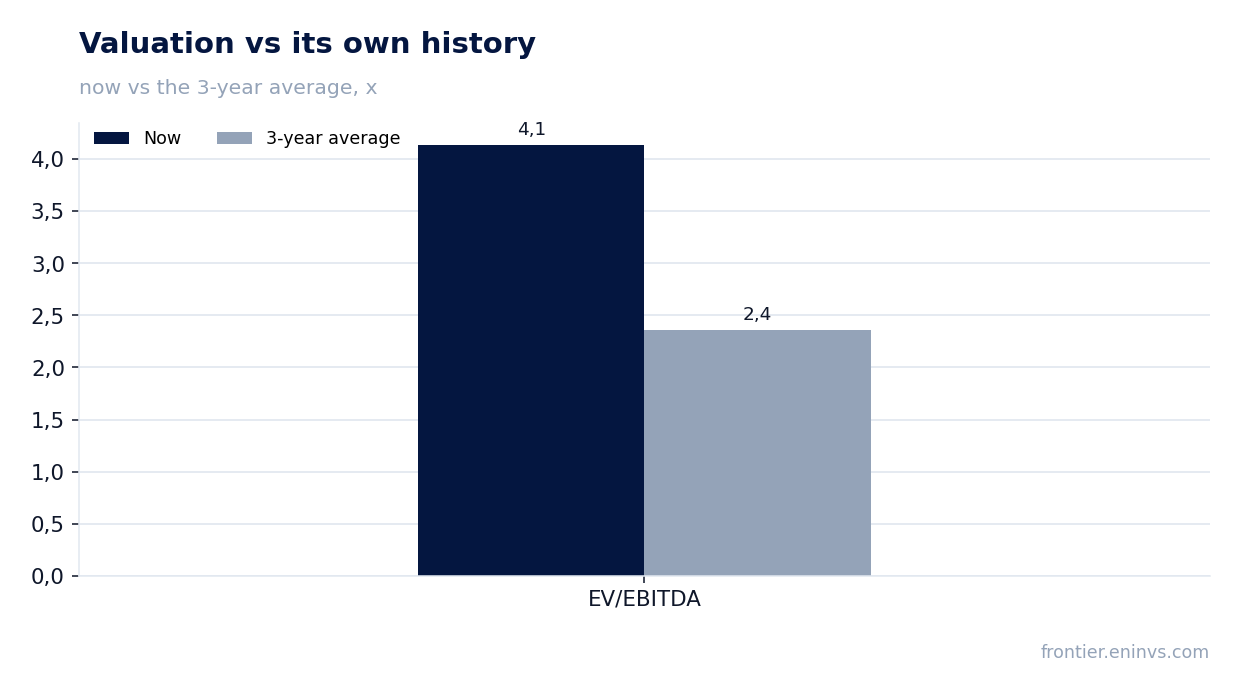
Lenta's current valuation on EV/EBITDA LTM is 2.62, above the three-year average of 2.36. This means the market values the company slightly higher than its average over the past three years. At the same time, P/E LTM is 6.23, which may also indicate a relatively low valuation compared to the broader market.
The multiple's rise above its historical average may reflect expectations of synergies from acquisitions, as well as general market growth. However, if profit does not recover, the current valuation could prove inflated. It is important to monitor EBITDA dynamics and debt load in future reports.
The portal's model puts the upside to fair value at +5%
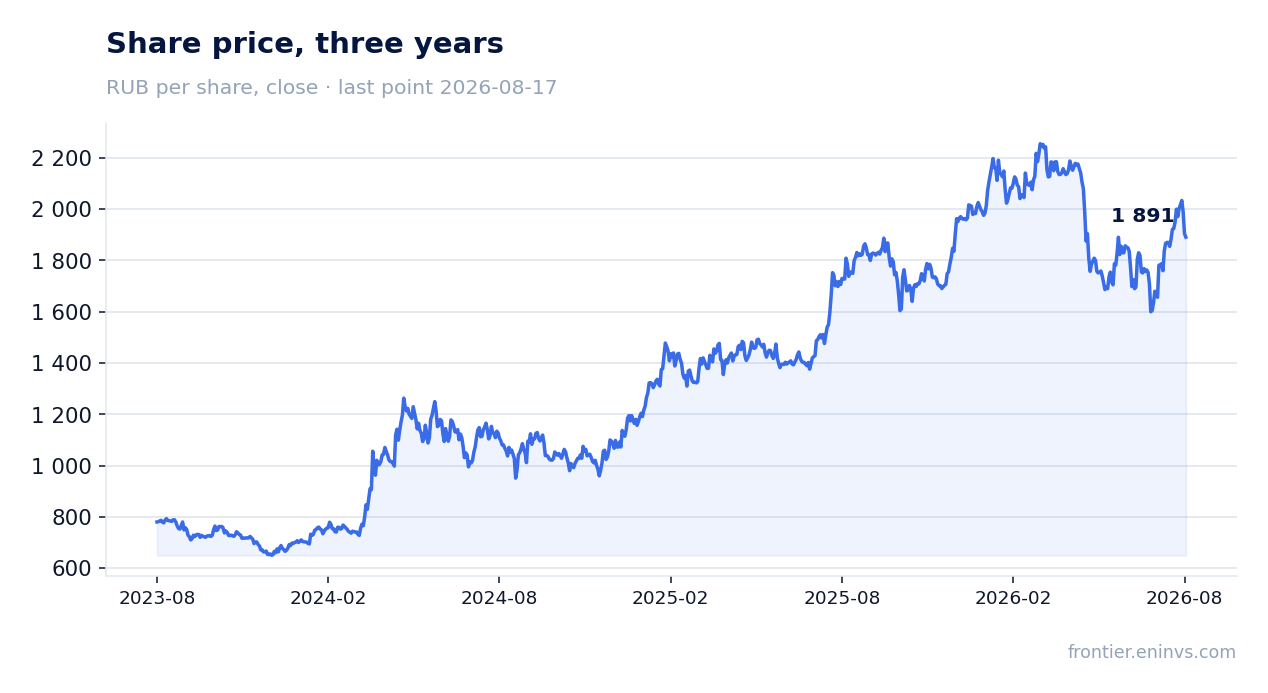
According to the portal's model, which factors in EBITDA growth and a target multiple, the upside for Lenta's shares to fair value is +5%. This is a moderate upside that does not imply a significant upward re-rating. The model is based on conservative assumptions and does not account for potential synergies from integrating O'Key.
Given the current price and a market capitalisation of RUB 194.5 bn, the shares trade at a small discount to fair value on our model. However, more substantial growth would require the company to demonstrate improved profitability and reduced debt load.
Valuation on the latest reported figures
| Metric | Value |
|---|---|
| Market cap | 195 bn ₽ |
| P/E (LTM) | 6.2 |
| EV/EBITDA (LTM) | 2.6 |
| P/B | 1.08 |
| Net debt / EBITDA (LTM) | 1.26 |
| Operating cash flow (LTM) | 86.7 bn |
| ROE | 11.5% |
| EV/EBITDA, 3-year average | 2.4 |
Bottom line
Lenta delivered strong revenue growth through acquisitions, but this did not translate into profit growth. EBITDA rose, but the margin declined, and net profit fell on interest expenses and the O'Key loss. Debt increased to RUB 117.4 bn, but the debt/EBITDA ratio remains moderate. The EV/EBITDA valuation is above its own history, and the portal's model implies +5% upside. At the current price the shares look rather attractive, but to confirm this the company needs to demonstrate improved profitability and reduced debt load.
Open the company's financial profile LENT →
See also: market overview · valuation map · stock screeners