Incentives at the minority's expense: how management reward programmes dilute shareholders – Russia versus global practice
Over the past two years almost every new Moscow Exchange issuer has announced a long-term share-based incentive programme for management. The market traditionally greets such news as "the company is buying back its own shares" – a signal of confidence and care for capitalisation. But a buyback "for incentives" and a buyback "for cancellation" are economically opposite operations. This review examines how much capital Russian companies have set aside for such programmes, how much has actually been distributed to management, whether the expense reaches the income statement, why shares keep being awarded even where the profit plan has failed – and why, in the whole "buy → hand out → sell" scheme, the market sees only the first two moves.
A buyback for incentives is not a return of capital to shareholders but its transit to management
A classic buyback with cancellation reduces the number of shares: the stake and earnings per share of every remaining owner rise. It is a form of payout to shareholders, an alternative to a dividend.
A buyback "for an incentive programme" does not cancel the shares: they settle on the balance sheet of a subsidiary (a quasi-treasury stake) and are then transferred to management at par value or a preferential price. For the shareholder this is not a return of capital but its transfer – the company's money is spent, but the shares have not disappeared; they have merely changed hands from the exchange to management. Economically it is cash compensation of staff financed from shareholders' funds, but presented as a "measure to support the share price". Hence the systemic confusion in perception.
The incentive expense is real, but "adjusted" profit hides it
Under IFRS (IFRS 2) share-based compensation is an expense recognised over the vesting period at fair value on the grant date. The expense is non-cash but quite real: it means dilution of future shareholders. Yet companies almost universally exclude it (stock-based compensation, SBC) from "adjusted EBITDA" and "adjusted net profit" – that is, from the very figures by which the market values them.
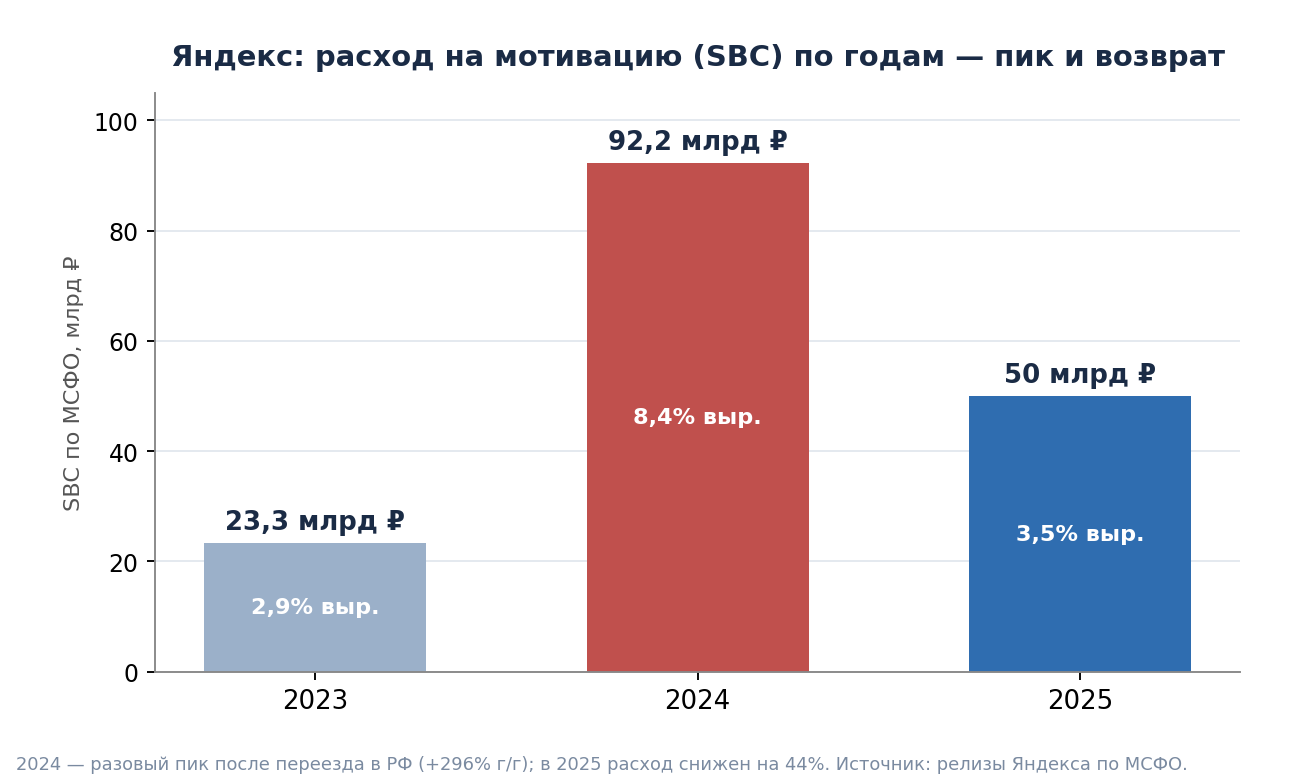
The scale in developed markets is clear. In the US (Russell 3000 index) SBC expense grew from about $25bn in 2006 (when it became mandatory to show it in the income statement) to ~$270bn in 2022 – from 0.2% to 1.3% of revenue and 6–8% of total compensation (Morgan Stanley/Mauboussin estimate). For individual technology companies the share is many times higher. Russia's Yandex is telling here: in 2024 SBC jumped to 8.4% of revenue (RUB 92.2bn) – a one-off peak after the move to Russia – but in 2025 it normalised to 3.5% (RUB 50bn, −44%).
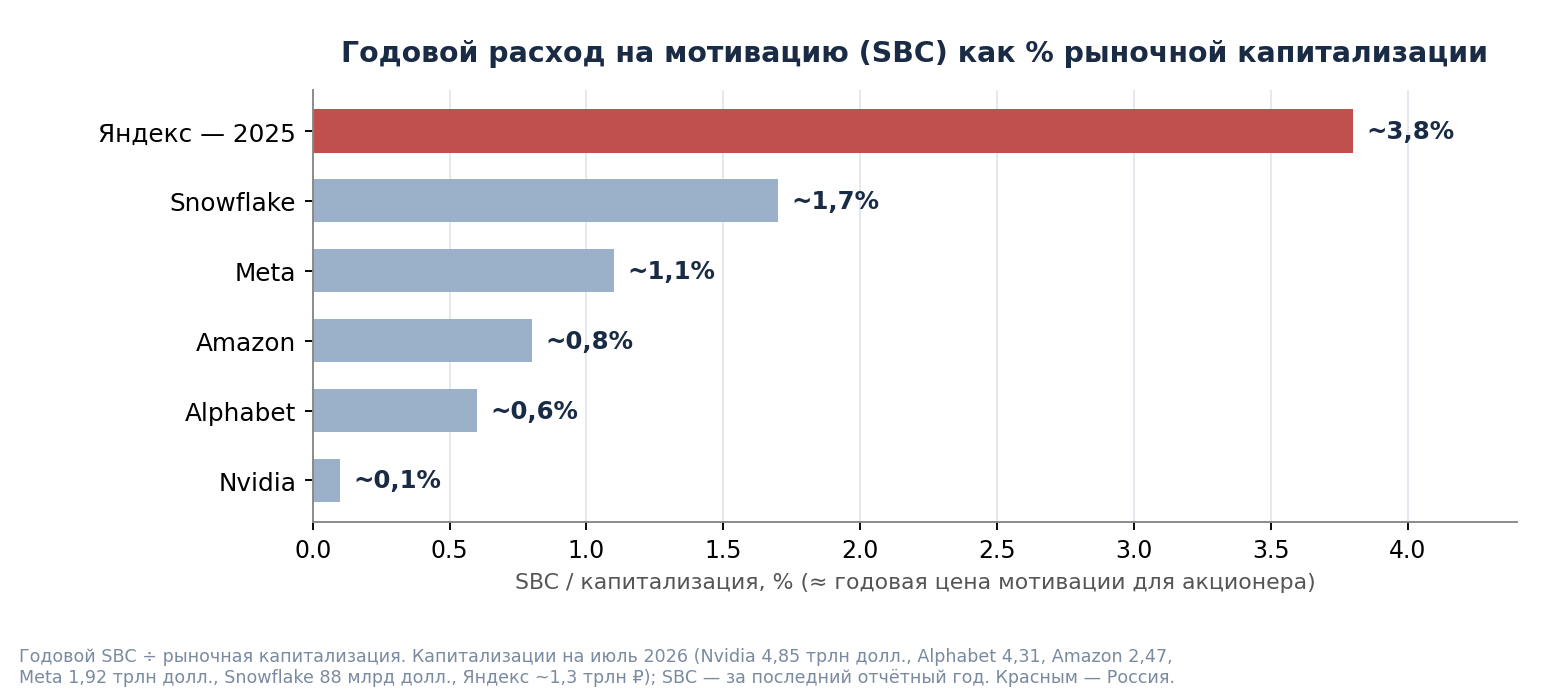
But revenue is not the best measure of the price for a shareholder. It is fairer to count the expense against market capitalisation: how much of the company's value goes to incentives each year. In these terms Yandex comes out at about 3.8% a year – heavier than any American giant: for Amazon it is 0.8%, for Nvidia a token 0.1%. This, rather than "40% of revenue" at individual names, is how the real annual cost of the programmes shows.
Russia: "new" issuers have set aside from 2% to 20% of shares for incentives
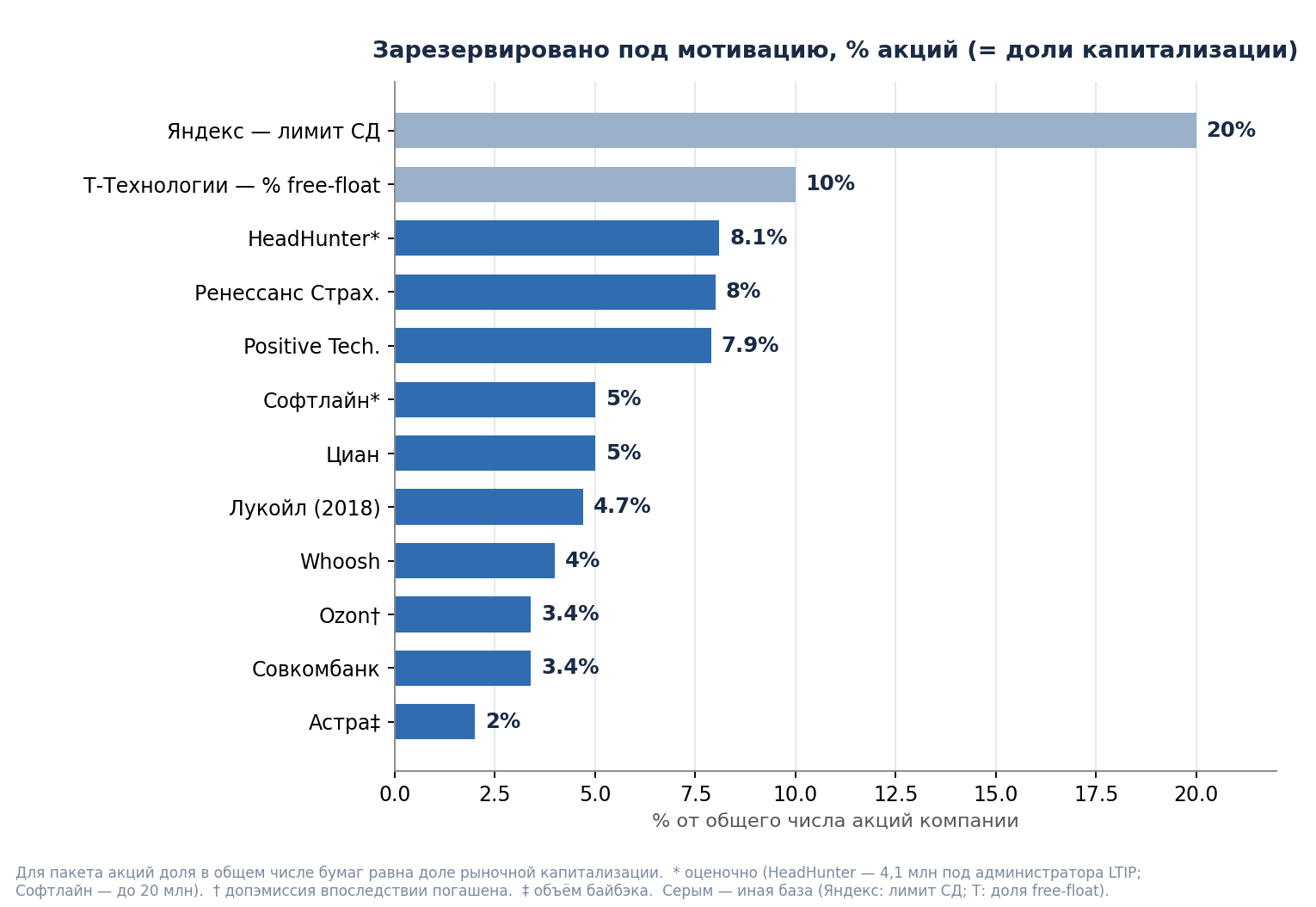
Practically the entire class of 2020–2024 IPO issuers has an incentive programme. The spread of declared amounts is wide – from ~2% (Astra, buyback size) to up to 20% (Yandex, board authorisation limit). The key difference between programmes is the mechanism: a new issue gives direct dilution, while a quasi-treasury stake or a market buyback creates no new shares, but the company's capital is spent all the same.
T-Technologies, Yandex, Ozon: three different mechanisms – one result
T-Technologies builds a reserve for management incentives by buying on the open market; the target is up to 10% of free float by the end of 2026. In just the first two weeks of July 2026 about RUB 2bn went on buybacks. In parallel an additional issue is under discussion, postponed to December 2026, the size of which has not been officially disclosed. The mechanism is treasury shares, with no direct dilution, but 10% of free float is a very large reserve for management.
After moving to Russia (International Public Joint-Stock Company Yandex), Yandex received the right to place up to 15.61 million shares by closed subscription for the employee incentive programme – this will increase the number of outstanding shares by at most 4.11% in the nearest tranche. The board of directors authorised the programme for 4 years with a total limit of no more than 20% of outstanding ordinary shares and a cap of ≤2% a year. This is the largest programme on the market by "ceiling", and the dilution here is direct – through a new issue.
Ozon is an instructive counter-case. Back in 2021 the company issued 7.4 million shares for incentives but could not use them because of regulatory restrictions. In 2026, after carrying out an additional issue for the programme, Ozon then cancelled exactly 7,421,626 shares, returning the total number of shares to 216,413,735 – that is, it zeroed out the dilution. The programme's obligations are now covered by a buyback (budget of up to RUB 25bn until the end of 2026). In effect Ozon was the first to publicly formalise the principle "incentives not at shareholders' expense".
Astra, Softline, Whoosh, Renaissance, CIAN, Sovcombank: the quasi-treasury stake as a quiet channel
- Astra – an LTI programme since 2025 with no new issue, from a quasi-treasury stake (10 million shares previously bought on the market); 464,186 shares have already been allocated to the first stage. The board approved a buyback of up to 4 million shares (~2% of capital) for incentives and M&A. The fate of its profit plan is examined separately below.
- Softline – up to 20 million shares (~5% of capital); the source is already issued treasury shares of a subsidiary, with market buying only if treasury shares run short. No dilution from new shares.
- Whoosh – an option pool of up to 4.5 million shares (~4% of share capital), exercisable at par value when EBITDA targets for 2024, 2025 and 2026 are met; a separate buyback was carried out for the pool.
- Renaissance Insurance – a 10-year programme approved by the board in 4Q2023; during 2023 about 8% of share capital was accumulated on the balance sheets of subsidiaries – by market buying, not by issuance.
- CIAN – part of the quasi-treasury stake is moved into a reserve for future long-term programmes: about 3.7 million shares (~5% of those issued).
- Sovcombank – 3.4% of capital is reserved for the option programme, with 675 million shares bought from minority shareholders.
LUKOIL 2018: a "model" buyback ended with a block set aside for management
The historical precedent arose long before the current wave. In 2018 LUKOIL held about 140 million treasury shares through Cyprus-based Lukoil Securities. Most of them – around 100 million (~10% of capital) – the company cancelled, which the market rightly saw as a return of value. But ~40 million (~4.7%) were not cancelled and were instead reserved for a new long-term incentive programme for key employees. Even the "benchmark" cancellation of treasury shares was accompanied by setting aside a sizeable block for management.
MGKL: dividends were cancelled, while the buyback shrinks the free float almost sixfold
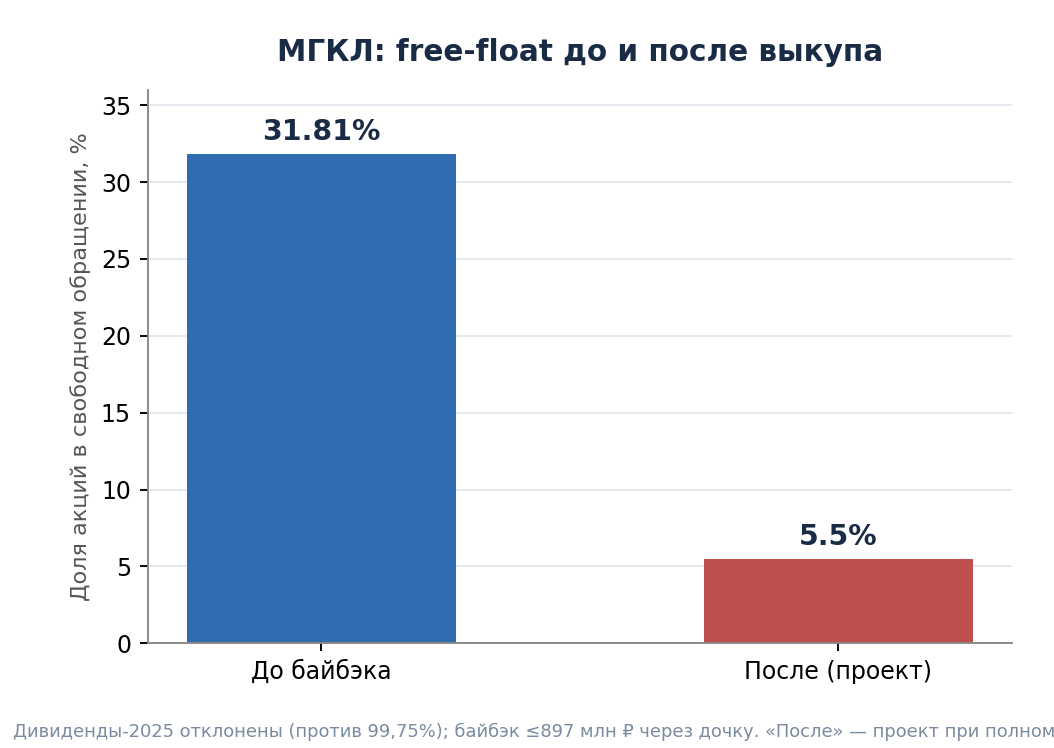
The most recent and clearest case of substitution is MGKL (Mosgorlombard). In July 2026 the annual meeting rejected the dividend for 2025 (the recommended RUB 0.28 per share, 49% of IFRS profit) – more than 99.75% of participants voted against. Instead of the payout the board launched a buyback of up to RUB 897mn through the 100%-owned subsidiary "Komanda MGKL" on the Moscow Exchange.
By the company's own calculation the buyback could cut the free float from 31.81% to 5.5% – almost sixfold. And the press release states directly that the bought-back shares "may be used... including for long-term management incentive programmes". That is, capital is not returned to shareholders as a dividend but taken off the market and may end up with management. A caveat: this is the *project maximum* – at the time of publication the buyback had not yet been executed, and incentives are only declared as one of the possible purposes.
Buy → hand out → sell: on the third move the trail goes cold
Let us put it all into one mechanism. Move one – "buy": the company's money (that is, shareholders' money) goes into buying shares or into an additional issue for the programme. Move two – "hand out": the shares settle with management and employees, often at par value and, as seen above, sometimes even when the plan has failed. Move three – "sell": after vesting and the end of the lock-up the recipient is free to sell the shares into the market. For shares issued for a programme this is not a hypothesis but arithmetic – sooner or later they become supply in the order book, to the same minority holders who were pleased about the "buyback".
The first two moves are documented and paid for by the shareholder. And at the third the trail goes cold: actual sales of vested shares by management and employees in Russia are not publicly disclosed – there is no requirement to report when an insider has sold shares received through incentives. Checking the exchange tape also gives no proof: on the highest-volume days for most shares with large programmes (Whoosh, Yandex, Sovcombank, Positive, Astra) elevated turnover falls on rises and falls about equally – there is no clean trace of a sell-off. Only at some weak names (T-Technologies, Diasoft) are the highest-volume days skewed downward, but this is closer to the general downtrend than to a caught dump; even intraday, on the days of results publication, T-Technologies moved calmly. The conclusion is uncomfortable but honest: it cannot be proven that management is pouring shares into the market – and not because it surely is not, but because nobody is obliged to show it. There is an overhang, but no meter has been provided for it.
What the market does see are indirect confirmations of pressure. The very announcement of Positive Technologies' incentive issue in October 2023 knocked the share down more than 7% in two days; in August 2024 the Bank of Russia suspended this issue after complaints from minority shareholders and resumed it only in October, and the size under pressure was cut from "25% for each doubling" to 15%. And, separately, how insiders lock in profit: the register of disclosed insider transactions shows that Astra's founder sold twice – 8.4 million shares at the IPO itself (October 2023) and another 21 million at the SPO in April 2024 (10% of capital, RUB 11.7bn), cutting his stake from 76% to ~62%. Another telling point: this register shows only such deals – sales by founders and major holders (Astra; CIAN's Cypriot structures at the relocation) – while sales of incentive blocks as such are not recorded there. An insider exits to cash publicly when it is his own stake; when shares equivalent in substance were received through a programme, their sale simply does not surface in the disclosures.
Announced does not mean handed out: the fact hides in the IFRS share-based payment note
The key question is not how much has been announced but how much has actually been transferred. The answer is in the note "Share-based payments" (IFRS 2): the number of instruments granted / vested / exercised / outstanding and the rouble expense. What the facts show:
- Yandex – SBC expense in 2024 reached RUB 92.2bn (8.4% of revenue) – a one-off peak after the move (a fourfold rise from RUB 23.3bn); in 2025 it fell to RUB 50bn (3.5%, −44%). In fact, in 2025 programme participants were transferred 4.4 million shares (1.12% of capital).
- HeadHunter – at redomiciliation an additional issue of 18 million shares was carried out (exchange plus LTIP), of which 4.1 million were placed in favour of the incentive programme administrator at RUB 5,450. An important nuance here: results meanwhile were growing (adjusted net profit 2024 +96%), so not every programme runs against poor results.
- Astra – of the announced package, 464,186 shares were actually handed out for the first stage; the buyback replenishes what has already been transferred to employees.
- Positive Technologies – for incentives (~1,900 contributors) 5.214 million shares were actually issued – 7.9% of capital at RUB 2,653, with the issue registered by the Central Bank in December 2024.
The general rule: in IFRS reporting the expense is shown (growth in personnel costs), but in press releases and presentations it is almost always excluded from adjusted EBITDA and profit. The adjusted profit of an issuer with a large programme is systematically overstated by the amount of SBC, and for comparability it must be put back into costs.
But even the thesis "the expense is shown in IFRS" is not entirely true – and this can be verified. First, under IFRS 2 part of the compensation of employees engaged in development is capitalised into intangible assets rather than written off to expenses: these amounts, in the words of Positive Technologies itself, "do not enter the statement of financial results". Because of this Positive even introduced its own metrics EBITDAC and NIC – its 2024 EBITDAC is minus RUB 1.2bn against a positive EBITDA; Astra in the same year capitalised RUB 2.9bn of development costs, which settled on the balance sheet rather than in profit. Second, one and the same SBC appears in different figures: for Yandex in 2024 it is RUB 92.2bn of total expense, RUB 89.1bn of "defined SBC" in the adjusted profit reconciliation and another ~RUB 81bn in the non-cash adjustment of the cash flow statement. The check is simple: reconcile these three numbers and look at the line "capitalisation of development costs" – that is where part of the price of incentives that did not reach profit hides.
Disclosure differs, though, and T-Technologies is an example of good practice here: in the personnel expense note there is directly a line "share-based compensation" – RUB 7.7bn for 2024 (against RUB 3.6bn in 2023), of which ~RUB 6.9bn fell on key management. A bank has nothing to hide in "capitalised development", and the expense is visible in full. But one nuance remains even with honest disclosure: under IFRS 2 the expense is calculated at fair value on the grant date and not remeasured afterwards – if the share rises, the value actually transferred to management exceeds the recognised expense. And the programme itself is swelling: T's announced grants jumped from 0.4 million shares in 2023 to 12.9 million in 2024 – which means the expense in the income statement will only grow.
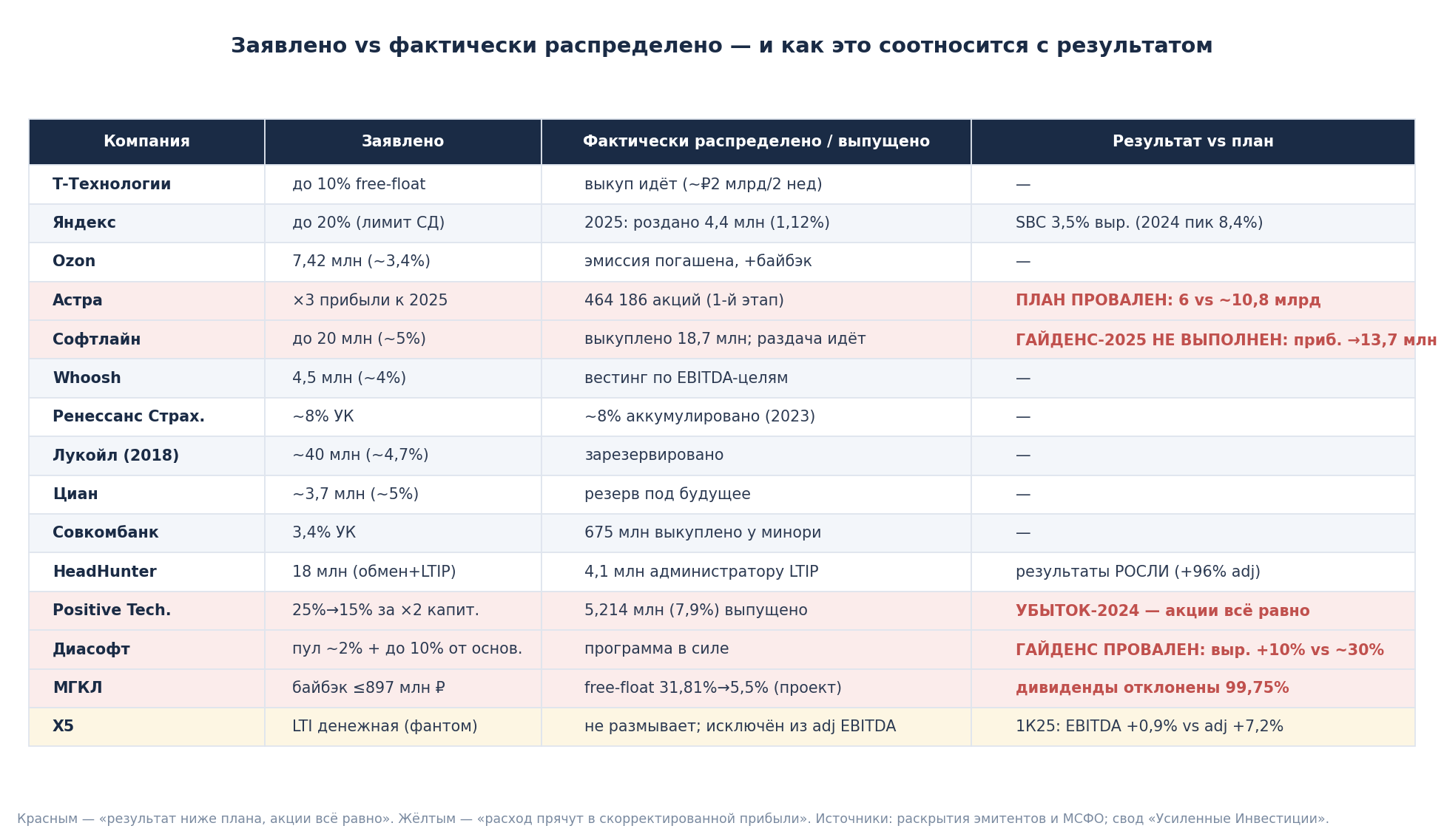
A separate question is whether in the end they hand out more than promised. Direct breaches of declared limits are not visible in the disclosures: what has actually been transferred so far fits within the announced ceilings. But the ceilings themselves are often "floating" and are being raised. At Yandex the limit is ≤2% a year, but up to 20% in total over four years – and the announced "nearest tranche of 4.11%" greatly understates the final size. At Positive Technologies the issue ran "for each doubling of capitalisation" – in effect an open-ended construction. Astra launched a new round of 2.5 million shares on top of the first package. Softline has already bought back 18.7 million of the declared 20 million – right up to the limit. What understates expectations is not an excess over the ceiling but the very design of programmes, in which the ceiling renews.
And more subtly: the declared "ceiling" usually hangs on one channel. At Yandex "≤2% a year" and "up to 20%" refer to new issuance by closed subscription into the ESOP subsidiary; but in parallel there was a separate issue for the exchange of "frozen" Yandex N.V. options for new shares (≈5.4 million, ≈RUB 18bn) – this flow does not read into "2% a year". At T-Technologies incentives come not by issuance at all but by buying back up to 10% of free float (the treasury channel), while T's additional issue is for the consolidation of Tochka, not for incentives. The point is the same: to see the real volume, all channels must be added – new issuance, treasury shares/buyback and the exchange of old options – while the public limit covers only one. It is no accident that the Ministry of Finance bill proposes counting the 10% "taking into account securities previously received by management" – this closes exactly such a gap.
Result below plan – shares are awarded anyway
This is the pain point. Incentives should pay for results achieved, but in practice shares are often still awarded when the plan has failed.
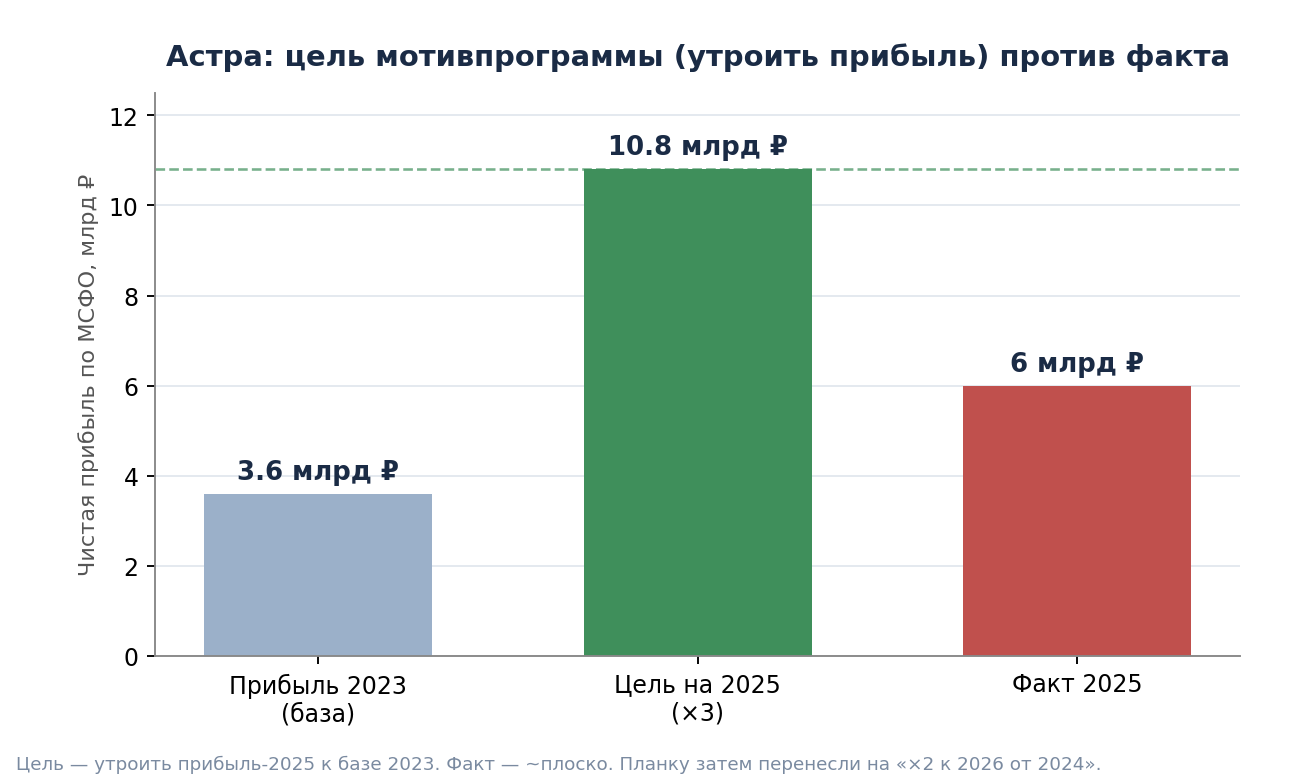
Astra. At the IPO the key goal of the incentive programme was declared to be tripling net profit by 2025 relative to the 2023 base (~RUB 3.6bn) – that is, reaching ~RUB 10.8bn. In fact 2025 profit stayed almost flat – about RUB 6bn, half the target. This did not stop the programme: a new round of 2.5 million quasi-treasury shares was launched, vesting of the next package is under way, and the bar was rewritten to "×2 by 2026 from 2024" – a classic moving of the goalposts.
Positive Technologies is an even cleaner example. The 2024 results came in half as good as management's own forecast: shipments of RUB 24.1bn against an expected 40–50bn, and in profit a net loss of about RUB 2.7bn. Nevertheless the incentive issue of 7.9% of capital was registered and distributed. The company promised to return to a new issue no earlier than 2026 and only if growth resumed – but employees had already received shares for the failed year.
Diasoft is the freshest example of how a growth story that does not come true gets sold. At the IPO in February 2024 the company was marketed on revenue growth of about 30% a year (a model of up to RUB 20.2bn by 2026). In fact, for FY2024 (year to 31 March 2025) revenue grew only 10% – to RUB 10.1bn (below consensus), EBITDA fell 25% to RUB 2.9bn (margin compressed from ~43% to 29%), and in 1H FY2025 the EBITDA margin collapsed to 10.5%. Yet the incentive programme remained in force: a pool of up to ~2% of capital for 50–100 employees plus a transfer of up to 10% from the founders' stakes. Growth was promised to shareholders – and it was the share price that paid first for the unfulfilled guidance.
Even without dilution the expense is hidden in "adjusted" profit: X5 and Softline
A programme does not have to issue new shares to cost the shareholder money. At X5 the long-term incentive is cash (payouts at the end of a three-year cycle); it does not dilute the stake, but the company excludes its expense from adjusted EBITDA. The effect is visible in the gap: for 1Q2025 reported EBITDA grew by only 0.9% (RUB 72.8bn), while adjusted grew by 7.2% (RUB 78.9bn); the difference of about RUB 6bn is precisely the incentive payouts and one-off items taken outside the brackets. The scale: in 4Q2023 alone the LTI expense was RUB 1.7bn (+138% y/y).
Softline is a second illustration, and based on 2025 results an even harsher one. The company did not meet its guidance: turnover of RUB 131.9bn (+9%) against a plan of "at least 150bn", adjusted EBITDA of RUB 8.1bn against the promised 9–10.5bn. And IFRS net profit collapsed almost to zero – RUB 13.7mn against RUB 2.6bn a year earlier (−99.5%): it was eaten by interest expense on swollen debt. Meanwhile the handing out of shares to management and employees continues – under the programme (up to 20 million shares) 18.7 million have already been bought back. Adjusted metrics grow, bottom-line profit disappears, and incentives are accrued – the same pattern as at Astra and Positive Technologies.
There is no hard "inverse correlation" with share growth, but there is a skew in favour of the large
The thesis "companies without dilution grew better" is intuitive but requires caution. The popular marketing figure – "no company with dilution above 3% has outperformed the Nasdaq" – does not withstand scrutiny: it is a one-year cross-section from the materials of an interested fund manager. The academic picture is mixed: there is a positive relationship between SBC and market value where options genuinely align the manager's incentives, and an insignificant one where it is simply a "reward". What matters is not the programme itself but its design.
What is robust: at small companies dilution is greater. For the Russell 3000 in 2020–2022 shareholders of the three smallest revenue deciles were diluted by an average of ~6% over three years, while at the three largest the stake even rose – thanks to buybacks. And it is precisely the companies with the highest SBC-to-revenue ratio that spend the most on buybacks: in 2022 gross buybacks were 4.1× SBC. Buybacks are widely used to mask dilution. The conclusion for the retail investor is direct: an incentive programme at a small issuer dilutes more, and a "buyback" next to it is often not a bonus to shareholders but a compensator for this dilution.
X5 is partly different: it returns capital to all shareholders by dividend (RUB 648 per share for 2024, ~RUB 159bn), and its incentive programme is cash-based (phantom) and issues no new shares – that is, it does not dilute the stake. But the same trick with "adjusted" profit works here too, as discussed below.
Even clearer is the recent DOM.RF. The state company's incentive programme is minimal: shares worth only ~RUB 4bn are reserved for it – around 1% of capitalisation (against a 20% limit at Yandex and 10% of free float at T-Technologies), and employees additionally bought shares with their own money. In parallel the company returns capital: a target payout of 50%, a dividend for 2025 of RUB 246.88 (yield ~10.7%). Result: since the IPO in November 2025 the share has gained about 24% – in a weak market where diluting tech names were spinning their wheels. This is not proof of causation (the period is short and the business itself is a state mortgage giant), but a clear illustration of the alternative: a small, limited programme plus a return of capital by dividend – instead of handing management large blocks.
And a heavyweight of the same row – Sberbank. It practically issues no new shares for incentives: the number of shares (21.6 billion ordinary plus 1 billion preferred) has not changed for years – no dilution. Instead the bank returns record profit (RUB 1.58trn for 2024) to shareholders by dividend: a 50% payout, for 2025 RUB 37.64 per share (yield ~12.6%), in total about RUB 850bn. The share price is near multi-year highs. The model is extremely simple: do not dilute and share the profit – and it, rather than a "generous option", has historically worked best for the long-term shareholder.
The most generous programmes are where the business changed owner cheaply after 2022
The two largest incentive pools on the market sit at companies that changed owner at a deep discount after 2022 – and this is hardly a coincidence. At Yandex it is up to 20% of new issuance plus a 3.7% quasi-treasury stake at the subsidiary "Yandex.Technologies" for future incentives (that same separate pool outside the issuance limit); at T-Technologies – a buyback of up to 10% of free float.
The Dutch Yandex N.V. sold the Russian business of Yandex to a consortium for RUB 475bn – at a discount of at least 50% to market value (a requirement of the government commission for foreigners' exit). The buyer's unit holders, the closed-end fund "Konsortsium.Pervyi", include Yandex's own managers. That is, the team entered the capital cheaply and at the same time received one of the largest incentive programmes on the market.
T-Technologies has a similar backstory: in 2022 Oleg Tinkov, under sanctions, was forced to sell 35% of TCS Group to Vladimir Potanin's Interros structure – in his words "for pennies", about 3% of fair value (the deal was valued at ~$300mn against a group capitalisation of ~$6bn). A new controlling owner – and then a large-scale buyback for management incentives.
The logic is readable: when a business passes from a founder-owner who worked for capitalisation to new owners who bought the asset at a discount, a generous option becomes a way to align interests and retain the team. This cannot be proven as universal causation, but the two largest incentive pools on the market fit one pattern – and minority holders who bought the same shares at full price pay for it.
The world regulates this with three levers: voting, disclosure, clawback
- Voting (say-on-pay). In the US the Dodd–Frank Act (2010) gave shareholders an advisory vote on top management pay; in the EU the Shareholder Rights Directive (SRD II) obliged companies to put the remuneration policy to a vote at least once every 4 years.
- Disclosure. The SEC requires detailed disclosure of the pay structure (CD&A, pay-versus-performance); vesting conditions and performance metrics are public.
- Clawback. SEC Rule 10D-1 (Dodd–Frank, §954) has since December 2023 required all NYSE and Nasdaq companies to adopt a policy of recovering erroneously awarded compensation (for the 3 preceding years, pre-tax) upon a restatement – under threat of delisting.
- Quality control. The proxy advisors ISS and Glass Lewis set standards: limits on "burn rate" and "overhang", and a priority for performance conditions. According to Glass Lewis surveys, over 85% of investors prefer performance shares (PSU) to ordinary time-vesting RSUs.
The landmark case is Elon Musk's package at Tesla (maximum value $55.8bn, fair value on the grant date $2.6bn). The Delaware court annulled it in February 2024 as not meeting standards of good faith; in December 2025 the state Supreme Court reversed the decision, awarding the plaintiff a symbolic $1. Even in the most developed jurisdiction the boundary between "incentive and expropriation" remains a matter for years of litigation.
Russia is catching up: the Ministry of Finance bill on a 10% ceiling and mandatory disclosure
Until 2026 there was no specific regulation – programmes were designed through the general provisions of the laws "On Joint-Stock Companies" and "On the Securities Market", and disclosure remained at the issuer's discretion. The Ministry of Finance has prepared amendments: for companies with more than 50 shareholders – a 10% ceiling on all current programmes in total (taking into account securities previously received by management); mandatory publication of the terms (number of shares, selection criteria, term); approval by the shareholders' meeting or by the board of directors with the unanimous support of all disinterested members. The draft is at inter-agency coordination. In parallel, a joint information letter of the Bank of Russia and the Ministry of Finance dated 17 March 2026 was issued with recommendations on the design of such programmes.
But this framework has a blind spot. The recommendations of the Central Bank and the Ministry of Finance promote long-term incentives as a tool for raising capitalisation (linkage to total return, a 5-year term, a bonus pool of 2–5% of market value) – and say not a word about the risk of overhang, dilution or pressure on the share price from such programmes. The dilution problem is so far recognised not by the regulator but only by complaints from minority holders – as in the Positive Technologies case, where intervention had to come through the suspension of the issue.
How it should be: tied to results, a dilution cap, an honest expense in the P&L
- A performance condition with a real bar and without the right to rewrite it retroactively when it is not met.
- A hard limit on total dilution and mandatory disclosure of "overhang".
- Reflecting SBC in the profit metrics by which the company is valued, not only in the notes.
- Returning capital to shareholders by dividend or cancellation, not by a buyback "in favour of management".
A practical filter for the investor: a programme via a quasi-treasury stake or a market buyback is softer on new shareholders than an additional issue; a programme with a hard and unchanging KPI is better than unconditional vesting; and a "buyback for incentives" should be read not as a return of capital but as a staff cost.
Conclusion
Share-based management incentives are a normal tool when they align interests and are honestly reflected in the figures. The problem of the Russian market is not the fact of programmes itself but that they are widely presented as "care for capitalisation", placed outside the brackets of adjusted profit, and shares are awarded even when the plan fails – as at Astra, Positive Technologies and Diasoft. And the most uncomfortable thing: in the "buy → hand out → sell" scheme the market sees only the first two moves – sales of vested shares by insiders in Russia are not publicly disclosed, and the regulator is silent about the overhang. As long as this holds, "the company buys back its shares" and "the shareholder receives value" are not the same thing. The Ministry of Finance bill on a 10% ceiling and mandatory publicity is the first systemic step towards making this stop being a one-way game.
See also: market overview · valuation map · stock screeners