OGK-2: revenue up 15.6%, but the entire quarterly EBITDA gain was eaten by interest costs and capex
On 11 August OGK-2 published its results for the second quarter of 2026. Revenue rose 15.6% year on year to 38.4 bn RUB, EBITDA added 96.7% to 3.2 bn RUB, while net profit remained negative at minus 357 mn RUB against minus 322 mn a year earlier. At the same time, revenue growth decelerated from 21.8% in the first quarter. At the current price the share looks neutral: a dividend yield of 28.4% against the 15.5% we consider fair supports the stock, but net debt of 45.9 bn RUB and negative free cash flow leave little confidence in the sustainability of payouts.
Key takeaways
— Revenue grew 15.6% year on year, but the pace decelerated from 21.8% in the first quarter
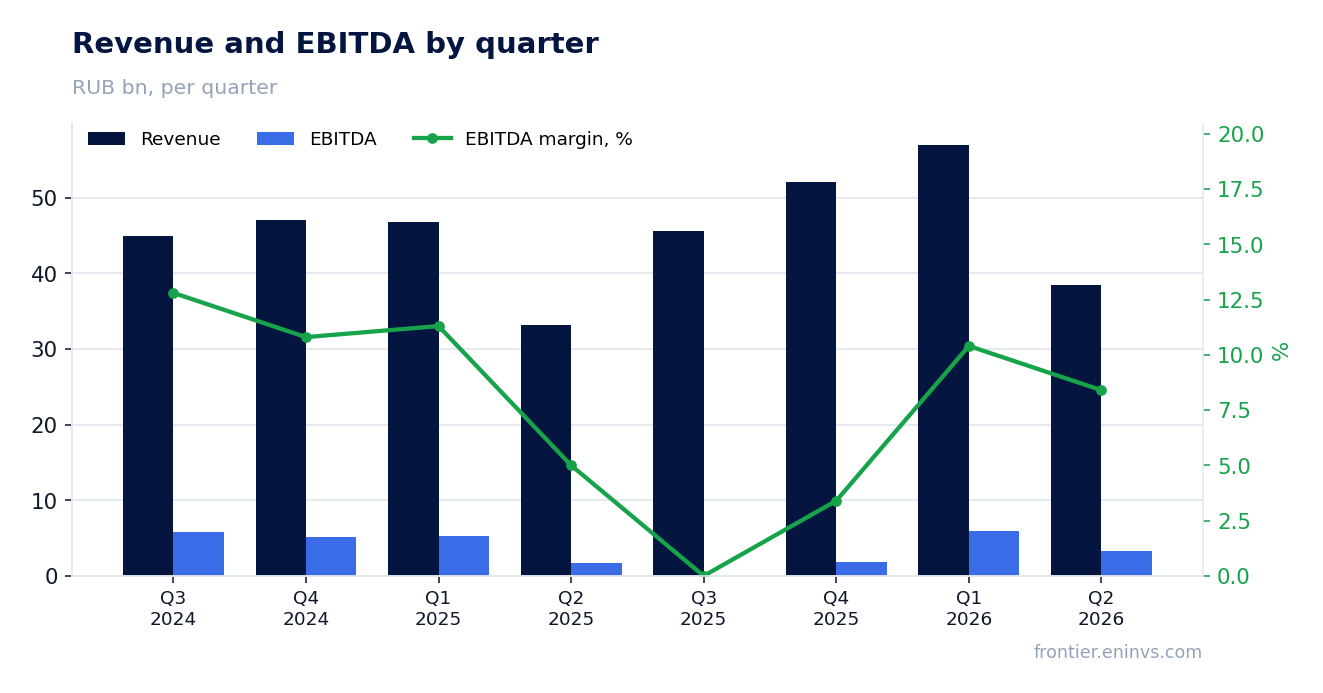
— EBITDA nearly doubled, yet the margin remains low at 8.4%
— A net loss of 357 mn RUB with positive EBITDA – interest costs are eating operating profit
— Operating cash flow turned negative at minus 445 mn RUB, while capital expenditure was 2.0 bn RUB
— Debt rose to 45.9 bn RUB, with net debt to LTM EBITDA at 4.8
— Dividend yield of 28.4% against a fair 15.5%, but the 2026 payout is in question
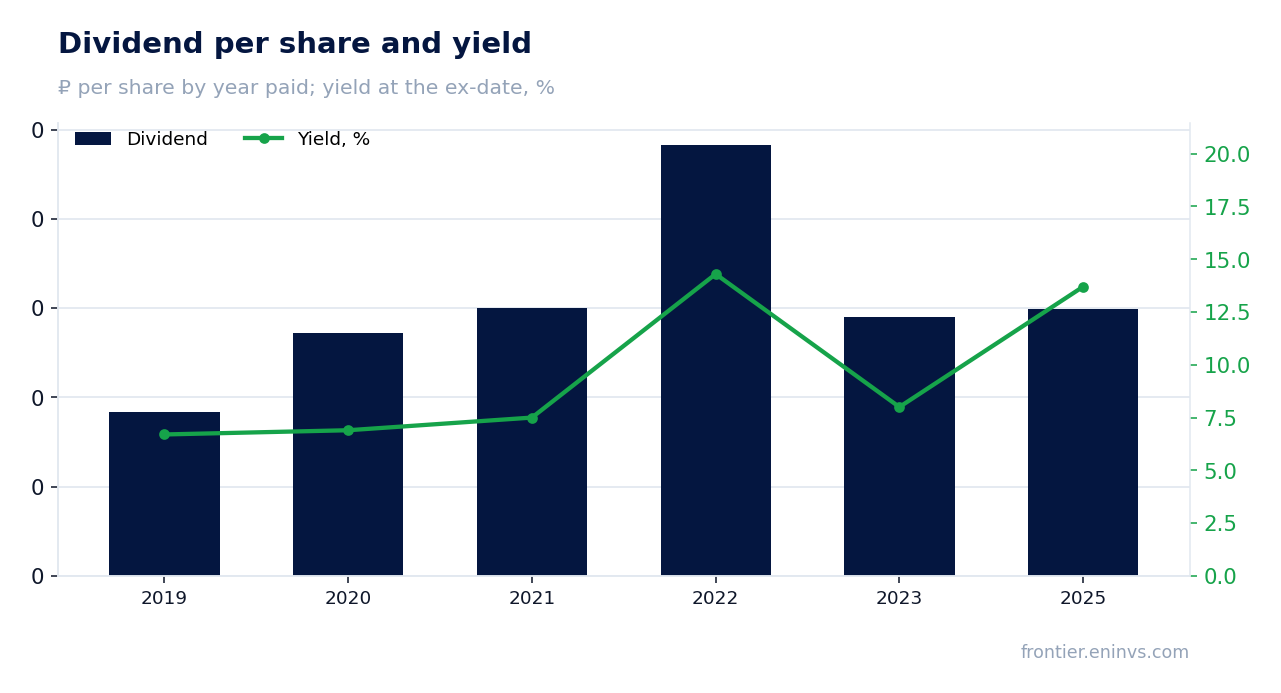
— EV/EBITDA LTM of 6.8 versus a three-year average of 3.2 – the valuation is above its own history
Attractiveness
Key figures, RUB bn
| Metric | Q2 2025 | Q2 2026 | Change |
|---|---|---|---|
| Revenue | 33.2 | 38.4 | +15.6% |
| EBITDA | 1.65 | 3.24 | +96.7% |
| Operating profit | -0.91 | 0.32 | to profit |
| Net profit | -0.32 | -0.36 | — |
| Operating cash flow | -3.68 | -0.45 | — |
| Capex | 10.4 | 2.04 | -80.4% |
| EBITDA margin | 5.0% | 8.4% | +3.4 pp |
| Net margin | -1.0% | -0.9% | +0.1 pp |
Revenue grew 15.6% year on year, but the pace decelerated from 21.8% in the first quarter
OGK-2's revenue in the second quarter of 2026 was 38.4 bn RUB, up 15.6% year on year. This is notable growth, but it is slower than in the first quarter, when revenue added 21.8%. The deceleration in the quarterly pace is the first signal that the momentum from the start of the year is fading.
Average electricity and capacity prices remain the main driver, but their contribution in the annual comparison has decreased. The report does not disclose a segment breakdown, so it is impossible to say exactly what provided the main increase. However, the very fact of decelerating revenue growth against a high base from last year suggests the market may be stabilising.
For the investor, it is important that even with revenue growth the company remains loss-making. This means operating leverage is not working at full capacity: revenue growth is not converting into profit due to high fixed and interest costs.
EBITDA nearly doubled, yet the margin remains low at 8.4%
EBITDA in the second quarter of 2026 was 3.2 bn RUB, up 96.7% year on year. This growth looks impressive, but it was achieved from a low base: a year earlier the figure was only 1.6 bn RUB. The EBITDA margin rose to 8.4% from 5.0% a year earlier, but remains low for a generating company.
The margin improvement occurred against revenue growth and, likely, some reduction in unit variable costs. However, without a breakdown of expense items in the report, it is impossible to determine the exact source of the profitability increase. Importantly, even with a nearly twofold increase in EBITDA, its absolute level remains modest relative to revenue of 38.4 bn RUB.
Operating profit was only 323 mn RUB, indicating that after deducting depreciation and other operating expenses, only a small portion of EBITDA remains. This limits the company's ability to service debt and finance investments from its own funds.
A net loss of 357 mn RUB with positive EBITDA – interest costs are eating operating profit
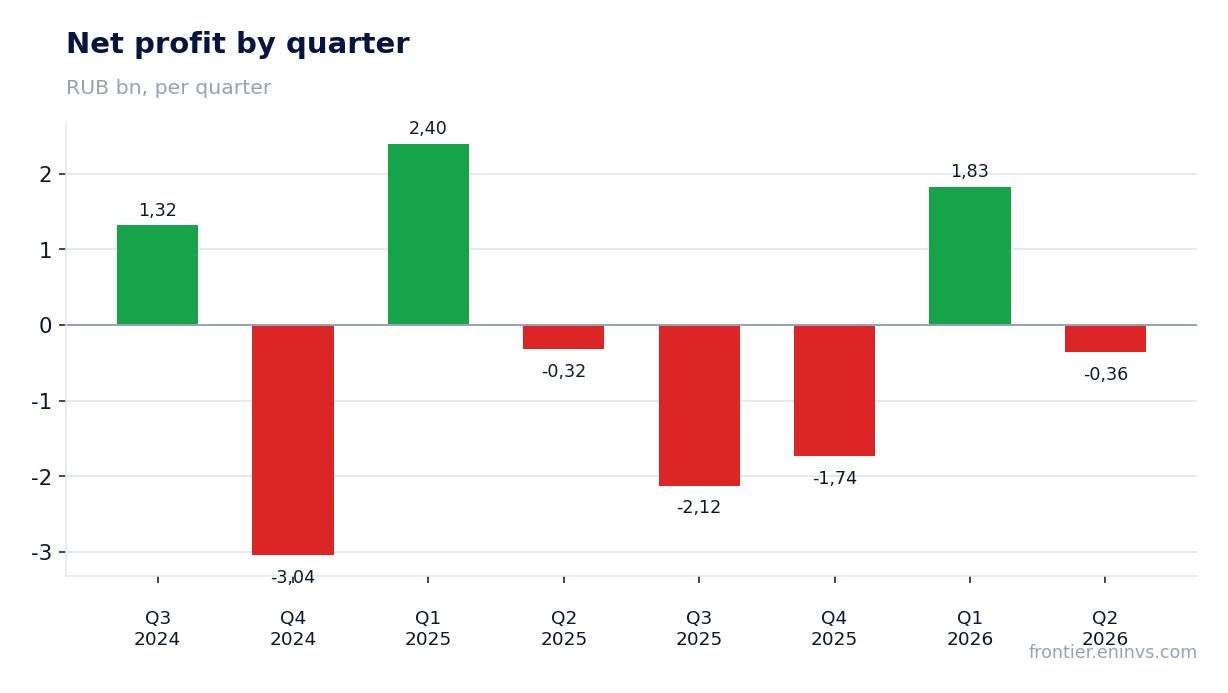
The net loss in the second quarter of 2026 was 357 mn RUB, virtually unchanged from the loss of 322 mn RUB a year earlier. At the same time, EBITDA was positive at 3.2 bn RUB, and operating profit was 323 mn RUB. The difference between operating and net profit is explained by interest expenses and other non-operating items.
The net margin remained negative at minus 0.9% versus minus 1.0% a year earlier. This means the company cannot yet generate net profit even with growing revenue. The main pressure comes from interest payments on debt, which reached 45.9 bn RUB at the end of the quarter.
For shareholders, it is important that the loss is not one-off: it repeats from quarter to quarter. This undermines the basis for dividend payments, as dividends are typically paid out of net profit.
Operating cash flow turned negative at minus 445 mn RUB, while capital expenditure was 2.0 bn RUB
Operating cash flow in the second quarter of 2026 was negative at minus 445 mn RUB versus minus 3.7 bn RUB a year earlier. The improvement is noticeable, but the flow still does not cover even current needs. Capital expenditure for the quarter was 2.0 bn RUB, meaning the company is financing investments through borrowing or reducing cash balances.
Negative operating flow and capital expenditure together create a financing deficit. At the same time, over the last 12 months operating cash flow was 9.2 bn RUB, which is still less than capital expenditure over the same period. This indicates that the company does not generate enough funds for self-financing.
For the dividend story, this is a bad signal: if operating flow does not recover, payouts may be cut or financed through new borrowings, increasing debt burden.
Debt rose to 45.9 bn RUB, with net debt to LTM EBITDA at 4.8
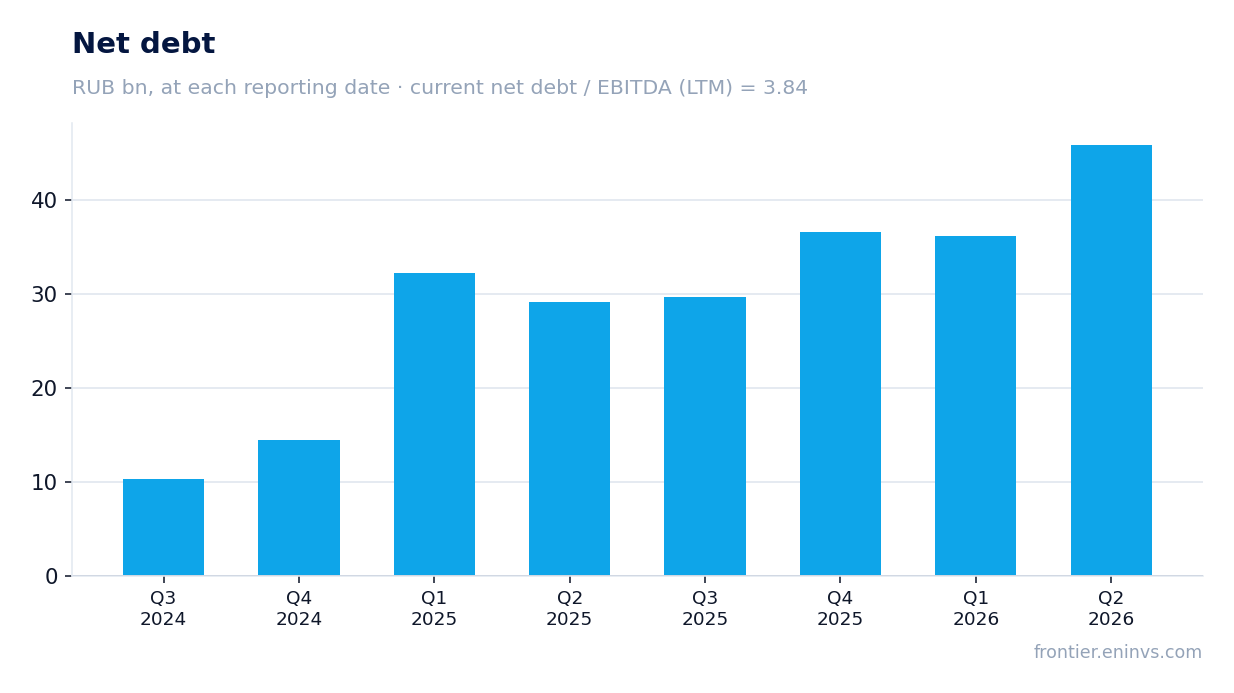
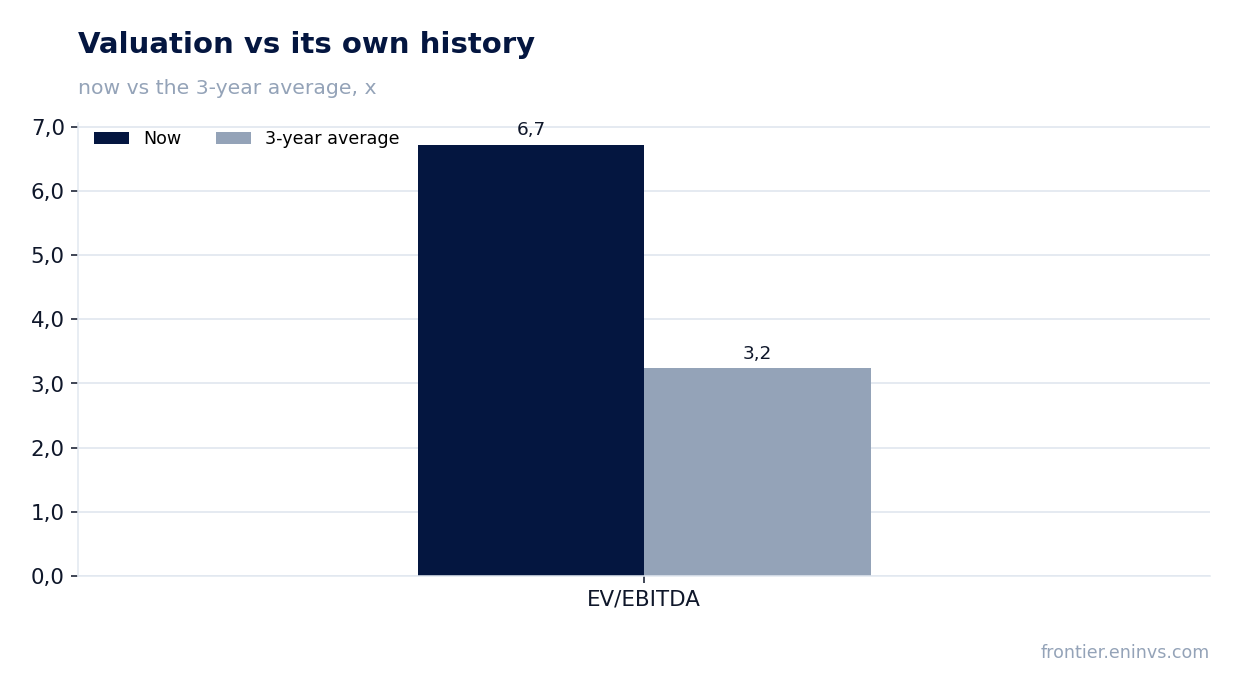
OGK-2's net debt as of 30 June 2026 was 45.9 bn RUB, up from 36.2 bn RUB on 31 March 2026 (+9.7 bn RUB) and from 29.1 bn RUB on 30 June 2025 (+16.8 bn RUB over 12 months). Debt growth continues, and this is a key risk for a company with negative net profit.
The net debt to EBITDA ratio over the last 12 months is 4.8. This level may be acceptable for a generating company, but only if EBITDA is stable. However, LTM EBITDA is 9.6 bn RUB, and if it declines, the debt burden will increase further.
Interest expenses on this debt likely consume a significant portion of operating profit. With the key rate at 14.0%, debt servicing is expensive. The company does not disclose the exact cost of debt, but the scale of debt and negative net profit suggest that refinancing could be a problem.
Dividend yield of 28.4% against a fair 15.5%, but the 2026 payout is in question
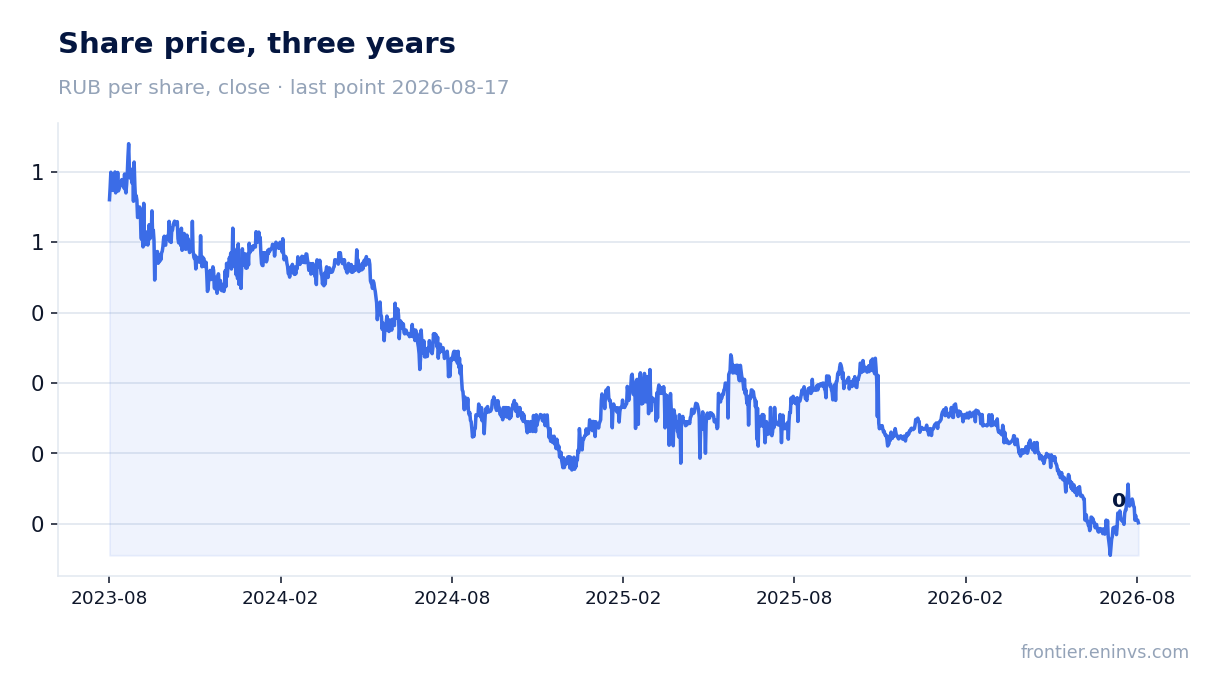
Over the last 12 months OGK-2 paid 0.0598 RUB per share, which at the current price gives a yield of 28.4%. This is significantly above the 15.5% we consider fair and the key rate of 14.0%. However, such a high yield is explained by the fall in the share price, not by an increase in payouts: the dividend for 2025 was the same as a year earlier, but the share price declined.
In the current calendar year the company has not yet paid dividends, and we do not expect payouts until the end of the year. Our estimate for the 2026 dividend is 0.0598 RUB per share, assuming the payout ratio remains at 54% of profit. However, the base for calculation – net profit – is negative, so the payout may be made from retained earnings or may not happen at all.
The historical dividend yield of OGK-2 ranged from 6.7% in 2019 to 14.3% in 2022. The current 28.4% is an abnormally high level, reflecting either market expectations of an imminent cut in payouts or an undervaluation of the share. We believe a sustainable yield is closer to 15.5%, and the current price offers a risk premium.
What could make the payout smaller: further debt growth, deterioration in operating cash flow, a decline in EBITDA, or a change in dividend policy. The company has not disclosed new dividend guidelines, so we rely on past payouts and the current financial situation.
EV/EBITDA LTM of 6.8 versus a three-year average of 3.2 – the valuation is above its own history
The current EV/EBITDA over the last 12 months is 6.8, more than double the three-year average of 3.2. This means the share trades significantly more expensive than usual relative to its EBITDA. At the same time, LTM EBITDA is 9.6 bn RUB, and market capitalisation is 28.3 bn RUB.
Such a high multiple is explained by the low EBITDA base: in 2024–2025 the company showed weak results, and over the last 12 months EBITDA remains at 9.6 bn RUB. If EBITDA recovers, the multiple could decline without a change in the share price. However, the recovery trend is not yet obvious.
For a dividend name, a high EV/EBITDA valuation is a risk: if the market stops pricing in a recovery, the share may fall. On the other hand, a dividend yield of 28.4% provides some support. The balance between risk and return looks neutral.
Valuation on the latest reported figures
| Metric | Value |
|---|---|
| Market cap | 28.3 bn ₽ |
| EV/EBITDA (LTM) | 6.8 |
| P/B | 0.17 |
| Net debt / EBITDA (LTM) | 4.80 |
| Operating cash flow (LTM) | 9.18 bn |
| ROE | -0.9% |
| Dividend yield (12m) | 28.3% |
| EV/EBITDA, 3-year average | 3.2 |
Dividend per share, ₽, and yield at the ex-date
| Year paid | Dividend | Yield |
|---|---|---|
| 2019 | 0.04 | 6.7% |
| 2020 | 0.05 | 6.9% |
| 2021 | 0.06 | 7.5% |
| 2022 | 0.10 | 14.3% |
| 2023 | 0.06 | 8.0% |
| 2025 | 0.06 | 13.7% |
Bottom line
In the second quarter of 2026 OGK-2 showed revenue growth of 15.6% and a nearly twofold increase in EBITDA, but net profit remained negative. The improvement in EBITDA margin to 8.4% is a positive signal, yet operating cash flow turned negative and debt rose to 45.9 bn RUB. A dividend yield of 28.4% looks attractive, but it reflects the fall in the share price rather than an increase in payouts. The EV/EBITDA valuation (6.8) is more than double the three-year average (3.2), which limits upside potential. At the current price the share looks neutral: the high dividend yield is offset by debt risks and the absence of net profit.
Open the company's financial profile OGKB →
See also: market overview · valuation map · stock screeners