Rolf: a profitable dealer carrying the loan taken to buy it. What lies behind the 21-22% yield
Rolf bonds yield 21-22% to maturity with the key rate at 14%. The issuer itself, ROLF JSC, earns money and services its own debt with a margin of safety. The premium of 7-8 percentage points is the price for the holding company sitting above it, which bought the business on credit in 2024. Rolf guarantees that loan, which is serviced with Rolf's cash and the owner's loans. We consider the short issues maturing in January and May 2027 an acceptable risk for investors who deliberately take high-yield bond risk. The long 1R09 to 2028 depends on how the group refinances the acquisition loan, and there the yield looks fair rather than generous.
The issuer page with financials by period and all bond issues: Rolf. Below are Enhanced Investments estimates based on the IFRS statements of Rolf Group (PromAgroLogistika JSC) and the standalone IFRS of ROLF JSC for 2025 and 1H2026, releases by ACRA, NCR and Expert RA, and Moscow Exchange and Federal Tax Service data. Where a figure is our estimate, it is marked.
Key points:
- In August 2024 the PAL holding company bought Rolf from the state for RUB 34.8bn. The money came from a bank, and Rolf became a guarantor of that loan (RUB 30.1bn at the end of 2025). The ultimate owner is Umar Kremlev, president of the International Boxing Association (IBA).
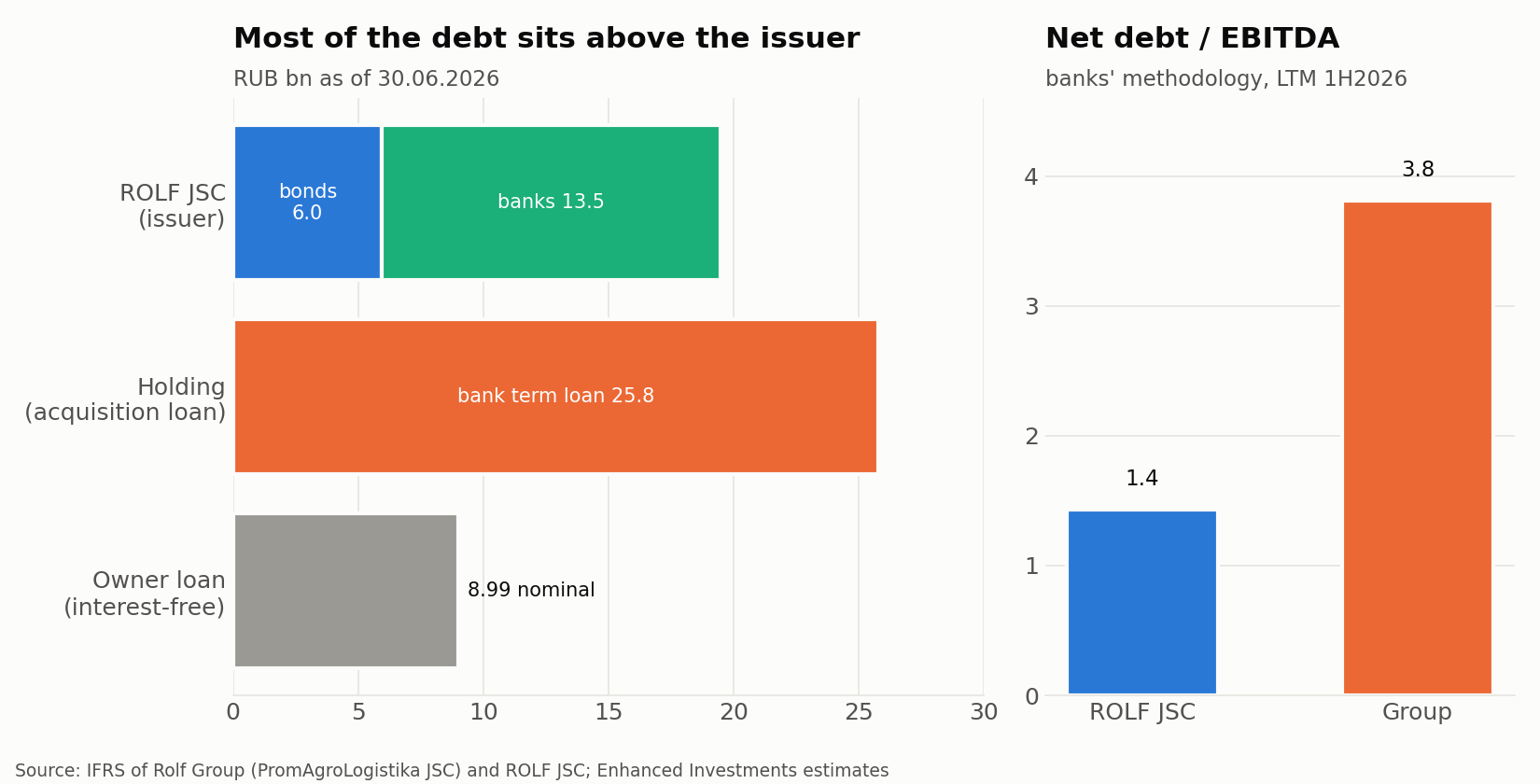
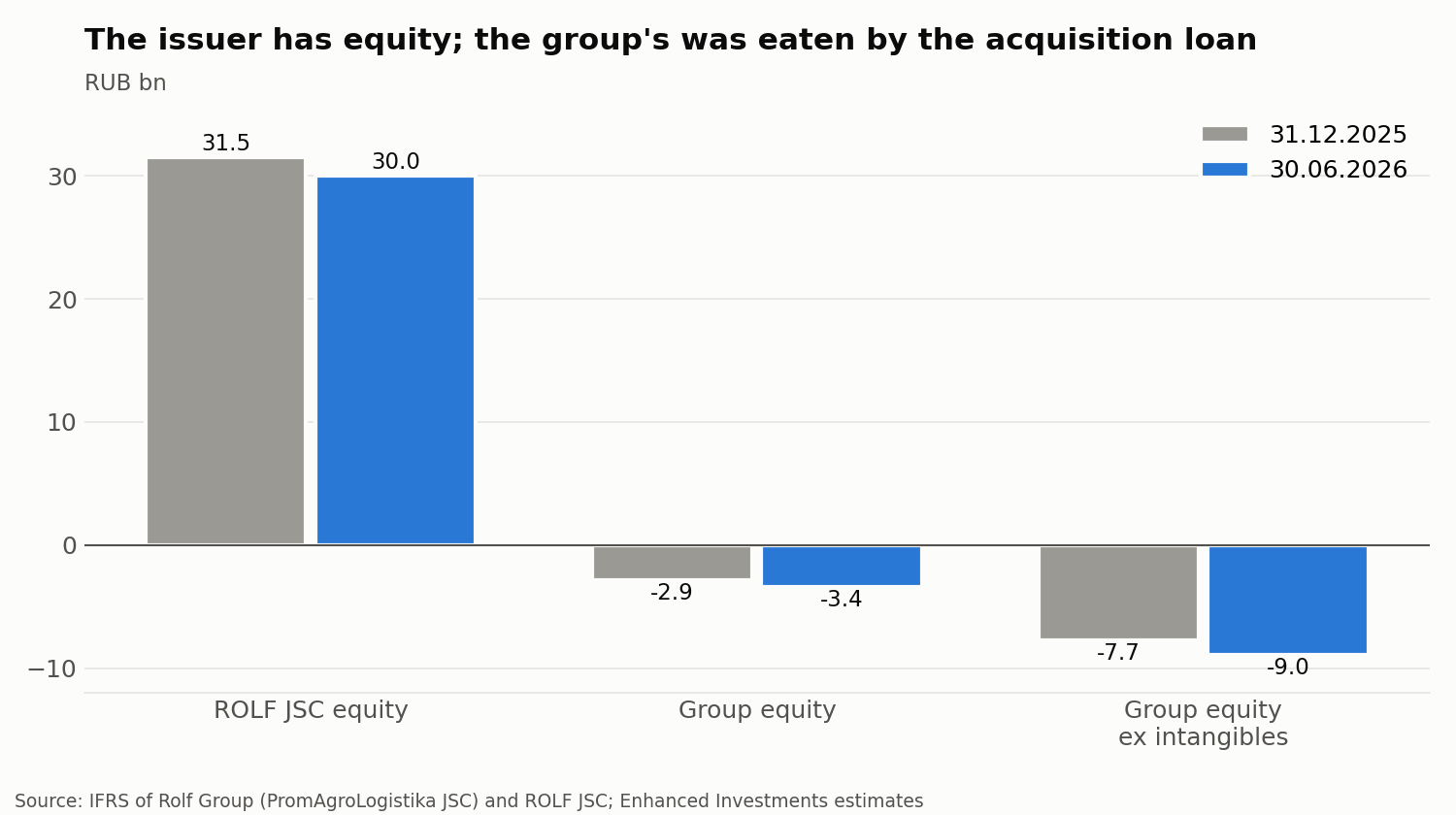
- The issuer's own numbers are good: net debt to EBITDA of 1.4x, net profit of RUB 1.0bn for the half-year, equity of RUB 30bn. But including the guarantee, Rolf's leverage is close to the group's.
- The whole group including the acquisition loan looks different. Net debt to EBITDA is 3.8x, equity is minus RUB 3.4bn, the half-year loss is RUB 1.7bn. The auditor's review report points to a material uncertainty about the group's ability to continue as a going concern.
- Rolf pays dividends to the holding even when its own cash flow is negative. The owner covers the gap with interest-free loans, which reached RUB 9bn by 30 June.
- The group sells new cars at a negative margin. The money comes from loans, insurance, service and used cars.
- Bonds are only RUB 6bn out of the group's RUB 51bn of debt. The next maturity is RUB 2bn in January 2027, against RUB 13.9bn of undrawn bank limits.
- Ratings are A-(RU) from ACRA and BBB+.ru from NCR. Expert RA cut its rating by three notches in a year and withdrew it in September 2026.
The bonds are issued by the operating company, while the loan used to buy it sits above it
Fact. Rolf is the largest car dealer in Moscow and St Petersburg; in 2026 it opened branches in Krasnodar and Kazan. In 2023 the shares were confiscated from founder Sergey Petrov in favour of the state. In August 2024 the Federal Property Management Agency sold Rolf to Avtomobilnye Tekhnologii JSC, 99% owned by PromAgroLogistika JSC (PAL). According to IFRS, the ultimate beneficiary of the group is Umar Kremlev, president of the International Boxing Association (IBA) and a prominent public figure. PAL has no board of directors, and Rolf itself has no independent directors.
The buyer paid RUB 34.8bn in cash. PAL's charter capital is RUB 10 thousand, so the purchase was made almost entirely with debt. The floating-rate loan from a Russian bank is secured by all the property and assets of the acquired companies. According to ACRA, the loan amortises until 2029, and a single bank accounts for more than 80% of the group's bank debt.
For a bondholder this is the key feature of the whole story. The bonds are issued by ROLF JSC, whose own debt is moderate. But the holding has nothing other than Rolf to service its loan with, and Rolf is legally liable for it. The Russian accounting (RAS) statements of ROLF JSC for 2025, in the note on collateral, disclose a guarantee issued for RUB 30.09bn (RUB 34.94bn at the end of 2024; less than RUB 1mn at the end of 2023). The amount matches the group's floating-rate term loan to the rouble, i.e. the acquisition loan. So the bank can claim the outstanding balance of this loan directly from Rolf. We did not find this guarantee in Rolf's standalone IFRS, and the company's investor materials show leverage without it. Rolf's bonds should therefore be assessed on group metrics, not the issuer's.
This is a standard structure for debt-funded acquisitions. The bank wants a direct claim on the company that holds the cash and assets, so the acquired company guarantees the buyer's debt. In Western markets bondholders are usually protected by the terms of the issue: a right to sell the bonds at 101% of par on a change of control, and limits on new debt, guarantees and dividends. In a number of European countries corporate law also restricts a company from guaranteeing debt taken to buy its own shares. In Russia there is no direct prohibition, such a guarantee is approved by the sole shareholder, and retail bond issues usually carry no such restrictions.
Current holders were not misled retroactively. The deal closed on 31.08.2024, and the earliest outstanding issue, 1R03, was placed on 24.09.2024, the rest later. Our complaint is about disclosure. The RUB 30bn guarantee is visible only in an image table in the RAS statements, while the company's communication emphasises an "operating perimeter" with leverage of 1.3x.
The scheme in plain terms: the holding borrowed, Rolf guaranteed and pays
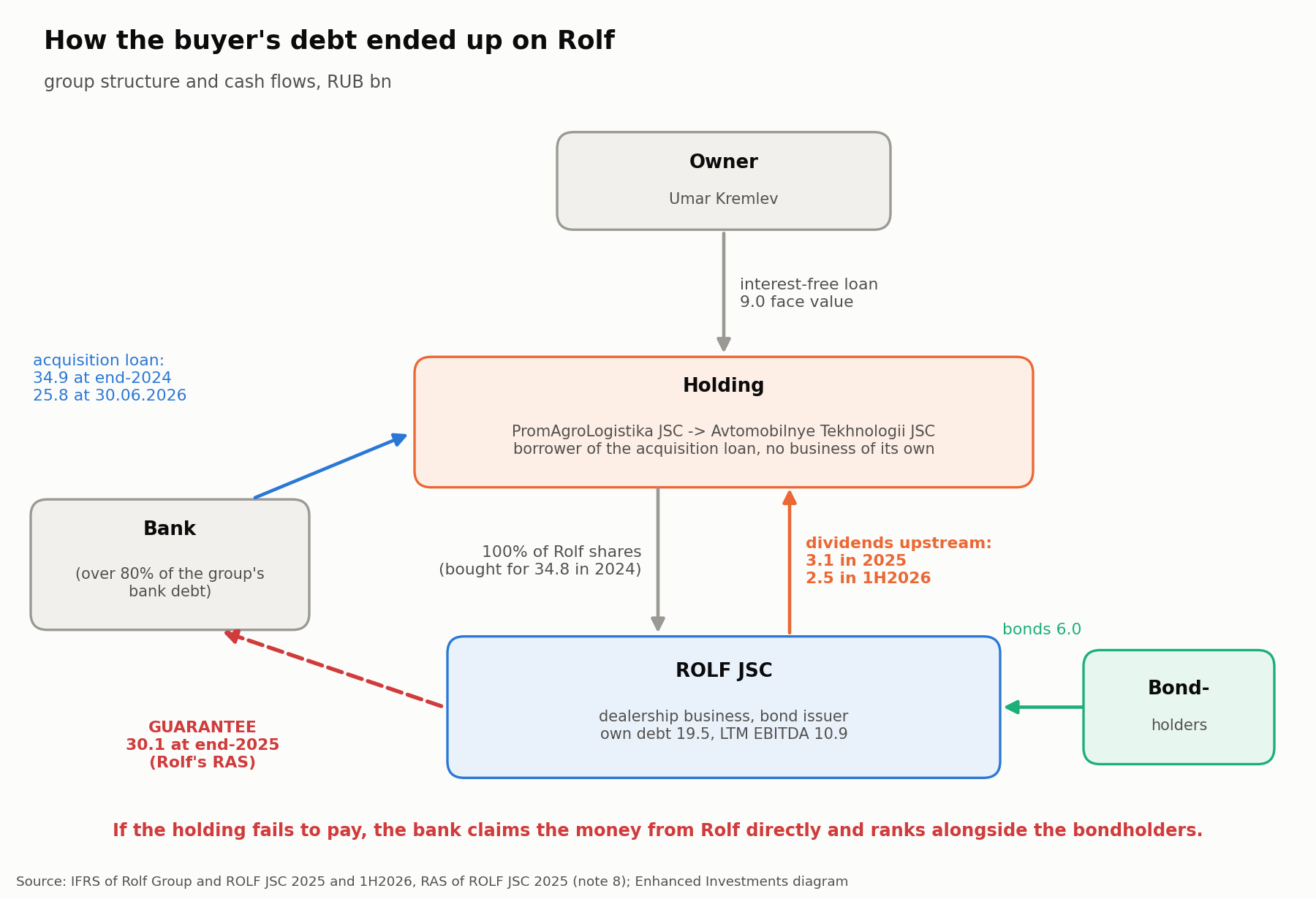
How it works, step by step:
- Step 1. A debt-funded purchase. A holding company with no business of its own takes a bank loan and buys 100% of Rolf's shares from the state for RUB 34.8bn.
- Step 2. The guarantee. The bank wants the loan backed by whoever has the cash. Rolf provides a guarantee: if the holding does not pay, the bank is entitled to claim the debt from Rolf. Under RAS the guarantee stood at RUB 30.1bn at the end of 2025.
- Step 3. Debt service. The holding pays the bank out of Rolf's dividends (RUB 3.1bn paid in 2025 and RUB 2.5bn in 1H2026) and the owner's interest-free loans (RUB 9.0bn of face value).
- Step 4. If something goes wrong. The holding stops paying, and the bank comes to Rolf as a debtor. A claim of RUB 26-30bn joins the queue of unsecured creditors next to RUB 6bn of bonds, and both will have to be paid from the same dealership business.
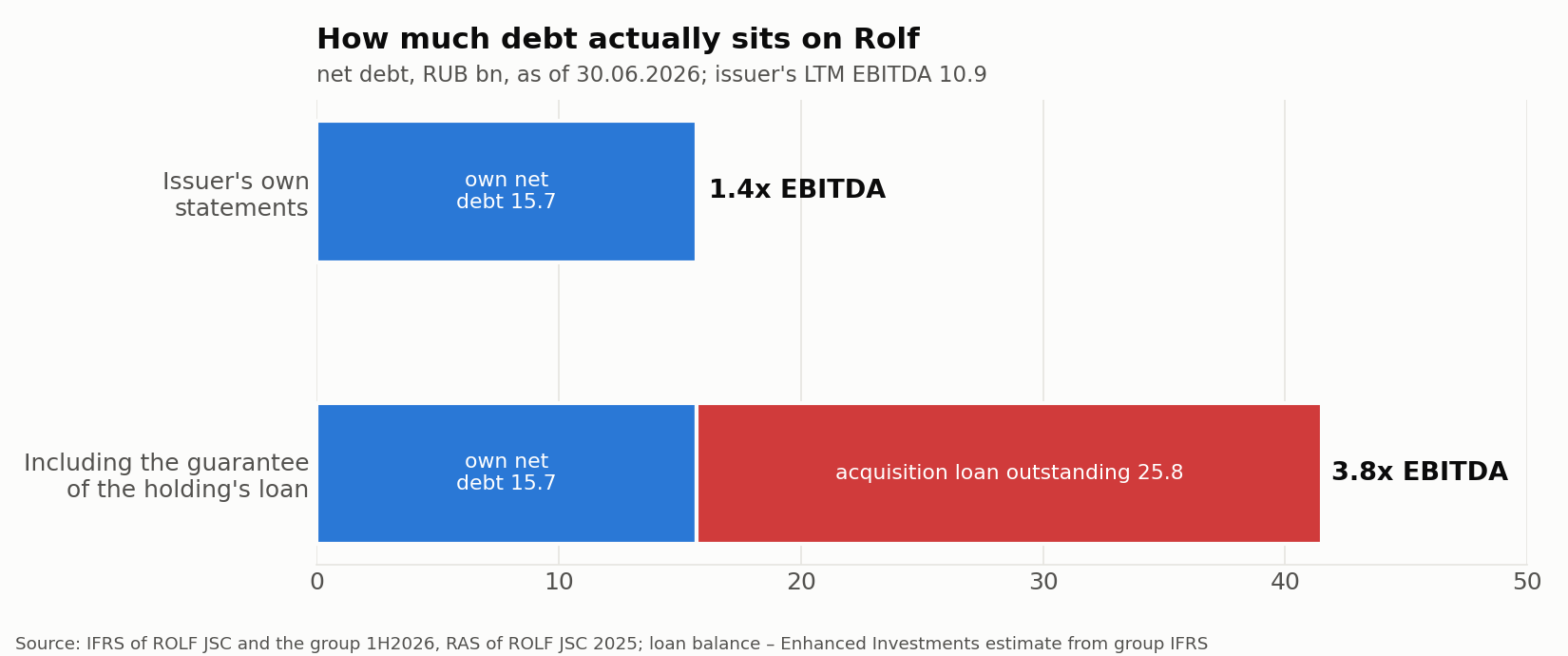
Authors' estimate. In the issuer's statements net debt is RUB 15.7bn, or 1.4x annual EBITDA. Adding the outstanding acquisition loan that Rolf guarantees gives RUB 41.5bn and 3.8x EBITDA, the same as the group under the banks' methodology. So for a Rolf bondholder the right starting point is the group's numbers, not the issuer's.
Rolf services its own debt with room to spare, but that excludes the guarantee
Fact, IFRS of ROLF JSC for 1H2026. Revenue was RUB 144.3bn versus RUB 70.0bn a year earlier (part of the growth came from merging subsidiaries in August 2025). Operating profit was RUB 3.24bn versus RUB 0.76bn, finance costs RUB 2.04bn versus RUB 2.67bn. Net profit was RUB 1.01bn versus a loss of RUB 0.95bn.
The issuer's debt as of 30 June was RUB 19.5bn: RUB 13.5bn of bank lines and RUB 6.0bn of bonds. Net of RUB 3.8bn of cash, net debt is RUB 15.7bn. Adjusted 12-month EBITDA excluding the lease effect was RUB 10.9bn, a ratio of 1.43x. The issuer's equity is RUB 30.0bn, most of it from revalued dealership buildings and land.
Authors' estimate and assumption. Over the 12 months to 30 June the issuer's operating profit was about RUB 9.9bn against finance costs of about RUB 4.0bn, a coverage of about 2.5x. If Rolf stood on its own, with these numbers its credit quality would, in our view, be noticeably higher than its current ratings. But it does not stand on its own: including the guarantee of the acquisition loan (about RUB 26bn outstanding as of 30 June 2026, our estimate from group IFRS), Rolf's leverage is close to the group's, about 3.8x.
The group with the acquisition loan does not yet cover its interest, and the auditor warns of going-concern risk
Fact, IFRS of Rolf Group (PromAgroLogistika JSC). 2025: revenue RUB 244.1bn, operating profit RUB 7.17bn, finance costs RUB 11.29bn, net loss RUB 4.95bn. 1H2026: revenue RUB 144.3bn (+61%), operating profit RUB 3.16bn, finance costs RUB 4.81bn, loss RUB 1.74bn versus RUB 5.01bn a year earlier.
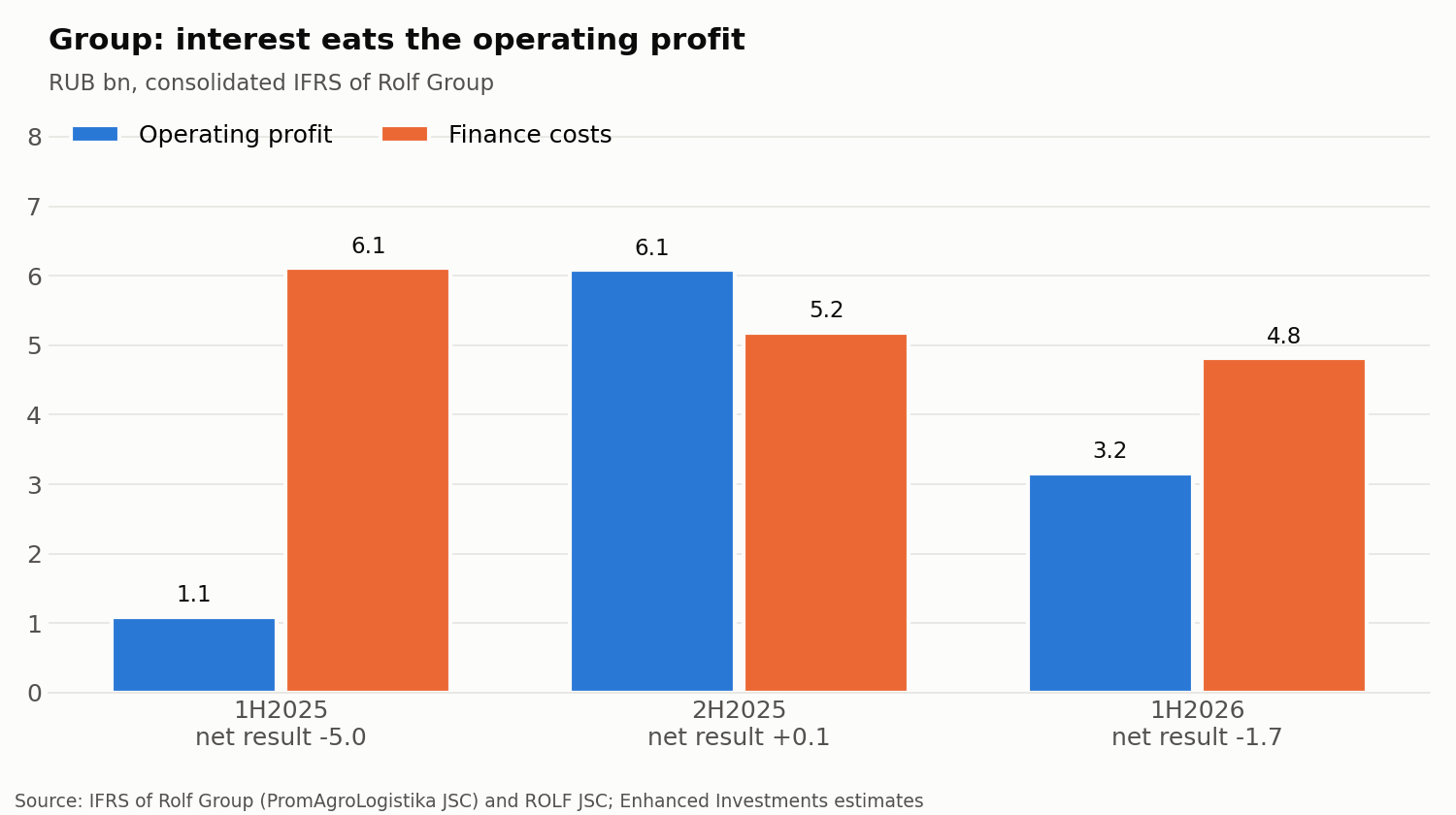
Authors' estimate. Over the 12 months to 30 June 2026 the group's operating profit was RUB 9.25bn and finance costs RUB 9.99bn, a coverage of 0.93x. EBITDA (RUB 11.4bn) against interest paid (RUB 9.6bn) gives coverage of 1.19x. Operating cash flow after interest for the same 12 months was negative at minus RUB 1.8bn, mainly because inventories grew by RUB 6.4bn in the first half.
The group's auditor, Unicon JSC, in its review of the 1H2026 statements drew attention to a material uncertainty about the group's ability to continue as a going concern. The reasons are listed in the statements themselves: negative net assets, a loss, negative operating cash flow, and operating profit not covering finance costs. Management responds that the loss shrank by 35%, interest falls along with debt and the key rate, and creditors have provided written waivers of sanctions and early repayment. According to the company, financial covenants are met; the waivers concern non-financial terms.
The group's negative equity is a direct consequence of the debt-funded purchase. There was almost no negative goodwill on the acquisition (RUB 1.4mn), and all losses in later years fell on equity that started at zero.
Rolf's cash goes up the chain, and the owner tops it up with interest-free loans
Fact. ROLF JSC paid its sole shareholder RUB 3.11bn in dividends in 2025 and RUB 2.47bn in 1H2026. In the same half-year the issuer's operating cash flow was negative (minus RUB 0.68bn), and its borrowings grew by RUB 4.4bn. The half-year dividend was 2.5 times the half-year IFRS profit.
The beneficiary, for his part, provided the group with an interest-free loan: RUB 4.7bn of face value at the end of 2025 and RUB 8.99bn as of 30 June 2026, plus RUB 0.5bn of financial aid. The loan is carried at a fair value of RUB 3.5bn, with the RUB 3.0bn difference booked as a capital contribution. The group's acquisition term loan shrank from about RUB 30bn to RUB 26bn over the half-year.
Authors' assumption. The scheme looks like this: the acquisition loan is repaid partly with Rolf's dividends and partly with the owner's money. For the bonds this is rather positive as long as the owner keeps putting money in. It is direct evidence of support, not just words. The owner is a public figure, and abandoning one of the country's largest dealers, bought from the state, would be costly for his reputation. As long as he funds the group with cash, we consider a scenario in which the owner walks away unlikely. But this is our assumption, not an obligation: legally the owner is not liable for the group's debts. But the dependence works both ways. If the owner stops topping up, the holding will have to take more from Rolf, and the operating company will start borrowing to pay dividends. This direction of cash flow is what to track in every subsequent report.
The statements show no loans from Rolf to the owner or related companies: as of 30 June 2026 the balance of loans with related parties is zero. Cash goes up through dividends, and risk comes down through the guarantee. One caveat: other related-party transactions in 1H2026 amounted to RUB 0.26bn of administrative expenses, and their nature is not disclosed.
New cars are sold at a loss; loans, insurance and service make the money
Fact, group management accounts (segment note). In 1H2026 the new car segment after direct costs produced minus RUB 4.16bn of gross margin on revenue of RUB 64.3bn. A year earlier it was minus RUB 2.42bn. Used cars moved into a small positive (RUB 0.16bn), service and parts gave RUB 4.96bn, and insurance and finance brought RUB 7.87bn versus RUB 4.39bn a year earlier.
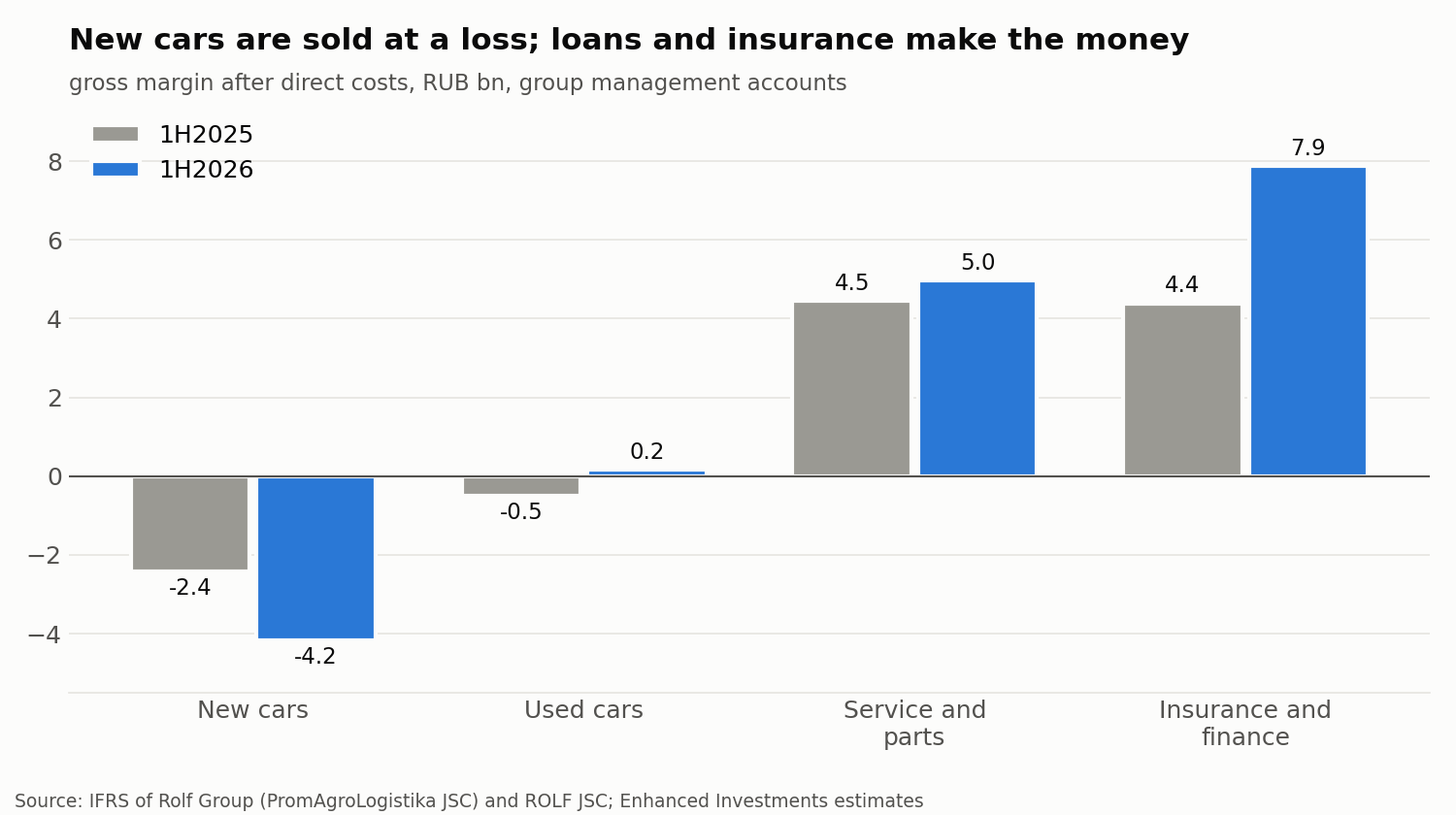
The model is clear: a new car is a reason to sell a loan, an insurance policy and later servicing. According to the company, more than 70% of sales are on credit. Hence the main operating risk. Group income depends on the volume of car loans and partner banks' commissions. If lending contracts or commissions are cut, there will be nothing to close the margin gap on new cars.
Inventories as of 30 June were RUB 29.4bn, of which RUB 23.3bn in cars. They grew by RUB 6.4bn since the start of the year, which is the main reason for the negative cash flow. Part of the purchases was financed by supplier deferrals: RUB 7.1bn versus RUB 5.0bn at the start of the year.
The market is recovering after the 2025 slump, but dealer margins remain thin
Fact. Sales of new passenger cars in Russia fell 15.6% in 2025, to 1.33mn units (Autostat). In 9M2026 the market grew 8%, to 968 thousand. Rolf sold 37.5 thousand new cars in 2025 (+14%), gaining share in a falling market. In 1H2026 it sold 19.6 thousand new and 26.5 thousand used cars.
Since 1 December 2025 the recycling fee has depended on engine power, and from 1 January 2026 the rates were indexed by another 10-25%. This supports prices but weighs on demand and favours locally assembled cars. Rolf works with Asian brands under non-exclusive agreements, without dependence on a single manufacturer.
Industry dealer margins hover around 1.5-2%, and according to the Russian Automobile Dealers Association almost 60% of dealers were loss-making in 2024. The key rate has been cut to 14%. For Rolf, with RUB 38bn of floating-rate debt, each percentage point of the rate costs roughly RUB 0.4bn of interest a year (authors' estimate). Rate cuts are the strongest argument for improving metrics in 2026-2027.
The company guides the market to EBITDA of RUB 11.4bn for 2026 (Interfax, SPIEF, June 2026, management forecast). Group adjusted EBITDA for the first half was RUB 4.3bn, so the guidance requires RUB 7.1bn in the second half. In 2H2025 it was RUB 7.1bn, so the forecast requires repeating last year's result with more expensive inventory. The target is achievable, but with no headroom.
Bonds are a small part of the debt. The key question is the rollover of bank lines
Fact. Group debt as of 30 June 2026 was RUB 50.7bn, including RUB 6.0bn of bonds, RUB 13.3bn of revolving lines and RUB 31.5bn of term loans, among them the acquisition loan and the owner's interest-free loan. RUB 23.0bn of it is due within 12 months. Cash is RUB 3.9bn, undrawn bank limits RUB 13.9bn, plus RUB 7.7bn of undrawn supply-finance limits.
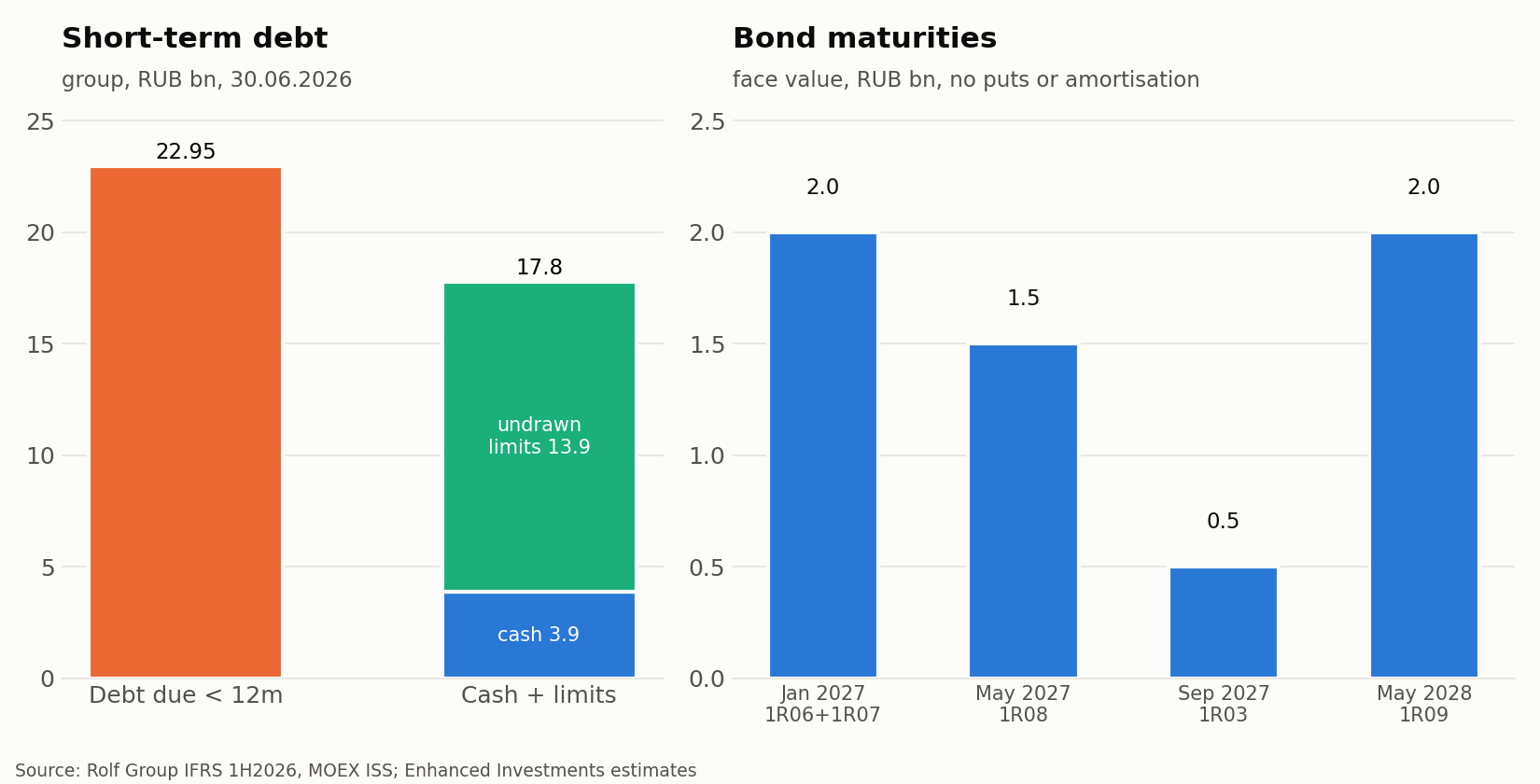
Authors' estimate. Revolving lines finance the car inventory and are usually rolled over as long as the cars sell. So the main risk is not the RUB 2bn of bonds due in January 2027, but whether the main bank keeps rolling over the lines and tolerating non-financial covenant breaches. So far it grants waivers and keeps RUB 13.9bn of limits undrawn. Bond payments including coupons until September 2027 will total about RUB 4.9bn (authors' estimate), roughly a third of the undrawn limits.
As of 30 June 2026, RUB 5.3bn of buildings and land and RUB 7.6bn of inventories are pledged against RUB 12.0bn of loans. Over these assets the banks rank ahead of bondholders; the bonds are unsecured. In total, under RAS at the end of 2025 Rolf had pledged RUB 13.6bn of assets, without specifying whose obligations they secure. Under the guarantee, the holding's bank is a direct creditor of Rolf and as a general rule ranks alongside bondholders.
Ratings: A- from ACRA and BBB+ from NCR; Expert RA cut by three notches in a year and walked away
- ACRA: A(RU) in August 2025, downgraded to A-(RU) on 04.08.2026, outlook stable. Standalone creditworthiness is assessed at bbb+, with one more notch added for beneficiary support. Downgrade triggers per the agency: debt to FFO above 5x, FFO to interest below 1x, FFO margin below 5% (currently 5.05%, i.e. at the threshold).
- NCR: BBB+.ru assigned on 31.03.2026, outlook stable, also reflecting the beneficiary's role in repaying the acquisition loan.
- Expert RA: ruA at the start of 2025, downgraded to ruBBB+ on 11.02.2025 and to ruBBB with a developing outlook on 06.02.2026. On 03.09.2026 the rating was withdrawn due to the expiry of the agreement and insufficient information to apply the methodology.
We read a withdrawal without a final review as a negative but not alarming signal: the two other agencies maintain their ratings. For some funds with rating constraints it narrows the pool of buyers.
Taxes and courts: no tax arrears, the story of the former owner closed by a verdict
Fact. According to Federal Tax Service open data as of 25.09.2026, ROLF JSC has no tax arrears, penalties or fines. We could not check the arbitration court records automatically. The group's statements contain the standard transfer-pricing risk disclaimer; no specific tax claims are disclosed.
On 17.08.2026 the Cheryomushkinsky court in Moscow sentenced Sergey Petrov in absentia to 9 years for siphoning about RUB 4bn out of the company (Interfax); the defence is appealing. We found no claims against the current group related to this case.
A 21-22% yield: the price of the deal structure, not of a weak business
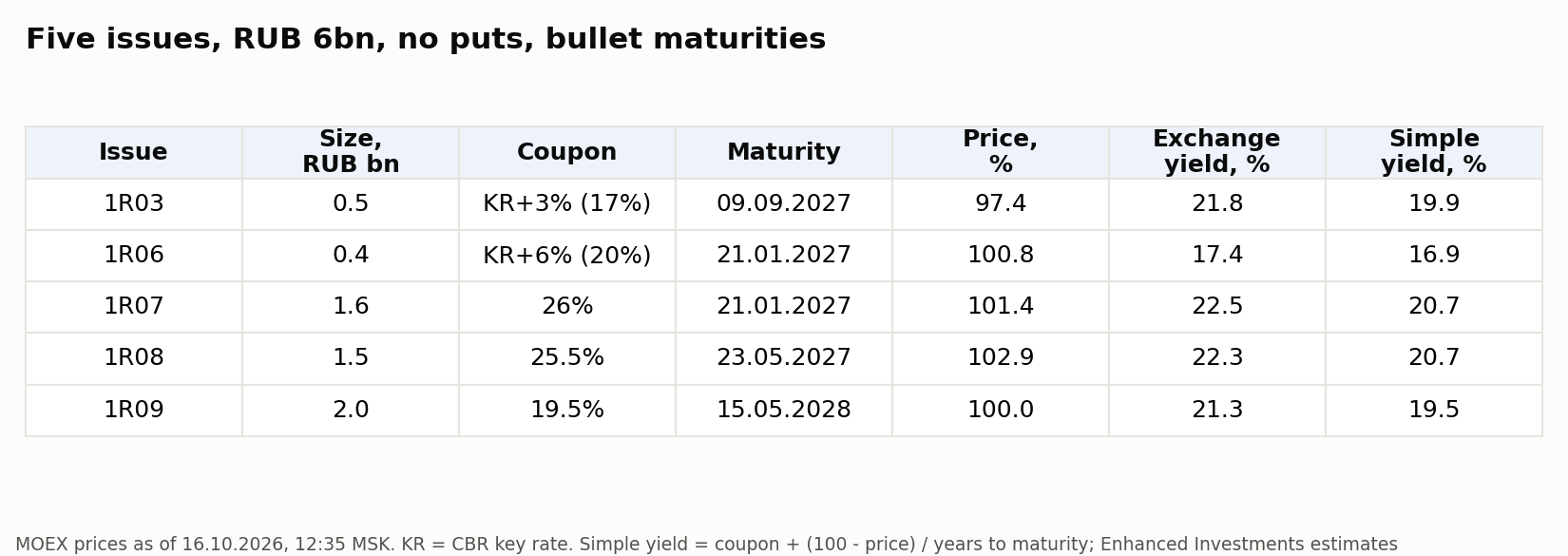
Authors' estimate. The three liquid issues 1R07, 1R08 and 1R09 trade at yields to maturity of 21.3-22.5%, with simple yields of 19.5-20.7%. The 1R03 floater (key rate plus 3%) trades below par at 97.4%: the market demands a higher spread over the rate than the coupon provides. The small 1R06 (key rate plus 6%) trades rarely.
The market has already repriced the 25.5-26% fixed coupons of 1R07 and 1R08: prices are above par, and at maturity the holder loses the premium. For BBB+/A- paper, a 7-8 percentage point spread over the key rate is the upper end of the market, but the structure here is also worse than usual: negative group equity, an auditor's emphasis of matter, dividends upstream, the issuer's guarantee of the acquisition loan.
Main risks
- The owner withdraws support. Without new interest-free loans the acquisition loan will be serviced only by Rolf's dividends, and the operating company will have to borrow to pay them.
- The main bank's stance. One bank holds more than 80% of the group's bank debt, and Rolf guarantees its acquisition loan. If the bank refuses to roll over lines or demands early repayment for non-financial covenant breaches, a claim of RUB 26-30bn will land on Rolf directly.
- Car lending. Profit comes from loan and insurance commissions. Tighter borrower terms or lower agency commissions hit the single large source of margin directly.
- Inventories. RUB 23bn in cars with a negative margin on new vehicles. A new drop in demand means write-downs and further discounts.
- Interest rate. RUB 38bn of floating-rate debt. If the easing cycle stops, the expected improvement in coverage will not happen.
- Disclosure. The 1H2026 IFRS statements are published on e-disclosure, but as of 16.10.2026 they are not on the investor page of the company's website. In its communication the company emphasises an "operating perimeter" without the acquisition loan (net profit RUB 2.87bn and leverage of 1.3x for 2025), although the whole group will have to pay its debts. The RUB 30bn guarantee is visible only in the RAS statements.
What to take from this story into your own practice
- Look at who sits above the issuer. The operating company's financials can be clean while the debt used to buy it sits one level up. In such deals (LBOs) the whole group's statements matter more than the issuer's.
- Look for guarantees in the RAS statements. An operating company can be liable for the holding's loan even if its IFRS says nothing about it. Russian accounting statements contain a mandatory note on collateral for obligations. For Rolf it shows a RUB 30bn guarantee that appears neither in the issuer's IFRS nor in its investor materials.
- Dividends with negative cash flow are a signal. When a company pays out more than its profit while increasing debt, creditors' money effectively goes to the shareholder.
- Owner support shows up in the cash flow statement. Interest-free loans and capital contributions are a verifiable fact. Promises of support without cash flows are worth nothing.
- Read the auditor's "Emphasis of matter" section. A going-concern note does not mean default, but it does mean the company lives on its creditors' consent.
- A rating withdrawal after a series of downgrades is a reason to double-check. It does not mean the new rating would have been lower, but the market will never know it.
- Compare yields the simple way. Coupon plus the difference between price and par per year to maturity shows what you actually keep. A bond with a 26% coupon priced at 103% yields about 21%, not 26%.
Bottom line: a profitable dealer with a heavy structure above it; short issues look more sensible than long ones
As a business, Rolf is a market leader that grew in a falling market in 2025, turned profitable at the issuer level and is reducing its interest burden along with the rate. The problem is the debt-funded purchase of the company. The loss, the group's negative equity and the auditor's emphasis of matter are consequences of this structure, not of failing sales. It rests on two supports: the bank rolls over lines and grants waivers, and the owner tops up with interest-free money. As long as both work, RUB 6bn of bonds against RUB 50bn of group debt are serviced without strain.
We would not put these bonds in the conservative part of a portfolio. The short 1R07 and 1R08 to May 2027, with a simple yield of about 20.7%, are an acceptable risk in the part of a portfolio set aside for high-yield paper. 1R09 to May 2028 at 19.5-21.3% carries the risk of refinancing the acquisition loan, and here the premium looks fair rather than generous.
What to watch next: the 2026 annual results (delivery on the RUB 11.4bn EBITDA guidance, inventory dynamics); the size of Rolf's upstream dividends; continued owner loans; continued bank waivers; ACRA and NCR rating actions; the key rate decision on 23 October; the repayment of RUB 2bn of 1R06 and 1R07 on 21 January 2027.
Sources and caveats
- IFRS consolidated financial statements of PromAgroLogistika JSC (Rolf Group) for 2025 with the audit report of Unicon JSC, and condensed interim statements for 1H2026 with the review report dated 28.08.2026 – issuer disclosure.
- IFRS financial statements of ROLF JSC for 2025 and 1H2026 – issuer disclosure.
- RAS financial statements of ROLF JSC for 2025, note 8 "Collateral for obligations" – issuer disclosure.
- ACRA press release of 04.08.2026; NCR press release of 31.03.2026; Expert RA releases of 11.02.2025, 06.02.2026 and 03.09.2026.
- Prices, yields and terms of the issues as of 16.10.2026 – MOEX ISS. EBITDA guidance and share of sales on credit – Interfax, 16.06.2026; RAS results for 1H2026 – Interfax, 03.08.2026; Petrov's sentence – Interfax, 17.08.2026.
- New car market – Autostat; recycling fee – Autonews; dealer margins – Russian Automobile Dealers Association via Autonews; tax arrears – Federal Tax Service open data as of 25.09.2026.
- Interest coverage, 12-month figures, simple yield, equity excluding intangibles and rate sensitivity – authors' estimates.
Reviews of other issuers are on the Enhanced Investments Telegram channel; issuer pages with financials by period are on the portal.
See also: market overview · valuation map · stock screeners