SFI: the short stays in force after the half-year report. Where to short it and when the idea should work
A speculative idea, not an individual investment recommendation. Data: MOEX ISS as of 15:20 Moscow time on 3 September 2026, SFI interim IFRS statements for 1H2026 (B1 review report of 28 August), issuer disclosures on e-disclosure, NCC and broker risk parameters as of 3 September, and the sum-of-the-parts model on the SFI card at frontier.eninvs.com.
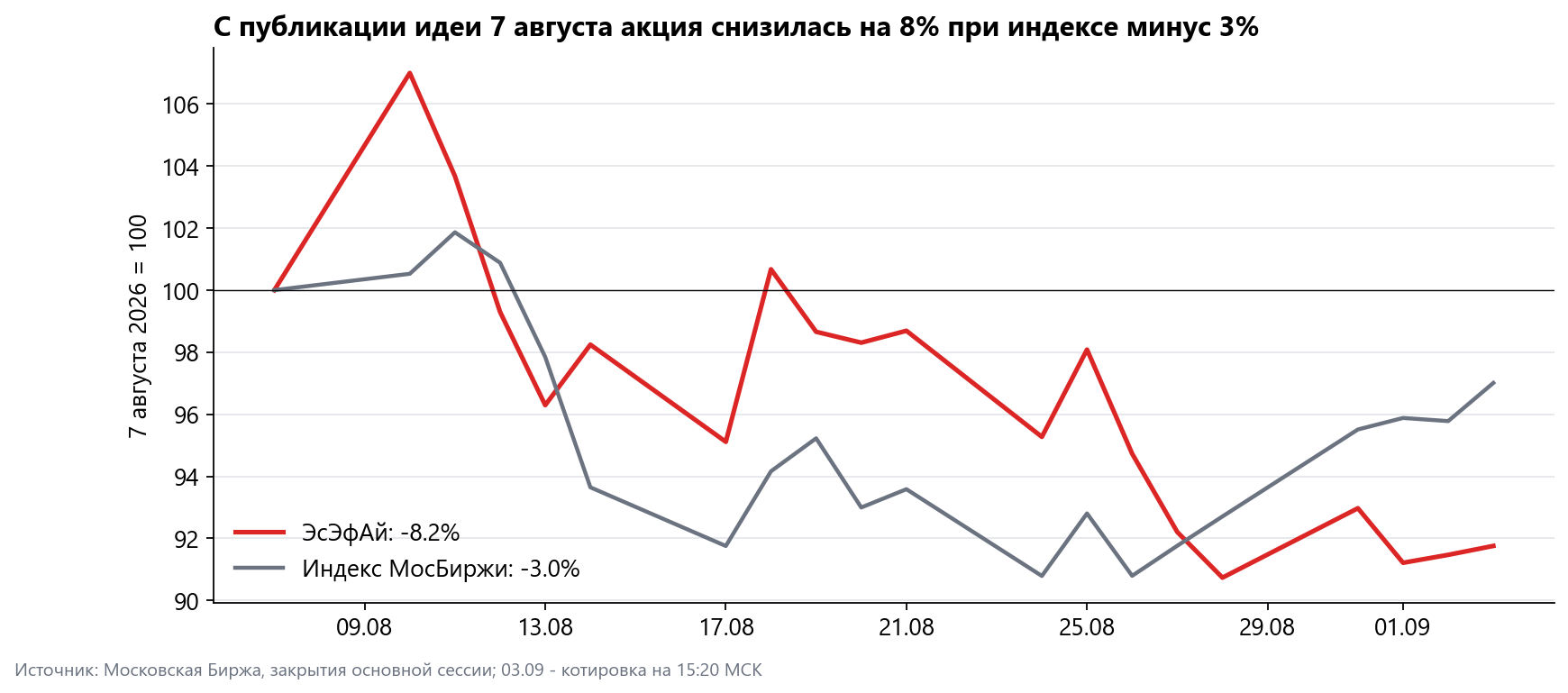
The short idea on SFI, published on 7 August, remains valid. The half-year report confirmed both theses on which it was built, and the target price has moved down, to RUB 334 against RUB 574 now. Downside is 42%. Since publication the stock has fallen from RUB 626 to RUB 574, down 8%, while the MOEX index is down 3% over the same period. The idea is expected to crystallise in November-December, when the board of directors decides on a nine-month dividend, and on 25 December the RUB 902 payment drops out of the twelve-month window and the triple-digit yield disappears from screeners.
- The RUB 2.95 bn loss for the half-year came from exactly the two items on which the idea rests. An impairment of the VSK stake of RUB 4.3 bn and a loan provision of RUB 1.8 bn.
- The main asset has disappointed: VSK's half-year profit halved, insurance turned negative, and no dividends came up to the holding.
- The sum of the parts after the report is RUB 485 per share, while the market pays 574. A premium of 18% against a historical median discount of 31%.
- There will be no nine-month dividend: there is no base under the dividend policy, and cash on accounts is RUB 1.0 bn.
- The stock can be shorted at T-Investments, BCS, VTB and Sber, but not at Finam and Gazprombank, and there are no NCC restrictions. The SFIN-12.26 future remains a fallback route.
- The main risk of the position remains infrastructural: a broker can close the short in a single day. Position size is set against this risk, not against the upside.
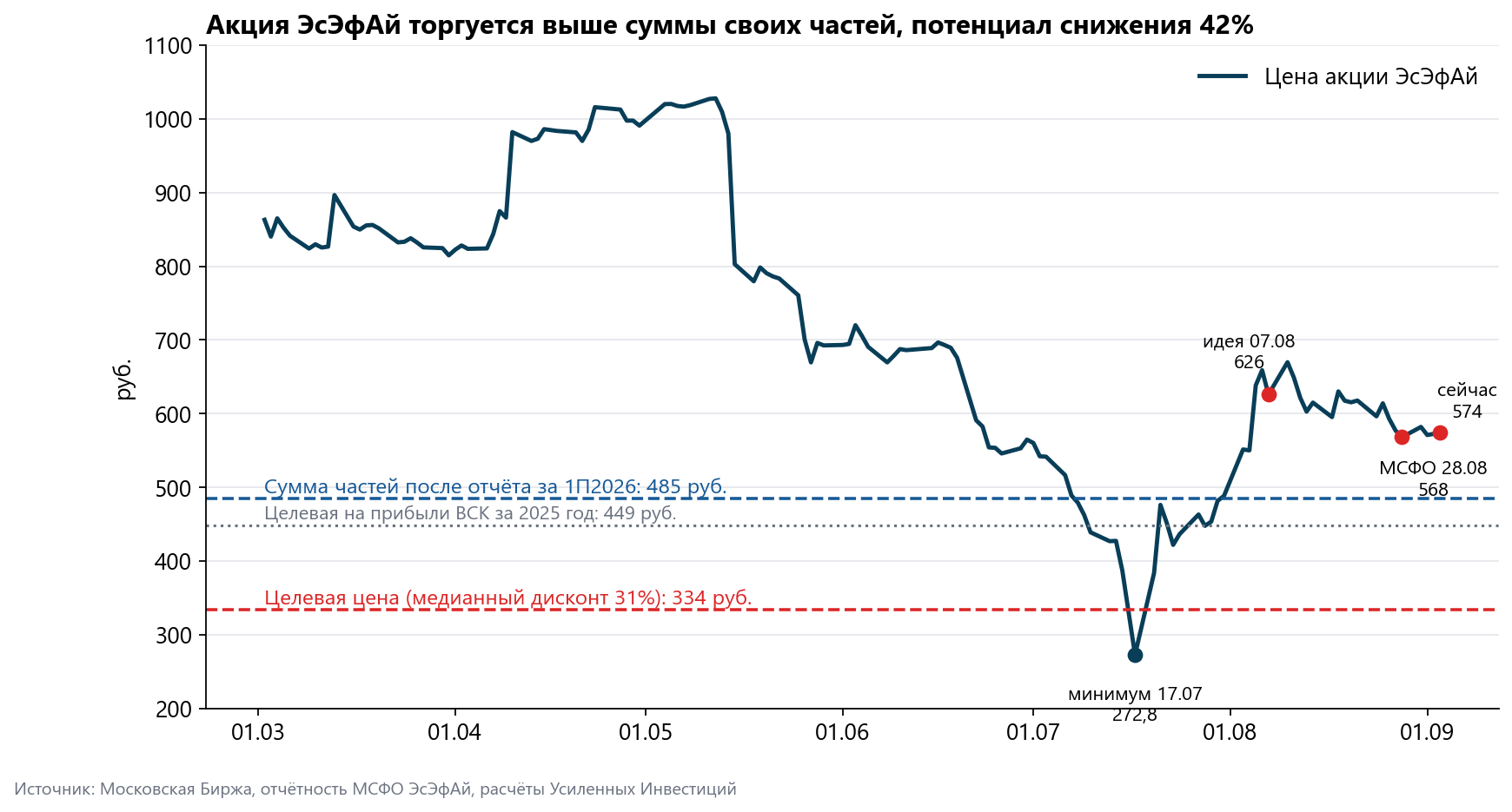
The half-year report confirmed the idea: a loss from the VSK revaluation and provisions
The holding closed 1H2026 with a loss of RUB 2,951 mn against a profit of RUB 5,866 mn a year earlier. The second quarter alone brought a loss of RUB 3,449 mn.
The first loss item. In the second quarter the company ran an impairment test of its VSK stake under IAS 36 and wrote off RUB 4,289 mn. The recoverable amount was calculated as value in use, from the insurer's five-year cash flow with discount rates from 22.42% to 14.93% and terminal growth of 5.35%. The carrying value of the stake fell from RUB 39.0 bn to RUB 36.2 bn. The main asset was marked down by management itself, not by us.
The second item. The provision for expected credit losses on the loan book rose from RUB 2,909 mn to RUB 4,712 mn. The charge for the half-year was RUB 1,802 mn, of which RUB 1,330 mn relates to moving debt to the second stage of credit risk, not to interest accrual. Gross loans are RUB 17.7 bn, carrying value RUB 13.0 bn. Interest accrued was RUB 1,889 mn, and RUB 573 mn was received in cash.
Cash. Dividends received in the cash flow statement are zero against RUB 853 mn a year earlier. Over the half-year the company paid RUB 8.0 bn in dividends and RUB 2.5 bn went to buying shares from dissenting shareholders. Cash including deposits fell from RUB 11.5 bn to RUB 1.0 bn, and shareholders' equity from RUB 64.7 bn to RUB 53.4 bn.
VSK: profit is half as high, insurance is in the red, no dividends going up
VSK's net profit for the half-year was RUB 3,636 mn against RUB 6,958 mn a year earlier. In 2024 the insurer earned RUB 11.1 bn, and in 2025 RUB 6.6 bn. The holding's share of the insurer's half-year profit was RUB 1,782 mn against RUB 3,409 mn.
The insurance service result for the half-year was minus RUB 71 mn against plus RUB 2,743 mn a year earlier. All the profit came from investment and finance income of RUB 7.2 bn, and this item shrinks together with the rate. Over the half-year the key rate fell from 16% to 14.25%.
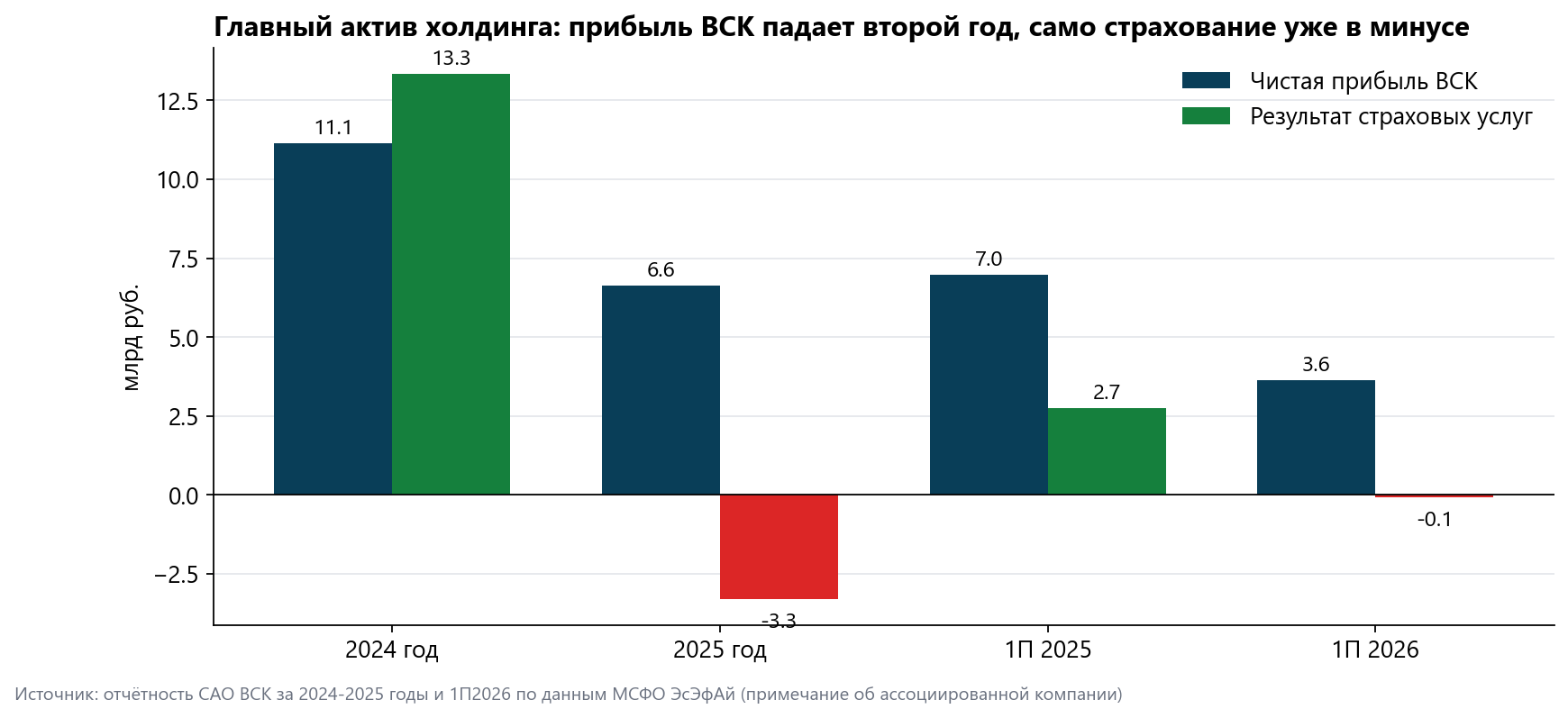
Nothing came from VSK to the holding for 2025, and the company does not assume any payments in its 2026 base case, as confirmed on the IR call of 19 August. The insurer's dividend decision is taken separately each time, and there is no formula.
The sum of the parts is RUB 485 per share against RUB 574 on the market: a premium of 18% against a historical discount of 31%
The model on the card has been recalculated after the half-year report. The composition in RUB bn.
- 49% stake in VSK at five times last-twelve-month profit (RUB 3.3 bn for VSK as a whole, holding's share RUB 1.6 bn) 8.1
- claim on M.Video of RUB 10.3 bn, convertible into shares at RUB 58 with a market price of RUB 46 8.2
- other loans, RUB 7.4 bn gross, at the audited ratio of carrying value to gross value 5.4
- 9.87% of M.Video shares at market 0.8
- free cash 0.95
- total RUB 23.6 bn, or RUB 485 per share
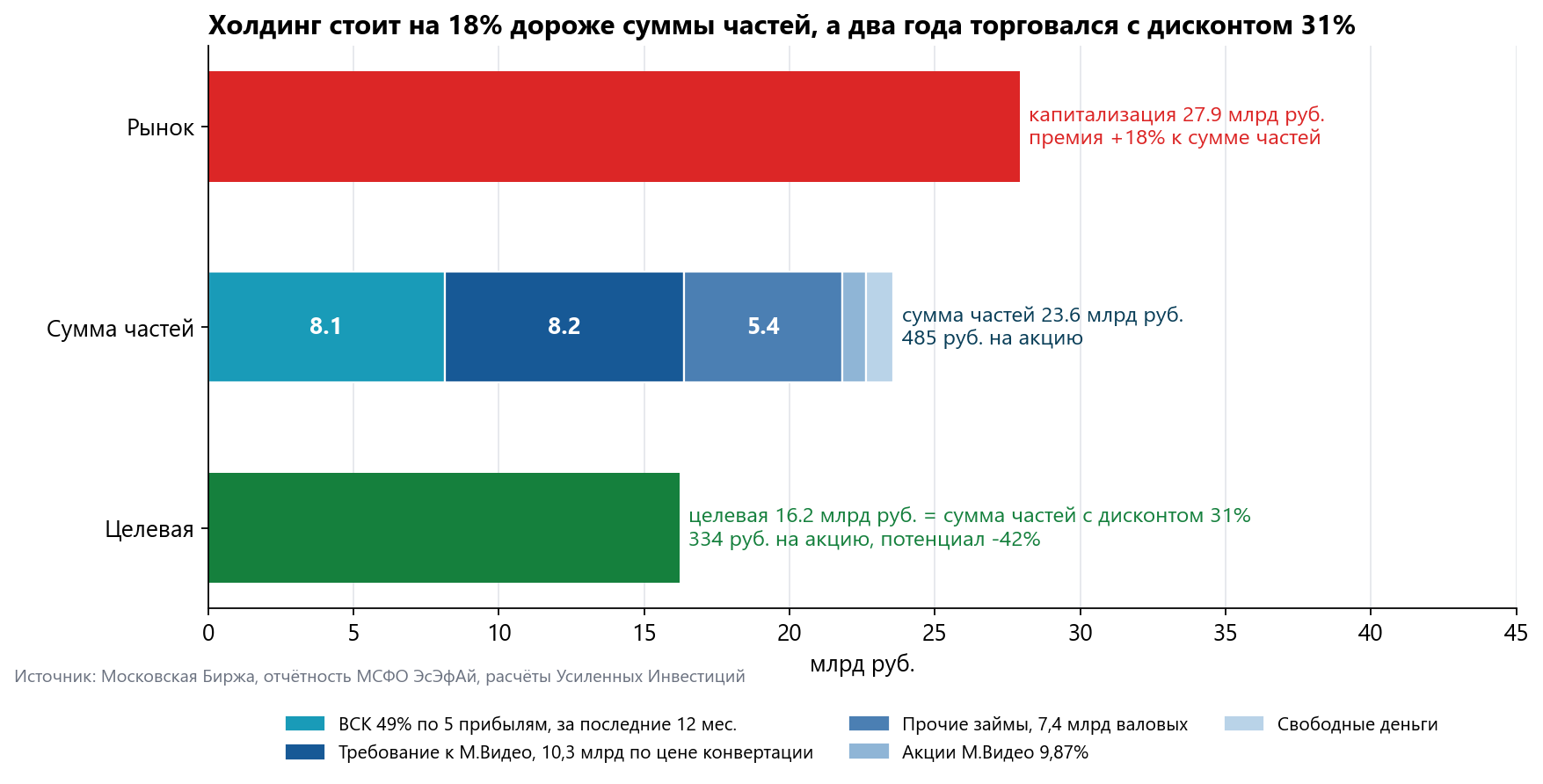
Market capitalisation at RUB 574 is RUB 27.9 bn, a premium to the sum of the parts of 18%. Over 624 trading days from March 2024 to December 2025, while the holding still owned Europlan and its stake could be valued at market, the median discount was 31%, and a discount was present on 85% of days. A return to the median gives RUB 16.2 bn, or RUB 334 per share, a downside of 42%.
Two caveats to the figure, both shown on the card as well. Valuing VSK at last-twelve-month profit takes the low point. On 2025 profit the stake is worth RUB 16.3 bn, the target is RUB 449 and the downside is 22%. In the other direction works the book of other loans: if it is counted as zero, the target is RUB 257. We hold to the base calculation, not the edge of the range.
Compared with the first review, the figures have shifted. Then the target was RUB 384 with a sum of the parts of RUB 558. The target fell for two reasons, both from the report. VSK earned half as much, and the company itself marked down the stake. Loan provisions rose and the carrying value of the book fell. At the same time we value the M.Video claim higher than before: according to IR, the borrower's obligations at the time of conversion will be RUB 10.3 bn, not RUB 15.8 bn of nominal, and the mark is now calculated from M.Video's own bonds, which trade at 102% of nominal, and from the conversion price.
There will be no nine-month dividend: there is no base and no cash
The dividend policy defines the base as at least 75% of the lower of two values, net profit under Russian accounting standards (RAS) and free cash flow for the period, provided dividends are received from subsidiaries and associates. Under RAS for the half-year the holding recorded a loss of RUB 0.14 bn on revenue of RUB 0.89 bn, and the half-year provision on the M.Video loan of about RUB 1 bn was formed by a norm tied to the length of non-payment. No dividends were received from VSK. Accounts hold RUB 1.0 bn against team and office costs of about RUB 0.5 bn a year.
On the call of 19 August the IR representative said directly that there is little to pay with, especially in amounts that matter for capitalisation. These are now the company's words, not only our estimate.
One caveat for the second half. The provision on the M.Video loan is released when the shares are received, so RAS for nine months or for the year may show a paper profit. This does not create a dividend base, because the second leg of the formula, cash flow, remains empty and the condition on dividends from subsidiaries is not met. But the argument "a RAS loss means no dividends" cannot be mechanically carried over to the second half.
When the idea should work: the November-December calendar
Two years in a row the holding paid an interim dividend for nine months in December. For nine months of 2024 it was RUB 227.6 per share, with the meeting on 11 December and the record date on 23 December. For nine months of 2025 it was RUB 902, with the board recommendation on 21 November, the meeting on 17 December and the record date on 25 December. Some holders expect a repeat, and it is this expectation that keeps the price above the sum of the parts.
Control dates based on last year's calendar.
- early November, RAS statements for nine months (5 November a year ago). If the loss persists, there is no base
- second half of November, board meeting on the nine-month dividend (21 November a year ago). The absence of a recommendation, or a recommendation not to pay, moves our thesis from an estimate to a fact
- 25 December 2026, the RUB 902 payment drops out of the rolling twelve-month window. In screeners the yield falls from 187% at the current price to about 30%, and after 15 May 2027 to zero
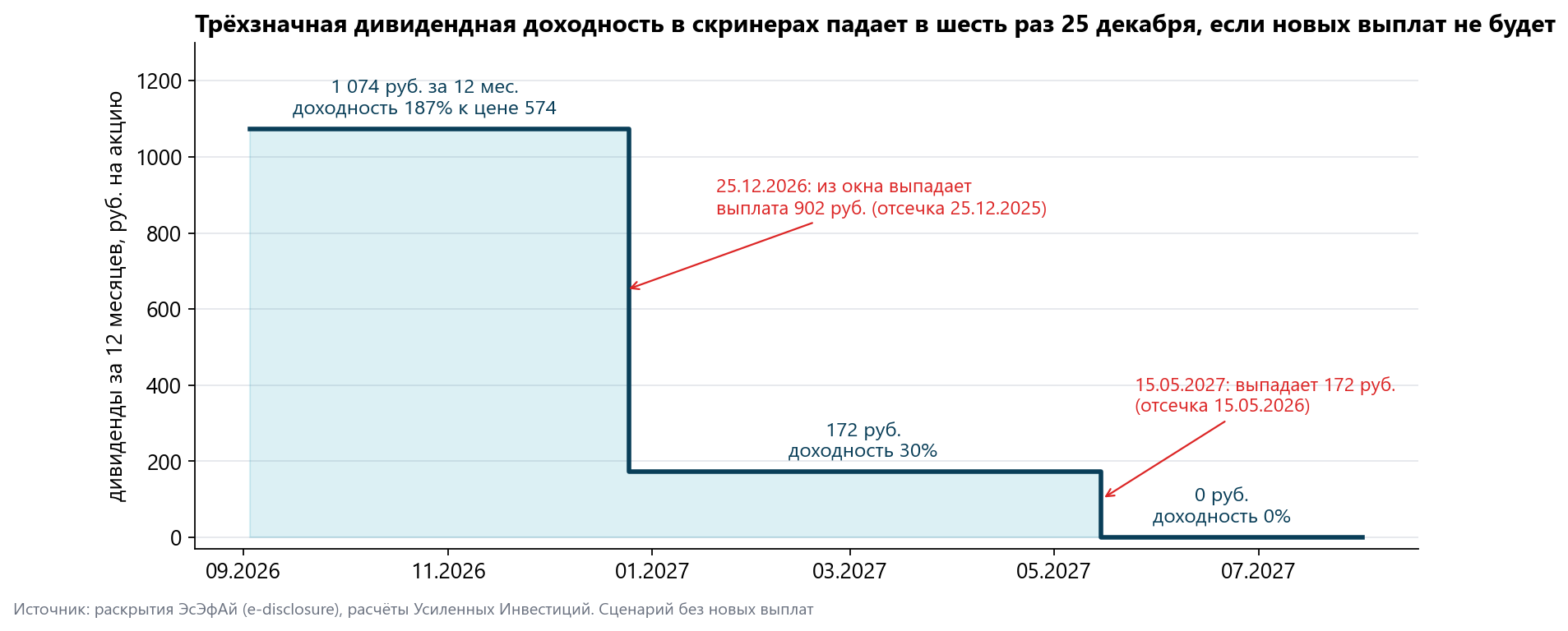
This is the crystallisation of the idea. An announcement of no payment removes the only reason for some holders to keep the stock. The market may price this in early, as it priced in the sale of Europlan in advance, and then the move would fall in November rather than December.
Where to short: four of the six brokers checked offer the stock, the SFIN-12.26 future is a fallback
Checked on 3 September against the brokers' own public lists and NCC data. The short risk rate differs by broker and depends on the client category, so ranges are shown below.
- T-Investments. Short is open, and the security card states directly that short selling is available. The short risk rate on our account is 68.5%
- BCS. Short is open, short risk rate from 38% to 108% by client category
- VTB My Investments. Short is open, liquid assets list dated 2 September, rate from 60% to 108%
- Sber Investments. Short is open, list dated 3 September, rate 35-50%
- Finam. No short, the rate table for the security shows only long
- Gazprombank Investments. No short, the security is not on the list for uncovered trades in force from 31 August
- Alfa-Investments, Sovcombank, Alor. We could not find a public list with rates, so check in the broker's app
- NCC (central counterparty). Minimum risk rates 33% / 50% / 75%, the security is not on the short-sale ban list. There are no restrictions at exchange level
Cost. A short position in the stock costs 7-10% a year at the brokers' rates, and the rate should be confirmed before entry. The SFIN-9.26 future expires on 17 September and trades at RUB 569.6 against a spot of RUB 574.4, backwardation of 0.8% over two weeks, about 22% annualised. The next contract, SFIN-12.26, expires on 17 December and trades at RUB 546.4, backwardation of 4.9% over 105 days, about 17% annualised, open interest of 46 thousand contracts, and a wide spread in the order book. The December contract closes a week before 25 December, that is before the dividend drops out of the window, but after the expected board decision.
The stock is still the cheaper way to take the position compared with the future. The future is needed where the broker does not allow a short, and as insurance in case the short in the stock is closed.
The main risk: a broker or the NCC can close the short in a single day
The mechanism is known from EuroTrans. On 20 July 2026 the exchange announced a short-sale ban effective 21 July, and the stock gained 101.8% on the day of the announcement and another 19% the next day, then after three sessions returned to RUB 35 from 51. Those who held a leveraged short and could not wait it out were squeezed out. SFI had a similar move profile in July: from 17 to 21 July the stock rose from RUB 273 to RUB 476, and, according to the company itself, short sellers were behind it.
Over fourteen months an NCC ban happened on stocks three times, and each time the trigger was a corporate event because of which the central counterparty could not assess the risk of the security. Default, court seizure, conversion. SFI has no such event, the company did not initiate a ban and held no dialogue with the exchange. A decision by an individual broker, however, is not published anywhere and leaves no trace. At T-Investments the short is switched off for most main-board securities, and they can add a security to this list under internal rules at any moment.
How we build the position with this in mind.
- position size such that an adverse move of 30-40% in a day does not lead to forced closing. Leverage is out of place here
- the future as a fallback channel. Short sales cannot be banned in a future, the exchange can only raise the margin requirement
- if the broker has closed the short in the stock but the NCC has not introduced restrictions, the position can be moved to the future or to another broker rather than bought back at the market in the hour of the announcement
- entry closer to the November control dates reduces the time during which the position is exposed to this risk
What else could break the idea
- A sale of the VSK stake together with the second shareholder at a price above five times profit. Negotiations are under way, with no substantive offers, according to the company
- A second-half paper profit from releasing the provision on the M.Video loan, and a dividend from retained earnings of past years contrary to the policy
- A repeat squeeze on a thin order book: free float is about 23% of capital, and in a single session in July 90% of its volume traded
- After conversion the M.Video stake may be packaged so that the retailer's losses do not flow line by line into the holding's statements, and the deterioration in reporting that we expect does not occur
Conclusion
The idea remains in force, with downside of 42% in the base calculation and 22% in the cautious one. The half-year report confirmed both theses. The main asset is getting cheaper, and there is nothing to pay dividends from. The nearest checkpoint is the board decision on the nine-month dividend in the second half of November, followed on 25 December by the RUB 902 payment dropping out of the window. The stock can be shorted at T-Investments, BCS, VTB and Sber, and there are no NCC restrictions. The position must survive a squeeze of 30-40% in a day, so size matters more than the entry point.
First review of the idea, of 7 August: [https://telegra.ph/EHsEHfAj-spekulyativnyj-short-akcii-08-07](https://telegra.ph/EHsEHfAj-spekulyativnyj-short-akcii-08-07)
Issuer card with the sum-of-the-parts model: https://frontier.eninvs.com/company/RU_SFIN?lang=en
See also: market overview · valuation map · stock screeners