Shares instead of cash: how much capital Russian companies hand to management each year
Russian public companies increasingly pay employees in their own shares. Some buy the shares on the exchange, others print new ones. A question that is rarely examined: how much capital goes into this every year, and is that cost visible in the profit by which investors value a company and calculate dividends.
We reviewed the 2025 IFRS annual reports of ten names: T-Technologies, Yandex, HeadHunter, CIAN, Positive Group, Astra Group, Arenadata Group, Softline, WUSH Holding and Renaissance Insurance. We measured three things. How many shares physically passed to employees during the year. What expense was recognised for this in the income statement. And whether that expense is removed from the "adjusted" metrics the company guides the market on.
This material was prepared by Enhanced Investments. All figures are taken from audited reporting; quotes are Moscow Exchange closing prices on 18 August 2026.
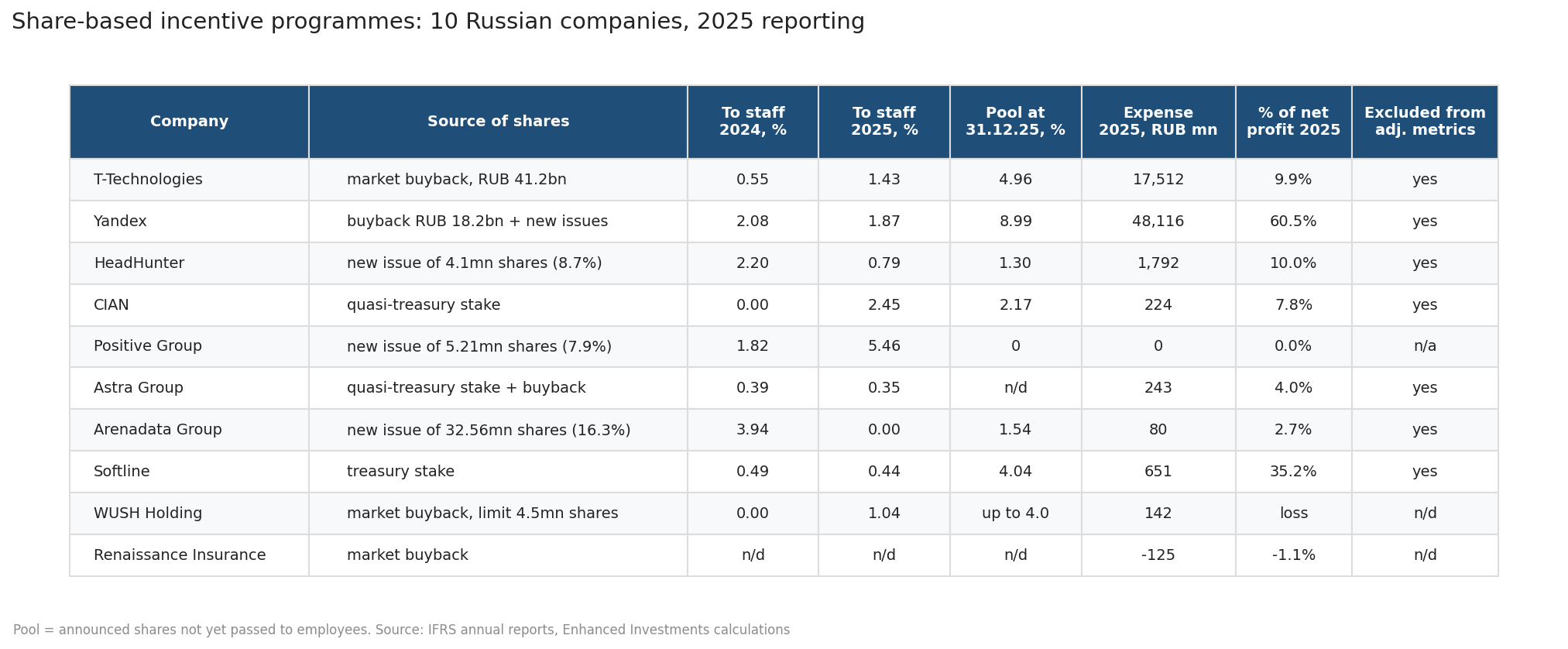
Terms in brief
- Share-based incentive programme – an employee is promised a certain number of shares that pass to them after several years if conditions are met. This transfer is called vesting.
- Announced grant and transferred share – these are different stages. A grant means the package is allocated to a specific participant, but the shares still sit with the company, and the employee has no votes or dividends on them. A transferred share means vesting has occurred and the share has been written off to the participant. Dilution happens at the second stage, while the expense in the accounts is accrued from the first.
- Treasury stake – the company's own shares, bought back from shareholders. They carry no votes or dividends, but can be passed to employees without issuing new shares.
- New share issue – the issuance of new shares. The stake of existing shareholders shrinks as a result.
- IFRS 2 – the standard under which promised shares must be measured at fair value on the grant date and expensed over the vesting period.
- Adjusted EBITDA and adjusted net profit – metrics that the company calculates itself. They usually exclude items management considers one-off or non-cash.
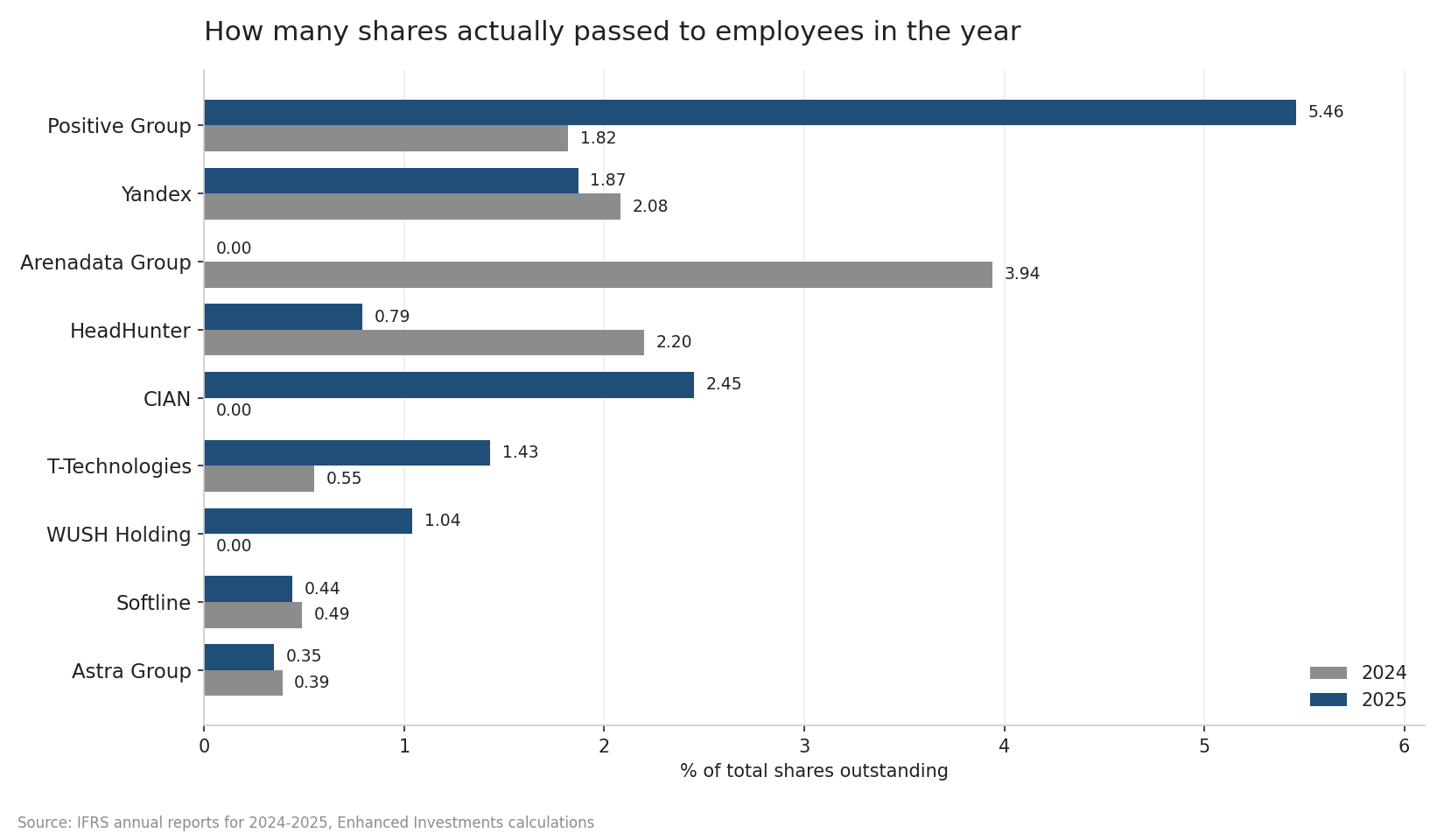
In 2024-2025 nine companies transferred between 0.7% and 7.3% of capital to employees
The most honest gauge of scale is not the rouble expense but the number of shares that actually changed hands. At Positive Group, 5.18 million shares went to employees over two years, which is 7.3% of the entire share capital. At Arenadata it is 9.16 million shares, or 3.9% of capital, almost all in 2024 alone. At Yandex, 15.5 million shares over two years, about 3.9% of capital. At HeadHunter, 1.41 million shares, exactly 3.0%.
At the other pole are Astra Group and Softline. Each is below 0.5% of capital a year. T-Technologies is so far at about 1% a year, but its announced and not yet issued pool is growing fast.
T-Technologies: RUB 41bn on buybacks over two years and a grant pool of almost 7% of capital
The long-term incentive programme at T-Technologies is backed by share purchases on the market. In 2024 the group bought back 11.88 million shares for RUB 34.9bn, and in 2025 another 2.05 million for RUB 6.3bn. In total, RUB 41.2bn of real cash over two years. The treasury stake at the end of 2025 was 10.88 million shares, or 4.1% of capital.
Employees received 1.48 million shares in 2024 and 3.84 million in 2025. That is 0.55% and 1.43% of capital. But the announced grants are more interesting. In 2024 the group announced grants for 12.9 million shares at once, almost 5% of capital in a single year. At the end of 2025 the programme's unallocated pool was 13.3 million shares, or 5.0% of capital, and in 1H2026 another 4.47 million grants were announced, taking the pool to 17.7 million shares, or 6.6% of capital.
The expense in the accounts is growing faster than the business. In 2022 the programme cost RUB 7.8bn, in 2023 RUB 3.6bn, in 2024 RUB 7.7bn, and in 2025 already RUB 17.5bn. That is 9.9% of 2025 net profit attributable to shareholders. In 1H2026 the expense was RUB 10.9bn.
A separate figure from the related-parties note. Of the RUB 17.5bn expense in 2025, RUB 8.2bn, or 47%, fell on key management personnel. A year earlier it was RUB 4.0bn out of RUB 7.7bn.
T-Technologies already has more announced grants than shares in its treasury stake
The difference between a grant and a transferred share deserves separate analysis, because it changes the assessment of the programme's scale. The pool movement table of the long-term incentive programme has three lines. "Announced grants" – the package is allocated to a participant, but the shares stay with the company. "Transferred shares" – vesting has occurred and the shares are written off to the employee. "Forfeitures" – the participant left or did not reach the required score in the annual review, and the unallocated part of the grant lapsed. In 2025, 1.13 million shares lapsed this way.
The "transferred shares" line reconciles with the share capital note: 1,476,809 shares for RUB 4,456mn in 2024 and 3,836,995 shares for RUB 9,845mn in 2025. This is the actual dilution. Over two years, 5.3 million shares against 14.7 million announced grants for the same period.
The pool is already included in diluted earnings per share. For 2025 the basic weighted average number of shares was 257.0 million, the diluted 266.6 million. Earnings per share were RUB 689 against RUB 664 diluted.
The most significant point. At 30 June 2026 the announced pool was 177.3 million shares after the split, while the company held 132.8 million of its own shares. A gap of 44.5 million shares, or 1.66% of capital. At RUB 258 per share this is about RUB 11.5bn that the company still has to spend on buybacks if it does not want to close the gap with a new issue. Buybacks were already under way in 1H2026: 24.0 million shares for RUB 7.7bn, and the treasury stake grew over the half-year from 108.8 to 132.8 million shares. So an announced grant is not an accounting abstraction but an obligation for which real money leaves the capital.
The 69 million share issue at T-Technologies paid for Rosbank, not for incentives
In 2024 the number of T-Technologies shares rose from 199.3 million to 268.3 million. The increase of 68.97 million shares is often cited as dilution in favour of management. This is not the case. The additional issue was carried out by closed subscription as part of the Rosbank integration and was valued at RUB 178.1bn of share premium. The incentive programme has nothing to do with this issue and is supported by market buybacks.
In April 2026 the company carried out a 1-for-10 share split, so the current number of shares is 2,682.7 million. All percentages above are unaffected.
Yandex does everything at once: buys back, issues new shares and keeps a charter option pool of 23% of capital
At Yandex the incentive programme was approved by the board of directors in June 2024. The charter fixes an option pool of 91.8 million shares. This is 23.2% of the current number of outstanding shares, the upper limit of what the company can in principle issue under the programme.
There are two sources of shares. In 2024 the subsidiary administering the programme bought 14.17 million shares on the market for RUB 18.2bn. In parallel, the company carried out additional issues in favour of the same administrator: 11.09 million shares in 2024 and another 4.42 million in 2025.
Employees received 8.10 million shares in 2024 and 7.39 million in 2025, a total of 3.9% of capital. Unexercised options at the end of 2025 stood at 35.52 million, or 9.0% of capital. The dilutive effect of the programme in earnings per share rose from 4.47 million shares in 2024 to 18.94 million in 2025.
The gap between what is promised and what is covered is even wider here than at T-Technologies: 35.52 million unexercised options against 14.18 million own shares on the balance sheet of the programme administrator. A difference of 21.3 million shares, or 5.4% of capital. But judging by the practice of 2024-2025, Yandex will close it not with buybacks but by printing new shares: the 91.8 million share charter pool exists precisely for this.
At Yandex the programme cost RUB 92bn against net profit of RUB 11.5bn
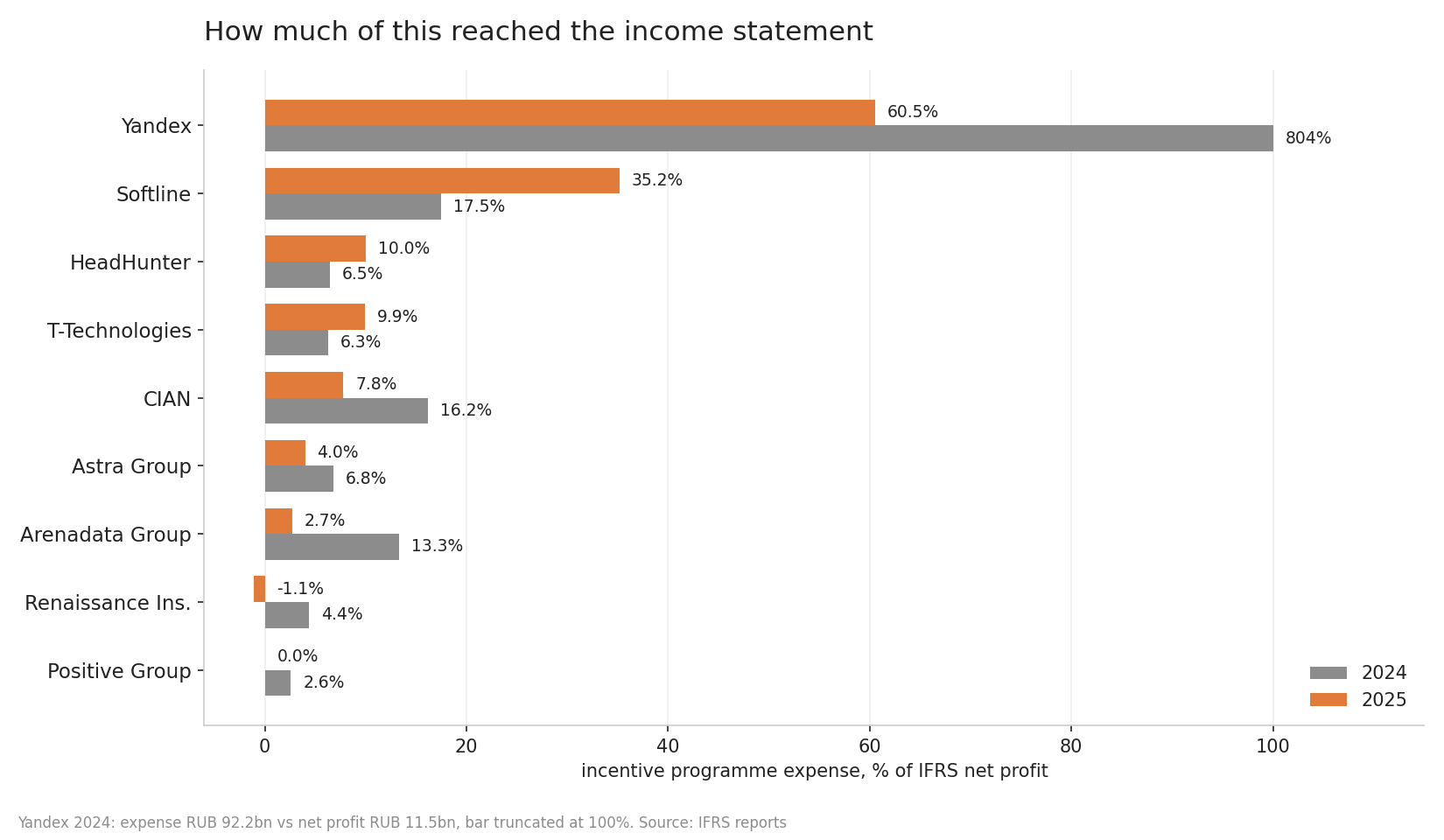
The share-based compensation expense for 2024 was RUB 92.2bn against net profit of RUB 11.5bn. For 2025 the expense fell to RUB 48.1bn against profit of RUB 79.6bn, that is to 60% of profit. As a share of revenue it is 8.4% in 2024 and 3.3% in 2025.
Of the equity-settled part, key management personnel accounted for RUB 80.9bn in 2024 and RUB 39.2bn in 2025. Formally this is almost the whole amount, but the circle is drawn broadly: the company classes as key personnel the heads of businesses and services, the heads of their divisions, development teams, corporate functions and centres of expertise. The number of recipients is not disclosed in the reporting. Over two years this group was issued 13.28 million shares.
The expense of the programme is excluded in full from adjusted EBITDA. In 2025 the figure was RUB 280.8bn, and RUB 48.1bn of it was struck out.
Positive Group handed out 7.3% of capital, but it barely shows in profit
The most telling case. In November 2024 Positive Group placed 5,214,000 new shares, increasing share capital from 66.0 million to 71.2 million shares, that is by 7.9%. For the "Growth Stimulation" programme a reserve of RUB 10,042mn was created, based on 5,180,000 shares at RUB 1,938.6 each. In 2024 recipients were transferred 1.29 million shares, and in 2025 the remaining 3.89 million. The programme was fully executed.
Now the profit. In the 2024 cash flow statement the line "share-based payment expense" is RUB 96.3mn; for 2025 it is empty. The RUB 10,042mn reserve itself was formed directly in equity and in 2025 was likewise written off directly to retained earnings. About 1% of the amount passed through the income statement.
Where did the other RUB 10bn go? The company's accounting policy allows such costs to be recognised as an asset if they meet the asset recognition criteria. The arithmetic confirms this. Additions of intangible assets in 2024 were RUB 15,237mn, while cash spent on creating and buying intangibles was RUB 5,249mn. The gap of RUB 9,988mn almost exactly matches the programme reserve. That is, the value of shares for developers was capitalised into the cost of software products and will reach profit gradually, through amortisation.
Formally this approach does not contradict the standard. Economically, in 2024 and 2025 the investor saw profit of RUB 3.66bn and RUB 7.27bn, unburdened by the cost of the shares handed out. Amortisation of intangibles meanwhile is growing fast: RUB 0.67bn in 2023, RUB 1.34bn in 2024 and RUB 2.28bn in 2025. For 2024 the company also paid RUB 6.55bn in dividends.
Arenadata issued shares equal to 16% of capital, yet calculated the expense at RUB 57.5 against an IPO price of RUB 95
In 2024 Arenadata Group carried out four issues of preferred shares totalling 32,558,140 shares and placed them in a specialised fund. Relative to 200 million ordinary shares this is 16.3%. The shares convert into ordinary shares as programme conditions are met, and are also used to buy out minority stakes in subsidiaries and for deals. Today 232.56 million shares are outstanding.
Option agreements with employees were signed in 2024 for 14.16 million shares, of which 9.16 million were exercised immediately, that is 3.9% of capital. The expense in the accounts is RUB 258mn for 2024 and RUB 80mn for 2025, with another RUB 40mn planned for 2026. In total about RUB 378mn for 14.16 million shares, or RUB 27 per share.
The share price on the grant date was taken as the fair value estimate of the company less a discount for lack of liquidity, and came to RUB 57.5. A few months later the company went public at RUB 95 per share. At the placement price, the 9.16 million shares transferred in 2024 were worth about RUB 870mn against a recognised expense of RUB 258mn. The charter also allows placing another 390.8 million authorised shares.
HeadHunter printed shares for the programme, but calculates dividends from profit without its cost
At HeadHunter the source of shares is the company's own additional issue. In October 2024, as part of the second stage of the reorganisation, the company placed 4,100,000 ordinary shares specifically for the long-term incentive programme. With share capital of 47.18 million shares this is 8.7%.
Participants were transferred 1,036,512 shares in 2024 and 372,560 in 2025. The balance holds 2.69 million own shares, or 5.7% of capital. This is the only case in the sample where the stake covers the obligations with a large margin: unexercised options at the end of 2025 are only 612 thousand. The company will not need new buybacks or issues for the programme. The programme expense is RUB 1.56bn for 2024 and RUB 1.79bn for 2025, that is 6.5% and 10.0% of net profit.
The weighted average share price on the exercise date in 2024 was RUB 4,111. So the transferred package was worth about RUB 4.26bn against an expense of RUB 1.56bn in the same year. The gap is explained by the fact that under the standard the expense accrues gradually while the delivery is a one-off, but for the shareholder the economics at the moment are exactly this.
The second point concerns dividends. IFRS net profit for 2025 is RUB 18.0bn, and the adjusted net profit that the company communicates to the market is RUB 20.8bn. The adjustments include the incentive programme expense. It is adjusted profit that the company takes as the starting point for dividends: for 1H2025, RUB 233 per share, or RUB 10.36bn, was announced. Meanwhile 2025 revenue grew by only 4%, to RUB 41.2bn, and IFRS profit fell by almost a quarter.
CIAN, Astra, Softline and WUSH: the pools are small, but at Softline the expense eats a third of profit
CIAN. The programme is backed by a quasi-treasury stake. In 2025, 1,900,753 shares were exercised, which is 2.45% of capital, whereas in 2024 nothing was exercised. The recognised expense is only RUB 224mn against RUB 399mn a year earlier. The grant-date fair value of the shares exercised is about RUB 660 per share, that is roughly RUB 1.25bn. Most of the cost of these shares was recognised as expense in earlier years, as they vested. The unexercised balance is 1.69 million shares, 2.2% of capital.
Astra Group. The most modest programme in the sample. The first cycle for 1.83 million shares at RUB 508 was approved in July 2024, the second in March 2025 for 2.50 million shares at RUB 404. Employees were transferred 809 thousand shares in 2024 and 732 thousand in 2025, that is 0.39% and 0.35% of capital. The expense is RUB 411mn and RUB 243mn. In 2Q2025 the company assessed the probability of reaching its net profit targets as low and reversed the previously recognised RUB 131mn and 258 thousand shares. The shares come from a quasi-treasury stake created back in September 2023, and in 2025 another 650 thousand shares were bought back.
Softline. Two programmes launched in 2024: TOP-100 for senior management and a long-term partnership programme for the rest. 19.9 million options were granted with an exercise price of RUB 0.0015, that is effectively free. This is 5.0% of capital. The unexercised balance at the end of 2025 is 16.2 million shares. So far not much is exercised: 1.95 million shares in 2024 and 1.77 million in 2025. But the expense of RUB 651mn is 35% of 2025 net profit, because the profit itself fell to RUB 1.85bn on revenue of RUB 95.5bn. Separately, in 2025 the company bought back 11.9 million of its own shares for RUB 1.13bn, sold treasury shares for RUB 5.03bn in the same year, and also settled bonuses with them for RUB 409mn. We also recall the June 2024 issue of 76 million shares by closed subscription; it is a story separate from incentives, but the dilution is real.
WUSH Holding. The programme was approved in November 2023, options are exercised at par value when EBITDA targets are reached, and the pool limit is 4.5 million shares, or 4.0% of capital. For it the company bought back 1.5 million shares for RUB 318mn, in 2025 transferred 1.15 million to participants, and the remaining 346 thousand had to be sold back under the programme terms. In August 2025 a new buyback of up to 1.5 million shares was approved. The expense is RUB 212mn for 2024 and RUB 142mn for 2025. The context is unpleasant: 2025 revenue fell by 13% to RUB 12.5bn, and the group recorded a net loss of RUB 2.9bn. Based on 2025 results, management considers the target EBITDA level achieved, which means the share payout will take place.
Renaissance Insurance is the only one whose programme reserve decreased in 2025
Renaissance Insurance runs programmes from 2021 and 2023, and the accumulated reserve under them at the end of 2025 is RUB 972mn. The reserve movement is plus RUB 481mn for 2024 and minus RUB 125mn for 2025, meaning payouts exceeded new accruals. Against net profit of RUB 11.0bn, the 2024 accrual was about 4% of profit, and in 2025 the programme did not reduce profit. The company does buy back its own shares: RUB 1.32bn in 2024 and RUB 1.36bn in 2025.
A caveat on the source. Renaissance's reporting is published as a scan, so the figures were obtained through text recognition and checked by reconciling equity. The 2025 report no longer contains a separate share-based payments note; the data are taken from the note on other provisions and from the statement of changes in equity.
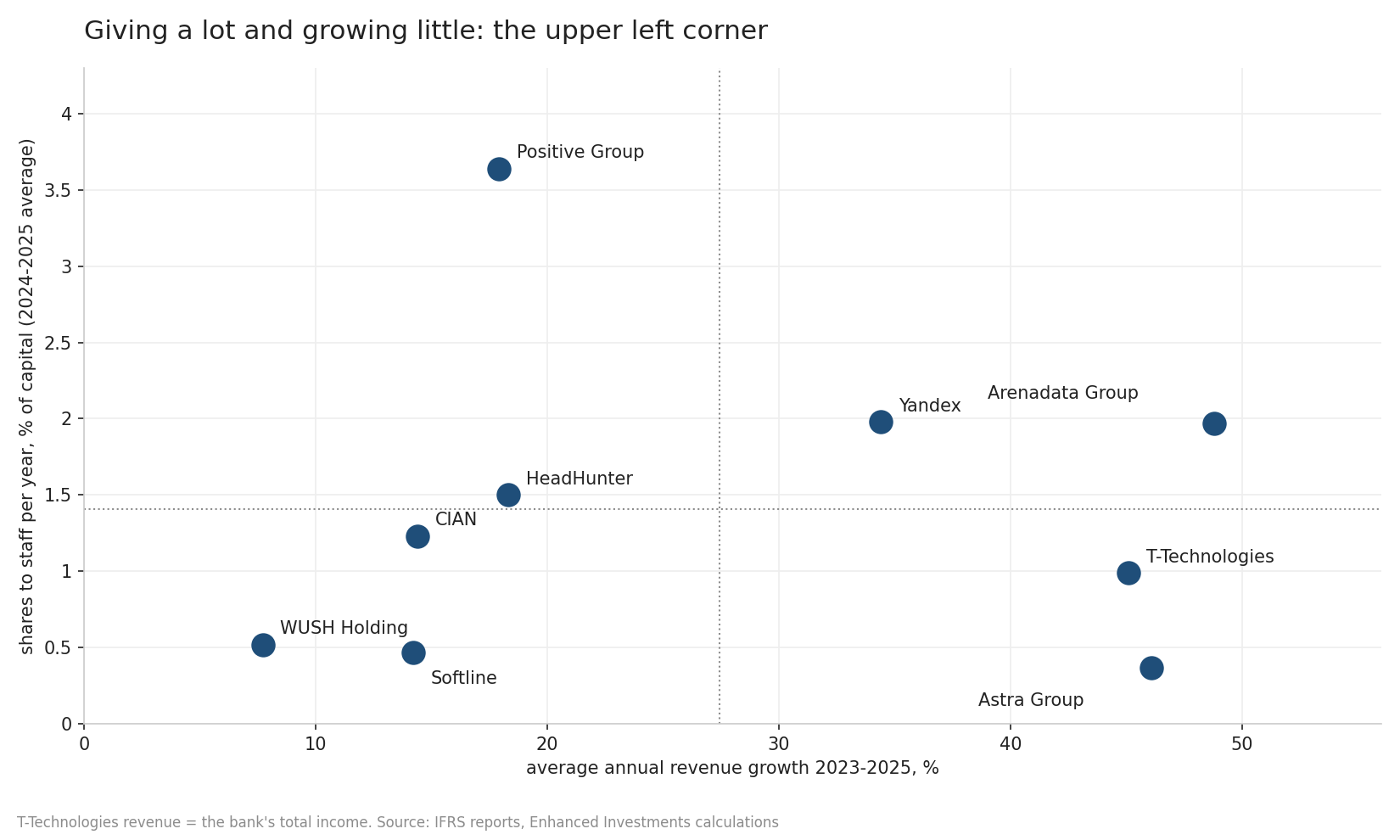
Giving a lot with weak growth – Positive, HeadHunter, CIAN and WUSH
If we compare average annual revenue growth for 2023-2025 with the share of capital that goes to staff each year, the picture separates.
Paying expensively without matching growth are Positive Group (3.6% of capital a year with revenue growth of 17.9% a year), HeadHunter (1.5% with growth of 18.3%, and in 2025 growth effectively stopped at 4%) and CIAN (1.2% with growth of 14.4%). WUSH stands apart: the share is small, 0.5% a year, but revenue is falling and the company is loss-making.
At the other pole is Astra Group: revenue growth of 46% a year with 0.37% of capital a year. T-Technologies pays about 1% of capital a year with total income growth of 45% a year. Arenadata has a high share, about 2% a year, but also the fastest growth in the sample, 49% a year. Softline hands out few shares, but its expense weighs heavily on shrunken profit.
The expense is in the accounts, but it is struck out of the metrics used to pay dividends
The answer to the question of whether it is reflected correctly is twofold. In the IFRS statements themselves the expense is recognised at almost everyone, and that is right. But seven companies out of ten strike it out of their adjusted metrics.
Yandex excludes RUB 48.1bn from adjusted EBITDA. T-Technologies removes RUB 10.9bn from adjusted EBITDA for 1H2026. Astra adjusts both EBITDA and net profit, explaining that exercising options does not involve a cash outflow. Arenadata excludes the programme from its NIC metric. Softline writes directly that it excludes programme expenses from adjusted EBITDA. CIAN does not analyse these payments when assessing the operating performance of its segments. HeadHunter shows adjusted net profit above IFRS profit and calculates dividends from it.
The argument "it is a non-cash expense" is only half true. It really is non-cash when shares are printed: then it is not the company that pays but the existing shareholders with their stake. When shares are bought on the exchange, the outflow is quite real. At T-Technologies that is RUB 41.2bn over two years, at Yandex RUB 18.2bn, at WUSH RUB 318mn, at Renaissance RUB 2.7bn.
What the investor should watch
- Count shares, not rouble expense. The expense under the standard is spread over time and valued at past prices, while dilution happens when the shares are actually transferred.
- Look not only at what has been issued but also at the announced pool. At T-Technologies it is 6.6% of capital in mid-2026, at Yandex 9.0% at the end of 2025, at Softline 4.0%.
- Compare the announced pool with the treasury stake. If more is promised than sits on the balance sheet, the difference will have to be either bought for cash or printed. At T-Technologies the uncovered balance is 44.5 million shares, or 1.66% of capital, about RUB 11.5bn. At Yandex it is 21.3 million shares, 5.4% of capital. At HeadHunter, by contrast, the stake covers the obligations with a margin.
- Check where the shares come from. A market buyback costs the company money and is visible in the cash flow statement. A new issue costs the company nothing and is therefore more dangerous for a minority shareholder.
- Recalculate multiples on the diluted share count and subtract the programme cost from adjusted profit if the company removed it from there.
- Separately compare the price at which the company valued the shares for the expense calculation with the market price. Arenadata's gap between RUB 57.5 and the IPO price of RUB 95 is a clear example.
Tickers
T · YDEX · HEAD · CNRU · POSI · ASTR · DATA · SOFL · WUSH · RENI. Extended issuer cards with financial history are on our portal.
Conclusion
Positive Group gives the most capital to staff – 7.3% over two years, and almost all of the cost bypassed the income statement through capitalisation into intangible assets. The most expensive programme in cash terms is Yandex's: RUB 140bn of expense over two years and a charter pool of 23% of capital. The fastest-growing is at T-Technologies, where the announced pool reached 6.6% of capital in a year and a half, has already required RUB 49bn for share buybacks and is still not covered by the treasury stake. Astra Group and Renaissance Insurance pay the least.
Share-based incentives are not a vice in themselves; for fast-growing companies they are justified. The point is that the investor should see their price. Today the standard practice of the Russian market is to show the expense in the accounts and remove it from the metric by which the company is valued and from which dividends are paid.
See also: market overview · valuation map · stock screeners