Russian grid companies after 1H2026: tariff tailwind, record capex and dividend yields of up to 17%
The sector is earning record money but shares it unevenly: the group's construction programme is funded by FGC and the weaker subsidiaries, while the profitable distribution companies pay shareholders double-digit dividends at valuations of 1-2x annual EBITDA.
A review of all listed Rosseti group companies based on 1H2026 reports: who discloses what, who can carry the capex programme, whose debt is growing, what trades at what price and where to expect dividends over the next year and over a three-year horizon.
- Tariff indexation stays in double digits at least until 2028. Sector profit grew by 20-120% YoY in 1H2026, and this is not a one-off.
- Debt is a problem of two names, not of the sector. All of the group's debt sits at FGC (RUB 805bn) and Rosseti Siberia (2.7x EBITDA); half of the companies have no net debt at all.
- The group's capex programme accelerates from RUB 725bn in 2025 to ~900bn in 2026. FGC pays for it by forgoing dividends and issuing new shares; the dividend moratorium does not apply to the subsidiaries.
- Eight issuers in the sector paid dividends for 2025. The leader is Rosseti Centre and Volga Region with 14.6% to the current price; for 2026, estimates reach ~15-17% for Centre and Volga Region, Urals, Volga and Moscow Region.
- The best combinations of growth, balance sheet and payouts are Centre and Volga Region, Moscow Region, Urals, Volga and Lenenergo pref. Expensive with the weakest balance sheet: Siberia; cheap options without a catalyst: FGC and North-West.
Disclosure: the sector is again among the most transparent, with three caveats
All ten liquid group companies reported 1H2026 RAS results at the end of July and IFRS results on 27-28 August. Rosseti Moscow Region, Rosseti Centre, Centre and Volga Region, Volga, North-West, South and Urals also publish quarterly IFRS, which is a luxury in today's market.
Three caveats. IFRS statements of Rosseti Urals and Lenenergo were, as of the review date, available only on the companies' websites: the reports did not reach the official disclosure system, so some aggregators will not see them. Rosseti South absorbed Rosseti Kuban on 01.12.2025 and the 1H2025 comparative base was not restated, so the reported growth rates (revenue up from RUB 38bn to 95bn) reflect the change in perimeter, not organic growth. Finally, Rosseti North Caucasus reports diligently but has posted losses for the twelfth year in a row (minus RUB 6.8bn under RAS in 1H2026), while TRK (Tomsk) discloses only RAS and does not exist for the business media.
Tariffs delivered double-digit profit growth, and this holds at least until 2028
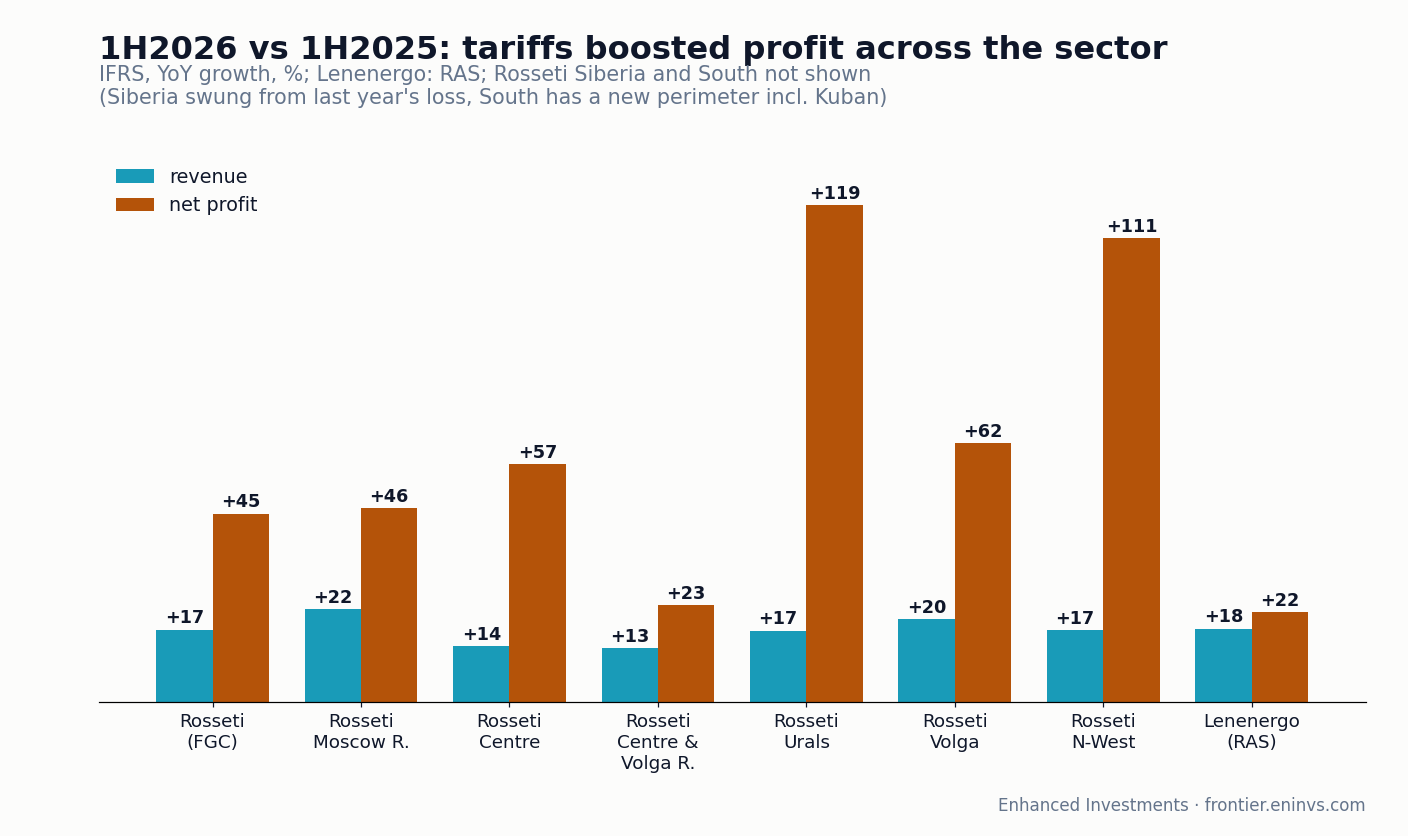
The common driver is the indexation of transmission tariffs by +11.6% from 01.07.2025 (trunk grids +11.5%) with a more modest increase in costs. 1H2026 IFRS results:
- Rosseti (FGC), consolidated: revenue RUB 981.5bn (+17.4%), EBITDA 382.4bn (+13.9%), net profit 176.0bn (+45%), of which attributable to shareholders 133.4bn (+43%).
- Rosseti Moscow Region: revenue RUB 159.0bn (+22%), EBITDA 53.3bn (+27%), net profit 24.4bn (+47%).
- Rosseti Centre: revenue RUB 80.6bn (+14%), EBITDA 21.3bn (+16%), net profit 8.5bn (+57%).
- Rosseti Centre and Volga Region: revenue RUB 85.9bn (+13%), EBITDA 27.9bn (+15%), net profit 14.8bn (+23%).
- Rosseti Urals: revenue RUB 69.6bn (+17%), operating profit +89%, net profit 11.5bn (2.2x).
- Rosseti Volga: revenue RUB 71.2bn (+20%), EBITDA 13.7bn (+44%), net profit 7.3bn (+62%).
- Rosseti North-West: revenue RUB 44.8bn (+17%), EBITDA 8.6bn (+57%), net profit 3.8bn (2.1x).
- Rosseti Siberia: revenue RUB 65.8bn (+21%), EBITDA 8.6bn (2.1x), net profit 2.0bn versus a loss of 2.6bn a year earlier. The company's 2025 revenue grew 1.7x on higher transmission tariffs and a doubling of grid connection fees.
- Lenenergo (RAS): revenue RUB 80.5bn (+18%), net profit 24.2bn (+21.5%).
Low-base check: FGC's 2024 loss (RUB 116.9bn) was a paper loss, driven by a RUB 387.5bn impairment of fixed assets due to a higher discount rate; excluding it, 2024 profit was 193.6bn. So the 2025-2026 growth comes from a normal level, not from a trough.
The tariff tailwind continues, but with a pause. The government moved the 2026 indexation from 1 July to 1 October, so the sector will miss roughly a quarter of the effect and 3Q2026 growth will be weaker than in 1H. On the other hand, from 01.10.2026 trunk grid tariffs are indexed by +16% and distribution tariffs by +15.2%, and the Ministry of Economic Development forecasts +14.7% from July 2027 and +12% from July 2028, well above inflation in every case.
Debt: half of the sector has none, and it grows where construction is
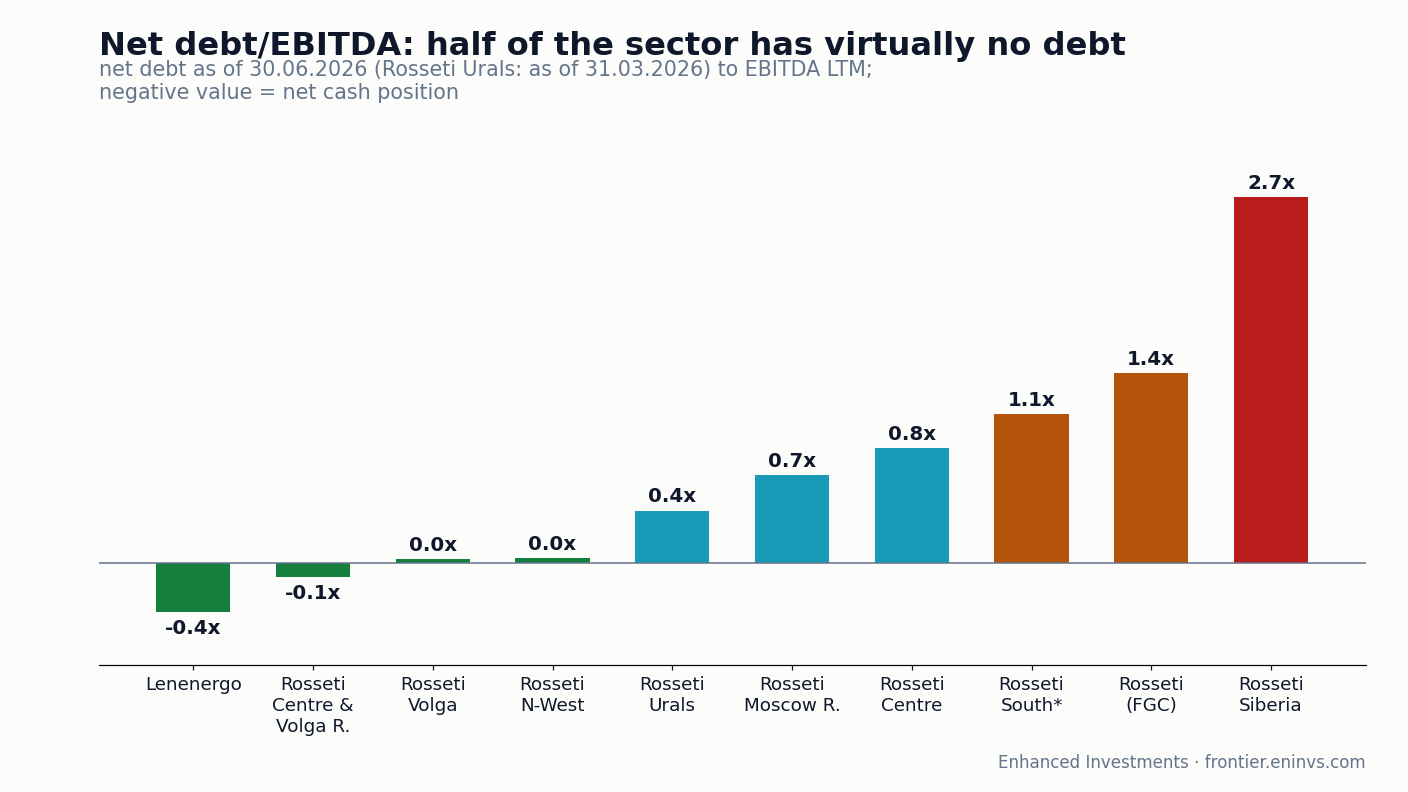
- FGC holds all of the group's debt, RUB 805bn, but it declined in 1H2026. Since the end of 2025, net debt fell from 873bn to 805bn: operating cash flow of 301bn for the half-year exceeded the investment outflow of 229bn. At 1.4x EBITDA this is comfortable, and the lower key rate makes refinancing cheaper.
- Rosseti Siberia is the only problem balance sheet. RUB 48bn of net debt against EBITDA LTM of 17.6bn (2.7x); the debt is stable, but interest still eats up most of the operating profit.
- Only Rosseti Moscow Region and South are noticeably increasing debt, to fund capex. Moscow Region's net debt rose from RUB 55bn at the end of 2024 to 67bn by mid-2026 on the most aggressive capex programme among the subsidiaries; South has 39bn after consolidating Kuban plus construction.
- The rest live without debt. Lenenergo and Centre and Volga Region have net cash (minus RUB 23bn and minus 5bn), Volga, North-West and Urals are around zero. For a sector with double-digit tariff indexation, this is a starting point of rare quality.
Capex: the group builds ~RUB 900bn a year, no schedule slippage, and FGC pays for it
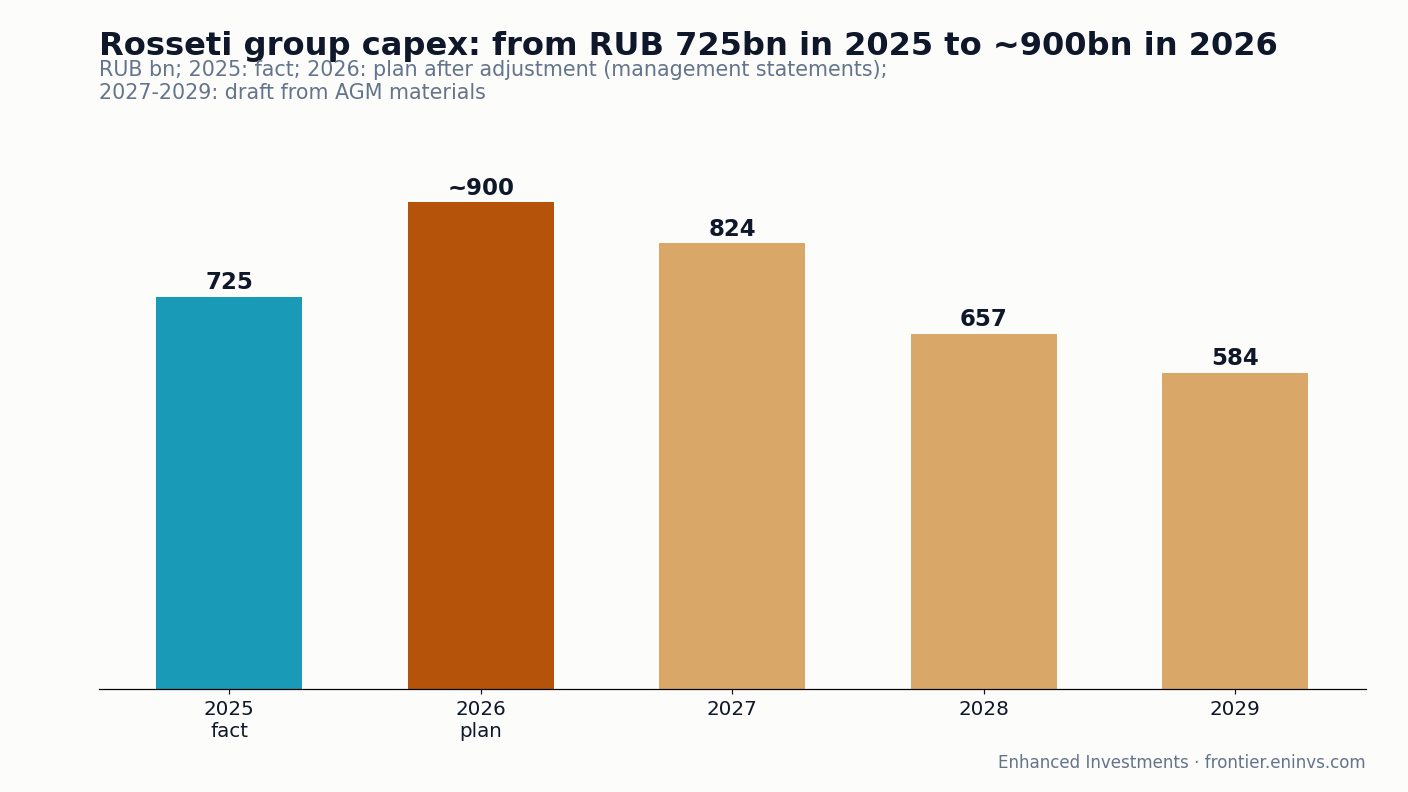
The 2025 fact was RUB 725bn against a plan of 719-720bn, so the group overdelivered on the programme. The approved figure for 2026 is 857bn; after the adjustment, management speaks of "about 900" (+25% vs 2025). The 2025-2029 five-year programme exceeds RUB 3.5tn, peaking in 2026-2027 and declining to 584bn in 2029 (draft from the materials for the shareholders' meeting). The main projects are completing the electrification of the Eastern Range in 2026, the new regions and covering power deficits in the south and east.
The picture by subsidiary (plan vs fact where companies disclose it):
- Volga is the only one with a full public plan vs fact: 2025 funding of RUB 19.9bn against a plan of 19.2bn (104%), capacity and power line commissioning above plan. The 2026 plan is 17.4bn, so capex is declining.
- Centre and Centre and Volga Region: 65.5bn combined in 2025, the 2026 plan is 63.3bn, also no growth, which only helps dividends.
- Moscow Region: 2025 capex was 101.3bn (+28%), the 2026 plan is about 120bn: the fastest capex growth among the subsidiaries, hence the rising debt.
- Urals: 22bn in 2025, the 2026 plan is over 27bn. Lenenergo: over 70.9bn in 2025; in May the Ministry of Energy approved a new capex programme through 2030. South: 17.7bn in 1H2026 (+29% vs the pro forma including Kuban).
- North-West and Siberia are increasing construction the most under the capex programmes approved by the Ministry of Energy (orders of 25-26.12.2025). North-West's 2025-2029 programme is RUB 67.6bn, doubling already in 2026 (10.4bn in 2025 to 22.4bn in 2026); Siberia's is 106.7bn, rising to 27.4bn by 2029. Both are building well beyond their own EBITDA for the coming years, which explains why they skip dividends.
There are no public data on anyone lagging behind the approved capex programme in 2025; the rhetoric of the Ministry of Energy and the companies is about overdelivery. The risk is not in the schedule but in the funding source. FGC's dividend moratorium covers 2022-2026 results, the Ministry of Energy proposes not to pay after 2026 either, and in the summer FGC shareholders approved an additional share issue of up to ~RUB 120bn at RUB 0.5 per share in favour of the state (ten times the market price, paid in cash and assets). For minority shareholders, dilution at this price is formally not a concern, but FGC's cash flow will go into construction rather than dividends for years to come.
Valuation: 1-2x EBITDA for almost everyone, the weakest balance sheet is the most expensive
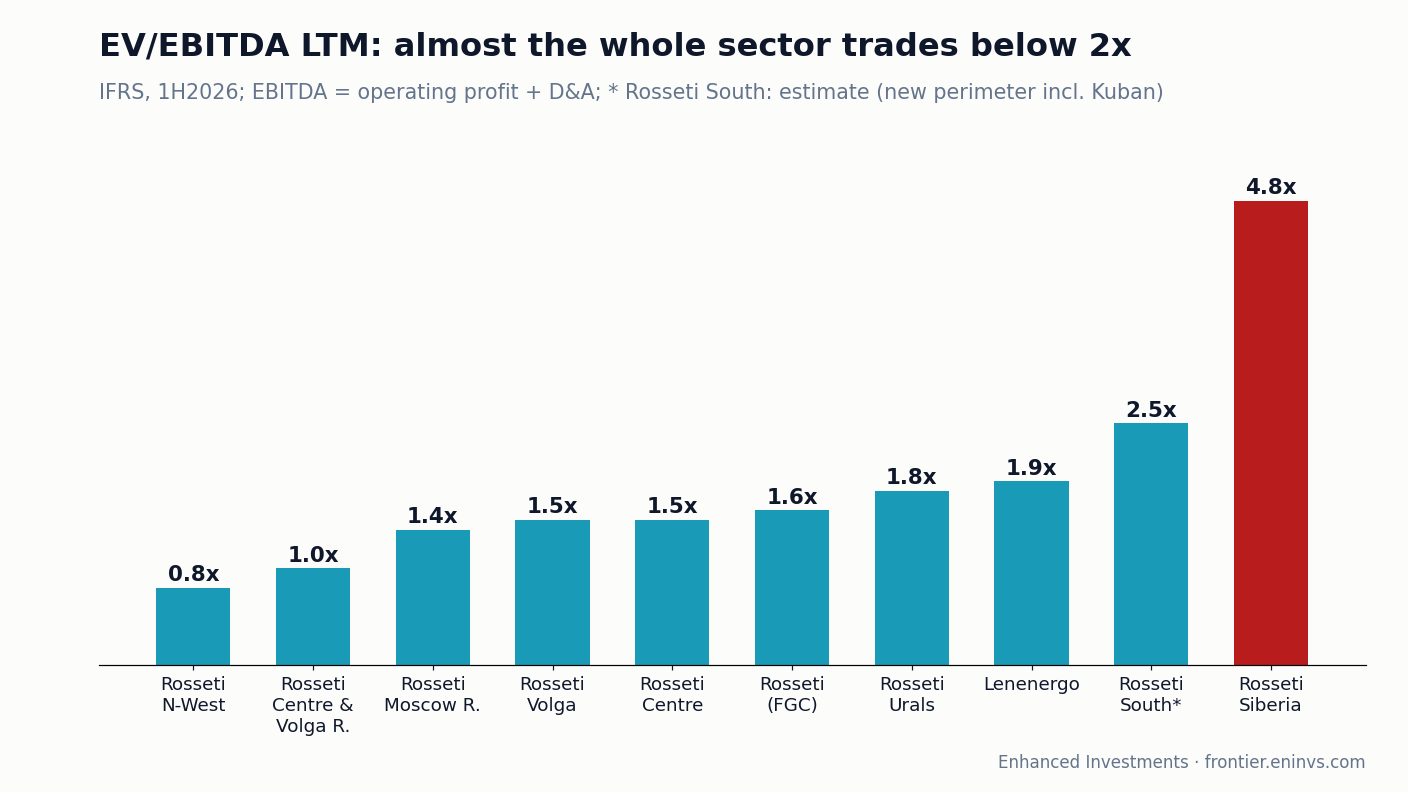
| Company | Ticker | Market cap, RUB bn | Net debt, RUB bn | ND/EBITDA | EV/EBITDA | P/E LTM | DY for 2025 (fact) | DY for 2026 (EnInv estimate) |
|---|---|---|---|---|---|---|---|---|
| Rosseti (FGC) | FEES | 112 | 805 | 1.4x | 1.6x | 0.4 | 0% | 0% |
| Lenenergo (ord+pref) | LSNG(P) | 149 | -23 | net cash | 1.9x | 3.8 | 3.9% / 11.0% | ~4.5% / ~13% |
| Rosseti Moscow Region | MSRS | 82 | 67 | 0.6x | 1.4x | 1.6 | 11.1% | ~14-15% |
| Rosseti Centre and Volga Region | MRKP | 56 | -5 | net cash | 1.0x | 2.1 | 14.6% | ~17% |
| Rosseti Urals | MRKU | 53 | 15* | 0.4x | 1.8x | 2.7 | 10.2% | ~13-18% |
| Rosseti South | MRKY | 47 | 39 | ~1.1x | ~2.5x | ~3.6 | 5.5% | ~5-8% |
| Rosseti Volga | MRKV | 38 | 1 | 0.0x | 1.5x | 2.6 | 10.6% | ~15% |
| Rosseti Siberia | MRKS | 37 | 48 | 2.7x | 4.8x | 10.3 | 0% | 0% |
| Rosseti Centre | MRKC | 27 | 33 | 0.8x | 1.5x | 1.8 | 6.1% | ~8-10% |
| Rosseti North-West | MRKZ | 12 | 1 | 0.0x | 0.8x | 1.7 | 0% | 0%? |
Sector summary table: market cap and prices as of 31.08.2026; EBITDA = operating profit + D&A, LTM; * Rosseti Urals: net debt as of 31.03.2026.
- North-West is the cheapest stock in the sector: 0.8x EV/EBITDA and P/E of 1.7. Half-year profit doubled and there is no debt. The only thing missing is dividends: 2025 profit was allocated to development, and under the approved capex programme the company's capex doubles in 2026 to RUB 22.4bn.
- Centre and Volga Region trades at one year of EBITDA with net cash and the highest yield. No one else in the sector offers this combination.
- FGC has a P/E of 0.4, but cash does not reach shareholders. EBITDA LTM exceeds RUB 550-700bn (depending on the definition), and all the value sits in EV via debt and capex. This is an option on the end of the big construction cycle after 2027, not a dividend story.
- Siberia is at 4.8x EV/EBITDA, three times more expensive than the sector with the worst debt. There is no fundamental premium here: the valuation rests on a low free float and retail demand.
Dividends: the sector paid broadly for 2025, and estimates for 2026 are even higher
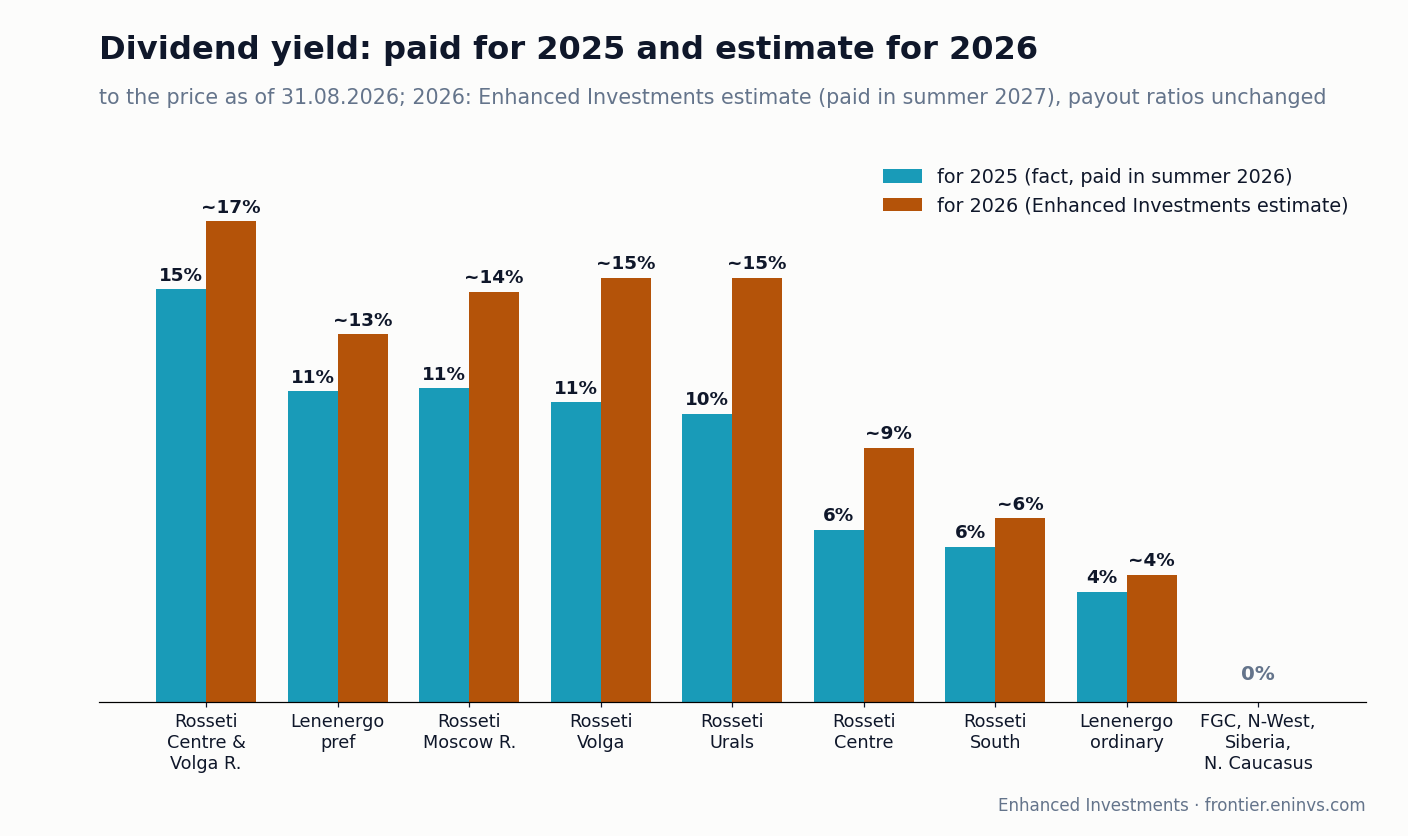
The policy is the same for all subsidiaries: 50% of adjusted net profit (the higher of IFRS and RAS), with adjustments for grid connection, revaluations and the capex funding gap, which is why actual payout ratios are below a straight 50%. Lenenergo also has a charter provision: 10% of RAS net profit goes to the preferred shares. Payouts for 2025 (record dates in June-July 2026):
- Rosseti Centre and Volga Region: RUB 0.0725, record date 30.06.2026, 14.6% to the current price;
- Rosseti Moscow Region: RUB 0.1865 (+24% YoY), record date 03.07.2026, 11.1%;
- Lenenergo pref: RUB 36.72 (10% of a record RAS profit of 34.3bn), record date 17.06.2026, 11.0%;
- Rosseti Volga: RUB 0.0212, record date 02.07.2026, 10.6%;
- Rosseti Urals: RUB 0.0612, record date 01.07.2026, 10.2%;
- Rosseti Centre: RUB 0.0385, record date 02.07.2026, 6.1%;
- Rosseti South: RUB 0.00377, record date 24.06.2026, 5.5%, the first dividend since 2018;
- Lenenergo ordinary: RUB 0.5379, 3.9%; TRK ordinary/pref: RUB 0.0156/0.0294, 2.1%/5.0%;
- did not pay: FGC (moratorium), North-West, Siberia, North Caucasus.
Next year (payouts for 2026, summer 2027): Enhanced Investments estimate assuming actual payout ratios are maintained and 1H2026 growth rates continue (all payers grew half-year profit by 20-110%):
- Centre and Volga Region: ~RUB 0.085-0.09, ~17% to the current price;
- Volga: ~RUB 0.030-0.033, ~15%; Urals: ~13-18% (1H2026 profit may include one-off items);
- Moscow Region: ~RUB 0.23-0.25, ~14-15%;
- Lenenergo pref: 1H2026 RAS profit is already 24.2bn, and 10% gives ~RUB 26 per pref share for the half-year alone; for the full year an estimated RUB 40-45, ~12-13%;
- Centre: ~8-10%; South: ~5-8% (high uncertainty after the perimeter change);
- FGC, Siberia, North Caucasus: zero. North-West: zero in the base case (under the approved capex programme capex doubles in 2026-2027), but at the current P/E of 1.7 any decision to pay out 50% turns the stock into a ~25-30% yield; this is an option, not a forecast.
Three years (cumulative payouts for 2026-2028 relative to current market cap): Enhanced Investments estimate under the following assumptions: tariff indexation per the Ministry of Economic Development forecast (+15.2% from October 2026, +14.7% from July 2027, +12% from July 2028), payout ratios unchanged, no new share issues by the payers:
- Centre and Volga Region: ~55-65% of market cap;
- Volga, Urals, Moscow Region: ~45-55%;
- Lenenergo pref: ~40-45%;
- Centre: ~28-35%; South: ~18-25%;
- FGC: 0% in the base case, as the Ministry of Energy publicly proposes extending the moratorium; the first realistic dividend year is 2027 (paid in 2028), and only if the capex peak has passed.
Conclusion
The sector is in a rare combination: double-digit tariff indexation until 2028, almost zero debt at half of the companies and valuations of 1-2x EBITDA. The split is simple: the group's construction is paid for by FGC, Siberia and North Caucasus, while dividends go to shareholders of the distribution subsidiaries. On the combination of growth, balance sheet and payouts, Centre and Volga Region, Moscow Region, Urals, Volga and Lenenergo pref stand out; FGC and North-West are cheap options without a near-term catalyst; Siberia, with the weakest balance sheet, trades at three times the sector multiple.
Tickers
FEES · LSNG · LSNGP · MSRS · MRKC · MRKP · MRKU · MRKV · MRKS · MRKY · MRKZ: extended issuer profiles on our portal: frontier.eninvs.com.
For weekly analytics, see the "Enhanced Investments" Telegram channel: @eninv.
See also: market overview · valuation map · stock screeners