The rouble is losing three supports: what drives the rate and what to expect in 2027
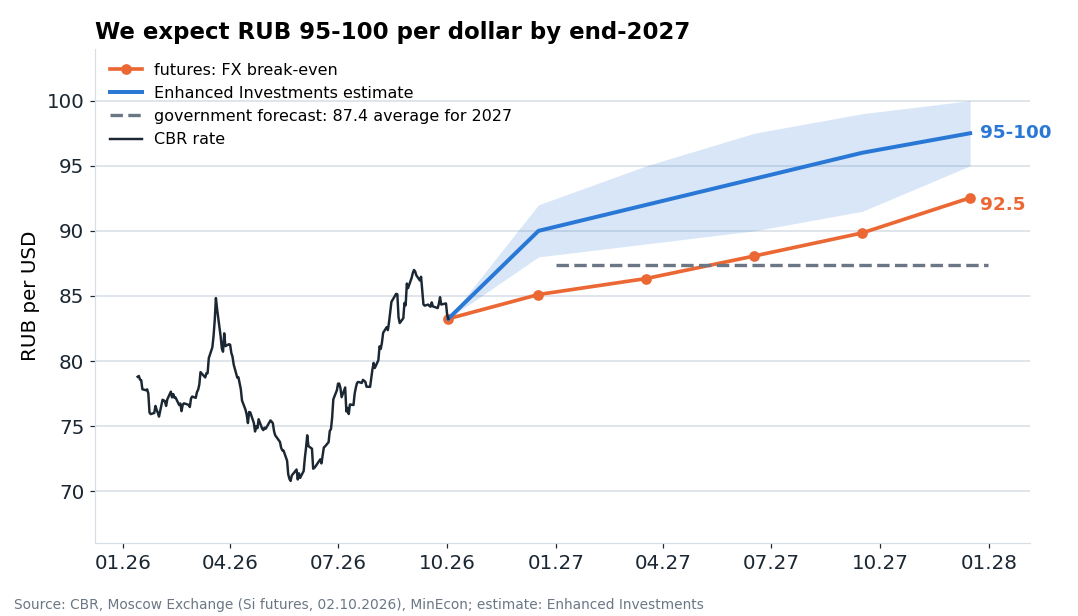
We expect the dollar at about RUB 90 by end-2026 and RUB 95-100 by end-2027. The government and analysts assume RUB 87-89 on average for 2027. The strong rouble of 2025-2026 rested on three supports: a key rate of up to 21%, FX sales by the state and expensive oil. In 2027 all three weaken, by the authorities' own decisions. The central bank is cutting the key rate, the CBR has already wound down its own FX sales, and the Ministry of Finance, with its new $50 cut-off, will buy foreign currency at almost any oil price. The official forecast is built on Urals at $53, at which there are almost no purchases. The gap between our estimate and the consensus decides whether an investor needs foreign currency. At RUB 87-89 it does not beat rouble instruments; at RUB 95-100 it does. Below we go through all the factors behind the rate, including those that work for the rouble.
The dollar now costs RUB 83, which is stronger than almost everyone expected
The official CBR rate on 2 October is RUB 83.25 per dollar and RUB 12.40 per yuan ([CBR](https://www.cbr.ru/currency_base/daily/)). In 2025 the dollar fell from RUB 101.7 to 78.2, or 23%. In 2026 the low was on 22 May at RUB 70.8 and the high on 3 September at RUB 87.0. Since June 2024 the dollar has not traded on the Moscow Exchange because of sanctions against the exchange. The CBR sets its official rate from over-the-counter bank trades, and the main exchange pair is now yuan-rouble. The dollar rate is in effect derived from the yuan rate and the dollar-yuan ratio on the world market.
Five groups of factors influence the rate: export revenue and imports, the fiscal rule, the CBR key rate, capital outflow and sanctions. We take them in turn.
Oil: Russia receives $92-94 a barrel, and expensive oil will hardly strengthen the rouble
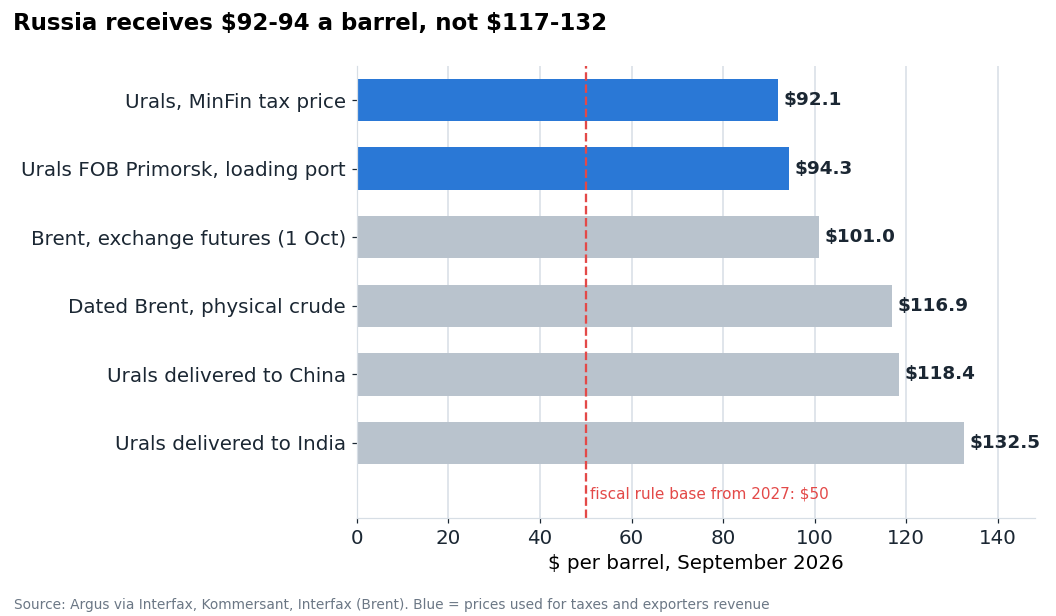
At the end of September the news carried oil prices from $80 to $132, and all of them are correct; they simply measure different things. What matters for the rouble is the price at which revenue actually reaches the exporter. That is Urals at the loading port, $94.3 on average for September, and the Ministry of Finance's tax price of Urals, $92.1. Expensive Brent and prices with delivery to India and China include freight, insurance and intermediaries, and that money does not reach Russia ([Interfax citing Argus](https://www.interfax.ru/business/1119753), [Kommersant](https://www.kommersant.ru/doc/8974352)).
Oil in 2026 is a shock story. After the closure of the Strait of Hormuz in spring, Brent came close to $126, in summer Urals fell back to $59, and in August the rouble weakened by 7%. In September the tax price of Urals rose from $67 to $92, or 37%. Revenue reaches the FX market with a lag of 1-2 months, so this wave will arrive in October-November. The Urals discount to Brent after the US sanctions against Rosneft and LUKOIL in November 2025 widened from $12-13 to $23 ([CBR data](https://sweetcrudereports.com/russias-urals-oil-price-discount-widens-to-23-in-november-central-bank-says/)); it is now narrowing gradually.
In its forecast for the budget the government assumes normalisation: Brent at $73 and Urals at $53 in 2027 ([Kommersant](https://www.kommersant.ru/doc/8991082)). If it is right, the oil support for the rouble disappears on its own. If oil stays expensive, the fiscal rule will take the surplus revenue.
The $50 cut-off gives the gains from expensive oil to the Ministry of Finance, not to the rouble
The fiscal rule works as follows. The Ministry of Finance spends the oil tax revenue above the base Urals price on buying yuan and gold for the National Wealth Fund. When oil is below the base, it sells them. Purchases create additional demand for foreign currency and weaken the rouble. In 2026 the base is $59. In the draft budget submitted to the State Duma on 30 September, the base falls to $50 from 2027 ([RIA Novosti](https://ria.ru/20261001/minfin-2121423181.html)). CBR Governor's adviser Kirill Tremasov called the new cut-off a factor pointing to a weaker rouble ([PRIME](https://1prime.ru/20260929/bank-873760694.html)).
By press estimates, each dollar of the Urals price above the base produces RUB 6-7 bn of FX purchases a month. Actual purchases in summer 2026 give slightly less, RUB 4-6 bn. With oil at $92, as in September, a $50 cut-off would mean purchases of about RUB 13 bn a day. That is comparable to the record sales of January 2026, only with the opposite sign. With oil at $53, as in the government's forecast, purchases are almost zero.
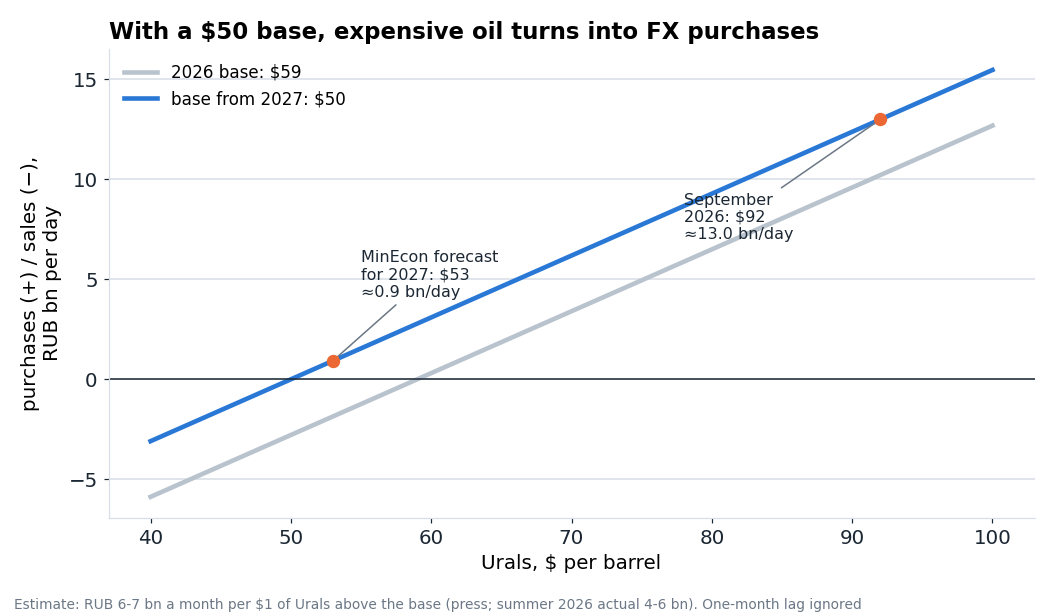
The main conclusion follows. With a $50 cut-off, expensive oil hardly strengthens the rouble, while cheap oil weakens it directly, through revenue. The first purchases under the new base will take place in February 2027, since the rule works with a one-month lag. If oil falls below $50, the Ministry of Finance will begin to sell foreign currency; the liquid part of the National Wealth Fund on 1 September was RUB 4.0 trn, or $46.7 bn ([Interfax](https://www.interfax.ru/business/1113682)). That is enough for roughly a year of sales at the pace of early 2026.
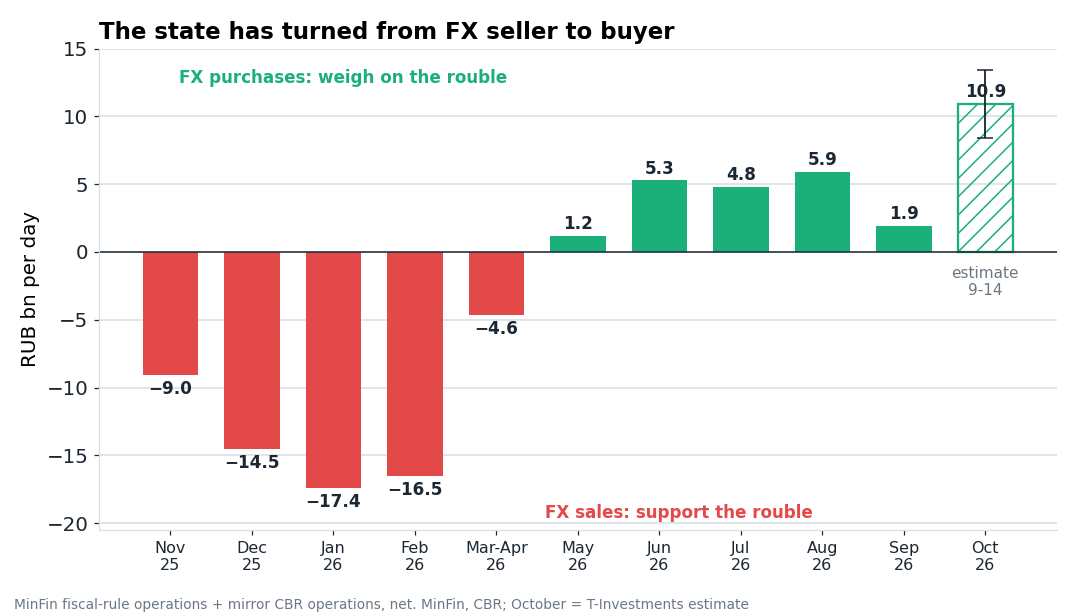
The second shift has already happened, and it is discussed less often. Besides the Ministry of Finance, the CBR also sold foreign currency. It placed on the market the National Wealth Fund spending of previous years. In 2H2025 this was RUB 8.9 bn a day, now it is RUB 0.6 bn. From November 2025 to February 2026 the state sold foreign currency at RUB 9-17 bn a day. Now the state is a net buyer, and since October purchases have risen five-fold. On 5 October the Ministry of Finance announced purchases of RUB 12.7 bn a day from 7 October to 6 November, RUB 279 bn in total, against RUB 2.5 bn in September ([Ministry of Finance](https://minfin.gov.ru/ru/press-center/?id_4=40664)). We expected about RUB 10 bn, T-Investments RUB 9-14 bn. Taking CBR sales into account, the state is net buying about RUB 12 bn a day. The swing from sales to purchases amounts to about $5-6 bn a month. For comparison, all non-financial companies sold $18.8 bn on the market in August ([Interfax](https://www.interfax.ru/business/1116078)).
A weak rouble benefits the budget. The 2027 deficit is set at RUB 5.5 trn, OFZ borrowing at RUB 7.7 trn, and each rouble of depreciation increases oil and gas revenue ([Kommersant](https://www.kommersant.ru/doc/8991082)).
A 14% rate still supports the rouble, but it will be cut in 2027
The CBR itself explained the strong rouble of 2025 by tight monetary policy ([Expert](https://expert.ru/news/tsb-zayavil-chto-zhestkaya-denezhno-kreditnaya-politika-bolshe-vsego-povliyala-na-ukreplenie-rublya/)). A high rate works in three ways. A rouble deposit pays more than a foreign-currency one, so households buy less foreign currency. Expensive credit restrains imports. For exporters it is more profitable to sell foreign currency than to borrow roubles at 20%.
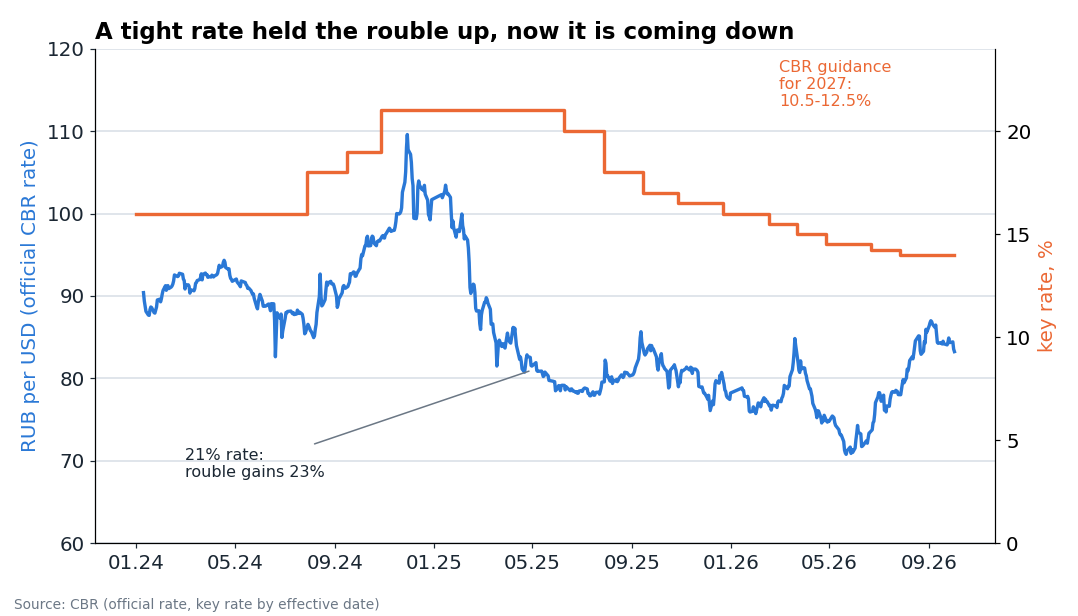
The rate is now 14%; the CBR left it unchanged on 11 September, and the next meeting is on 23 October ([CBR](https://www.cbr.ru/hd_base/KeyRate/)). The CBR's guidance for 2027 is an average rate of 10.5-12.5% ([SberCIB](https://sbercib.ru/publication/reshenie-banka-rossii-po-klyuchevoi-stavke-ot-11-sentyabrya-2026-goda)). The rate cut and the FX purchases under the $50 base will fall in the same year. Households are already buying less foreign currency, RUB 597 bn in January-August against RUB 673 bn a year earlier and RUB 1.1 trn in 2024 ([CBR](https://cbr.ru/Collection/Collection/File/62360/ORFR_2026-8.pdf)). When deposit rates fall to 10-12%, this demand will revive. Neither the CBR nor brokers estimate by how much.
The dollar future at RUB 92.5 shows the rate differential, not a forecast
Exchange-traded dollar futures on 2 October cost RUB 85.1 for December 2026 and RUB 92.5 for December 2027 ([Moscow Exchange](https://www.moex.com/ru/derivatives/)). These figures are often read as the market's expectation, but a futures price is calculated by formula. It is today's rate plus the difference between rouble and dollar rates over the life of the contract. With a rate of 14% in roubles and about 4% in dollars, a one-year future should cost 8-10% more than spot, and it does.
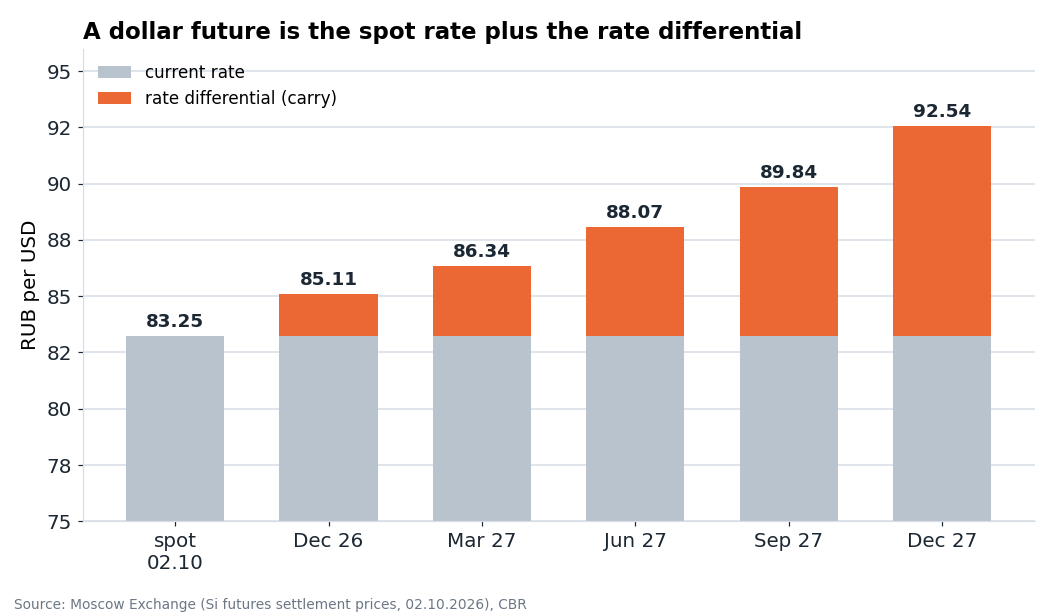
For an investor this means the following. Whoever buys dollars through a future pays 8-9% a year. If the rate a year later stays at RUB 83, he will lose that money. So a future wins only if the rouble weakens by more than is priced in.
The trade surplus and the narrowing oil discount work for a strong rouble
The strongest argument for the rouble is trade. The current account surplus for January-July is $33.9 bn against $21.5 bn a year earlier. In the second quarter exports grew 27% year on year, with all commodities getting more expensive: aluminium by 46%, copper by 40%, fertilisers by 39% ([CBR](https://cbr.ru/Collection/Collection/File/62277/Balance_of_Payments_2026-2_27.pdf)).
But these figures have weak spots. In July the surplus shrank to $1.7 bn, because services and income payments abroad ate almost the entire trade plus ([CBR](https://www.cbr.ru/statistics/macro_itm/external_sector/pb/bop-eval/)). Imports in the second quarter grew 16%: a strong rouble and stockpiling ahead of the technology levy from 1 December. The fourth quarter is traditionally the peak for imports. In addition, 63% of exports are now paid in roubles against 53% a year earlier. Part of the revenue is converted abroad and does not reach the domestic market as foreign currency. Net errors and omissions in the second-quarter balance of payments are minus $12.2 bn, half of the quarterly surplus ([CBR](https://cbr.ru/Collection/Collection/File/62277/Balance_of_Payments_2026-2_27.pdf)).
Sanctions work in both directions. New restrictions against large exporters widen the oil discount and hit revenue. News about negotiations produces quick moves of the rouble by several percent, but such moves are usually reversible. The EU price cap is fixed at $44.1 until July 2027, and from 1 January 2027 an EU ban on Russian LNG under long-term contracts comes into force.
Two years in a row the rouble turned out stronger than forecasts
This is an important caveat for any forecast of depreciation. For 2026 the Ministry of Economic Development in April 2025 expected an average of RUB 100.2 per dollar, and in September 2025 already 92.2. The Eurasian Development Bank in December named 94, and the median of the CBR analyst survey was 90.3. The Ministry of Economic Development now estimates the 2026 average rate at 79.5 ([PRIME](https://1prime.ru/20250924/dollar-862719882.html), [Investfuture](https://investfuture.ru/articles/eabr-prognoziruet-padenie-rublya-do-97-za-dollar-k-kontsu-2026-goda-4C0F9F5E87EC464C43258D640021E35D), [Bankiros](https://bankiros.ru/news/ehkonomisty-zhdut-rosta-dollara-do-97-rublej-i-inflyacii-do-6-6-novyj-opros-cb-22334)). The gap was 14-26%. It was the same with 2025.
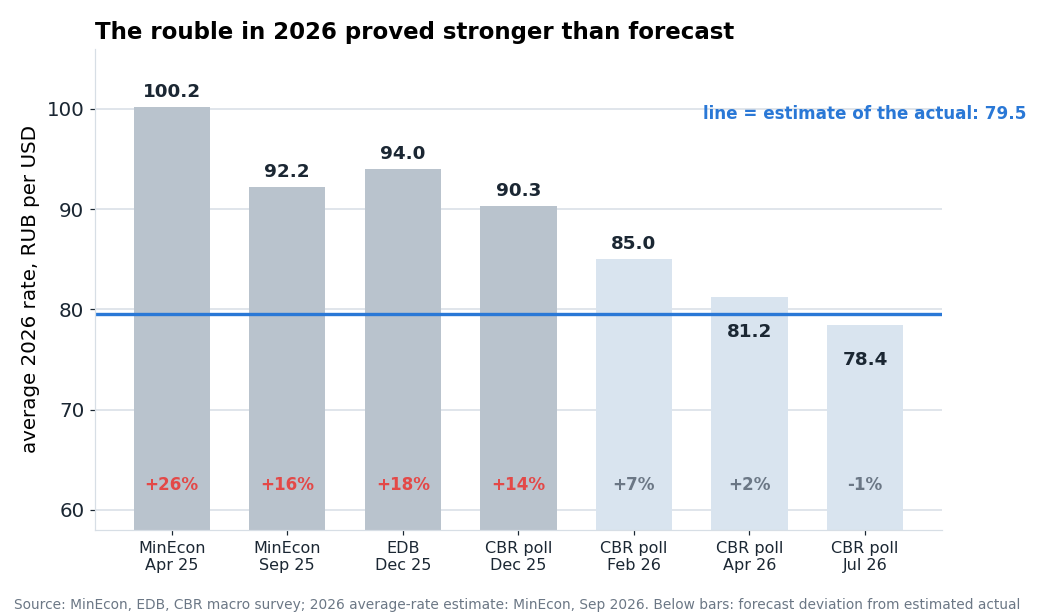
Three factors supported the rouble then. The 21% rate lasted longer than expected. The state sold foreign currency at RUB 9-17 bn a day. A Middle East oil shock occurred. In 2027 the first two reverse by the authorities' own decision, and the fiscal rule with a $50 base will turn the gain from the third into FX purchases. So the experience of 2025-2026 does not mean that the rouble will keep beating forecasts.
Recent bank forecasts for end-2026 almost coincide with the current rate. SberInvestments expect RUB 85 and 12.5 per yuan, VTB about 86 ([RBC](https://amp.rbc.ru/rbcnews/quote/07/09/2026/6a9ebd709a79470691929e2e), [VBR](https://www.vbr.ru/novosti/kursy-valyut/2026/08/31/kakoj-budet-kurs-rublya-31-dekabrya/)). The median of the CBR survey for 2027 is an average of RUB 88.8, and for 2028 RUB 94 ([Bankiros](https://bankiros.ru/news/ehkonomisty-zhdut-rosta-dollara-do-97-rublej-i-inflyacii-do-6-6-novyj-opros-cb-22334)).
In 2018 a similar rule and a rate cut gave the dollar a 21% rise over the year
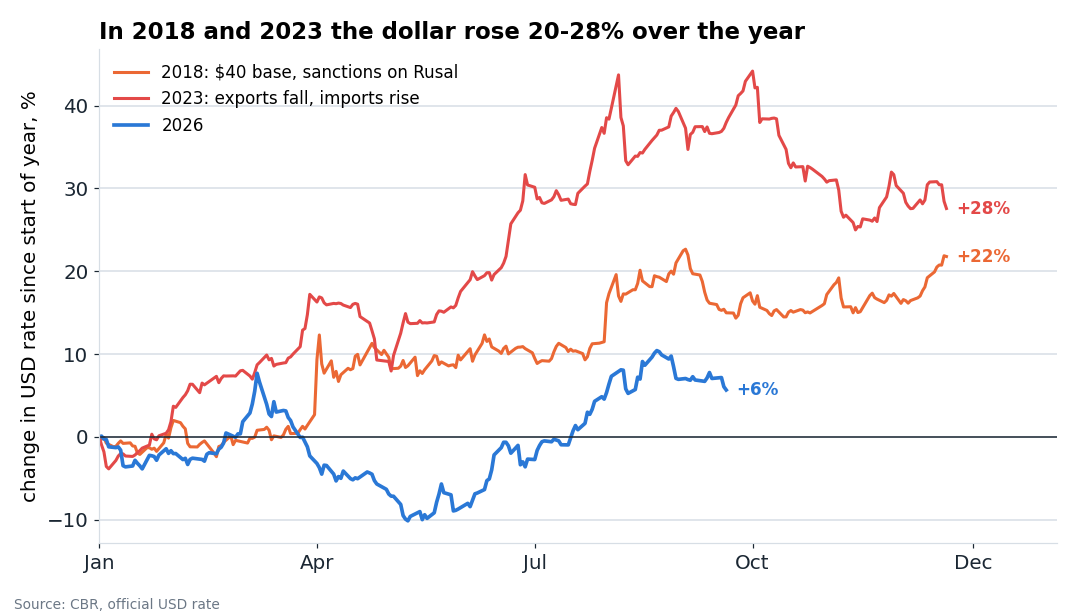
The closest analogue is 2018. The fiscal rule then started to work with a base of $40, early in the year the CBR was cutting the rate, and in April sanctions against Rusal were added. By the official CBR rate the dollar rose over the year from RUB 57.6 to 69.5, or 21%, and by 26% from low to high. The CBR twice suspended FX purchases for the Ministry of Finance, in April and from the end of August until January 2019, when the depreciation became too sharp ([CBR](https://www.cbr.ru/Content/Document/File/145392/press_5.pdf)). So the authorities have a safeguard against a collapse, but not against a gradual depreciation.
In 2023 the dollar rose from RUB 70.3 to 89.7, or 28%. Then exports were falling while imports recovered quickly. In 2026 the dollar has gained about 6% since the start of the year.
Our estimate: about RUB 90 by end-2026 and RUB 95-100 by end-2027
This estimate is built from FX flows, not from other analysts' forecasts. The premises are as follows.
End-2026: RUB 88-92. Since October the Ministry of Finance has been buying foreign currency against September oil, by T-Investments' estimate up to RUB 9-14 bn a day against RUB 2.5 bn in September. The fourth quarter is always the peak for imports, and ahead of the technology levy on 1 December electronics are imported in advance. The CBR will most likely return to rate cuts in October or December. A wave of export revenue from September oil prices will give support, but to a large extent it will be absorbed by Ministry of Finance purchases.
2027: another 7-10% on top. We assume Urals at an average of $70-75. That is below the September $92, because the physical shortage in the oil market is easing, and above the $53 in the government's forecast. With such oil the Ministry of Finance buys foreign currency all year at RUB 6-8 bn a day. In 2026 the state's net operations for the year are close to zero: the sales of January-February ate the purchases of summer. So in 2027 an additional buyer of foreign currency appears on the market, of about $18-20 bn a year. That is comparable to one month of FX sales by all exporters.
The rate falls in 2027 from 14% to about 11%. This revives credit-funded imports and household FX purchases, which in 2024 at comparable rates were RUB 1.1 trn a year against RUB 0.9 trn at the 2026 pace. Inflation in Russia is 3-4 pp a year higher than in the US and China, and that in itself gives a gradual depreciation. After 2025 the rouble is strong in real terms, and the real effective rate for January-May 2026 rose a further 6.8%, so there is room for a correction.
The 2018 analogue confirms the scale. Then Urals averaged about $70 against a base of $40, that is $30 above the cut-off, and the dollar rose 21% over the year. In 2027, with Urals at $70-75 and a base of $50, the excess will be $20-25, a similar order of magnitude. Add 15-20% to the current RUB 83 and you get RUB 95-100.
When this estimate would prove wrong. If Brent stays above $90 throughout 2027, the CBR cuts the rate more slowly than its guidance and sanctions ease, the rouble will stay in a RUB 85-90 corridor. That is possible, but it requires the oil shock to last another year. The risk is larger in the opposite direction. With Urals below $60, new sanctions against large exporters or a sharp rate cut, the rate could go above RUB 100. The authorities insure themselves against too sharp a depreciation. In 2018 the CBR twice suspended FX purchases for the Ministry of Finance when the rouble was falling too fast ([CBR](https://www.cbr.ru/Content/Document/File/145392/press_5.pdf)). So we do not expect a collapse; we expect a sustained depreciation.
Foreign currency wins if the dollar is above RUB 92.5 by end-2027
Roubles currently earn more than foreign currency. Deposits and OFZ yield 13-16% a year, foreign-currency bonds 5-7%. The December 2027 future, RUB 92.5, shows the rate at which the return in roubles and the return in dollars are equal. At the government's forecast, RUB 87-89, foreign currency loses to roubles and there is no point in holding it. At our estimate of RUB 95-100 foreign currency wins by 3-8% on top of the rouble return.
The second argument for foreign currency is the asymmetric risk. If the dollar costs RUB 88 at the end of 2027, the holder of foreign currency will miss out on about 5% compared with roubles. If 2018 or 2023 repeats, a holder of roubles only will lose 20-28% in dollar terms. So we regard part of savings in foreign currency as insurance, not only as a bet on return.
It is wiser to hold foreign currency in dollar and yuan bonds than in cash. They pay a coupon on top of the change in the rate. We calculate yields, maturities and credit quality of Moscow Exchange foreign-currency issues on the foreign-currency bonds page. Buying dollars through a future costs 8-9% a year and is justified only if you bet on a depreciation stronger than that priced in.
In equities a weak rouble is on the side of exporters. It increases their rouble revenue, but for metals and fertiliser producers part of the gain will be taken by the 2027-2029 windfall tax. Companies that earn in roubles and buy imports lose from a weaker rouble.
Dates that will show which scenario is playing out
- Early November: the volume of Ministry of Finance purchases for November-December; in October it is RUB 12.7 bn a day.
- 23 October: CBR rate meeting.
- October-November: State Duma review of the budget, whether the $50 cut-off is kept.
- 1 December: technology levy on imported electronics; imports are stockpiled ahead of it.
- 1 January 2027: the new $50 base and the EU ban on Russian LNG under long-term contracts.
- Every month: exporters' FX sales in the CBR risk review, the Urals discount, household FX purchases.
See also: market overview · valuation map · stock screeners