A trillion in unreceived interest, provisions lag behind, and reporting is being closed
The number of defaults on the Russian bond market almost doubled in 2025, to 48 cases versus 25 a year earlier according to Cbonds, while the number of credit events including technical defaults and restructurings rose from 234 to 325. Banks' overdue debt added a third in a year and a half. Unreceived interest on loans passed one trillion roubles for the first time. Provisions against all this grew more slowly, and overdue-loan coverage has fallen for the fifth quarter in a row.
Against this background, the Bank of Russia, by its decision of 19 December 2025, allowed banks not to publish part of their reporting. Large banks first of all removed the cash flow statement from it, the very form that shows whether accrued interest arrives as real money. Of the top five, only Sberbank kept it.
Enhanced Investments collected Bank of Russia forms 101 and 102 for all 354 operating banks since 2022 and analysed public IFRS reporting to understand where the deterioration is real and where it is a facade. A caveat on scale up front. Defaulted issues still account for less than 0.1 percent of corporate debt outstanding, and there is no collapse in the numbers. What is worrying is the speed of accumulation and the fact that part of the data is being closed.
A short conclusion. The overdue share shows almost nothing, because restructuring resets the counter of overdue days. Where it is harder to hide, in unreceived interest and provisions, the picture splits. In retail, provisions keep pace with overdue loans. In corporate lending, recognition lags, and the Bank of Russia itself confirms this. A separate story is analysed at the end, about capitalisation of development costs, which pulls a fifth of annual profit out of VTB.
Restructuring takes a loan out of overdue without making it better
If a borrower's maturity is extended, a deferral on principal is granted, or unpaid interest is added to the loan amount, formally no overdue payments remain. The loan returns from overdue to the ordinary portfolio. The borrower has not become a better payer.
The second way to remove overdue loans from the report is to sell them or write them off against provisions. Bank Saint Petersburg cut its overdue debt from RUB 27 bn to 15 bn over a year with a growing portfolio, and in some months the outflow was at once on principal and on interest. This is what a balance sheet clean-up looks like, not a rise in payment discipline.
The sector's overdue interest has passed one trillion roubles
Account 459 on a bank's balance sheet holds interest that has been accrued but not received on time. It is an awkward line to disguise. While the borrower does not pay, interest keeps accruing and settles here.
On 1 January 2025 this account held RUB 0.70 trn for the sector, and on 1 July 2026 already RUB 1.02 trn. That is growth of 46 percent. The loan portfolio over the same year and a half added 9 percent, and overdue principal 34 percent. What grows fastest is exactly what banks were not paid.
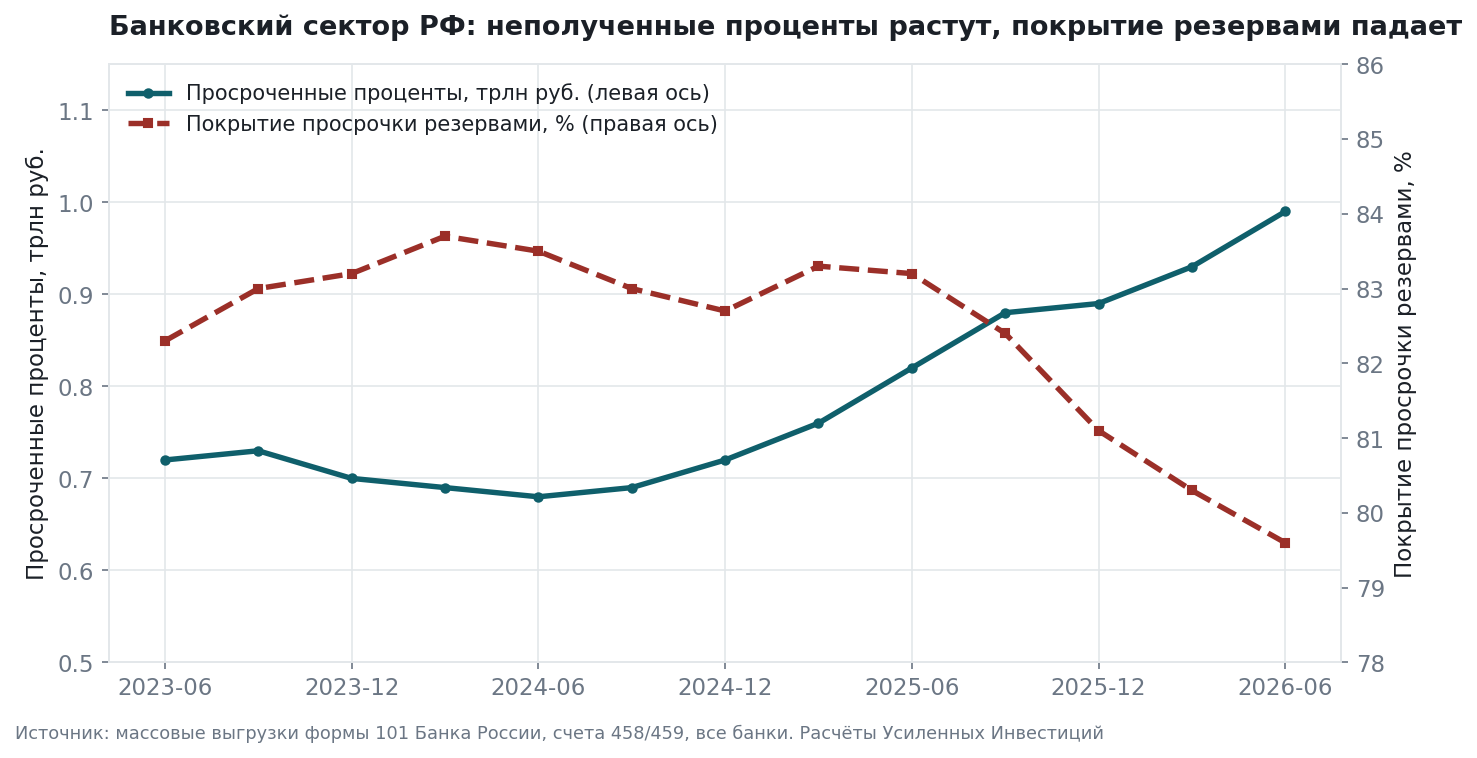
Provision coverage of overdue loans has fallen for the fifth quarter in a row
Coverage is the ratio of the provision set aside against overdue loans to the amount of the overdue loans themselves. For the sector it fell from 82.8 percent at the start of 2025 to 79.3 percent on 1 July 2026. Overdue loans are accumulating faster than banks recognise losses on them.
The Bank of Russia records the same. In the financial stability review for 4Q2025 and 1Q2026, the share of category IV and V quality loans in the sector rose from 5.9 percent at the start of 2025 to 7.6 percent on 1 April 2026, and it says so in plain text.
That is, the regulator itself explains the improvement in statistics on large borrowers by restructurings. Further down, the banks show who already reflects this in the numbers.
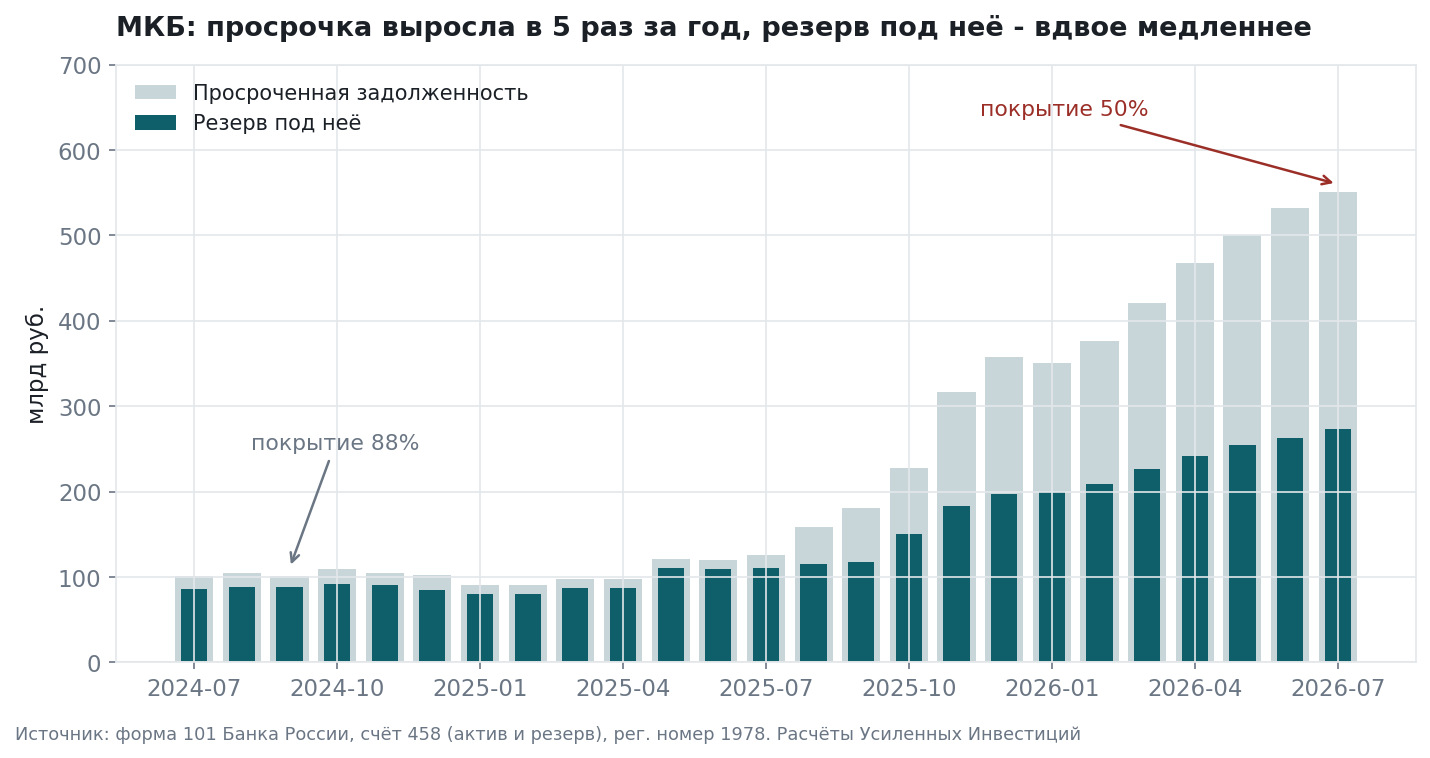
At MKB overdue loans grew fivefold in a year, while provisions for them grew half as fast
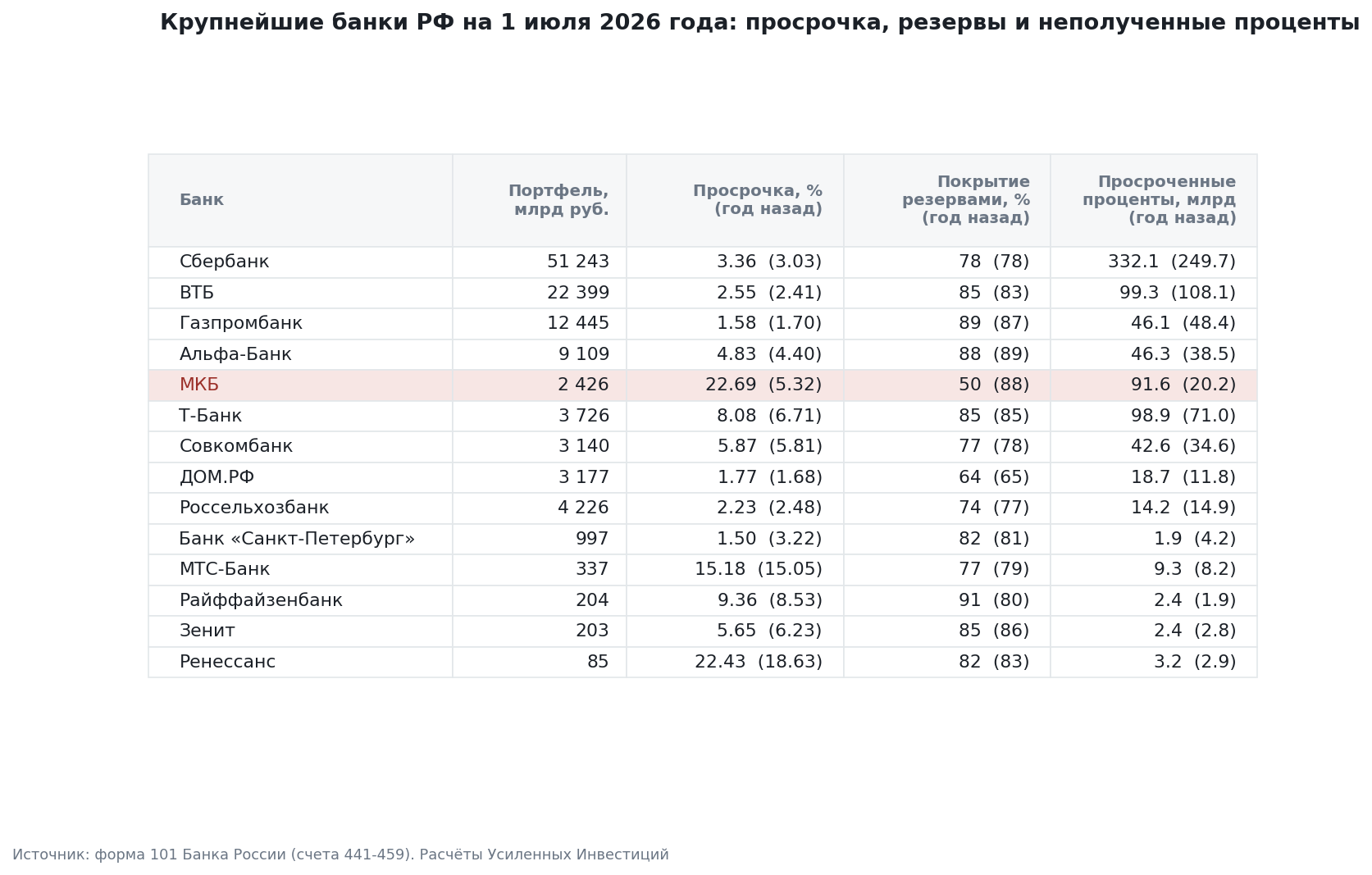
Moscow Credit Bank is the most prominent case in the sample. On 1 July 2025 overdue debt was RUB 126 bn against a portfolio of RUB 2.4 trn. A year later overdue debt is RUB 551 bn, with the portfolio unchanged. Overdue interest rose from RUB 20 bn to 92 bn.
Provisions did not keep up. Overdue debt added RUB 80-120 bn a quarter, while net provision charges ran at RUB 11-22 bn. Coverage fell from 88 to 50 percent. The gap between RUB 551 bn of overdue debt and RUB 274 bn of provisions against it amounts to RUB 277 bn of losses that are still to be run through profit and capital. In June 2026 Expert RA affirmed the bank's rating at ruA+ with a stable outlook.
At Sberbank the provision buffer relative to the portfolio is shrinking as overdue loans grow
The overdue loans of Sberbank look calm, 3.36 percent of the portfolio versus 3.03 percent a year earlier, with coverage holding around 78 percent. The neighbouring lines behave differently.
Overdue interest rose from RUB 123 bn in mid-2023 to RUB 332 bn in mid-2026, that is by 170 percent against portfolio growth of 47 percent. Its ratio to overdue principal rose from 13.9 to 19.3 percent. Total provisions to the loan portfolio fell over the year from 6.76 to 6.41 percent, although overdue loans over the same year grew 24 percent against portfolio growth of 12 percent. In the second quarter of 2026 the bank released RUB 14 bn of provisions, although overdue loans over the quarter grew by RUB 66 bn.
Each of these figures on its own can be explained by collateral and the structure of the book. Together they add up to exactly the profile that the regulator describes as slower recognition of losses.
VTB looks twice as good as the sector, and there is nothing to check it against
VTB has overdue loans at 2.55 percent of the portfolio against a sector average of 4.29 percent, and provisions to portfolio of 5.77 percent against 7.02 for the sector. Over the year, overdue-loan coverage even rose, from 83.2 to 84.8 percent, and unreceived interest fell by 8 percent. Public data show no deterioration.
How much of this is the quality of the book and how much the speed of recognition cannot be told from the reporting. VTB is the most corporate of the large banks, and it is exactly on large loans that the Bank of Russia notes slower recognition of losses. A cash test using the cash flow statement cannot be run here, because VTB publishes condensed reporting without this form.
At Alfa-Bank overdue loans grew by half in two years, and the cash flows are closed
Alfa-Bank is not traded on an exchange, but it discloses IFRS reporting, so it is worth keeping in the sample. Overdue loans rose from 3.39 percent of the portfolio in mid-2024 to 4.83 percent in mid-2026. Overdue interest over the same two years rose from RUB 26.6 bn to 46.3 bn, by 74 percent against portfolio growth of 24 percent. Overdue-loan coverage fell from 91.9 to 87.6 percent.
Unlike at MKB, recognition is happening here. Provisions to portfolio rose from 6.10 to 7.11 percent, and the bank is building a cushion along with the deterioration. But Alfa-Bank's condensed consolidated statements for 2025 explicitly list what is not disclosed, and information on cash flows for the reporting periods is on that list.
For comparison, Gazprombank looks steady, with overdue loans of 1.58 percent and coverage of 89 percent unchanged over the year. At Rosselkhozbank overdue loans declined, but coverage slipped from 77 to 74 percent.
In retail, provisions keep pace with overdue loans
For retail public banks the picture is calmer, and it is worth saying so directly.
- T-Bank. The portfolio grew 23 percent over the year and overdue loans 48 percent, but provision coverage did not move, 84.6 percent versus 84.5 a year earlier. The cost of risk holds around 5.2-5.3 percent quarter after quarter. A fast-growing retail bank, with overdue loans catching up with the portfolio at the usual lag. There are no signs of deferred recognition in the data.
- Sovcombank. The portfolio added 10 percent, overdue loans 11 percent, coverage 77 percent versus 78 a year earlier. Everything moves at the same pace, no questions.
- MTS Bank. The portfolio shrank 10 percent, overdue loans 9 percent. The overdue level is high, 15 percent of the portfolio, but for a retail model with high rates it has held there for two years. Coverage slipped from 79 to 77 percent. The bank is compressing its book and cleaning up, and no deterioration is visible in the data.
DOM.RF is wrongly counted as a retail bank, three quarters of its book is developers
DOM.RF Bank is usually classed as retail because of mortgages, but its balance sheet looks different. By account groups of form 101 on 1 July 2026, loans to legal entities stand at RUB 2.36 trn, three quarters of the selected loan portfolio, and the main part of them is project financing for developers. Mortgages to individuals are on the balance sheet at RUB 652 bn, about 21 percent. The bank itself estimates approved project financing limits at more than RUB 8 trn, that is, less than a third has been drawn so far.
So the figures read differently too. The portfolio grew 22 percent over the year, overdue loans 28 percent, and unreceived interest 58 percent, from RUB 11.8 bn to 18.7 bn. Overdue-loan provision coverage is 64 percent, the lowest among large banks against a sector average of 79. Part of the gap is explained by the structure of project financing, where the loan is repaid from escrow account funds and the bank's risk is lower than in ordinary corporate lending. But the book here is precisely corporate, in an industry that is now slowing, and unreceived interest is growing almost three times faster than the portfolio.
The cash test shows that money does reach Sberbank
A direct check for paper income is done with the cash flow statement. Sberbank prepares it by the direct method and shows on a separate line how much interest was received in cash. This amount is divided by interest income from the income statement, giving the conversion of accrued income into cash income.
For 1H2024 the conversion was 95.1 percent, for 1H2025 93.9 percent, for 1H2026 94.4 percent. There is no gap. Sberbank's accrued interest income turns into cash just as it did two years ago. The claims against Sberbank remain at the level of provisions, not cash.
Of the large banks, only Sberbank publishes cash flows
For the other large banks the same test cannot be run. Under the Bank of Russia board of directors decision of 19 December 2025 on disclosure requirements in 2026, banks are allowed not to publish part of the information. MKB explicitly lists what is not disclosed in its reporting, and information on cash flows for the reporting and comparative periods is on that list. The same item is on Alfa-Bank's list. VTB publishes condensed reporting, where this form is also absent.
The word "restructuring" does not appear even once in MKB's three-month 2026 report.
The refusal to publish cash flows should be treated as an indicator in its own right. It closes the only direct way to tell accrued income from received income.
Banks capitalise software development, and at VTB this is a fifth of profit
A separate story from the same area of accounting, only about expenses. A bank can write off developers' salaries to expenses immediately, or recognise them as an intangible asset and spread them over years through amortisation. IFRS permits this when the project delivers a measurable return. In the first case current-year profit is lower, in the second higher.
At VTB, additions to software in 2025 were RUB 170.3 bn, of which RUB 158.1 bn went into development in progress. Amortisation for the same year was RUB 58.5 bn. The gap is RUB 112 bn against net profit of RUB 502.1 bn. If the bank wrote off development as costs were incurred, 2025 profit would have been about a fifth lower.
At Sberbank the scale is larger, but the proportion milder. Additions to intangible assets for 2025 were RUB 362.3 bn, including RUB 130.7 bn created inside the bank, amortisation RUB 153 bn, impairment RUB 10.2 bn. The gap is RUB 209 bn against profit of RUB 1,705.9 bn, about 12 percent. The pool of intangible assets in progress grew over the year from RUB 154 bn to 294 bn, and this is future amortisation that will land on the profit of coming years.
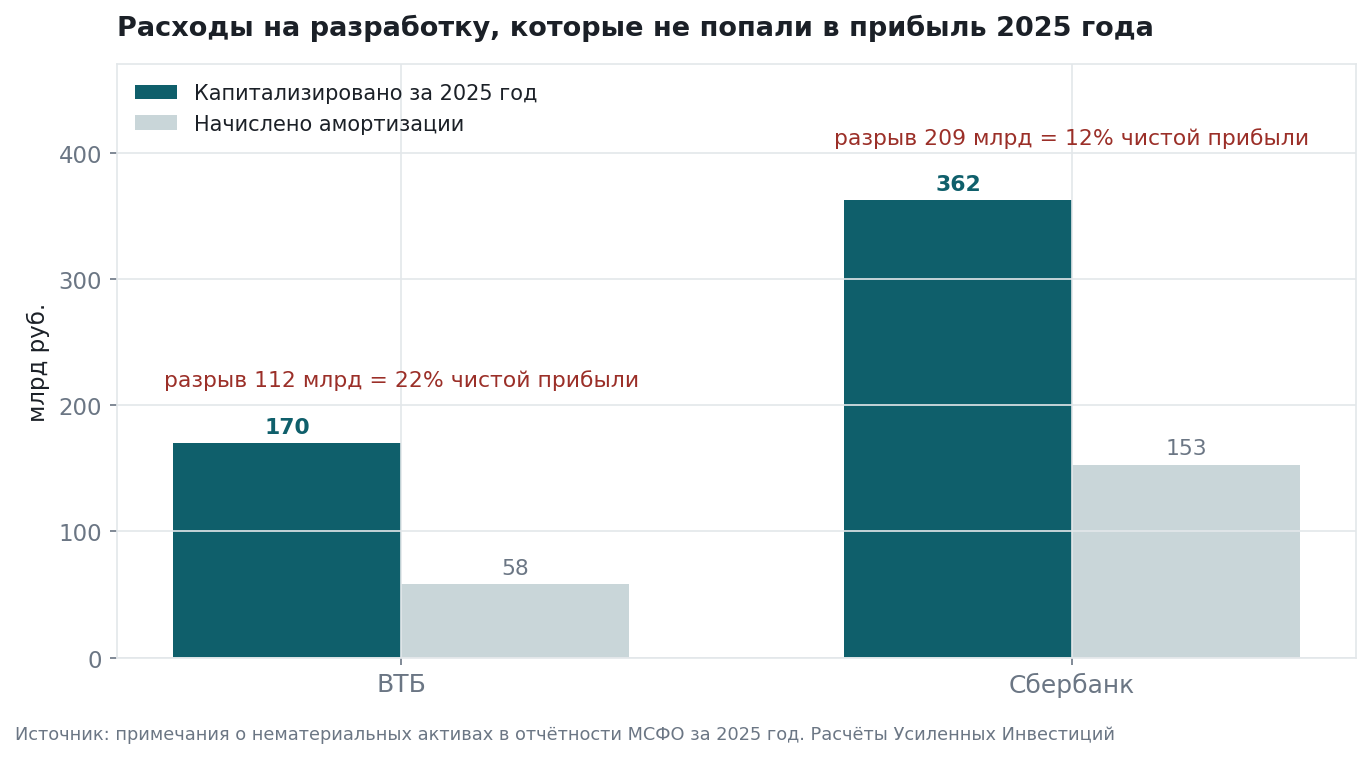
For a sense of scale. VTB's intangible assets on 30 June 2026 stand at RUB 788 bn against RUB 716 bn at Sberbank, with a loan portfolio 2.3 times smaller.
This does not affect capital adequacy. Under regulation 646-P intangible assets reduce core capital, and the Bank of Russia separately clarified that even acquired licences on account 609 are deducted regardless of whether there is a title to them. Capitalisation shifts expenses between periods and supports profit together with the dividend base, but the bank's capital does not benefit from it.
Write-offs so far are small. At VTB in 1H2026 software with an original cost of RUB 14.5 bn was written off, but almost all of it was already amortised, and profit was hit by about RUB 1.5 bn. At Sberbank impairment of intangible assets for 2025 was RUB 10.2 bn. The risk lies not in current write-offs but in the growing pool of development in progress, which will have to be either amortised or recognised as a failure.
For the other banks the scale is visible in form 101, account 609 net of amortisation on 1 July 2026. Alfa-Bank RUB 108 bn versus RUB 32 bn three years ago, T-Bank RUB 74 bn, Rosselkhozbank RUB 59 bn, MTS Bank RUB 11 bn. Alfa-Bank and Rosselkhozbank are building it up fastest.
What to watch in third-quarter reports
- Provision coverage of overdue loans on form 101. It comes out around the 24th of the following month, well before IFRS reporting.
- Total provisions to the loan portfolio. Its decline while overdue loans grow says more than the overdue share itself.
- Overdue interest to overdue principal. Its growth shows that debt is serviced ever worse, even when the overdue share stands still.
- In annual IFRS reporting, transitions of loans between stages and disclosure on modified loans. A return from stage two to stage one without cash payments means a facade cured by restructuring.
- Additions to intangible assets versus accrued amortisation in the IFRS notes. The gap shows what part of profit was obtained by shifting costs to future periods.
- For corporate borrowers a mirror test works. Interest paid from the cash flow statement divided by interest expense. A persistent value below one says that part of the interest is not paid in cash.
Conclusion
While you look at the overdue share, no problems are visible in the sector. Once you move to interest and provisions, the picture changes. Unreceived interest has grown 46 percent in a year and a half, provision coverage of overdue loans has fallen for the fifth quarter in a row, at MKB the gap between overdue loans and provisions has reached RUB 277 bn, at Sberbank the provision buffer to portfolio is shrinking as overdue loans grow, and at Alfa-Bank overdue loans grew by half in two years.
In retail everything reads normally, where provisions keep pace. Questions concentrate in corporate lending, and the Bank of Russia itself writes that the improvement in statistics on large borrowers is accompanied by restructurings and slower recognition of losses. Since 2026 an outside observer has had almost nothing to check this with. Of the large banks, only Sberbank discloses cash flows, and with every quarter it will be harder to tell a working portfolio from one cured by restructuring.
Added to this is a second line along which profit looks better than current costs. Capitalisation of development gives VTB about a fifth of annual profit and Sberbank about a twelfth. It does not affect capital, but it shifts costs to future years, and the pool of unfinished projects is growing faster than amortisation accrues.
Tickers: SBER, VTBR, T, SVCB, BSPB, DOMRF, MBNK. Extended issuer cards are on our portal.
Weekly analysis is on the Telegram channel "Enhanced Investments".
See also: market overview · valuation map · stock screeners