Bank subordinated bonds: 15-29% a year for the bank's right not to pay
In the chat someone asked about "MKB at 20%". It is a good question, because behind such yields stands a special instrument, and few people have read how it works. We analyzed the subordinated bonds of Russian banks: what they are, how guaranteed the payments are, when they are written off, and which of them are worth your money now. Prices and yields as of 18.09.2026, capital ratios from the banks' reporting to the Bank of Russia as of 01.08.2026.
A subordinated bond is formatted as a bond but is in essence bank capital. The bank borrows on the condition that in case of trouble the holders lose their money before depositors and ordinary creditors. That is what the higher coupon pays for.
On perpetual issues the bank may skip the coupon without giving reasons, and this has already happened. VTB did not pay on 12 issues from December 2022, on some of them until February 2024. Unpaid coupons are not recovered.
Write-off occurs on bailout or when capital falls below a threshold, and then holders lose everything. In 2017-2018 this is how the subordinated debt of Otkritie and Promsvyazbank was wiped out, and the courts upheld the write-offs.
The market is now most afraid for VTB. The bank has 1.2 pp to the write-off threshold, its perpetual bonds fell to 65-71% of par, and the current yield on the ruble issues is 27-29%.
"MKB at 20%" means the ZO-2027 issue, the clearest rate in the sample. The issue matures in a year, write-off threatens only in case of an almost complete loss of capital or a bailout, and the yield is about 19% in dollars.
Almost all subordinated bonds are available only to qualified investors. The exceptions are several issues of 2016-2018, above all RSHB.
A subordinated bond may not be repaid, and the law expressly allows it
An ordinary bank bond is debt. The bank must pay the coupon and repay the par value, or it defaults. A subordinated bond works differently. The bank counts this money as its capital, that is, as the cushion that absorbs losses. In return, holders agree that in a bad scenario their money will go to cover the hole.
Subordinated bonds come in two kinds.
- Perpetual (AT1, additional Tier 1 capital). No maturity date. The bank may redeem the issue at par no earlier than after 5 years and only with the Bank of Russia's consent. The bank may cancel the coupon at any moment, and a missed coupon does not accumulate. They are written off if the common equity Tier 1 ratio N1.1 falls below 5.125% for at least 6 days out of any 30 consecutive, or if the Bank of Russia or the DIA approves a bailout plan.
- Subordinated with maturity (Tier 2, additional capital). Term of at least 5 years, the coupon is mandatory. They are written off at N1.1 below 2% or on a bailout.
N1.1 shows the bank's safety margin. It is common equity (shares plus retained earnings) to risk-weighted assets. The legal minimum is 4.5%.
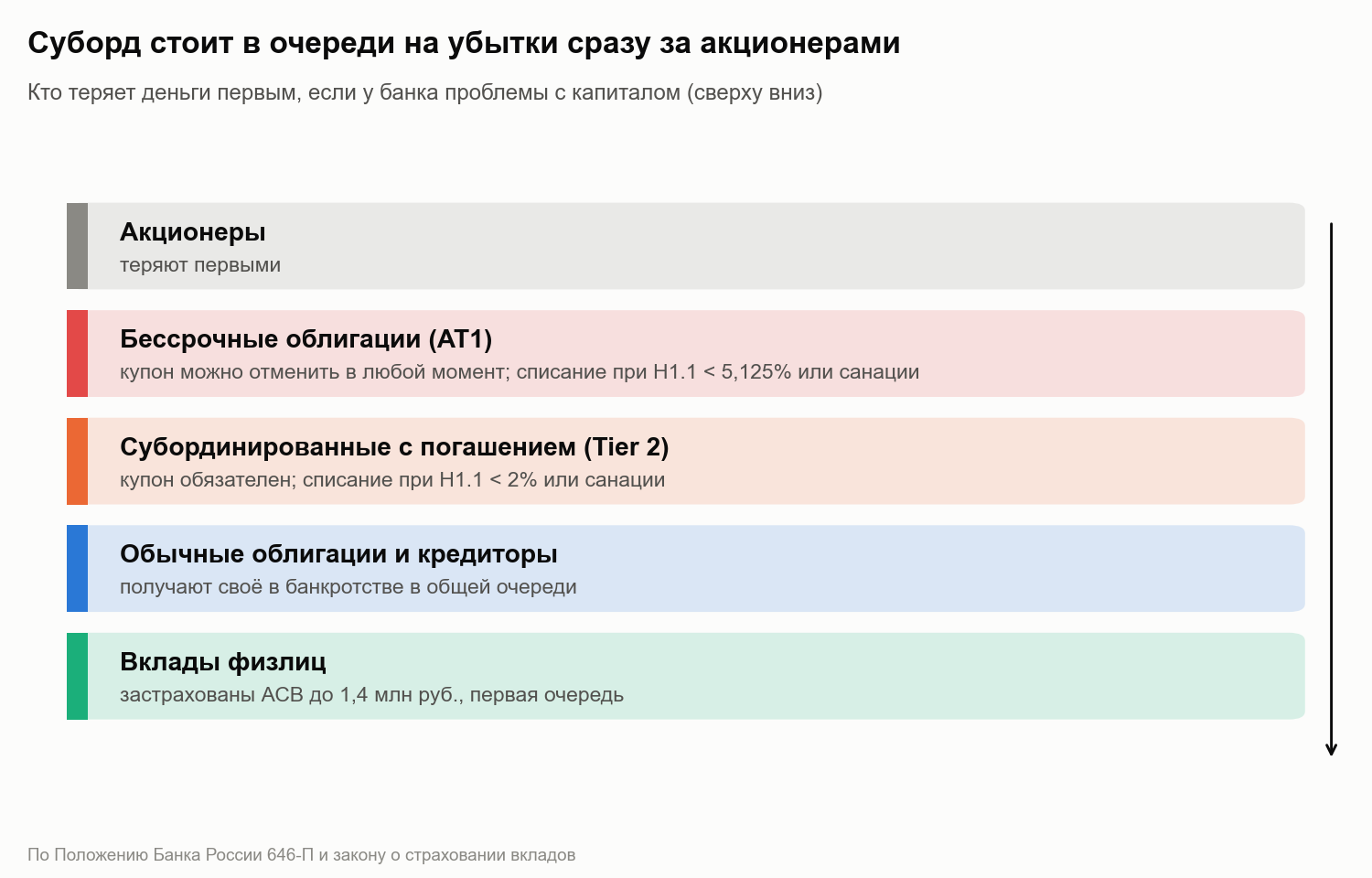
The rules are set out in Bank of Russia Regulation 646-P. There is a separate restriction on sales. Since 2019, subordinated bonds are placed only for qualified investors, with a par value of at least RUB 10mn. Everything issued earlier trades under the old rules, so RSHB's perpetual issues of 2016-2018 and Sovcombank's dollar 1V02 are available on the exchange to non-qualified investors too (after a test at the broker).
The coupon on perpetual bonds is not guaranteed, and VTB has already shown it
Under 646-P the bank may unilaterally refuse an AT1 coupon. There is no obligation to stop dividends on shares at the same time. In its June report the Bank of Russia itself acknowledges that many banks continued to pay on AT1 even as capital worsened, but that is their choice, not an obligation.
On 6 December 2022 VTB, in agreement with the Bank of Russia, stopped paying on its perpetual eurobond and 12 domestic SUB-T1 issues. The reason was the purchase of Otkritie bank, which consumed capital. Payments on four issues resumed on 5 February 2024, and the missed coupons were not returned to holders. For the other issues the exchange coupon schedule has been filled since 2024, but we could not find confirmation of actual payments on them in open sources. Before buying a specific issue, check the history of credits with your broker.
Sovcombank did not pay the coupon on its perpetual dollar issue 1V02 on 3 February 2023. For T-Bank, Alfa-Bank, MKB, RSHB and Gazprombank we found no reports of missed payments.
Tier 2 gives no right to refuse the coupon. There the only risk is write-off.
Write-off happens on a bailout, and then holders lose everything
Russia's history here is short and harsh.
- Otkritie, 2017. N1.1 fell below 5.125% at the end of September, coupons were not paid from 26 October, on 29 November the $500mn issue was written down to zero, followed by two more of $300mn and $200mn.
- Promsvyazbank, 2017-2018. After the bailout in January 2018, $1.32bn of subordinated debt was written off, including two perpetual issues of $600mn.
- ATB and Uralsib. Subordinated debt was written off entirely. Foreign creditors sued in London arbitration and partly recovered money; Russian courts recognized the write-offs as lawful.
An important detail. In a bailout the write-off does not depend on the N1.1 level. If the Bank of Russia decides to rescue a bank, subordinated bonds are wiped out even if the ratio was formally above the threshold. So the second question, besides the capital cushion, is how likely it is that the bank will need a bailout.
The market is most afraid for VTB: 1.2 pp to the write-off threshold
The Bank of Russia publishes each bank's ratios once a month. At 01.08.2026 VTB's N1.1 is 6.3%. This is the smallest margin above the AT1 write-off threshold among the large banks. Sberbank has 10.4%, T-Bank 8.8%, MKB 8.0%.
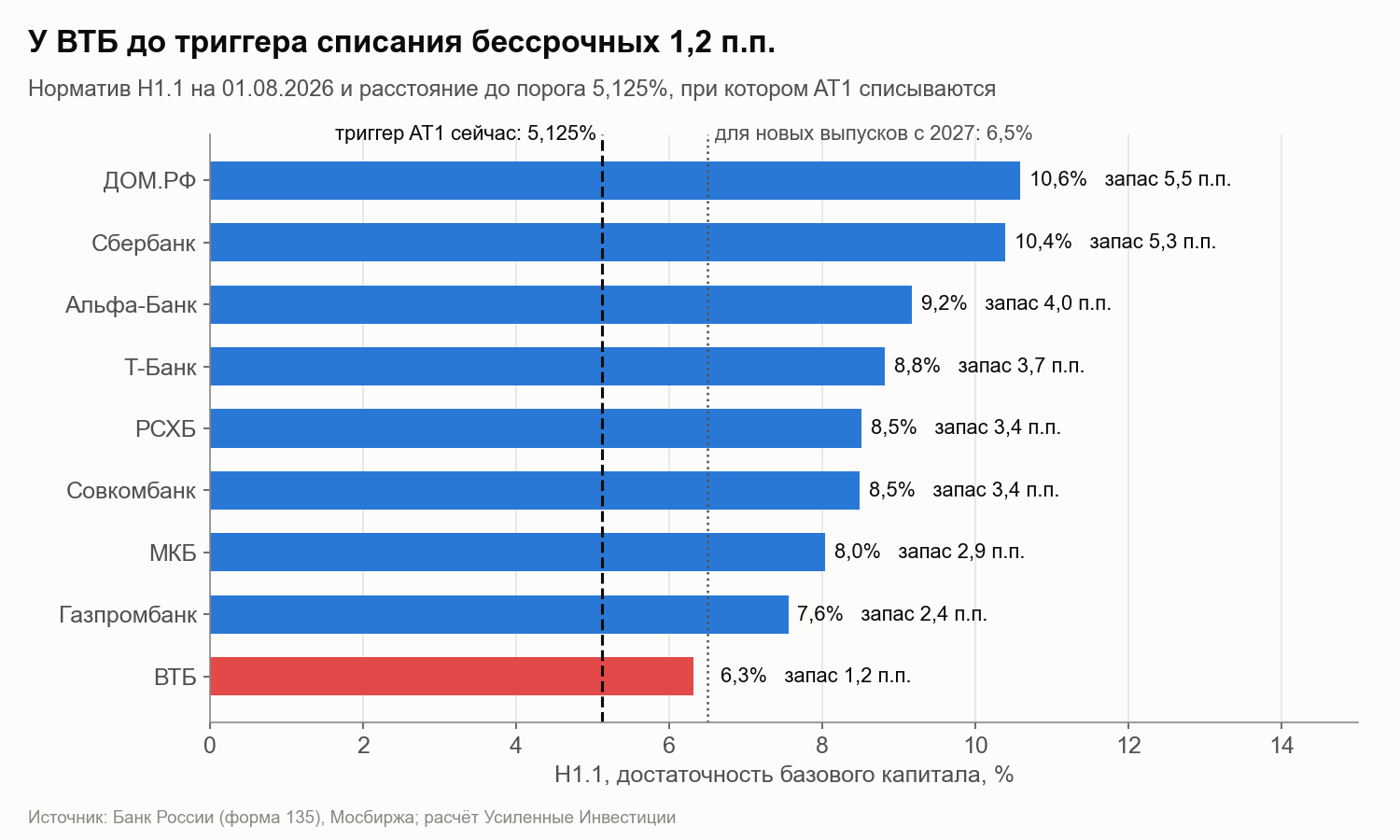
VTB's ratio has been hovering near the threshold for a year and a half. At 01.01.2025 it was 5.38%, a margin of 0.25 pp. By monthly data it has never fallen below 5.125%.
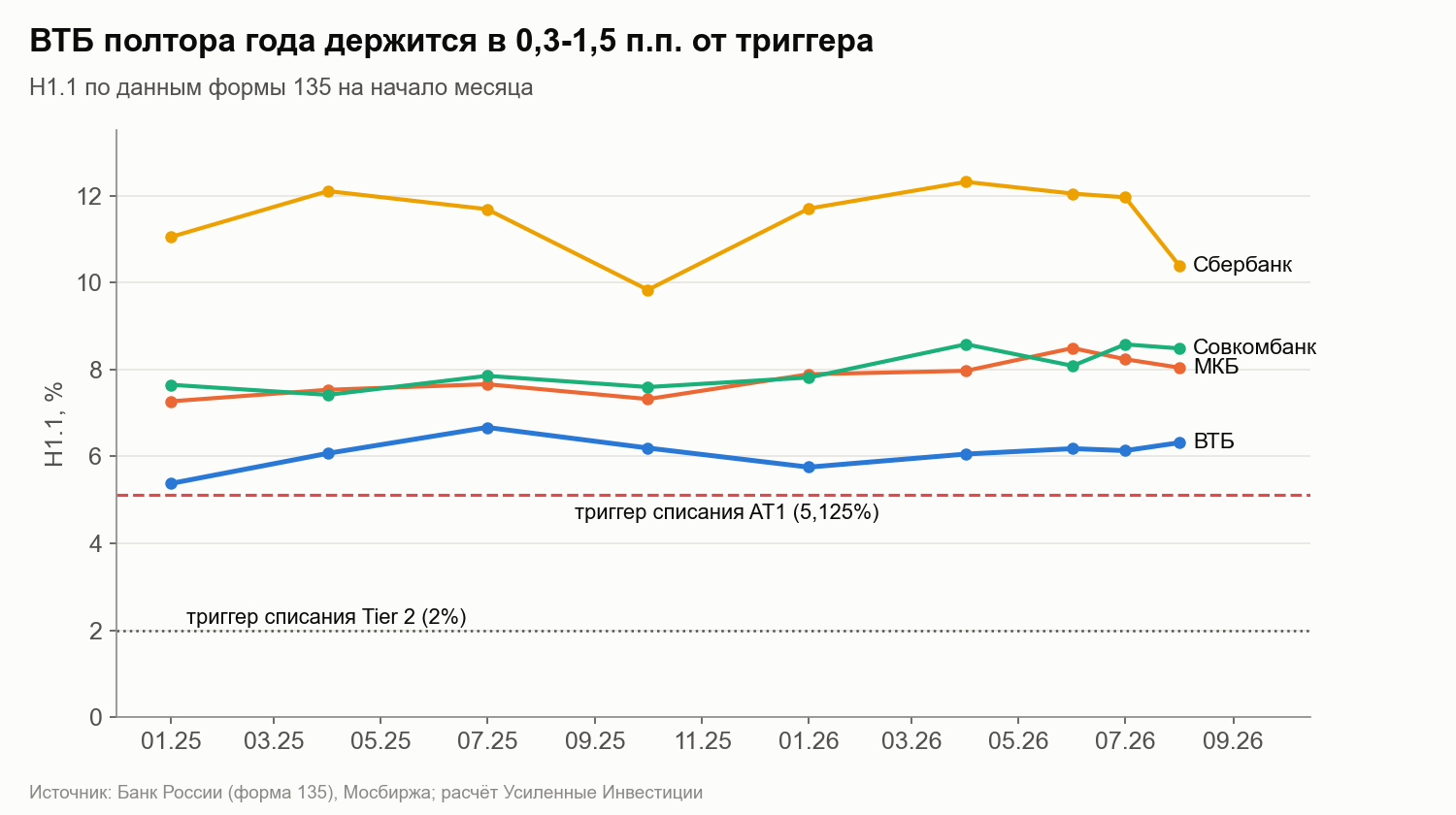
What supports capital. At the group level VTB meets the 2026 minimum requirements together with buffers (N20.1 of 7.3% against a 6.5% target). The dividend for 2025 was cut to 25% of profit, and Dmitry Pyanov in July called a 50% payout for 2026 unlikely. Shareholders approved an additional share issue of up to RUB 547.5bn at RUB 87 a share, and the Bank of Russia registered the issue in July. If it is placed even partially, common equity will grow, which helps subordinated bondholders. There are no placement results yet.
What weighs on it. VTB shares hit an all-time low on 26 August, down a third over the year. Capital buffers rise on schedule through 2028, and holding them with a margin of 1 pp is hard.
The Bank of Russia's concept added fear in summer, even though it does not touch old issues
On 22 June the Bank of Russia published a concept for reforming subordinated bonds. For new AT1 the write-off threshold rises from 5.125% to 6.5%, and the coupon must be stopped if N1.1 is below 7.5%. Perpetuity is replaced by a term of at least 10 years, and systemically important banks will be barred from issuing new Tier 2. The draft amendments to 646-P envisage entry into force on 1 January 2027.
Under the new rules VTB, with its 6.3%, would be below the write-off threshold. This does not extend to bonds already issued; they live by the terms of the issue. But the market saw where the regulator is heading. From July to September VTB's perpetual bonds lost 13-15 points, Sovcombank T1-01 lost 10, and even T-Bank's perpetual, which usually trades around par, dropped to 95.
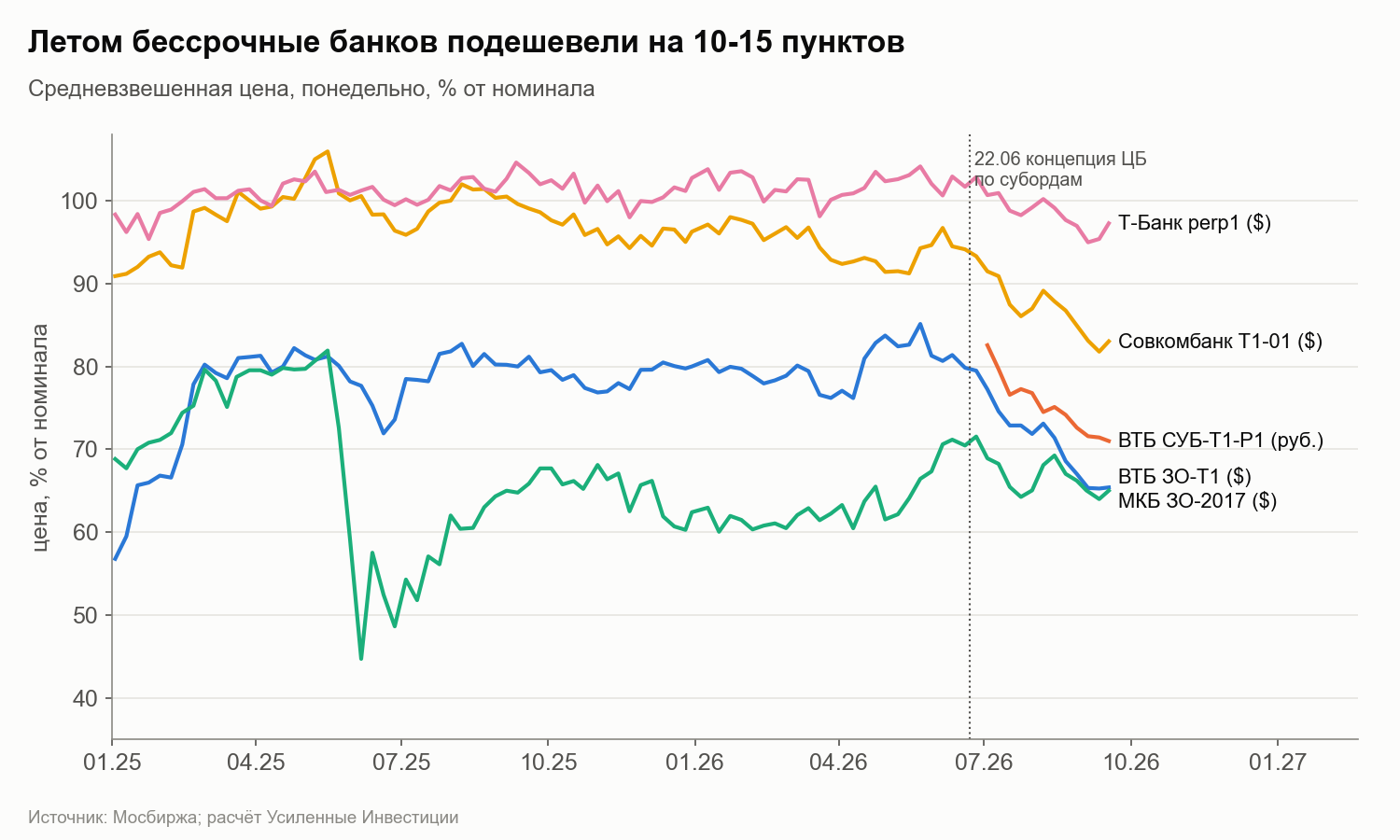
Volatility should also be remembered separately. In May-June 2025, MKB's dollar perpetual ZO-2017 fell from 83% to 44% of par within a month. The coupon was not skipped at the time, the rating agency changed nothing, and the press linked the sell-off to the bank's weak 2024 results. By the end of July the bond had returned to 64%. For a bond that cannot be tendered for redemption, the price depends entirely on market sentiment.
VTB's ruble perpetuals yield 27-29% because the market prices in a noticeable chance of write-off
In May-June 2026 VTB exchanged its foreign-currency perpetual issues for three ruble ones: SUB-T1-R1 (instead of the dollar ZO-T1), R2 (instead of three dollar issues) and R3 (instead of three euro issues). About RUB 120bn was exchanged in total. The par value was converted at the Bank of Russia rate of 25 June, RUB 74.77 per dollar, so one R1 bond has a par value of RUB 74,774.
The terms of the new issues:
- the coupon equals the key rate plus 5 pp, reset every six months; the first two coupons are fixed at 19.5%, after that at the current 14% rate it will be 19%;
- the first payments are still ahead, 16 November on R2 and R3 and 6 December 2026 on R1;
- the bank has a call right with the Bank of Russia's consent in December 2031, then every 5 years;
- write-off and coupon cancellation under the old rules (5.125% threshold).
At a price of 70.9% of par the current yield of R1 is 27.5%, and of R2 28.3%. The old ruble SUB-T1-12 with a coupon of key rate plus 3.75 pp shows the same picture, 28.8%. Issues with a fixed 10% coupon (SUB-T1-5) trade at about 65% of par, a current yield of 15.3%.
To understand what the investor is buying, we calculated the cash flow per 100 rubles invested over 5 years in different scenarios. For comparison we took OFZ for the same term, which yield 16.1% on the Moscow Exchange curve.
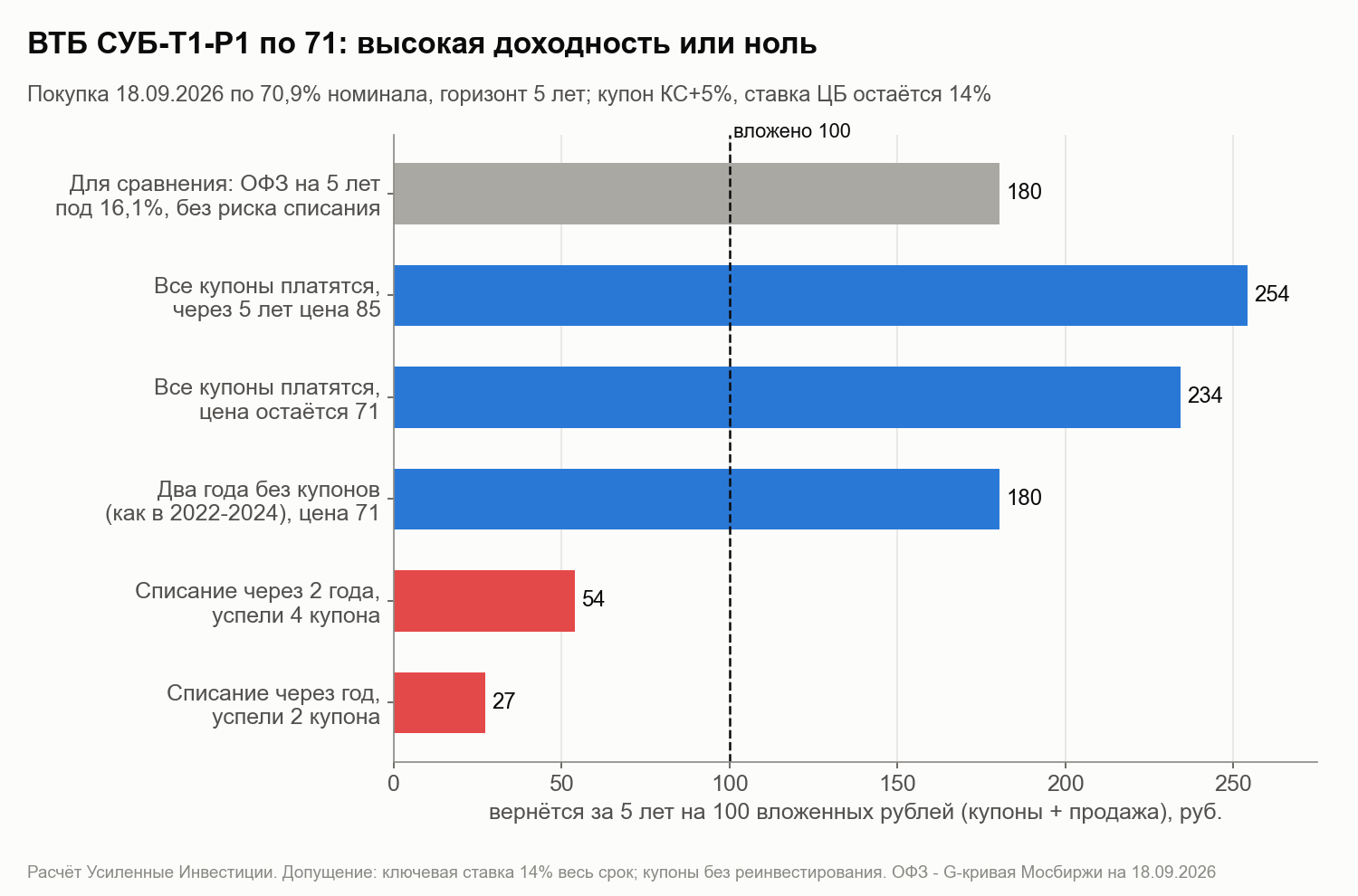
If VTB pays and does not write off, a buyer at 71 gets RUB 234 per 100 over 5 years at an unchanged price, against 180 in OFZ. Even a repeat of 2022 with two years without coupons gives the same 180 as OFZ. A write-off after two years leaves RUB 54 out of 100.
A rough reverse estimate. For a VTB perpetual to equal OFZ in expected outcome, the probability of write-off in the next two years must be about 30%. That is what the market is pricing in at the current price.
Our view of the likely scenario. The state controls VTB, the bank is systemically important, and a bailout with the wiping out of subordinated bonds looks like a last resort for it. A realistic bad scenario is closer to 2022: the bank, in agreement with the Bank of Russia, stops coupons for a while until capital recovers. It is unpleasant, but at a purchase price of 71 it is not loss-making. So a 30% write-off probability seems excessive, and that is the source of the yield. But it is a bet on the behavior of the state and the Bank of Russia, not on the bank's credit quality, and in terms of risk such a bond is closer to VTB shares than to a bond.
"MKB at 20%" turned out to be a Tier 2 maturing in a year, and it is the clearest risk on the list
MKB has four subordinated bonds on the exchange. Three perpetual (ZO-2017, ZO-2021 in dollars and the ruble issue 15) and one with a maturity, ZO-2027. It is the one that gives about 20%.
- What it is. A replacement bond of $78mn, Tier 2, maturing on 5 October 2027, coupon 7.5% in dollars, payments in rubles at the Bank of Russia rate.
- Yield. At a price of 89.9% of par, yield to maturity is 19.5% a year in dollars (18.8% per the exchange, the difference being due to the calculation price).
- Write-off risk. For Tier 2 the threshold is at N1.1 of 2%. At 01.08.2026 MKB's N1.1 is 8.0%, that is, 6 pp above the threshold. The only real risk is a bailout of the bank.
- Condition of the bank. ACRA affirmed MKB's A+(RU) rating and gave the ZO-2027 issue BBB+(RU), three notches lower owing to subordination. In 2025 the bank changed owner and management; according to Expert RA it received RUB 196bn to cover problem assets. Profit for the first half of 2026 under IFRS is RUB 15.6bn, 2.3 times more than a year earlier.
The short term decides almost everything here. For a ZO-2027 holder to lose money, MKB would have to go through a bailout in the next 12 months. There are no external signs of this: N1.1 rose from 7.3% to 8.0% over the year, and profit is recovering. 19% in dollars for such a risk is the most attractive ratio among bank subordinated bonds available on the exchange.
With MKB's perpetuals the picture is different. Rating BB(RU), five notches below the bank's own assessment, a price of about 65% of par, a current yield of 12-14% in dollars. The bank may redeem ZO-2017 in November 2027 and ZO-2021 in April 2027, but at these prices the market does not count on it.
Other subordinated bonds: VTB's Tier 2 is more interesting than its perpetuals
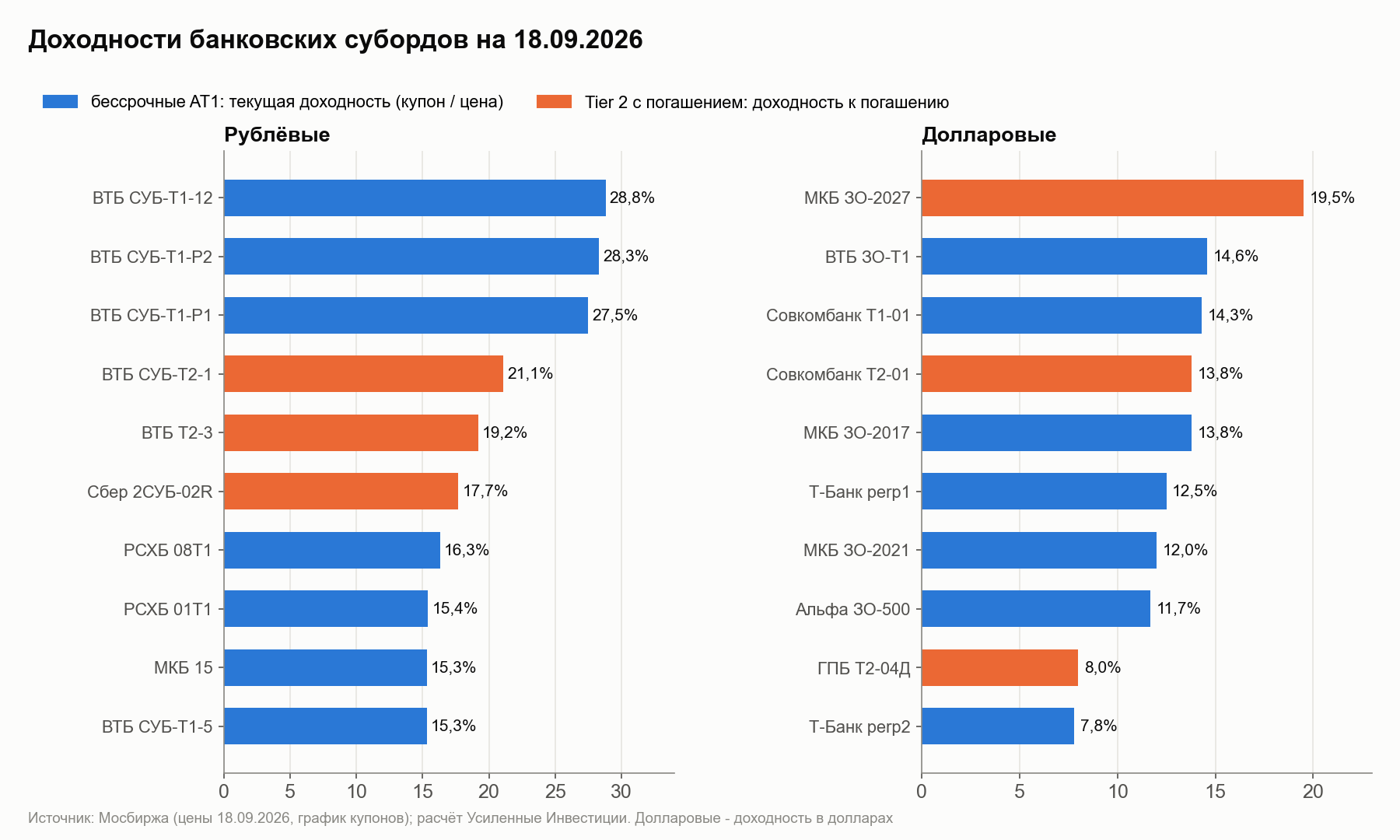
- VTB Tier 2. SUB-T2-1 with a fixed 16.66% coupon to April 2031 trades at 90, yield to maturity 21.1%. T2-3 with an 18.22% coupon to May 2030 yields 19.2%. The write-off threshold is 2% of N1.1, and VTB is 4.3 pp above it. The yield is 3-5 pp above OFZ for a risk that arises only on a bailout. The minus is the RUB 10mn lot and few trades.
- Sberbank 2SUB-02R. Tier 2 to March 2031, coupon 15%, yield to maturity 17.7%. The most reliable issuer, a premium to OFZ of about 1.5 pp.
- T-Bank. The dollar perpetual perp1 trades at 97, coupon 12.1% (tied to the yield of 5-year US Treasuries), current yield 12.5% in dollars. In September T-Bank placed its first ruble Tier 2 for RUB 5bn, with a first coupon of 18%, then key rate plus a spread, but the par value of one bond is RUB 100mn.
- Sovcombank. The dollar T1-01 at a price of 82 yields 14.3%. The bank did not use its call right in May 2026 and in 2023 skipped a coupon on another perpetual issue.
- Alfa-Bank. The dollar perpetual ZO-500 at a price of 69.5 yields 11.7%. The ruble Tier 2 of the T2-CR series were issued at a par value of RUB 100mn and barely trade on the exchange.
- RSHB. The only subordinated bonds available to non-qualified investors. 01T1 with a fixed 9% coupon trades at 58.5% of par, a current yield of 15.4%. 08T1 at a price of 87.5 yields 16.3%, and from the next coupon period the rate rises to 15%, which is already 17.1%. Also available to non-qualified investors is Sovcombank's dollar perpetual 1V02 (coupon 10%, price about 85.5, 11.7% in dollars), but there are few trades in it, and it is the one on which Sovcombank skipped a coupon in 2023. The bank is 100% state-owned, N1.1 is 8.5%, and in 2022 and 2025 it received share recapitalizations.
What is attractive and what is not
MKB ZO-2027 offers the best ratio of yield to risk. 19.5% in dollars for a year, a Tier 2 with a large margin to the threshold, write-off only on a bailout.
Tier 2 of VTB and Sberbank yield 18-21% in rubles to 2030-2031. This is a premium to OFZ for the risk of a bailout of a systemically important bank, but only for a large qualified investor with a lot of RUB 10mn or more.
VTB's ruble perpetuals at 27-29% are a bet that the state will not let VTB's capital be wiped out. The market prices in about a 30% probability of write-off over two years, which in our estimate is with a margin. But the main real risk here is a pause in coupons, and in crisis behavior these bonds are closer to shares.
Dollar perpetuals with a 6-8% coupon (T-Bank perp2, Alfa ZO-400) are the least interesting. A yield of 8-9% does not compensate for the risk of coupon cancellation and the absence of a maturity.
For a non-qualified investor the choice is limited to RSHB 01T1 and 08T1. 16-17% for the perpetual risk of a state bank is almost no different from 5-year OFZ (16.1%), and the premium for subordination here is almost zero.
More analytics on bonds and banks is in the Telegram channel Enhanced Investments @eninv and on the portal eninvs.com.
See also: market overview · valuation map · stock screeners