How the Russian stock market was taken apart. Part one: corporate governance
In May 2024 the president signed a decree setting the stock market capitalisation target for 2030 at 66% of GDP. That is a doubling. The Bank of Russia calculated that reaching this goal requires placing RUB 7-10 trn of shares over five years. Over the previous ten years, about RUB 1 trn was placed.
People were invited to this market in earnest. Individual investment accounts, the long-term savings programme, talk of minority shareholder protection, the corporate governance code. In 2024, 14 companies came to the exchange, the most in seventeen years.
Let us see what became of those who responded.
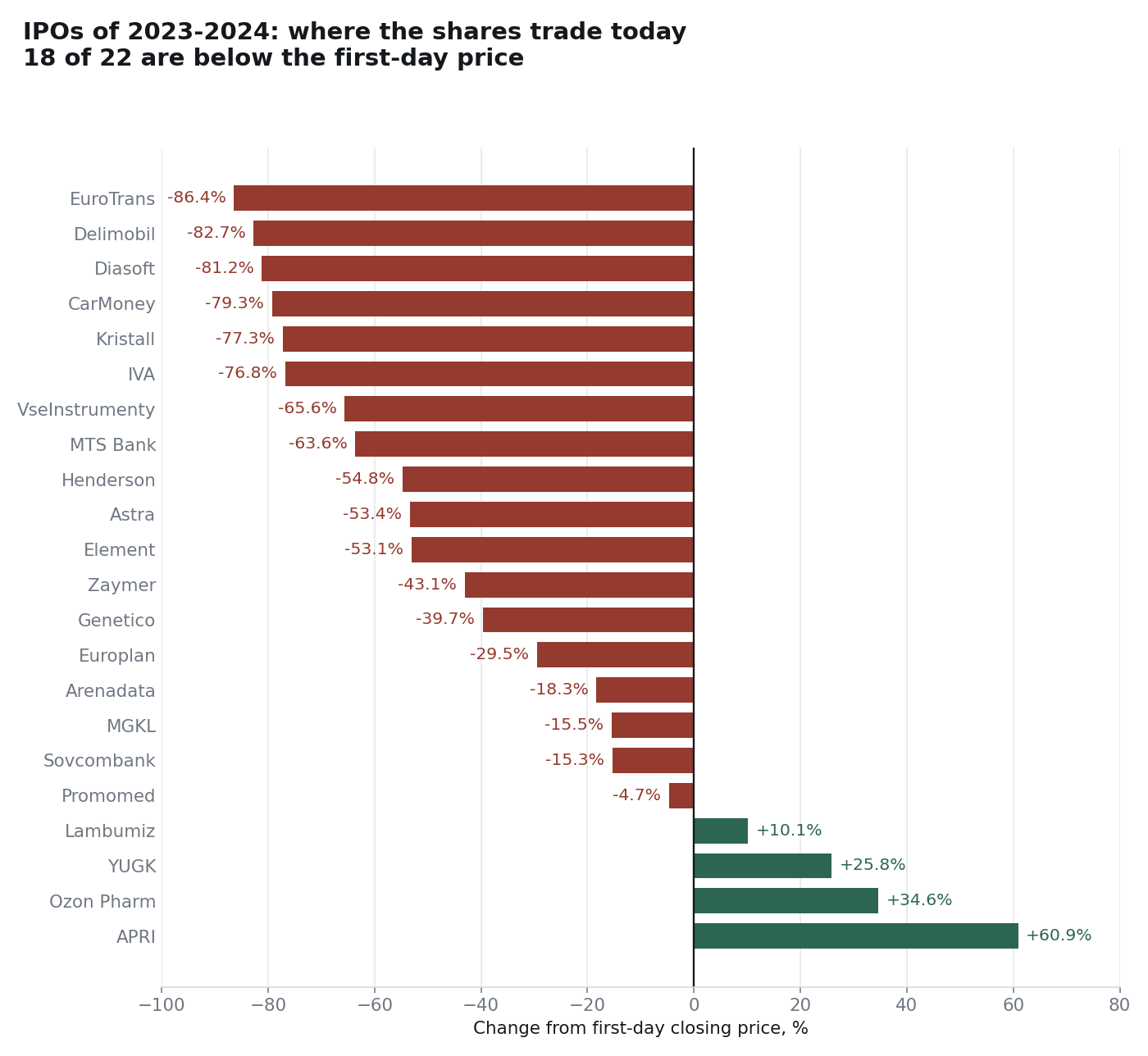
Of the 22 companies that listed in 2023-2024, 18 trade below the closing price of their first trading day. The group median is about -48%. EuroTrans is down 86% and defaulted on its bonds in August 2026. Delimobil is down 83%, Diasoft down 81%. Astra was placed at RUB 333, closed the first day at 466 and now trades at 217.
Market capitalisation, instead of 66% of GDP, holds at about 30%. In May 2025 the Bank of Russia estimated it at 26.6%. The finance minister called the target rather ambitious.
Usually the conversation moves on to geopolitics and the key rate. But the market was not only falling from outside, it was being taken apart from within, and we spent a year and a half counting how exactly. There turned out to be three large mechanisms.
First, corporate governance. This part is devoted to it.
Second, monetary policy. A rate at which a company's higher profit goes entirely into interest, and investing in development is less attractive than putting money on a deposit.
Third, information asymmetry. Blocked securities that someone deliberately dumped into the order book in large volumes while everyone else was unaware.
They promised transparency, and reporting is disappearing
Polyus carried out both operations within two months.
On 9 July 2026 the board of directors, unanimously, nine votes out of nine, took note of management's recommendation to suspend dividends until 2030. The reason in the disclosure was stated directly. The high cost of debt capital and limited supply of bank financing. That is, a gold miner at a historically high gold price announces that it cannot afford a dividend.
A month and a half later, on 31 August, the same board approved the half-year report. It shrank from 26 pages to 13. The cash flow statement disappeared from it. A year earlier it had shown operating cash flow of RUB 240 bn, capital expenditure of RUB 98 bn and dividends paid of RUB 71.9 bn.
The income statement now consists of four lines. Revenue RUB 352,667 mn. A single line "operating expenses and other income and expenses" RUB 259,343 mn. Profit before tax RUB 93,324 mn. Profit for the period RUB 61,234 mn. Cost of sales, selling and administrative expenses, finance costs, interest income, derivative revaluation and exchange differences are folded into one expense line. A year earlier each was shown separately. The auditor issued a qualification for incomplete compliance with IFRS.
Transneft disclosed in its first-half report the purchase of a 7.52% voting stake in an entity whose ultimate controlling party is the Russian Federation, for RUB 40 bn. The name is not disclosed. To give a sense of scale, RUB 40 bn is 17% of the company's entire 2025 net profit. The counterparty was reconstructed from outside. RBC, citing sources, named Gazprombank, and the version matched the bank's own disclosure about placing about 7.5% of shares in August. A shareholder could learn what 17% of annual profit had been paid for only from the reporting of the company being bought.
Separately, we wanted to measure the quality of banks' loan portfolios in the second year of a high rate. It turned out that this is no longer measured directly, as disclosure was permitted to be withheld.
For some issuers the sanctions risk from disclosure is real, and this is not an invention. The problem is that the regime does not distinguish between cases. It is unclear how buying a stake in a public company raises sanctions risks. The Ministry of Finance and the Bank of Russia, incidentally, issued a clarification that a formal approach should not be applied.
They promised dividends by policy, and got a lottery
Dividend aristocrats were the last thing private investors held on to. Let us see what became of them.
Polyus goes five years without payments. Rosneft cut its dividend from RUB 14.68 to 2.27, by 85%, against a fall in annual profit from RUB 1,341 bn to 544 bn. Bashneft paid RUB 69.29 against 147.31, 2.1 times less, RUB 12.3 bn in total for everyone. VTB distributed 25% of profit instead of the expected 50%, which is RUB 9.71 against 25.58, and is conducting a large additional share issue in parallel. With one hand they underpay, with the other they dilute. Gazprom and EMC paid nothing, as a year ago.
The Bashneft story deserves a separate mention. In June 2026 Bashkortostan sold Rosneft part of its stake, a blocking 25% plus one share, 44.4 mn securities. The republic's authorities disclosed neither the size of the stake sold nor the price, but declared an intention to sell the remainder. The minority shareholder lost the second large shareholder, whose interests on payouts coincided with his own. The preferred shares reacted with a 20% fall.
Unipro came up with its own method. On 1 September 2026 the board of directors approved an updated dividend policy. The payout is determined on the basis of IFRS profit, but what share will go to shareholders is not stated. The shares fell 6.7% the same day. The company has not paid since 2021, and its cash cushion has grown to RUB 91.2 bn against a market capitalisation of RUB 65.2 bn. It costs less than the cash lying on it.
The only reversal came from Nornickel. On 25 August the board of directors recommended RUB 1.85 per share for the first half, with an extraordinary meeting scheduled for 30 September. This is the first recommendation since the record date in December 2023, and the background behind it is strong. Half-year revenue is RUB 632.7 bn, up 12.8%, and net profit is RUB 153.2 bn, up twofold.
It is still too early to rejoice. Restated for the current shares, the previous dividend was about RUB 9.15, the new one is five times smaller, with a yield of 1.4%. And the recommended amount, about RUB 28.3 bn or USD 371 mn, exceeds the company's adjusted free cash flow for the same half-year, USD 264 mn.
In fairness, Sber, MTS and X5 keep their word. Their shares also behaved differently in the market.
They promised that money works for the shareholder, and it goes past him
The mechanism here is one, the forms are two. Purchases at opaque prices and investments without returns.
Magnit has consolidated Azbuka Vkusa since 20 May 2025. The result of the first full year after the deal looks like this. Revenue RUB 3,509.2 bn, up 15.3%, and a net loss of RUB 31.6 bn against a profit of RUB 44.3 bn a year earlier. Operating cash flow fell from RUB 194.7 bn to 45.0 bn, fourfold. Net debt rose from RUB 797.5 bn to 1,096.8 bn. The first half of 2026 did not break the trend, with a loss of RUB 9.5 bn. There have been no dividends since the third quarter of 2024. The company's market capitalisation is now RUB 169 bn, six and a half times smaller than its net debt.
Softline turned a net cash position of RUB 1.9 bn into net debt of RUB 31.6 bn over two and a half years, which is one and a half times its entire current market capitalisation. Over that time revenue grew from RUB 73.2 bn to 95.5 bn, net profit halved, and the dividend fell from RUB 2.50 for 2025 to 18 kopecks for 2026.
Inter RAO provides the cleanest example of investment without returns one can find.
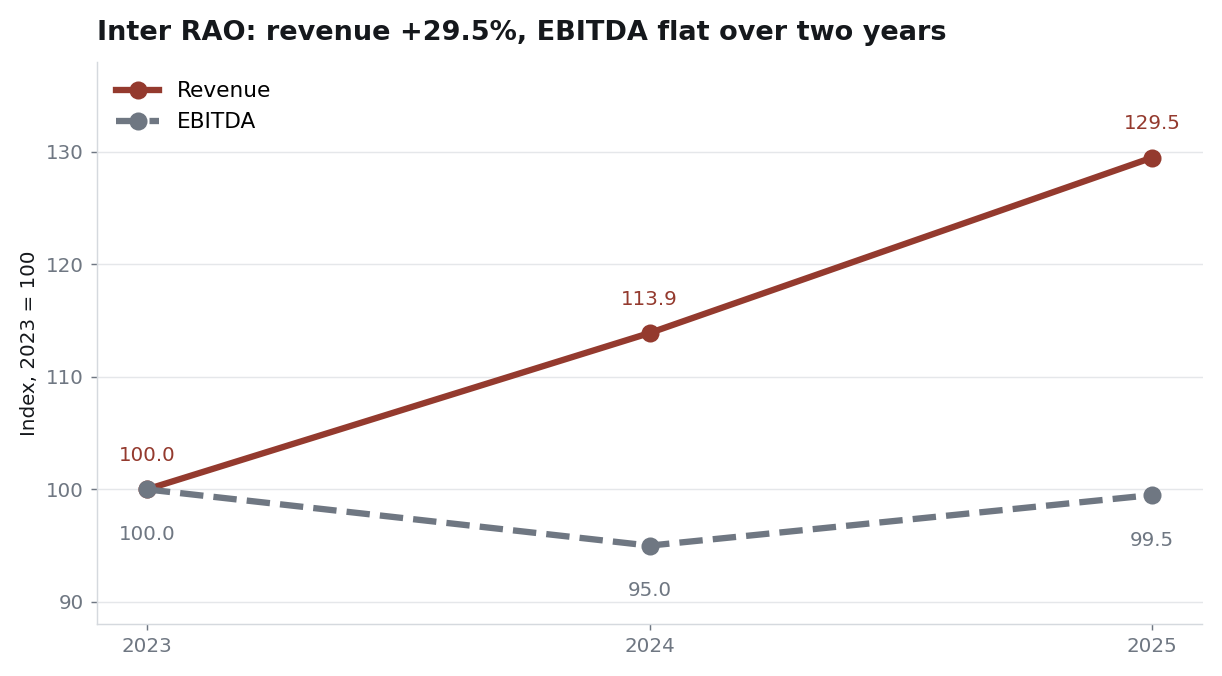
Revenue over two years rose from RUB 1,359.8 bn to 1,760.6 bn, almost a third. EBITDA over the same two years went RUB 182.4 bn, 173.3, 181.5. Zero. The first half of 2026 sharpened the picture: revenue up 16.5%, EBITDA down 4.3%, net profit down 17.2%.
And all this time the cash pile for which the company was held was melting. From RUB 279.9 bn in 2023 to 163.8 bn in 2025. Minus RUB 116 bn in two years with a dividend at the lower bound.
They promised that a buyback raises your share, and shares go to management
Companies used to buy shares back from the market and cancel them. There were fewer shares, and each shareholder's stake grew. Now they buy back but do not cancel. Or they cancel after giving them to management first.
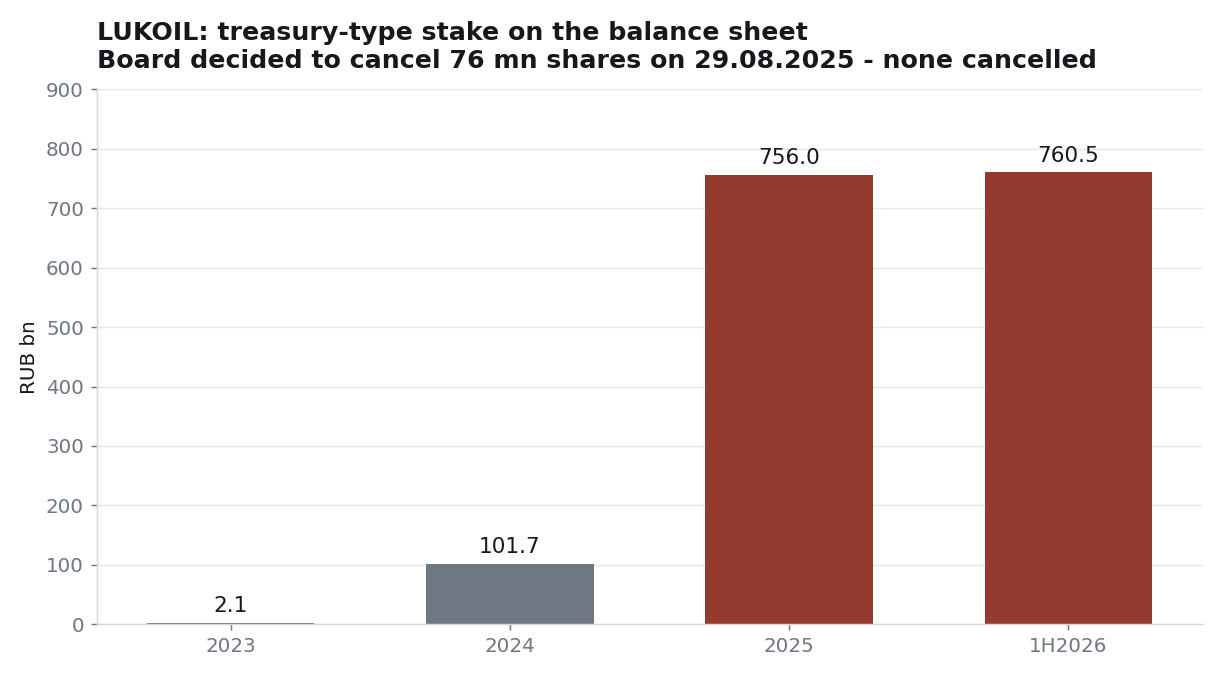
LUKOIL turned this into proof. The quasi-treasury stake on the balance sheet grew from RUB 2.1 bn in 2023 to RUB 101.7 bn in 2024 and RUB 756.0 bn in 2025. At 30 June 2026 it stands at RUB 760.5 bn, that is, it has not shrunk.
On 29 August 2025 the board of directors decided to cancel up to 76 mn shares, about 11% of the issue, and the quotes jumped on the news. A year later the issue contains the same 692,865,762 shares, exactly as since February 2020. Nothing has been cancelled. The price deserves separate attention. The stake of 90.75 mn shares was bought back at about RUB 7,200, 4% above the average market price for the first half of 2025. Today the share trades at about RUB 5,049.
LSR in August 2023 transferred 21.5% of its capital to ten employees, worth RUB 17.4 bn, from the treasury stake of a wholly owned subsidiary. Fifteen percent, worth RUB 12.15 bn, went to the chief executive Andrey Molchanov, who is also the company's main owner. Roughly one percent each went to the financial director, the deputy chief executive and the chief executive's son, a first deputy. One percent was valued at RUB 800 mn. In 2025 the company's profit fell to RUB 10.8 bn from 28.6 bn, while the dividend of RUB 78 per share amounted to 74% of the entire annual profit.
In the IT sector dilution runs at a different pace, and it should be counted in the number of shares transferred, not in rubles of expense. The ruble expense under IFRS is spread over vesting and valued at the past price, while dilution happens at the moment of transfer. By this measure in 2025 Positive gave employees 5.46% of its capital, CIAN 2.45%, Yandex 1.87%, T-Technologies 1.43%, Wush 1.04%. In the largest American technology companies, incentive grants usually do not exceed one percent a year.
And this is not the end. The undistributed pool at the end of 2025 is 9.0% at Yandex against a charter limit of 23.2%, 5.0% at T-Technologies and 4.0% at Softline.
How this expense is hidden is clearly visible at Positive. A reserve of RUB 10,042 mn, which is 5.18 mn shares at RUB 1,938.6, was formed directly in equity. The income statement received RUB 96 mn for 2024 and zero for 2025, while the debit went to intangible assets and will return to the shareholder later, through amortisation. The picture is common across the sector. Seven companies out of ten exclude the incentive expense from adjusted EBITDA, the very figure from which dividends are then calculated.
Indexation of compensation amid weak business also persists. At Europlan, 2025 profit fell 2.9 times to RUB 5.13 bn, revenue declined, while administrative expenses stayed exactly in place, RUB 10.97 bn against 10.94 bn.
What did not survive the check
An analysis is worth little if it has no line "we were wrong". Three points did not pass the check.
Rostelecom went into our list as an example of capital expenditure without returns. The data do not confirm this. EBITDA from 2021 to 2025 grew by 53%, slightly faster than revenue. Leverage also did not rise but fell, from 2.2 to 2.1 by the company's own metric, and with leases included. A different link breaks. Interest expense rose from RUB 38.9 bn in 2021 to 123.4 bn in 2025, by 3.2 times. Of the RUB 113 bn of EBITDA growth over four years, interest took RUB 85 bn, three quarters. This is not corporate governance, it is the rate, and that is why Rostelecom will be a hero of the second part of the anthology.
Softline was cited as a company where gross profit grows faster than EBITDA and the difference goes into administrative expenses. For 2025 this did not reproduce, with EBITDA rising from RUB 5.3 bn to 8.2 bn. But in the first half of 2026 it came back, and with it came back the question of which EBITDA we are discussing. The company announces growth in adjusted EBITDA of 27%, to RUB 4.4 bn. Unadjusted for the same period it is RUB 2.88 bn, growth of 5.1%. Net of capitalised development, RUB 1.62 bn remains. And operating profit, the line after all real expenses, declined, RUB 0.63 bn against 0.72 bn. Between the top and bottom step there is a factor of seven.
We nearly put X5 in the same category on half-year data, where adjusted EBITDA grows 8.7%. In the standalone second quarter it declines 2.4%, to RUB 77.0 bn, margin falls to 5.8% from 6.2%, and net profit falls 28.9%. The half-year is carried by a strong first quarter and hides the turn. It is still too early to put X5 down as corporate evil. The company attributes faster expense growth to staff, utilities and delivery, and that is cost inflation, not compensation of management.
What is needed to fix this
None of the measures below requires either favourable conditions or the lifting of sanctions. All of it is a matter of rules.
Narrow the right not to disclose to genuinely sanctions-related cases. Buying a stake in a public company is not one of them. The clarification of the Ministry of Finance and the Bank of Russia on the inadmissibility of a formal approach already exists, what is missing is consequences for ignoring it.
Introduce mandatory disclosure of the terms of large and related-party transactions with an independent fairness assessment for minority shareholders. In the world this is the norm, here the terms of a deal worth tens of billions are learned from the counterparty's reporting.
Make a deviation from the dividend policy an event that must be explained. Not prohibit it, but oblige disclosure of the calculation and the reason. A policy in which the share of profit is not written down is not a policy.
Limit the share of equity-based incentives and prohibit excluding them from the base for dividends. The incentive expense is real, and adding it back into adjusted EBITDA, from which the payout is calculated, is not acceptable.
Repurchased shares should either be cancelled or have their term and purpose disclosed. A buyback that sits on the balance sheet for a year after an announced cancellation misleads the market.
Restore a working board of directors. Unanimous decisions, nine out of nine, on questions that cost shareholders a five-year dividend say more about the quality of discussion than any reporting.
What comes next
The second part will be about monetary policy: how the rate eats companies' profit faster than they can earn it, and why under such conditions nobody invests in development. The third part will be about information asymmetry and sales of blocked securities into the order book.
Some questions remain that it is more honest to name than to stay silent about. Nornickel's capital expenditure relative to EBITDA, the results of ElSib after the purchase by Inter RAO, the exact number of shares in LUKOIL's quasi-treasury stake and the line-by-line breakdown of X5's expenses. We continue to count each of them.
Analyses, calculations and issuer data are published in the Enhanced Investments channel.
See also: market overview · valuation map · stock screeners