MTS swaps dividend for buyback: how much the shareholder earns from it
On 15 September the board of directors of MTS approved a new capital return policy for 2027-2028. The dividend ceased to be a fixed amount and became a share of OIBDA, and a share buyback appeared alongside it. We examine what this changes for the shareholder in money and in the return on the investment.
In brief. The dividend per share falls from RUB 35 to RUB 26 a year, while the total cash return to shareholders rises from RUB 65.8bn to RUB 70bn, that is to a fifth of market capitalisation: 14% in cash and 6% in buyback. The increase is one-off, and for the next two years the return stays at the same level. The expected return on the investment in our three-year model changes little, 44.0% a year against 45.2% under the previous assumption. The main risk is not the size of the return but that, under the policy's terms, repurchased shares are not cancelled.
What exactly the board of directors approved
- Capital return to shareholders of up to 20% of annual OIBDA during 2027-2028.
- A minimum target return of RUB 70bn in each calendar year of the policy.
- 70% of the return goes to dividends, which corresponds to 14% of OIBDA for the reporting period. The remaining 30% goes to buying back shares in circulation.
- Payments at least three times a year, six in total over two years. In 2027 for 9 months of 2026, then for 2026 and 1Q2027, then for 6 months of 2027. In 2028 for the same periods of the following year.
- The first payment is expected in January 2027.
- The buyback is carried out by a separate decision of the board of directors, and repurchased shares remain the property of MTS.
The previous policy, in force for 2024-2026, promised at least RUB 35 per share per calendar year, usually in one payment in summer.
The return rises once by 6% and then stays flat for two years
We count in money, not per share. RUB 35 on 1,881mn shares in circulation gives RUB 65.8bn a year. The new policy gives RUB 70bn: RUB 49bn in cash and RUB 21bn in buyback. This is a one-off increase of 6.3%, and the growth ends there. In the next window the return is RUB 70.3bn, up 0.4%.
The reason is that the floor pays, not the formula. 20% of OIBDA gives RUB 65.6bn in the first year and RUB 70.3bn in the second, and both times it is no more than the promised minimum of RUB 70bn. The formula starts to work only in the third year, when a fifth of OIBDA reaches RUB 74.9bn, but by then the announced policy will already have ended.
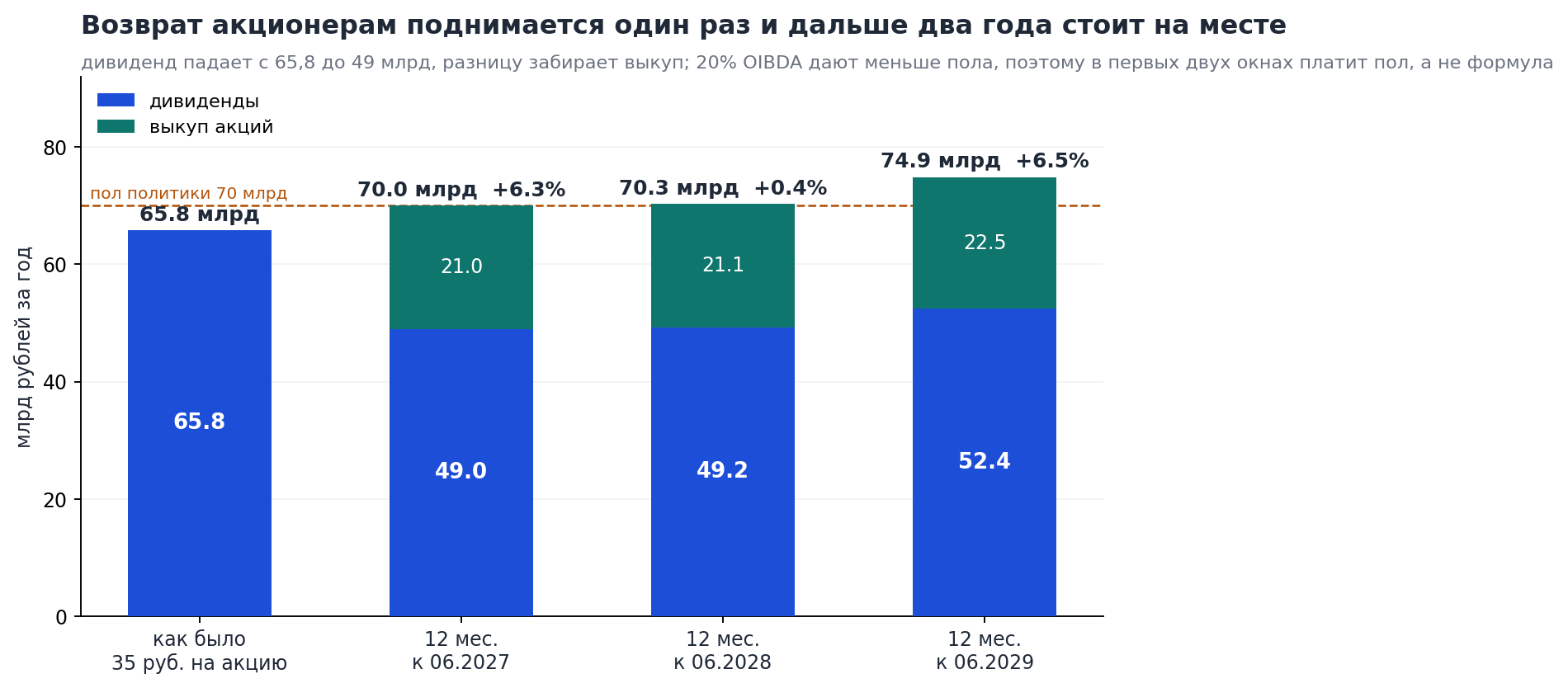
On a market capitalisation of RUB 349bn at a price of RUB 185.5, these RUB 70bn give 20.1% a year, of which 14.0% is dividends and 6.0% is buyback. The dividend yield on the current price falls from 18.9% to 14.0%.
There are two different numbers of 20% here, and they are easy to confuse. 20% of OIBDA is the rule of the policy, 20% of capitalisation is what the rule turns into at today's price. They coincided by chance.
On per-share figures in rubles. They are easy to calculate in a way that shows growth that does not exist. The dividend per share rises from RUB 26 to RUB 27, and the total return from RUB 37 to RUB 39, although in money both stand still: these figures rise only because the number of shares falls, 1,881mn at the start and 1,797mn a year later. If the return is counted per share, the buyback is counted twice, first as money paid out and then as a shrunken denominator. There is one right number: the company pays out RUB 70bn a year.
This also leads to a caveat on the calculation itself. The per-share gain is correct only if repurchased shares do not receive the payout. That will be so if they sit on the balance sheet of PJSC MTS itself. But the current quasi-treasury block is held by the subsidiaries Erion and Bastion, and shares on a subsidiary's balance sheet do receive the dividend, and the money simply returns to the group. In that case the outside shareholder gets the same RUB 26, and the difference comes through lower debt rather than through the payout.
There is enough money for this: OIBDA is growing faster than revenue and debt is falling
Second quarter of 2026. Revenue RUB 213.5bn, up 9.2% year on year, OIBDA RUB 84.6bn, up 16.3%. For the first half revenue was RUB 414.8bn, up 11.9%, OIBDA RUB 159.3bn, up 17.1%. For the last 12 months revenue was RUB 851bn and OIBDA RUB 303bn. The margin is growing faster than revenue, and this is the very base from which the dividend is now calculated.
Debt. The company itself shows net debt of RUB 474.1bn and 1.6x OIBDA. In our database debt is calculated as a pair with OIBDA, from which lease payments are not deducted. It therefore includes lease liabilities, RUB 172bn at 30 June 2026 after the leaseback in the tower business deal, and the cash of MTS Bank, RUB 60.6bn, which the telecom cannot access, is added back. The result is RUB 707bn and 2.33x OIBDA. Both figures are correct, they simply count different things, and debt should be compared with profit on the same basis.
Free cash flow in the model is RUB 90bn in the first year, RUB 122bn in the second and RUB 142bn in the third, against a return of RUB 70bn. The policy is paid for out of cash flow, not new debt, and leverage falls from 2.33x to 1.5x OIBDA by 2029. The rate helps. Interest expense falls from RUB 107bn to RUB 67bn with a key rate of 13.35% in the first year of the model and 8.5% in the third. Revenue growth is assumed at 8.8% in the first year and 7.1% in the third, and the margin holds around 35%.
The expected return barely changes, the money just changes form
Under the previous assumption the model paid the dividend as a share of profit and gave RUB 148 of payments over three years with a target of RUB 358 per share. Under the announced policy payments come to RUB 75, but the target rises to RUB 449. The total for the shareholder is even slightly higher, RUB 338 against RUB 321, but it arrives later and through the price. The annual return is 44.0% against 45.2%.
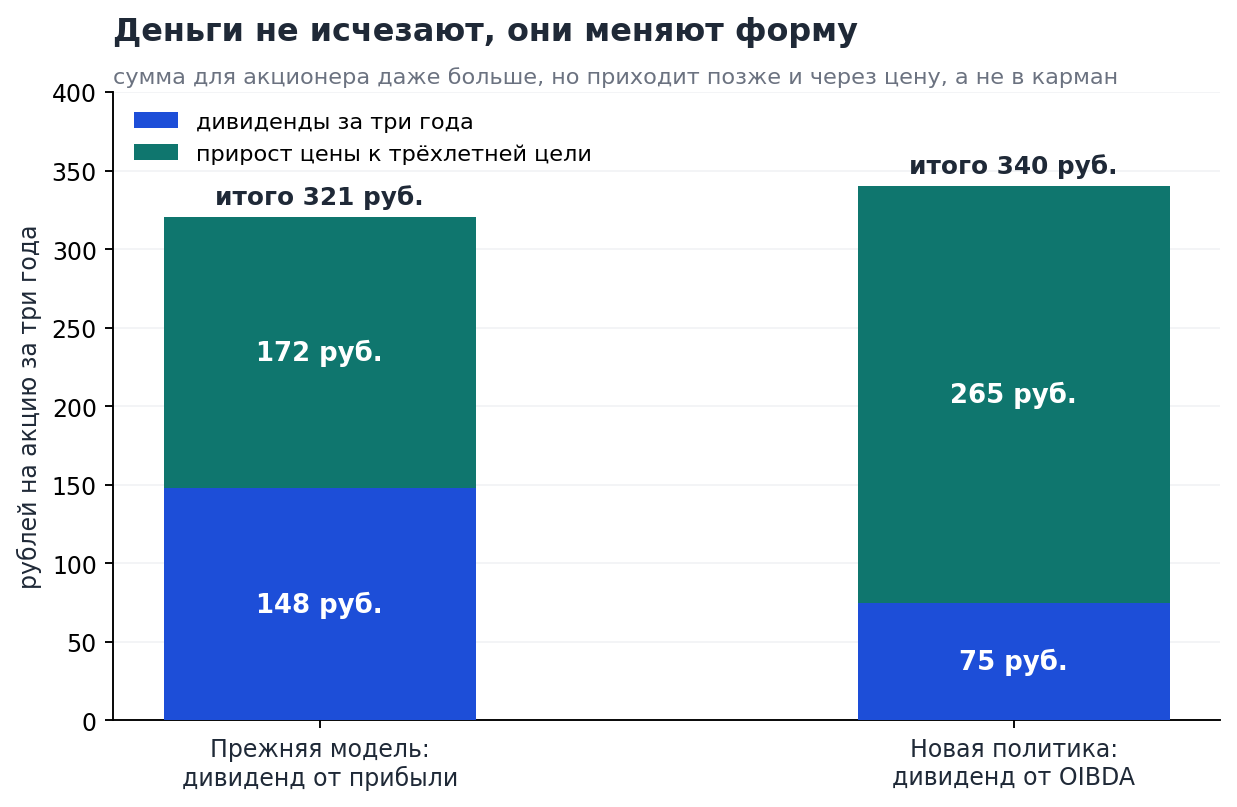
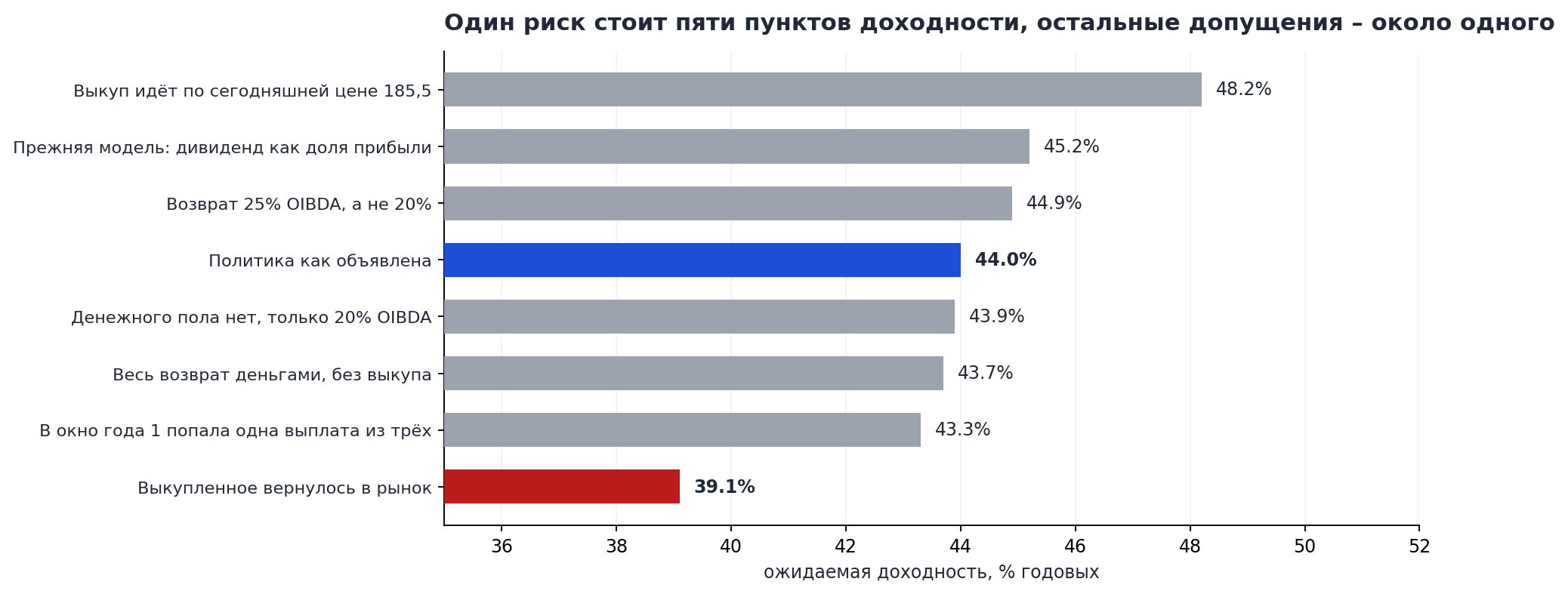
The mechanics are simple. Money that is not paid out does not vanish, it repays debt, and lower debt means a larger value of the equity stake. A buyback reduces the number of shares among which the value of the company is divided. By themselves, a buyback and a dividend are almost equivalent. If the whole return were paid in cash, the return would be 43.7%.
The buyback price. This is a separate assumption, and an important one. If today's price is used, the model starts to feed on its own upside, buying at 186 what it has valued at 449. The buyback price in the calculation therefore rises from the current price to the three-year target. If the buyback really goes through at today's levels, the return comes to 48.2%.
The main risk is not the size of the return but that the repurchased shares are not cancelled
The release says it directly. Shares repurchased as part of the capital return remain the property of MTS. This is not the same as cancellation, and the difference is not formal.
Capital structure at the end of the second quarter of 2026. 1,998.4mn ordinary shares have been issued. PJSC MTS itself holds 76,942 shares, and the subsidiaries Erion and Bastion hold 27.8mn and 85.7mn. The quasi-treasury block totals 113.5mn shares.
Three years ago there were 1,698.6mn shares in circulation, and on 25 January 2026 the counter jumped to 1,881.0mn. About 182mn shares from the quasi-treasury block ended up in the market. In addition, Bastion has entered total return swaps on part of its block, which means the economics of these shares already lie outside the company.
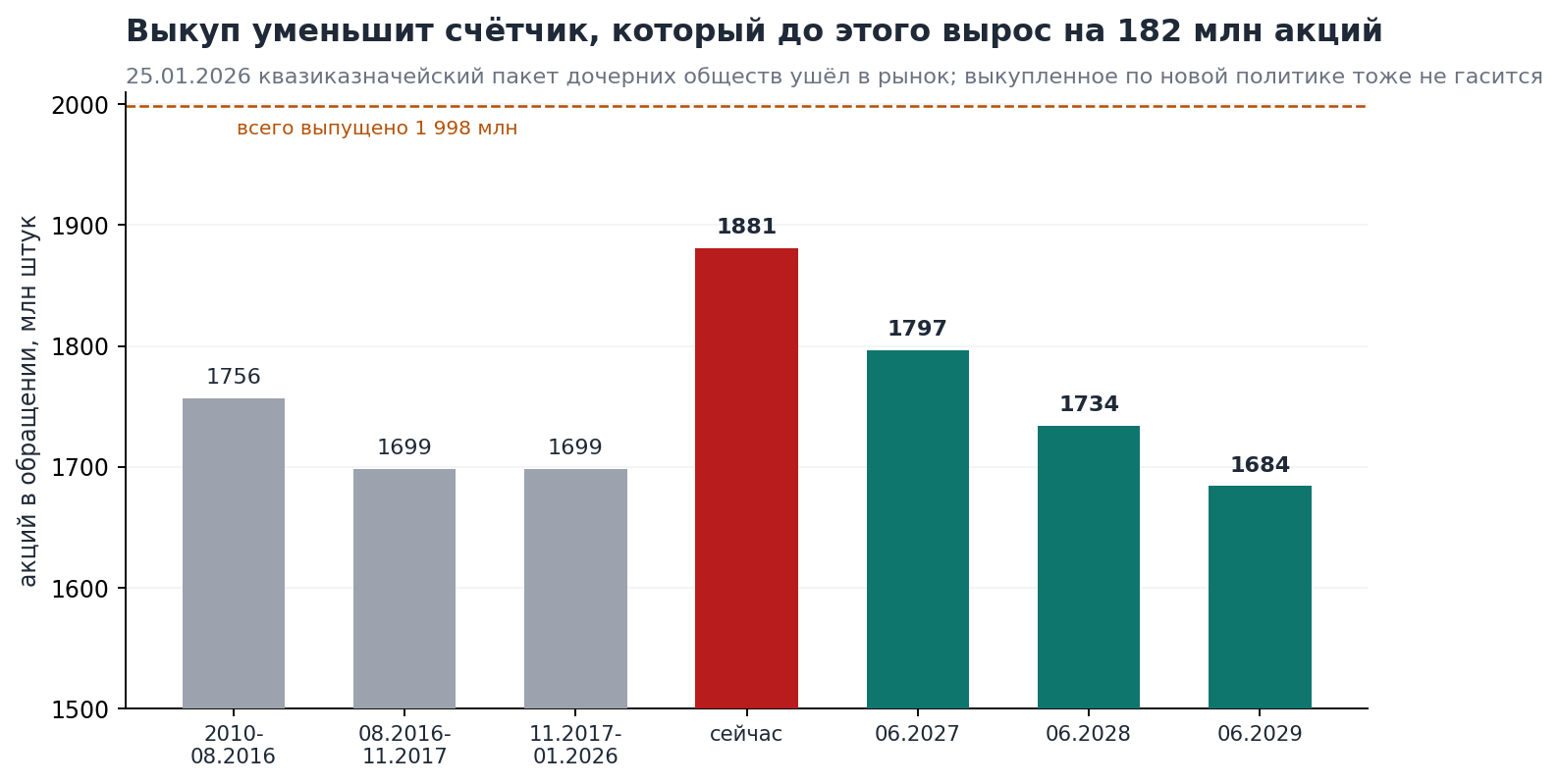
MTS has already travelled the path from a quasi-treasury block to free float, and nothing prevents it from travelling it again. If the repurchased shares return to the market, the expected return falls to 39.1% a year, and the bear scenario from 5.9% to 2.5%. Until the board decides to cancel, it is reasonable to treat this third of the return as a promise rather than as money.
The January payment is already under the new policy and will be about a third of the annual amount
The release names January 2027 as the first payment under the new policy, for nine months of 2026. At a return of RUB 70bn the annual dividend budget is RUB 49bn, or RUB 26 per share, and with three payments a year January accounts for about a third of this amount. The company has not named the exact figure.
For the three-year calculation this is a question not of size but of the calendar. The window of the first model year ends on 30 June 2027, and two payments out of three fall into it, January and spring. The autumn one goes into the second year. This detail is worth 0.8 percentage points of return, and if only the January payment fell into the window, the result would be 43.3%.
What could go wrong
We recalculated the model under different assumptions. Of these, exactly one is costly, the fate of the repurchased shares; the others change the return by less than a percentage point.
Separately there is the bear scenario, 5.9% a year. With debt at 2.33x OIBDA, the value of the equity stake depends heavily on the multiple. If the exit happens not at 3.5x but at 2.8x OIBDA, almost nothing is left of the return. And the policy itself is announced only until the end of 2028; what comes after is not promised.
One more observation on the design of the policy. The cash floor of RUB 70bn and the ceiling of 20% of OIBDA almost coincide, because a fifth of 2027 OIBDA in our model is RUB 68bn. That is, the policy is built around OIBDA of about RUB 350bn, and this is an implicit company benchmark for the business.
How MTS looks against other Russian names
In our ranking of expected return from three-year models MTS is third: Promomed 57%, Rostelecom 46%, MTS 44%, VTB 43%, TBank 43%, OZON 41%, Gazprom 39%, Sovcombank 38%, NMTP 35%, Sberbank 34%.
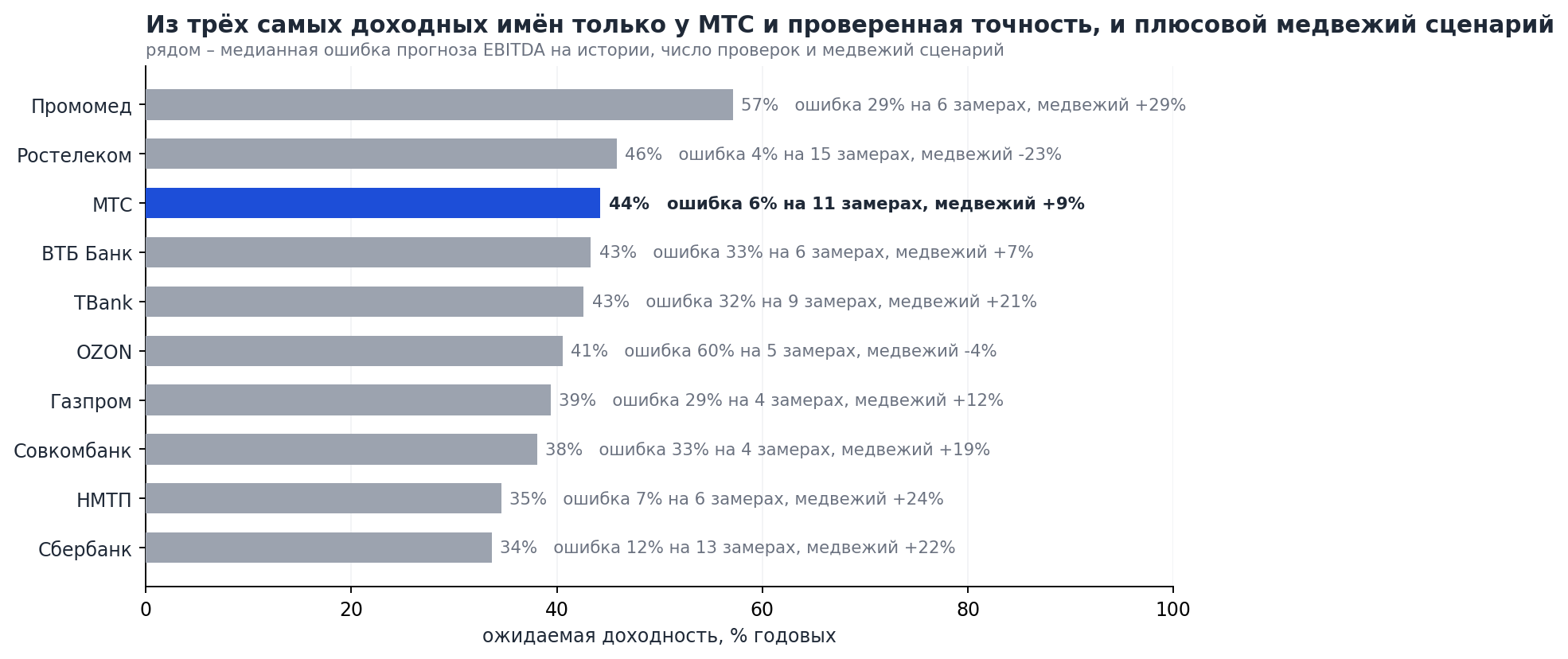
Return cannot be read in isolation from accuracy. Models are checked by backtest on financial results, not on a guessed price. The model is placed at each past reporting date, allowed to see only the data available at that moment, and its one-year-ahead forecast is compared with the actual. For MTS the median OIBDA forecast error is 5.6% over eleven measurements, and 3.2% for revenue. For comparison, Promomed has 29% over six measurements, VTB 33% over six, and Ozon 60% over five.
Of the three highest-return names, Promomed has weak measured accuracy and Rostelecom a negative bear scenario, minus 23%. At MTS all three things come together: return, a verified model and a positive bear scenario.
Summary
MTS's new policy is a trade-off. Less cash in the pocket now, more value in the share later. In money the shareholder gets more than before, RUB 70bn against RUB 65.8bn, but the increase is one-off, the next two years stay at the same level, and a third of this money comes as buyback. The company does not cancel repurchased shares, and the history of the quasi-treasury block shows that these shares have a way back.
The expected return on the investment in the model is 44.0% a year, with a bear scenario of 5.9% and a target of RUB 449 per share in three years. The key question for 2027 is the fate of the repurchased block. A decision to cancel would turn a third of the return from a promise into money.
The full three-year model with a year-by-year breakdown, sources of the growth rate and a check on history is on the MTS card on our portal. The ranking of all Russian names is at frontier.eninvs.com/ru/models.
See also: market overview · valuation map · stock screeners