Upcoming dividends: how much LUKOIL, X5, MTS, CIAN and Novabev will pay and when they will be announced
In autumn Russian companies announce interim dividends for the half-year or nine months. Below are the five stocks we are asked about most often: LUKOIL, X5, MTS, CIAN and Novabev. For each we calculate how much the company may pay, when the board of directors will announce the amount and when the record date will be. Prices are as of 2 October 2026.
The biggest cheque is LUKOIL's: RUB 560–780 per share, or 10.3–14.4% of the price for one payment. X5 and MTS will pay in January, but less than a year ago. CIAN promised at least another RUB 30 (4.6%) before the end of the year. Novabev pays RUB 8 (3.2%), record date 12 October.
We expect announcements from late October to late November, with record dates in December and January. Ahead of the record date, stocks yielding 6% or more beat the market by 5.5% on average, but almost all of that gain comes in the six weeks before the record date. Buying a stock the day before the record date just for the dividend is on average not worth it.
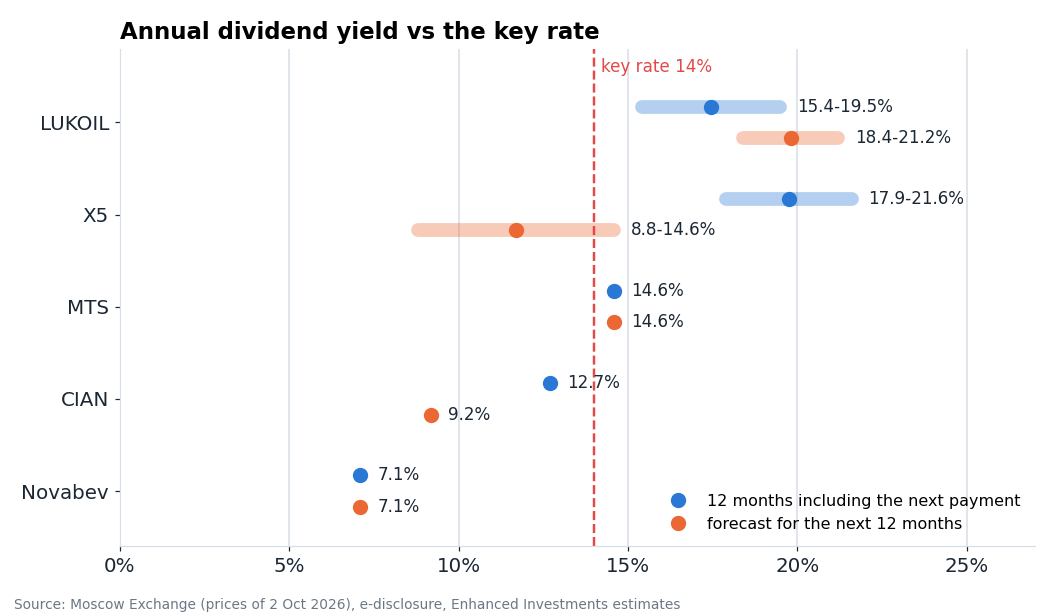
With the key rate at 14%, only annual yield is a fair comparison, not a single payment. So for each stock we calculate two annual measures. The first is the 12-month yield including the nearest payment: the new dividend replaces its last-year counterpart, and the other payments of the year remain actual. The second is our forecast of payments for the next 12 months. Both measures are consistently above the key rate only for LUKOIL (15.4–19.5% and 18.4–21.2%) and MTS (14.6%). For X5 the first measure is high, 17.9–21.6%, but it is propped up by last year's final dividend of RUB 245; going forward the company will pay less, 9–15%. CIAN gives 12.7% including the special dividend and about 9% on regular payments, Novabev 7.1%.
LUKOIL may pay RUB 560–780, with an announcement expected from 20 October to the end of November
Under its dividend policy LUKOIL pays shareholders at least 100% of adjusted free cash flow. An important detail is that the interim dividend is formally declared for nine months but is calculated from the six-month results. Results for 1H2026 are already out, so the base for the payment can be calculated now.
Adjusted free cash flow for the half-year was RUB 519 bn. In practice the company does not distribute the whole base. In 2024 shareholders received 87%, in 2025 82% (share buybacks are excluded from the base). At that payout ratio, on 581 mn shares outside the group, the payment comes to RUB 730–780. Market estimates are more cautious, RUB 557–720. Against a price of RUB 5,434 one payment gives 10.3–14.4%. Together with the spring dividend of RUB 278, the 12-month total is RUB 838–1,058, or 15.4–19.5%, and on the forecast for the next 12 months 18.4–21.2%.
Past timing. In 2024 the board of directors recommended RUB 514 on 25 October, and the record date was 17 December. In 2025 the meeting was first scheduled for 23 October and then moved to 21 November; the board recommended RUB 397, and the record date was 12 January 2026. So we expect the 2026 announcement between 20 October and the end of November, and the record date between mid-December and mid-January.
What could reduce the payment. About RUB 115 bn of the half-year's cash flow came from growth in taxes and accounts payable due. The policy does not deduct such amounts, but the company will have to pay those taxes later. The half-year itself was strong, with an operating margin of 29.7% against 14% for 2025, so it cannot simply be doubled for an annual forecast. There is a precedent. In 2025 the interim dividend came in below expectations because the money went to a share buyback.
X5 will pay RUB 100–170 in January, almost half of last year
X5 pays twice a year: an interim dividend for nine months and a final one in summer. In November 2025 the supervisory board recommended RUB 368, and in summer 2026 shareholders received another RUB 245. The annual amount is described well by a simple rule: 1.4 times annual EBITDA minus net debt at 31 December, both excluding leases. On the payments for 2025 it was off by 2.3%. The interim tranche was 60% of the annual amount.
This year there is less money for payments. In the first half net debt rose from RUB 228.5 bn to RUB 310.6 bn, and we expect about RUB 335 bn by the end of the year. EBITDA stopped growing in the second quarter. By the formula the January dividend comes to RUB 100–170, which is 5.2–8.8% of the RUB 1,923 price. Together with the summer RUB 245, the 12-month total is RUB 345–415, or 17.9–21.6%, but that is last year's doing. The next summer dividend by the same formula will be about 40% of the annual amount, and the forward 12 months come to RUB 170–280, or 9–14.6%. The detailed calculation is in our [review of X5's half-year report](https://telegra.ph/X5-Q2-2026-December-Dividend-08-14). A deviation upwards is possible: in 2025 the supervisory board recommended 39% more than the consensus.
Timing. X5 publishes third-quarter results at the end of October. In 2025 the supervisory board recommended the dividend on 13 November, the meeting was held on 18 December and the record date was 6 January. We expect the 2026 announcement in mid-November and the record date in the first half of January.
MTS will start its new policy with a January payment of RUB 8–12
On 16 September MTS announced its dividend policy for 2027–2028. Shareholders will receive up to 20% of OIBDA a year, but not less than RUB 70 bn. Of that amount, 70% will go to dividends and 30% to share buybacks, with three payments a year. At the lower bound the dividend will be RUB 24.5 per share a year instead of RUB 35 before. Against a price of RUB 167.65 that is 14.6% annualised, still above the key rate.
The first payment will be in January 2027, entirely as a dividend with no buyback. The company has not named its size. If the annual amount is split into three equal parts, the January dividend will be about RUB 8; if a third of the total return is paid out in January, about RUB 12. That is 4.8–7.2% of the price. The board will most likely stay near the lower bound of RUB 70 bn. The parent company's profit under Russian accounting standards for 2025 was RUB 26 bn, with retained earnings of RUB 54 bn, and paying more than the minimum is tight for it on an accounting basis. The policy mechanics are covered in a [separate piece](https://telegra.ph/MTS-dividend-policy-2026-09-19).
Timing. According to the company, the board of directors will recommend the dividend at the end of November together with the third-quarter report, and the money will arrive in January.
CIAN promised at least another RUB 30 before the end of the year
On 19 August, together with its second-quarter report, CIAN promised one more payment of at least RUB 30 per share before the end of 2026. In June the company had already paid RUB 53, of which RUB 23.7 was a special dividend. Under its policy CIAN directs 60–100% of adjusted IFRS net profit to dividends.
The business is growing. Second-quarter revenue grew 22.8%, adjusted EBITDA 60%, and the margin reached 31%. In parallel a RUB 4 bn share buyback is under way, 8% of market capitalisation. RUB 30 against a price of RUB 653 gives 4.6% for one payment. Together with the June RUB 53, the 12-month total will be RUB 83, or 12.7%, but RUB 23.7 of it is special. Regular payments of about RUB 60 for the year give roughly 9%. With the buyback, the return to shareholders is in double digits.
Timing. In 2025 the board recommended RUB 104 on 28 October, together with nine-month results, and the record date was 12 December. Since the payment was promised before the end of the year, we expect the 2026 announcement from late October through November, and the record date in December.
Novabev pays RUB 8, the weakest yield of the five
Novabev's board of directors recommended RUB 8 for the first half on 28 August, and the shareholders' meeting approved it on 30 September. The record date is 12 October, and the last day to buy with the dividend is 9 October. That is 3.2% of the RUB 252.2 price.
Payments are shrinking. For 2025 the company paid RUB 45 per share, and with the new payment the 12-month total will be RUB 18 (RUB 10 in June and RUB 8 in October), or 7.1% of the price. Profit is falling, net debt is about two times annual EBITDA, and on 29 September the company was collecting orders for a new bond issue. With the key rate at 14%, a 7% yield does not compensate for the risk of the stock.
Announcements will start in late October, record dates will fall in December and January
All expected dates are built from last year and from what the companies have said. Exact dates will appear when boards of directors schedule their meetings; this is usually visible about a week ahead in disclosures on e-disclosure.
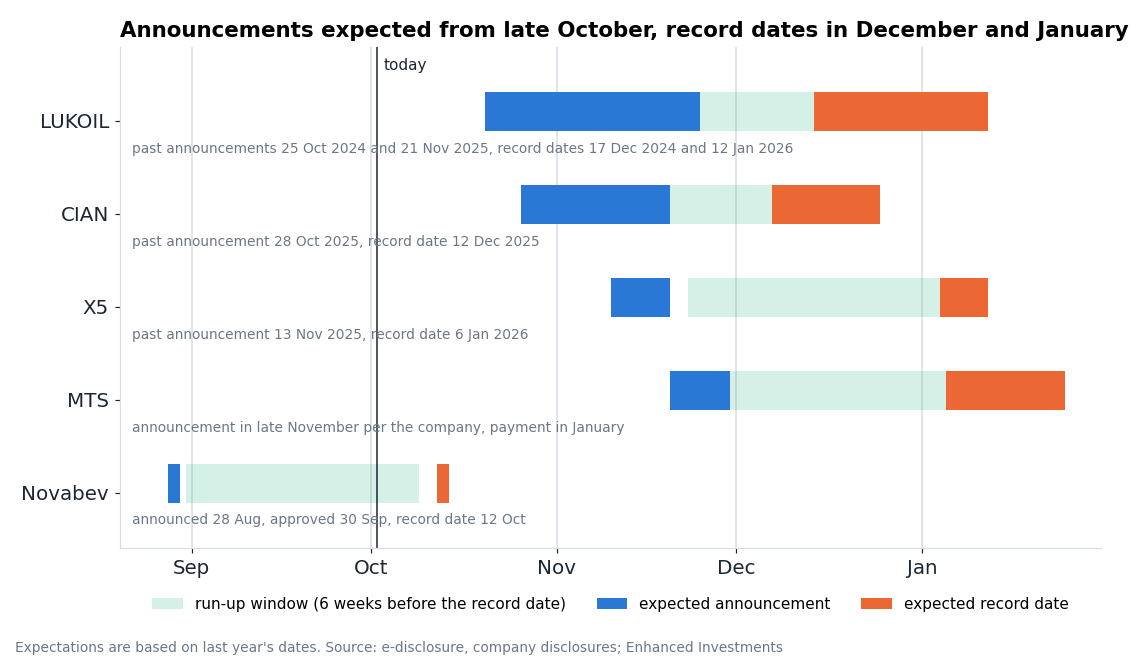
- LUKOIL: announcement from 20 October to the end of November, record date from mid-December to mid-January.
- CIAN: announcement from late October through November, record date in December.
- X5: announcement in mid-November, record date in early January.
- MTS: announcement in late November, record date in January.
- Novabev: already announced, record date 12 October.
In October, record dates for Gazprom Neft and Tatneft
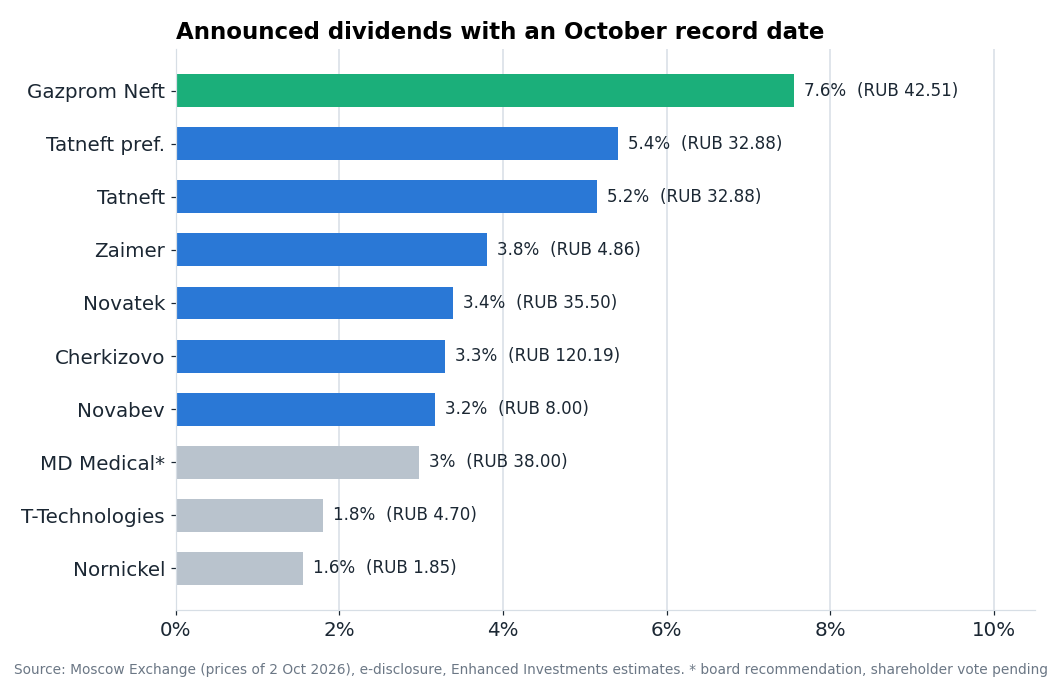
These dividends have already been recommended or approved. Only Gazprom Neft pays above 6% (RUB 42.51, 7.6%, buy by 12 October). Tatneft pays RUB 32.88 on both ordinary and preferred shares, 5.2–5.4%. Novatek, Cherkizovo, Zaimer and MD Medical yield 3–4%, and T-Technologies and Nornickel less than 2%. On 30 September MD Medical recommended RUB 38 with a record date of 19 October; the shareholders' meeting is still ahead. For Bank Saint Petersburg and Inarctica the last day to buy with the dividend has already passed.
In December and January the five stocks in this review will most likely be joined by Tatneft for nine months, PhosAgro for the third quarter and Rosneft. In 2025 the boards of directors discussed these payments on 12 November (Tatneft) and 17 November (Rosneft).
Stocks rise into the record date, but it is already too late to buy on the last day
We checked all dividend record dates on the Moscow Exchange for 2016–2026: 661 events, of which 224 had a yield of 6% or more. Stocks were compared with a basket of liquid shares that had no record date on those days.
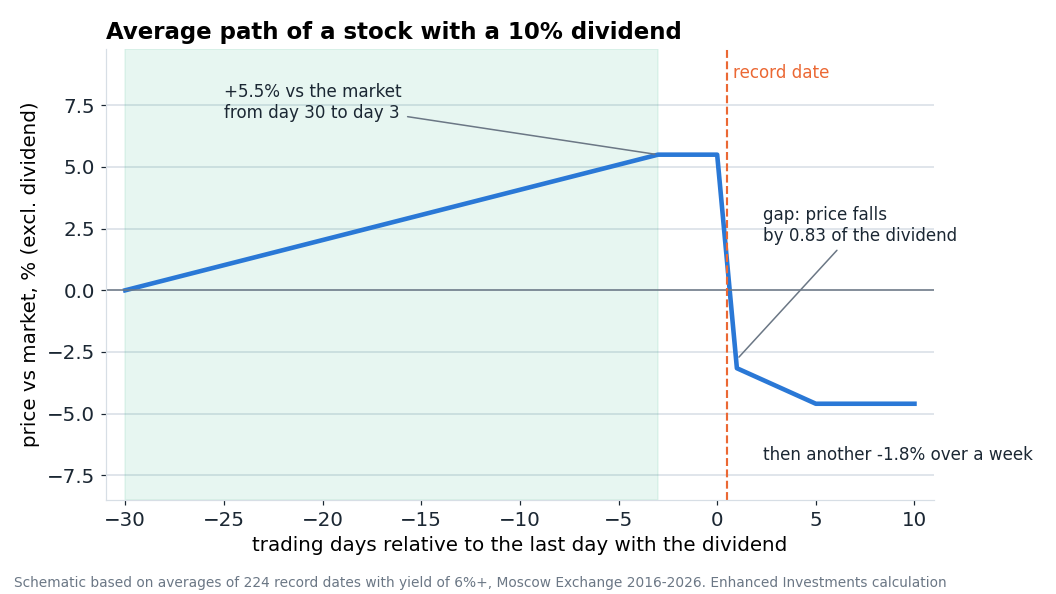
- From the 30th to the 3rd trading day before the record date, stocks yielding 6% or more beat the market by 5.5% on average. This strategy was in the black in 9 years out of 11, and about zero in 2026.
- Two days before the record date the rise stops.
- On the first day without the dividend the price falls by 83% of the dividend on average. After the 13% tax the investor receives 87%, so almost the same.
- After the fall the stock loses another 1.8% or so over a week. On average it does not close the gap quickly.
For the five stocks in this review the picture is the same. LUKOIL beat the Moscow Exchange index over the 30 trading days before the record date in 12 cases out of 14, by 3.2 pp on average. MTS did so in 10 out of 14. For X5 and CIAN there were too few record dates to draw conclusions.
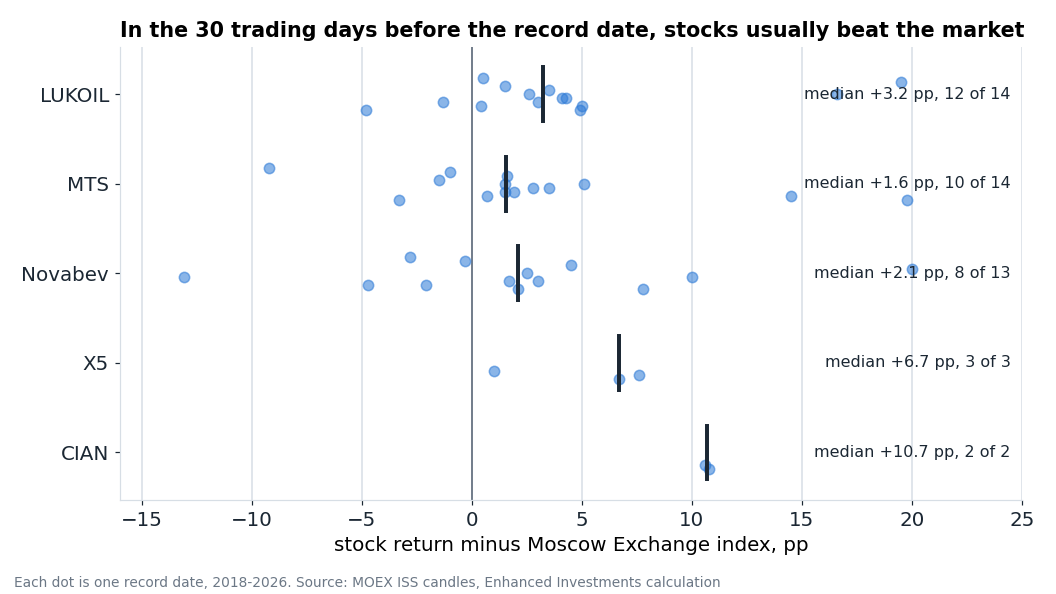
The dividend announcement itself does not predict a rise. Across 419 announcements in 2024–2026, buying before the expected announcement date gave −0.84% on average, and the market lifted stocks equally ahead of dividend increases and cuts. The part of the effect that works is the six weeks before the record date, not the announcement day.
What follows from this. For LUKOIL and X5 the window for gains falls in November and December. LUKOIL's dividend looks the largest of the five even on the market's cautious estimate. MTS is first of all a bet on a lower key rate: 14% annualised in dividends with debt of about 2.4 times annual EBITDA. Buying a stock just for one payment the day before the record date is not worth it: tax eats almost the entire difference between the dividend and the gap.
Company cards with dividend history, a payout model and multiples are on the Enhanced Investments portal.
See also: market overview · valuation map · stock screeners