1H 2026 reporting season: who is accelerating, who is slowing, and why the market pays for predictability
Over the past two weeks Russian issuers presented operating results for 1H/2Q 2026 and the first half-year IFRS reports. The article covers the key figures of the season and what is visible above individual reports: an almost universal slowdown in revenue with rising margins, a turn in capital expenditure at companies dependent on domestic demand, and a dividend agenda that in mining has become more important than the results themselves. Prepared by Enhanced Investments (t.me/eninv).
Consumer sector: growth is there, but it comes harder
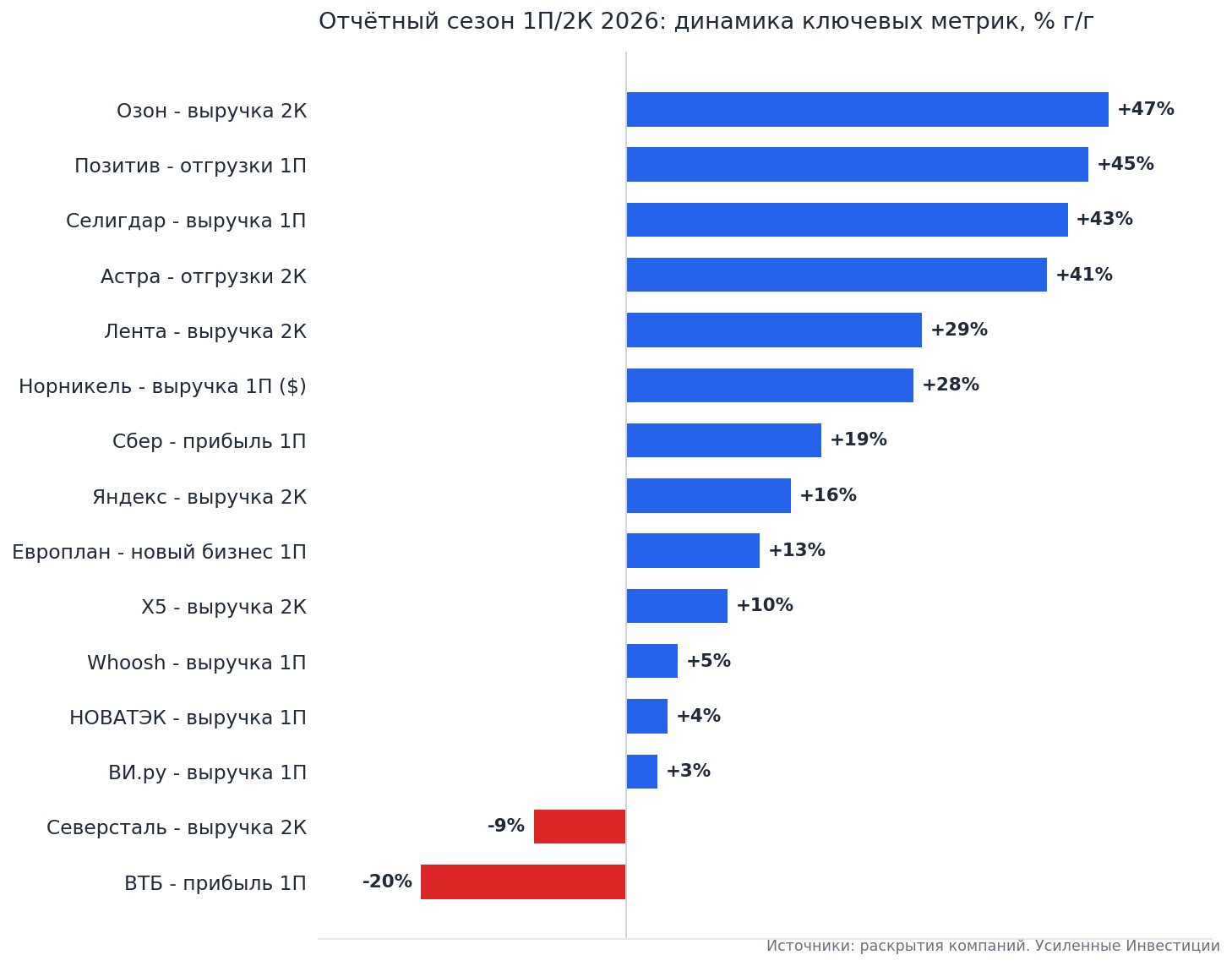
X5 increased 2Q revenue by +9.9% to RUB 1.29 trn - the pace is slowing (it was +11.3% in 1Q). Like-for-like sales grew 4.2%: traffic returned to positive (+1.2%), but average-ticket growth halved (+3.0%). The hard discounter Chizhik (RUB 134.8 bn) has already caught up with Perekrestok (RUB 138.9 bn) - the next question for the company is what happens to the margin with such a shift in formats.
Lenta is growing faster than anyone in grocery retail: 2Q revenue +28.8% to RUB 341.6 bn with like-for-like sales of +6.5%. The flip side of the expansion (O'Key, Remi, OBI Russia): net profit fell -18.8% to RUB 8.0 bn, and EBITDA margin shrank to 6.1% - integrating the acquisitions so far costs more than it adds.
VI.ru - 1H revenue +3% to RUB 89.6 bn, 2Q in positive territory after -4.1% in 1Q. Growth comes from the average ticket and the B2B segment (~78% of revenue), while orders in units declined - a confident demand recovery is still far off.
Whoosh returned to growth: revenue +5% after a decline a year earlier, 56.5 mn rides. The Russian kick-sharing market is maturing - the driver is now Latin America (+23% in rides).
Europlan - a turnaround: new business in 1H +13% to RUB 49.1 bn after a 49% fall over the whole of 2025. The base is low, and management itself ties a full recovery of car leasing to a lower key rate.
IT and internet: high growth rates, but the year is decided by the fourth quarter
Ozon showed the fastest growth among the season's large names: gross merchandise value (GMV) in 2Q +37% to RUB 1.3 trn, revenue +47% to RUB 334.2 bn, adjusted EBITDA +48% to RUB 57.9 bn, and the quarter closed with a net profit. The company beat consensus on all key metrics.
Positive Technologies increased 1H shipments by +45% to RUB 10.7 bn - above its own forecast (expected from RUB 8.5 bn), the annual target of RUB 40-45 bn is confirmed, and costs were held 13% below last year. A nuance: for software companies the bulk of sales falls in the 4th quarter - and that is where the company missed in 2024, so trust in its guidance is still being rebuilt.
Astra is accelerating: 2Q shipments +41% after a weak 1Q (RUB 1.9 bn), +26% for the half-year to RUB 7.3 bn; a buyback and dividends are under way at the same time. The question is the same as for Positive: the half-year is a small part of the year, and 4Q will decide everything.
Yandex - 2Q revenue +16% to RUB 386 bn: growth is slowing (it was ~+22% in 1Q), but adjusted net profit grew +56% to RUB 48 bn - the company's focus has noticeably shifted from growth to efficiency.
Banks: the resilience gap is widening
Sber earned a net profit of RUB 1.02 trn for the half-year (+19% y/y), 2Q came in better than market expectations - the bank is getting through the tight monetary policy noticeably better than the sector.
DOM.RF - the fastest-growing result in the financial sector: 1H net profit RUB 57.2 bn (+46%) at a return on equity of 23.8%. Net interest income +30%, fees +47%, the cost-to-income ratio cut from 28.3% to 23.7%; management guides to RUB 117 bn of profit for the year (+30%).
VTB - profit RUB 225 bn (-20% y/y): the contrast with the sector leaders keeps growing.
Speed of change: the quarter-by-quarter picture
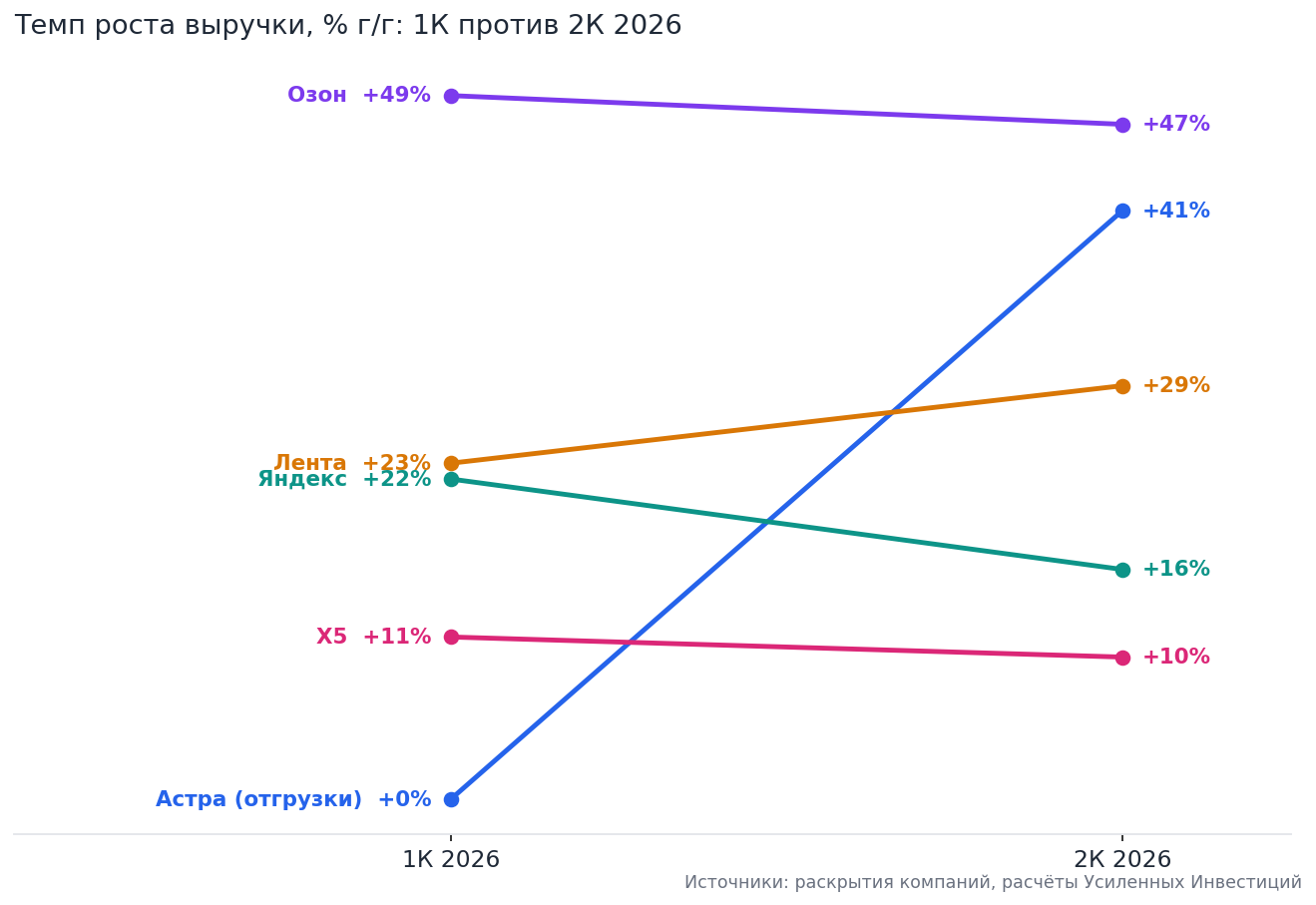
If we look not at levels but at the first derivative - the rate of change in growth - the season splits into three groups:
- Slowing gradually: X5 (+11.3% → +9.9%), Yandex (~+22% → +16%), Ozon on revenue (+49% → +47%). This is not a collapse in demand but its gradual cooling - it becomes critical if the trend continues in 3Q
- Accelerating: Lenta (~+23% → +28.8%, effect of consolidating acquisitions), Astra (around zero in 1Q → +41% in 2Q - deferred deals closed in the second quarter)
- Turning from negative: VI.ru (2Q in positive territory after -4.1%), Europlan (+13% after -49% for 2025), Whoosh (+5% after a decline). What the three have in common is that the turn came with a still-tight rate, that is, on their own measures rather than on a macro tailwind
Pattern of the season: revenue slows, margin rises
The most persistent cross-cutting theme of the season is the divergence between revenue and profit dynamics. Companies have stopped buying growth at any price and protect margin with cost control:
- Yandex: revenue +16%, adjusted profit +56%
- Positive Technologies: shipments +45% with costs 13% below last year
- VI.ru: even in 1Q EBITDA grew +26% with revenue down 4.1%
- DOM.RF: cost-to-income ratio cut from 28.3% to 23.7%
- Ozon: EBITDA grows along with turnover at a record profitability to GMV
There are exactly two counterexamples, and both are explicable: Lenta deliberately sacrifices margin for expansion, Severstal is under pressure from the cycle. Conclusion: the corporate sector has adapted to expensive money through cost management - but this resource is finite. The next leg of profit growth will require a recovery in demand, and therefore a lower rate.
Capital expenditure: the investment cycle is turning, but not for everyone
The answer to the question "are capital investments being cut" is yes, but selectively:
- Severstal cut its 2026 investment programme by 24% (to RUB 112 bn from the planned ~RUB 147 bn), in 1Q capex was cut 34% y/y; the guide for 2027 is lower still - about RUB 85 bn. Weak steel demand made some projects unprofitable
- Nornickel, by contrast, increased cash capex for the half-year by ~24% (to \$1.36 bn according to the statements) - environmental obligations and maintaining assets are harder to cut than growth projects
- Polyus and Seligdar are keeping to their megaprojects (Sukhoi Log; Kyuchus and Khvoynoye) - for both, capex effectively competes with dividends for cash flow
- IT companies with a net cash position direct surpluses not into capex but into buybacks and dividends (Astra, Positive Technologies)
The picture is logical: capital investment is cut by those who depend on domestic cyclical demand; investment continues either in mandatory programmes (ecology) or in projects whose horizon lies beyond the current cycle.
Commodities, metals and power: strong figures do not move share prices on their own
Severstal reflects the state of the whole of ferrous metals: 2Q revenue -9% to RUB 169.6 bn, EBITDA RUB 24.4 bn (14% margin), net profit -74%, free cash flow negative (-RUB 29.8 bn). Leverage is low (0.9x EBITDA), so there is a margin of safety.
Seligdar showed operationally one of the strongest reports of the season: gold output +20% (3,337 kg), tin +17%, total revenue +43% to RUB 40.8 bn.
NOVATEK went through the half-year weaker than last year: revenue +4%, EBITDA -9%, profit -3%; pressure came, among other things, from the spring reduction in utilisation of the Ust-Luga complex. The key question for the second half is the pace of recovery in processing.
Nornickel reported noticeably above expectations: revenue \$8.3 bn (+28% y/y), EBITDA \$3.9 bn (+50%, margin 47% vs 41% a year earlier), net profit \$2.0 bn (2.4x). Interest payments fell 37% after the restructuring of the debt portfolio.
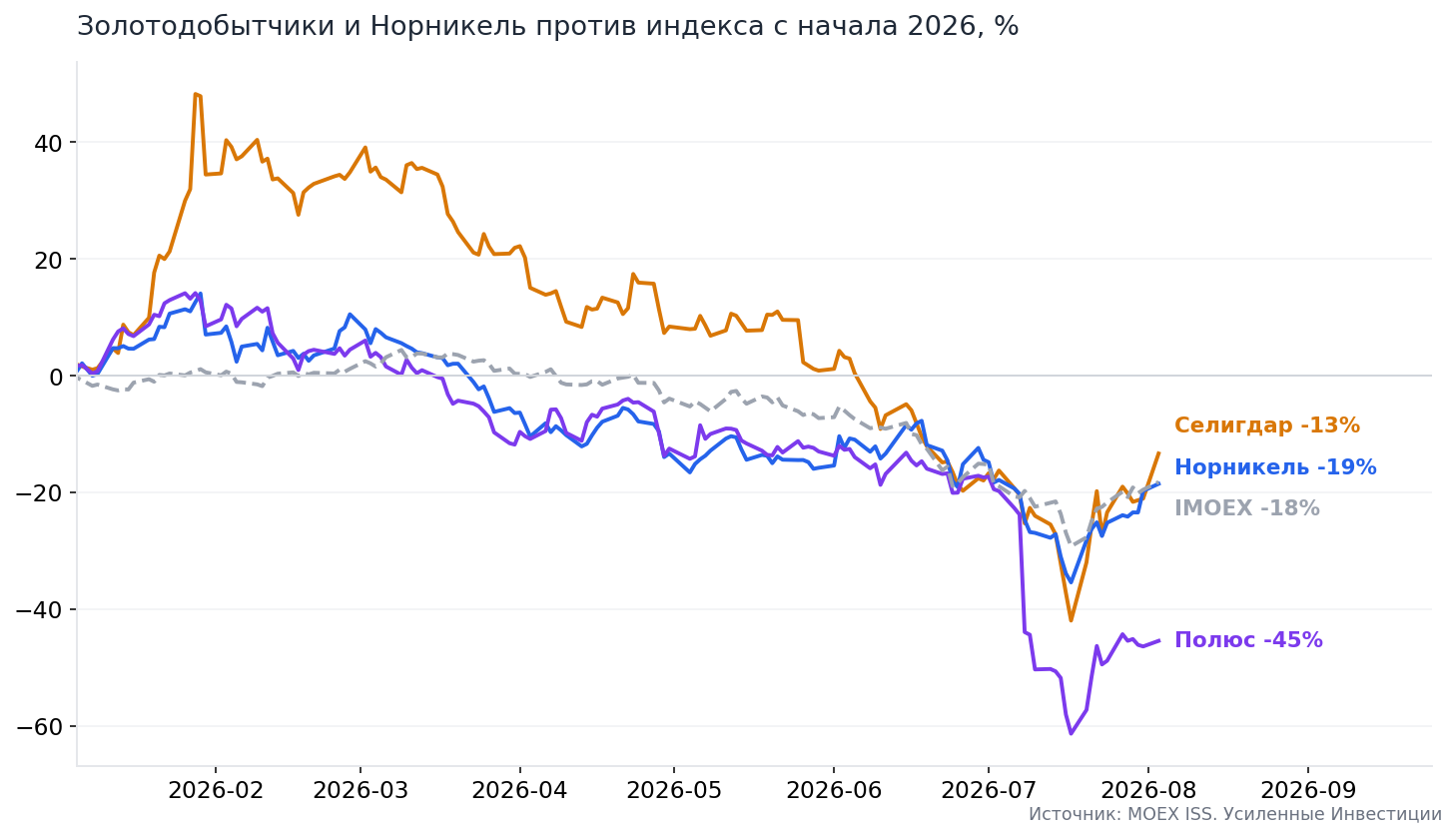
At the same time, sector share prices live not on operating results: the year-to-date performance was determined by the dividend agenda - the collapse of Polyus on 8 July (-26% in a day) happened not because of production but on the news of the refusal to pay.
Dividend question: where the rules are clear and where they are not
Polyus announced that there will be no payouts until 2030 - harsh for shareholders, but the horizon and the reason (the large-scale construction of Sukhoi Log) are stated directly.
Severstal has not paid for the seventh quarter in a row, but here too the logic is transparent: the dividend policy is tied to free cash flow, which is negative in the investment phase and with weak steel demand. When the flow returns, payouts will return. MMK is in a similar situation.
At Seligdar payouts are tied to leverage: at net debt of about 4x EBITDA the dividend policy does not provide for payouts - the shareholders' meeting decided not to pay for 2025, and the guide for a return to payouts is 2027 with lower debt.
On Nornickel, after the report the chief financial officer allowed a return to interim dividends. There are grounds in the statements: the margin has turned up, the weaker rouble works in the exporter's favour, debt servicing has become cheaper. A nuance in the methodology: management assesses dividend capacity not by full free cash flow (\$1.15 bn for the half-year) but by an "adjusted" measure - \$243 mn. The flow is reduced by interest paid, leases and dividends to the minority shareholders of Bystrinsky GOK - Interros (36.66%) and the Chinese fund Hopu (13.33%), which grew 20% over the half-year to \$276 mn.
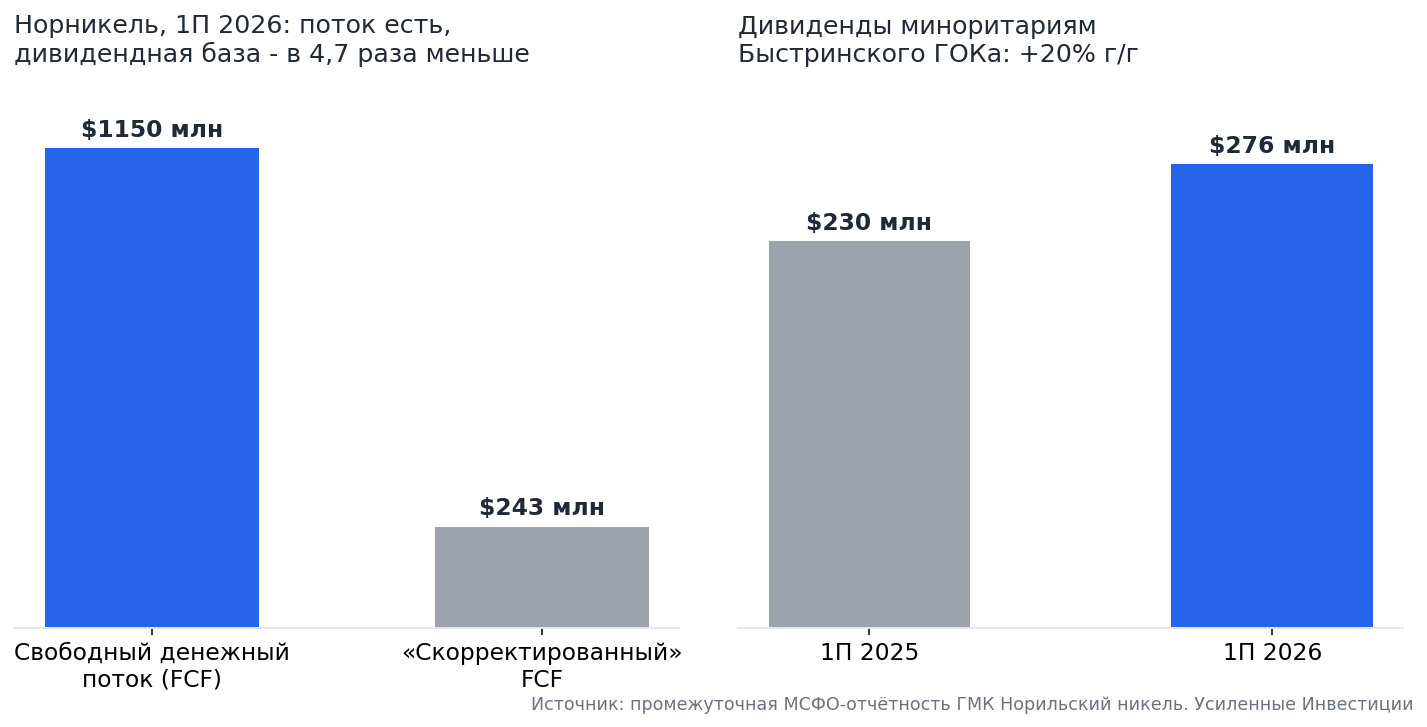
An asymmetry emerges: inside the group dividends are paid and growing, while at the parent level there is a pause for the third year, and the very base for assessing future payouts shrinks with every payment by the subsidiary. The key question for investors is not the fact of the pause but the transparency of the rules: a clear logic of the dividend base would cost the company little and remove a lot of uncertainty.
Spot signals from RAS reports
The RAS statements of holding parent companies do not reflect the consolidated picture, but for operating companies they are a quick early indicator - a few figures from fresh disclosures:
- ALROSA: 1H revenue -36% to RUB 74.2 bn, net loss of RUB 10.7 bn vs a profit of RUB 39 bn a year earlier - the diamond crisis in its acute phase, the IFRS report should be expected to be weak
- Transneft: revenue +2.7%, profit +3.2% (RUB 78.7 bn) - the tariff model works as a cycle shock absorber; a curious detail from the report: in July the company acquired a 7.52% stake in an unnamed organisation for RUB 40 bn
- FSK-Rosseti: revenue +12%, but net profit -18% (RUB 64.7 bn) - tariff indexation does not keep up with cost growth
- Nornickel (RAS, parent company): profit +31% - an illustration of the limits of the method: the consolidated IFRS picture, as shown above, differs several-fold
Calendar: what to watch next
The nearest calendar points (dates from corporate calendars and aggregators, preliminary):
- 5 August - Rostelecom, 1H IFRS
- 6 August - Unipro, 1H IFRS (the company has already classified its RAS - the intrigue is whether it will disclose the consolidation)
- August - T-Technologies, Moscow Exchange, Tatneft and oil and gas with half-year IFRS
- Polyus 1H IFRS - the first financial snapshot after the refusal to pay dividends until 2030
- end of October - Nornickel 9-month production results; on the horizon - the board of directors' decision on interim dividends
Tickers
X5 · LENT · OZON · POSI · ASTR · LEAS · VSEH · WUSH · SELG · SBER · DOMRF · VTBR · YDEX · GMKN · NVTK · CHMF · PLZL · ALRS · TRNFP · FEES - extended cards on our portal: frontier.eninvs.com/region/ru
Conclusion: four takeaways from the season
- Revenue is slowing almost everywhere outside e-commerce - the economy is cooling, and 3Q will show whether this is a trend or a pause
- Profit is protected through costs: for half of the reporters the margin is rising while revenue slows. The resource is finite - the next leg of profit growth will require a lower rate
- Capital investment is cut selectively: projects dependent on domestic demand are cut; environmental programmes and commodity megaprojects continue and compete with dividends
- Dividends have become the main currency of trust: in mining, share prices are determined not by operations but by the clarity of profit distribution rules - and this is the cheapest source of market-capitalisation growth available to issuers
See also: market overview · valuation map · stock screeners