Frontierby eninvs

Language: EN · RU

Region: COMMODITIES

Key commodities — 1-day change · 2026-07-23
Brent 97.73 ▲ +2.4%
WTI 89.64 ▲ +2.1%
Henry Hub 2.95 ▲ +0.3%
Copper 14,264 ▼ -0.5%
Aluminum 3,179 ▼ -0.4%
Nickel 17,399 ▲ +1.2%
Zinc 3,603 ▲ +0.3%
Gold 4,095 ▼ -0.6%
Silver 58.89 ▼ -0.9%
Iron Ore 97.22 +0.0%
Coking Coal 221 +0.0%
Uranium 85.75 ▲ +0.1%
Our recommended portfolios
Performance & current holdings of our strategies for this market — why it makes sense to join.
Global Commodities● live +145.9%
CAGR +17% · vs index +3% · Sharpe 0.50 · maxDD -61%
Day+0.6%S&P 500 +0.0%
Week+4.3%S&P 500 +1.3%
YTD+29.0%S&P 500 +11.5%
By calendar year vs S&P 500
YearStratS&P 500Δ
2026*+28.3%+9.4%+18.9%
2025+55.9%+16.4%+39.5%
2024-2.6%+23.5%-26.1%
2023-6.9%+24.2%-31.1%
2022+5.8%-19.7%+25.5%
2021+5.7%+27.4%-21.6%
2020*+51.7%+23.1%+28.6%
* partial year

Sectors: Oil & gas (36) · Gold mining (15) · Oil refining (13) · Coal (9) · Natural gas (9) · Silver mining (5) · Copper mining (5) · Diversified mining (4) · Agribusiness (4) · Fertilizers (4) · Steel (4) · Cannabis (4) · Freight & shipping (4) · Oil (4) · Precious-metals royalty (4) · Lithium (3)

Rows are ordered partly by extraction health (share of stable periods). Hover a row for OK / partial / error counts.

CompanyCountrySectorUpsideDiv. %FCF Yield LTMΔ revenue (NII for banks)Δ EBITDA (assets for financials)EV/EBITDA LTMP/E LTMP/B FYROE (ann.)
ZIM Integrated Shipping
COMM_ZIM
COShipping+201%3.4%-0.7%-30.4% ▼-61.1%1.2x30.8x0.7x-8.8%
PBF Energy
COMM_PBF
COOil refining+138%1.8%-4.1%11.9%7.4x16.7x1.4x14.5%
Par Pacific
COMM_PARR
COOil refining+130%11.2%4.5% ▼379.5%6.8x8.9x2.7x14.2%
Valero Energy
COMM_VLO
COOil refining+104%1.5%4.2%7.0% ▲-2.9%11.2x22.8x4.0x20.0%
Euroseas
COMM_ESEA
COShipping+66%3.9%22.8%-0.9% ▼-15.8%3.3x3.9x1.1x27.3%
Danaos Corporation
COMM_DAC
COShipping+64%2.0%11.0%0.2%3.6%3.9x4.7x0.6x14.6%
Expand Energy
COMM_EXE
CONatural gas+63%3.5%13.7%100.2% ▲406.1%3.5x6.9x1.2x24.3%
Range Resources
COMM_RRC
CONatural gas+54%1.0%0.8%-2.6%6.5x10.7x2.1x30.6%
Ero Copper
COMM_ERO
COCopper+52%2.5%110.4% ▲113.6%7.3x9.7x3.0x42.8%
Phillips 66
COMM_PSX
COOil refining+47%2.4%-2.0%6.9% ▼69.7%23.4x20.6x2.9x2.8%
Energy Transfer LP
COMM_ET
CONatural gas+34%6.5%7.9%32.1%18.4%9.1x16.1x1.4x10.1%
Baker Hughes
COMM_BKR
COCrude oil+33%1.6%4.0%2.5%92.4%11.8x22.3x2.9x19.5%
B2Gold
COMM_BTG
COGold+32%1.0%5.5%117.7% ▼222.0%2.3x9.7x1.8x22.0%
EQT Corporation
US_EP_EQT
COUnited States — oil & gas exploration & production+29%1.2%0.9%-29.2% ▲-77.6%6.5x12.5x1.4x3.4%
National Oilwell Varco
COMM_NOV
COCrude oil+22%2.1%9.7%-2.4% ▼-42.3%11.2x80.6x1.2x1.2%
CrossAmerica Partners
COMM_CAPL
COCrude oil+18%9.6%18.3%-2.4% ▼44.2%8.4x14.1x-47.3%
Amplify Energy
COMM_AMPY
COCrude oil+15%-32.9%-48.0%1.6x5.1x0.4x-34.7%
Newmont Corporation
COMM_NEM
COGold+12%1.1%10.9%45.8% ▼70.2%6.3x12.3x3.1x37.8%
EQT Corporation
COMM_EQT
CONatural gas+9%1.2%0.9%-29.2% ▲-77.6%6.4x12.3x1.4x3.4%
Alamos Gold
COMM_AGI
COGold+7%0.3%3.7%79.2%166.3%9.4x12.2x2.9x16.9%
Comstock Resources
COMM_CRK
CONatural gas+6%-11.1%14.5% ▲7.6%5.4x6.5x1.5x15.0%
Texas Pacific Land Corporation
COMM_TPL
COCrude oil+6%0.5%-0.2%20.8%21.2%43.0x59.3x20.5x37.9%
Cresco Labs
COMM_CRLBF
COCannabis+3%-62.5%-8.7% ▼-10.6%4.2x0.8x-15.5%
PrimeEnergy Resources
COMM_PNRG
COCrude oil-1%11.8%-21.3%-30.9%3.1x14.7x1.5x8.0%
Comstock Resources, Inc.
US_EP_CRK
COUnited States — oil & gas exploration & production-2%-11.0%14.5% ▲7.6%5.4x6.6x1.6x15.9%
Intrepid Potash
COMM_IPI
COFertilizers-2%11.3%4.4% ▲19.3%6.7x32.8x0.9x6.0%
APA Corporation
COMM_APA
COCrude oil-3%2.7%11.9%-14.2% ▼6.6%3.1x8.5x2.1x25.2%
SSR Mining
COMM_SSRM
COGold-3%10.2%83.7% ▲140.6%6.6x24.7x1.8x-10.7%
Sunoco LP
COMM_SUN
COOil refining-5%5.0%6.1%106.4% ▲154.9%10.8x10.8x1.3x31.5%
Innovative Industrial Properties
COMM_IIPR
COCannabis-6%12.4%22.9%-3.8% ▼-1.6%8.8x14.6x0.9x7.0%
Hudbay Minerals
COMM_HBM
COCopper-6%0.1%5.8%27.3% ▼38.8%8.4x14.1x2.9x22.5%
Barrick Mining Corporation
COMM_B
COGold-7%2.5%8.5%66.7% ▲111.3%5.1x10.3x2.4x23.8%
APA Corporation
US_EP_APA
COUnited States — oil & gas exploration & production-8%2.7%12.1%-14.2% ▼6.6%3.1x8.3x2.1x28.4%
Murphy Oil Corporation
US_EP_MUR
COUnited States — oil & gas exploration & production-9%3.4%3.3%10.2%16.1%5.6x66.0x1.1x4.1%
Murphy Oil
COMM_MUR
COCrude oil-10%3.4%3.3%10.2%16.1%5.6x65.7x1.1x4.1%
Alliance Resource Partners
COMM_ARLP
COCoal-12%9.7%9.3%-4.5% ▼-36.0%5.9x13.0x1.7x2.0%
CF Industries
COMM_CF
COFertilizers-12%1.6%8.2%19.4% ▲61.4%6.2x9.7x4.3x53.1%
UFP Industries
COMM_UFPI
COLumber-12%1.7%4.5%-8.4%-20.2%9.5x19.2x1.7x6.6%
Range Resources Corporation
US_EP_RRC
COUnited States — oil & gas exploration & production-14%1.0%0.8%-2.6% ▲97.4%6.4x10.6x2.1x30.6%
Teck Resources
COMM_TECK
COCopper-16%0.5%10.3%80.0% ▼175.0%8.5x20.9x1.6x12.9%
Occidental Petroleum
COMM_OXY
COCrude oil-16%1.7%17.5%-8.3%-26.7%7.1x11.9x1.6x35.8%
Trulieve Cannabis
COMM_TCNNF
COCannabis-18%11.7%-3.7% ▼4.5%6.6x1.5x0.8%
Suzano
COMM_SUZ
COPulp-19%0.0%5.0%6.3% ▲8.5%5.9x4.8x1.3x39.0%
Canadian Natural Resources
COMM_CNQ
COCrude oil-20%1.9%5.8%-15.9%-23.7%9.1x13.7x3.0x12.1%
Coeur Mining
COMM_CDE
COGold-23%0.1%7.7%137.8% ▲326.6%7.2x12.7x3.1x14.4%
Southern Copper
COMM_SCCO
COCopper-24%2.0%1.2%40.6%46.3%17.3x29.0x14.9x55.4%
Kinross Gold
COMM_KGC
COGold-24%0.5%9.4%60.8% ▲89.3%5.4x10.2x3.4x38.2%
Canadian Natural Resources Limited
US_EP_CNQ
COUnited States / Canada — oil & gas exploration & production-25%1.9%1.0%-2.0% ▲-25.5%8.0x14.0x3.0x12.2%
ONEOK
COMM_OKE
CONGL-25%4.5%1.8%19.6% ▲12.9%12.2x16.4x2.6x13.8%
Equinor
COMM_EQNR
COCrude oil-27%3.6%7.4%-5.3% ▲1.5%3.4x18.8x2.6x29.6%
Industrias Peñoles
COMM_IPOAF
COGold-27%0.8%10.7%91.6%153.8%4.3x10.0x4.4x44.0%
Fortuna Mining
COMM_FSM
COSilver-27%14.5%75.6%126.9%2.9x7.7x1.9x25.7%
Antero Resources
COMM_AR
CONatural gas-30%-7.4%43.8% ▲104.4%7.4x10.9x1.4x27.8%
Royal Gold
COMM_RGLD
COGold-31%0.9%-2.7%142.5% ▲148.5%16.6x26.8x2.4x15.4%
Marathon Petroleum
COMM_MPC
COOil refining-33%1.2%0.5%8.5%49.5%10.5x20.9x5.6x10.0%
Weyerhaeuser
COMM_WY
COLumber-33%3.6%2.7%-2.0% ▲22.0%16.8x43.4x1.8x6.6%
Hecla Mining Company
COMM_HL
COSilver-33%0.1%6.4%100.4% ▲230.2%11.8x38.4x4.1x-2.9%
Freeport-McMoRan
COMM_FCX
COCopper-36%0.9%-0.6%8.8% ▼49.9%10.3x19.6x4.9x28.9%
Green Thumb Industries
COMM_GTBIF
COCannabis-38%6.0%7.4% ▼1.7%6.5x13.4x0.9x3.2%
Alcoa Corporation
COMM_AA
COAluminium-39%0.9%0.7%31.4% ▼186.9%6.3x9.4x2.0x26.3%
GeoPark
COMM_GPRK
COCrude oil-41%0.5%-13.8%-6.3% ▼4.6%3.1x9.4x2.2x30.0%
Chevron
COMM_CVX
COCrude oil-42%3.6%2.1%2.1% ▼0.5%9.9x32.5x1.9x4.7%
EOG Resources
COMM_EOG
COCrude oil-42%2.8%-2.0%22.1%32.0%7.0x14.1x2.6x26.1%
Sociedad Quimica y Minera de Chile
COMM_SQM
COLithium-42%1.5%4.0%69.8% ▼105.9%12.1x24.2x3.8x25.3%
Epsilon Energy
COMM_EPSN
CONatural gas-43%4.3%5.3%58.4% ▲29.7%3.9x1.0x2.3%
SandRidge Energy
COMM_SD
CONatural gas-43%4.9%0.8%16.8% ▲31.9%3.9x6.8x1.0x14.4%
Core Natural Resources
COMM_CNR
COCoal-44%0.5%5.4%6.6% ▲164.6%8.1x1.2x2.3%
Exxon Mobil
COMM_XOM
COCrude oil-44%2.6%2.8%2.4% ▼-20.6%10.7x25.5x2.5x6.4%
Antero Resources Corporation
US_EP_AR
COUnited States — oil & gas exploration & production-44%-7.4%43.8% ▲104.4%7.4x10.9x1.4x28.1%
Agnico Eagle Mines
COMM_AEM
COGold-45%1.2%5.6%66.1% ▲88.9%7.6x13.8x3.0x26.6%
EOG Resources, Inc.
US_EP_EOG
COUnited States — oil & gas exploration & production-45%2.8%5.0%22.1%32.0%6.9x13.9x2.6x26.1%
Vermilion Energy
COMM_VET
COCrude oil-46%1.8%30.3%8.9% ▼-62.1%4.8x1.1x-27.5%
Nutrien
COMM_NTR
COFertilizers-47%1.6%-4.2%18.5% ▲29.1%7.0x14.0x1.3x2.1%
Pan American Silver
COMM_PAAS
COSilver-49%0.8%4.8%49.3% ▲102.1%8.3x13.6x2.5x25.5%
Caledonia Mining
COMM_CMCL
COGold-49%0.8%26.0%18.3% ▲2.6%2.3x5.8x1.7x23.9%
Devon Energy
COMM_DVN
COCrude oil-52%2.3%7.2%-14.5% ▲-31.3%5.5x12.3x1.8x3.1%
Wheaton Precious Metals
COMM_WPM
COGold-52%0.4%2.7%91.8% ▲104.5%21.3x28.1x5.8x26.0%
Matador Resources
COMM_MTDR
COCrude oil-52%2.8%3.4%-33.8% ▼-49.4%4.9x14.2x1.2x-2.6%
Franco-Nevada Corporation
COMM_FNV
COGold-53%0.4%-0.3%76.6% ▲82.9%21.0x30.1x5.4x23.8%
Nucor Corporation
COMM_NUE
COSteel-53%0.9%-0.9%21.3% ▲126.6%12.6x25.5x2.6x14.0%
Warrior Met Coal
COMM_HCC
COCoal-56%0.4%-6.9%52.9% ▼371.9%13.0x31.8x2.0x13.3%
Devon Energy Corporation
US_EP_DVN
COUnited States — oil & gas exploration & production-57%2.3%7.3%-14.5% ▲-31.3%5.4x12.2x1.8x3.1%
Eldorado Gold
COMM_EGO
COGold-57%0.5%-6.3%50.0% ▲71.8%6.5x11.6x1.5x12.7%
Matador Resources Company
US_EP_MTDR
COUnited States — oil & gas exploration & production-58%2.8%3.4%-33.8% ▼-49.4%4.9x14.1x1.2x-2.6%
Kimbell Royalty Partners
COMM_KRP
CONatural gas-58%10.0%-21.0%-22.2%-30.3%7.7x17.5x2.3x4.1%
Magnolia Oil & Gas
COMM_MGY
COCrude oil-60%2.4%1.3%2.3% ▼-0.2%5.8x14.7x2.4x19.8%
Genco Shipping & Trading
COMM_GNK
COShipping-61%4.5%2.6%60.6% ▼335.1%12.5x65.4x1.2x4.2%
Alpha Metallurgical Resources
COMM_AMR
COCoal-63%57.1%-1.3% ▼689.7%10.9x1.2x-2.9%
Black Stone Minerals
COMM_BSM
COCrude oil-63%8.2%7.6%0.2% ▲0.5%9.4x10.3x3.7x5.6%
Peabody Energy
COMM_BTU
COCoal-64%1.3%-6.8%3.9% ▲-47.3%11.5x0.8x-3.7%
ConocoPhillips
COMM_COP
COCrude oil-64%2.7%5.8%-4.6% ▲-13.1%7.1x20.3x2.3x13.5%
Magnolia Oil & Gas Corporation
US_EP_MGY
COUnited States — oil & gas exploration & production-65%2.4%1.4%2.3% ▼-0.2%5.7x14.6x2.3x19.8%
First Majestic Silver
COMM_AG
COSilver-65%0.2%6.6%95.5% ▲190.5%9.3x26.4x3.0x20.9%
Petrobras
COMM_PBR
COOil refining-67%2.7%7.0%12.5% ▲13.6%7.1x11.9x3.2x31.6%
W&T Offshore
COMM_WTI
COCrude oil-68%1.0%5.4%15.5% ▼70.0%9.6x45.7%
Silvercorp Metals
COMM_SVM
COSilver-70%0.1%2.3%96.2% ▲248.5%7.1x37.7x3.1x-0.3%
Ovintiv
COMM_OVV
COCrude oil-71%2.0%-10.5%6.5% ▲-142.3%8.7x19.9x1.4x-22.2%
Steel Dynamics
COMM_STLD
COSteel-74%0.9%2.1%33.4% ▲78.5%14.3x21.9x3.9x17.8%
Dorchester Minerals
COMM_DMLP
COCrude oil-75%9.3%-1.0%36.4% ▼45.5%9.1x18.9x4.3x38.7%
Curaleaf Holdings
COMM_CURLF
COCannabis-78%-0.8%5.7% ▼-14.4%12.1x2.9x35.4%
Ovintiv Inc.
US_EP_OVV
COUnited States / Canada — oil & gas exploration & production-80%2.0%6.3%6.5% ▲187.7%5.6x22.2x1.5x-22.2%
Albemarle Corporation
COMM_ALB
COLithium-80%1.4%10.4%32.7% ▲115.6%29.6x1.4x13.2%
W&T Offshore, Inc.
US_EP_WTI
COUnited States — oil & gas exploration & production-84%1.0%5.4%15.5% ▼70.0%9.5x42.8%
The Andersons
COMM_ANDE
COAgriculture-87%1.0%-19.7%-1.2%81.1%16.3x25.6x2.2x10.6%
Talos Energy
COMM_TALO
COCrude oil-88%12.8%-7.9% ▼-65.8%12.9x1.2x-50.7%
Vale
COMM_VALE
COIron ore-88%6.9%4.7%15.0% ▲27.8%8.0x49.5x1.5x22.1%
Archer-Daniels-Midland
COMM_ADM
COAgriculture-91%2.4%5.9%1.6%5.8%21.0x38.8x1.8x5.2%
Hallador Energy
COMM_HNRG
COCoal-92%7.3%-13.5% ▲-82.8%8.7x31.6x4.5x-20.4%
Gerdau
COMM_GGB
COSteel-96%1.6%-3.0%7.8% ▲35.6%7.4x28.9x1.0x7.9%
NACCO Industries
COMM_NC
COCoal-96%2.1%-10.0%-4.3% ▲14.1%8.1x16.1x0.8x8.2%
Endeavour Silver
COMM_EXK
COSilver-99%-0.8%230.2% ▲666.4%12.8x5.1x42.4%
Battalion Oil
COMM_BATL
COOil & gas-117.5%-17.5%-37.9%2.5x0.2x-27.1%
Barnwell Industries
COMM_BRN
COOil & gas-4.8%-29.0% ▼-151.9%1.5x-56.5%
Bunge Global
COMM_BG
COAgriculture2.3%-40.9%87.8% ▲-26.0%22.3x35.1x1.5x1.7%
Cleveland-Cliffs
COMM_CLF
COSteel-3.2%6.3% ▲-283.0%0.9x-15.9%
Daqo New Energy
COMM_DQ
COPolysilicon-9.4%-78.5% ▲0.2x0.2x-8.0%
Almaden Minerals
COMM_AAU
COGold mining21.2%34.2x4.6x-6.5%
BRF S.A.
COMM_BRFS
COProtein46.0%10.7% ▲-3.8%3.0x5.5x1.0x14.8%
Lithium Americas
COMM_LAC
COLithium-119.4%-209.7%1.5x-0.1%
Matson
COMM_MATX
COShipping0.7%3.9%-2.3% ▼-16.1%12.4x15.0x2.5x8.2%
Ramaco Resources
COMM_METC
COCoal-45.2%-9.7% ▼-239.3%1.3x-15.9%
Martin Midstream Partners
COMM_MMLP
COChemistry0.8%-3.7%18.2% ▲-29.9%7.4x30.3%
The Mosaic Company
COMM_MOS
COFertilizers4.0%-8.6%14.4% ▲-109.7%10.3x160.7x0.6x-8.6%
Mexco Energy
COMM_MXC
COOil & gas1.1%5.8%-10.8% ▼-13.8%4.6x15.0x1.0x14.0%
REX American Resources
COMM_REX
COOil refining-4.4%-1.2% ▼94.2%14.9x16.6x2.7x11.9%
Rio Tinto
COMM_RIO
CODiversified mining4.4%3.0%14.6% ▲10.4%4.5x6.9x2.4x36.7%
Sibanye-Stillwater
COMM_SBSW
COPGM3.9%-10.2%18.5% ▲65.2%10.8x2.8x-12.9%
CSN
COMM_SID
COSteel-109.8%8.9% ▲-14.0%5.5x0.5x-14.6%
SM Energy
COMM_SM
COCrude oil2.5%8.6%75.0% ▲-75.5%6.3x29.1x0.9x-22.9%
Tronox Holdings
COMM_TROX
COTitanium dioxide3.1%-31.0%3.0%240.0%38.1x0.8x-30.4%
US Energy
COMM_USEG
COOil & gas-41.0%-26.9% ▼1.4x-40.7%
Valvoline
COMM_VVV
COOil refining-12.2%25.0% ▼34.8%16.8x53.1x14.7x54.2%
Tyson Foods
COMM_TSN
COProtein3.6%3.2%4.4%73.7%18.2x51.3x1.1x5.8%
Permian Resources Corporation
US_EP_PR
COUnited States — oil & gas exploration & production2.9%2.9%0.8% ▼1.7%5.6x24.8x1.6x1.6%
Chord Energy Corporation
US_EP_CHRD
COUnited States — oil & gas exploration & production3.7%3.5%37.1% ▼4.3%5.3x173.9x1.0x5.4%
SM Energy Company
US_EP_SM
COUnited States — oil & gas exploration & production2.5%4.4%75.0% ▲-75.5%8.6x60.7x1.9x-22.9%

Work in progress — needs attention

Issuers below have weak extraction, thin market data, missing valuation inputs, or extreme headline YoY/ROE. Hover the row for the checklist.

CompanyCountrySectorUpsideDiv. %FCF Yield LTMΔ revenue (NII for banks)Δ EBITDA (assets for financials)EV/EBITDA LTMP/E LTMP/B FYROE (ann.)
Delek US
COMM_DK
COOil refining+133%1.6%-0.0%0.4% ▲10.3x7.3x-189.6%
CNX Resources
COMM_CNX
CONatural gas+114%14.9%276.9%3.6x4.2x1.1x31.1%
CNX Resources Corporation
US_EP_CNX
COUnited States — natural gas & NGL exploration & production+101%14.9%34.8%4.9x4.2x1.1x31.1%
Gulfport Energy
COMM_GPOR
CONatural gas+63%8.5%122.1% ▲290.3%3.3x4.9x1.6x36.4%
Riley Exploration Permian
COMM_REPX
COCrude oil-6%4.4%-6.3%11.2% ▼1.1%4.4x12.7x1.2x-47.4%
BHP Group
COMM_BHP
COIron ore-12%1.7%8.7%-7.9% ▼9.5%9.1x19.3x4.5x24.1%
California Resources
COMM_CRC
COCrude oil-16%2.9%1.1%6.7%-3.6%5.4x12.9x1.3x-86.3%
California Resources Corporation
US_EP_CRC
COUnited States — oil & gas exploration & production-32%2.9%0.9%-87.0%-282.3%28.6x13.2x1.3x-86.3%
Northern Oil and Gas, Inc.
US_EP_NOG
COUnited States — oil & gas exploration & production-34%8.2%-10.3%-9.6% ▲-19.6%5.0x60.2x1.1x-107.0%
Targa Resources
COMM_TRGP
CONGL-37%1.5%-3.7%-10.2%39.7%15.2x28.6x19.9x60.6%
Evolution Petroleum
COMM_EPM
COCrude oil-41%12.1%-5.8%-10.6% ▲-28.2%5.5x90.5x1.9x-18.9%
Gold Resource Corporation
COMM_GORO
COGold-46%-2.4%255.7% ▲11.9x53.5x8.0x40.8%
Taseko Mines
COMM_TGB
COCopper-46%3.2%73.4% ▼252.7%15.5x244.7x7.4x8.5%
Osisko Gold Royalties
COMM_OR
COGold-52%0.4%2.8%87.3% ▲96.0%19.7x22.0x4.5x20.3%
Cheniere Energy
COMM_LNG
CONatural gas-53%0.8%0.7%7.8% ▲-344.7%13.9x39.9x7.4x-166.4%
NGL Energy Partners
COMM_NGL
COCrude oil-72%7.1%-9.0% ▲-39.1%14.9x160.7%
Cameco
COMM_CCJ
COUranium-80%0.2%1.5%9.0% ▼-5.3%58.3x84.2x8.5x7.6%
Diamondback Energy
COMM_FANG
COCrude oil-82%2.0%0.7%4.7% ▲-49.1%14.5x203.4x1.6x0.3%
PEDEVCO
COMM_PED
COCrude oil-83%-5.0%360.4% ▼447.9%1.9x0.3x-52.6%
Diamondback Energy, Inc.
US_EP_FANG
COUnited States — oil & gas exploration & production-85%2.0%0.7%4.7% ▲-49.1%14.3x201.1x1.5x0.3%
AngloGold Ashanti
COMM_AU
COGold-96%5.9%8.7%70.8% ▲126.8%7.3x13.0x5.1x43.1%
VAALCO Energy
COMM_EGY
COCrude oil-97%4.4%-18.7%-43.3% ▼-96.3%22.3x1.3x-95.1%
Anglo American PLC
COMM_AAL
COCopper0.5%3.9%10.8%119.2%22.9x276.9x39.2%
American Resources
COMM_AREC
COCoking coal1.9%-100.0% ▲3.4x2.0x9.1%
Aemetis
COMM_AMTX
COCrude oil27.4% ▼27.7%
Calumet
COMM_CLMT
COOil refining6.7%3.6% ▲-62.1%36.6x142.8%
CVR Energy
COMM_CVI
COOil refining0.3%-1.5%20.3% ▲64.3%8.2x129.8x4.8x-107.0%
Gold Fields
COMM_GFI
COGold4.5%0.2%71.4% ▲100.7%5.3x6.1x5.8x142.7%
Gran Tierra Energy
COMM_GTE
COCrude oil71.0%2.3%-234.4%1.1x
Houston American Energy
COMM_HUSA
COOil & gas-42.9%29.9%1.1x-77.0%
Kosmos Energy
COMM_KOS
COCrude oil-14.0%27.8%-515.9%2.4x-172.9%
Mercer International
COMM_MERC
COTimber & wood-3.5% ▼-83.3%0.7x
Northern Oil and Gas
COMM_NOG
COOil & gas8.2%-2.8%113.6% ▲-32.8%4.7x55.3x1.0x-107.0%
Ring Energy
COMM_REI
COCrude oil-16.8%-6.9% ▼-367.8%0.3x-121.0%

Earnings analysis

Short take-aways from recent corporate results and commodity trends.

The gas pause: US gas producers and the widest arbitrage in energy (EXE, GPOR, RRC, CNX)

NATGAS →

While oil spiked 31% in a month on the Hormuz crisis (Brent ~$101) and European gas jumped to ~EUR 60/MWh, US natural gas went the other way: Henry Hub - the benchmark price at the US pipeline hub in Louisiana - sits near $2.9-3.2/MMBtu, and the producers' shares have gone nowhere. This review checks whether that gap is an opportunity: the macro setup, our screening model, and a hard look at four names - Expand Energy, Gulfport, Range Resources and CNX - through primary filings: hedge books, breakevens, debt and buybacks.
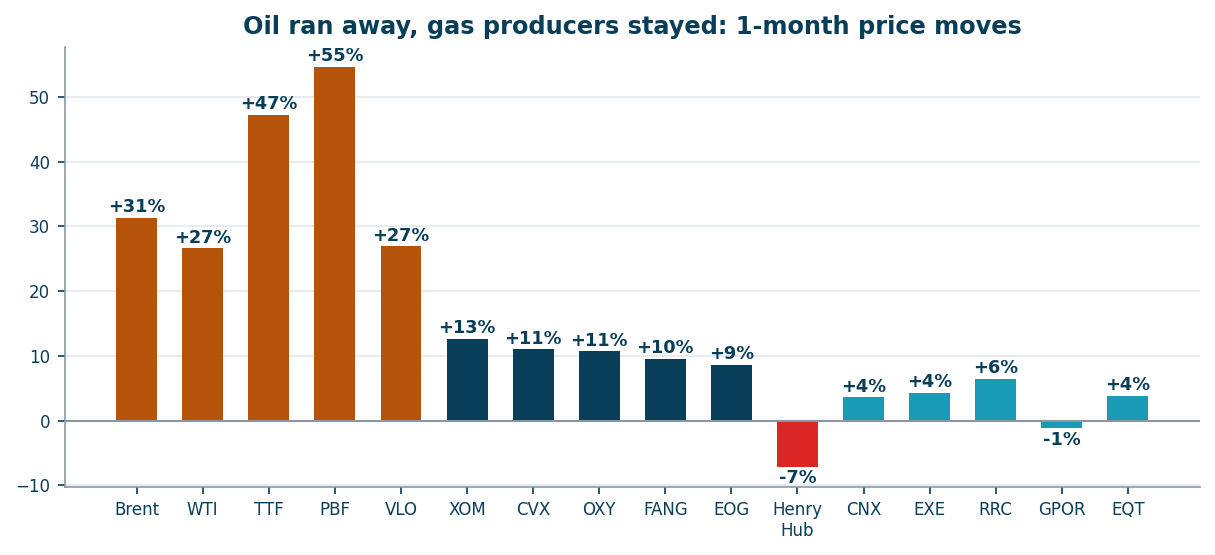
Oil and refiners ran away in a month; gas producers stayed flat

Why not the oil producers: the move is largely priced in

The obvious question is why not simply buy oil names - Exxon, EOG, Occidental, Diamondback. Because their repricing has largely happened: the stocks followed crude up, and on a normalized oil price they are now expensive. Our model values producers on the lower of spot and the 3-year average - for oil that means ~$75-80, not $101 - and on that basis the US oil E&Ps screen deeply negative: OXY -16%, EOG and Chevron around -42%, Exxon -44%, ConocoPhillips -64%, Diamondback -82%. Buying them today means paying for spike-level oil as if it were permanent, while the spike itself is geopolitical and reverses on any Hormuz de-escalation. If your scenario is a prolonged blockade and $100+ oil for quarters, oil producers will deliver earnings upgrades - but that is a bet on geopolitics, not on a mispricing. The gas leg offers the opposite asymmetry: spot near the floor and structural demand still ahead.

Two prices for the same molecule: the widest arbitrage in energy

The same unit of energy costs ~$2.9-3.2 in the US and ~$20 equivalent in Europe (TTF is the European gas benchmark). The gross spread of ~$17/MMBtu dwarfs the full cost of liquefying and shipping US gas (~$4-5), so every LNG plant on the Gulf Coast runs at maximum: March 2026 set an export record, and terminals consume ~17.9 billion cubic feet of gas a day (Bcf/d) - about 15% of all US production. The constraint is liquefaction capacity, not economics - and that capacity is in the middle of its biggest expansion wave ever.
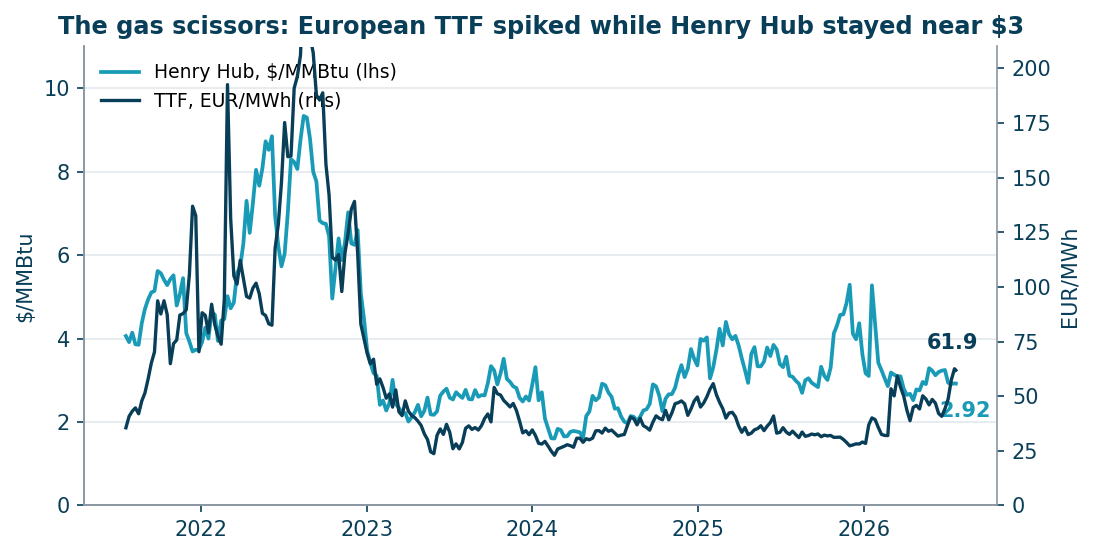
Five years of Henry Hub vs TTF: Europe pays multiples of the US price

Why Henry Hub is cheap - the honest part

US gas is cheap for real reasons. Production is at an all-time record (~111 Bcf/d of dry gas in June, +3.4% y/y). Storage is 6% above the 5-year average. And oil at $100 makes it worse: Permian oil wells produce associated gas as a by-product regardless of gas prices (~28 Bcf/d and growing). The most sobering fact: back in January the US Energy Information Administration forecast $4.60 gas for 2027; by July it had cut that forecast to $3.49 - supply keeps absorbing the demand growth. Anyone buying gas producers must respect this: the bear case is not hypothetical, it is the current trajectory.

What changes in 2026-2028: the LNG wave plus data centers

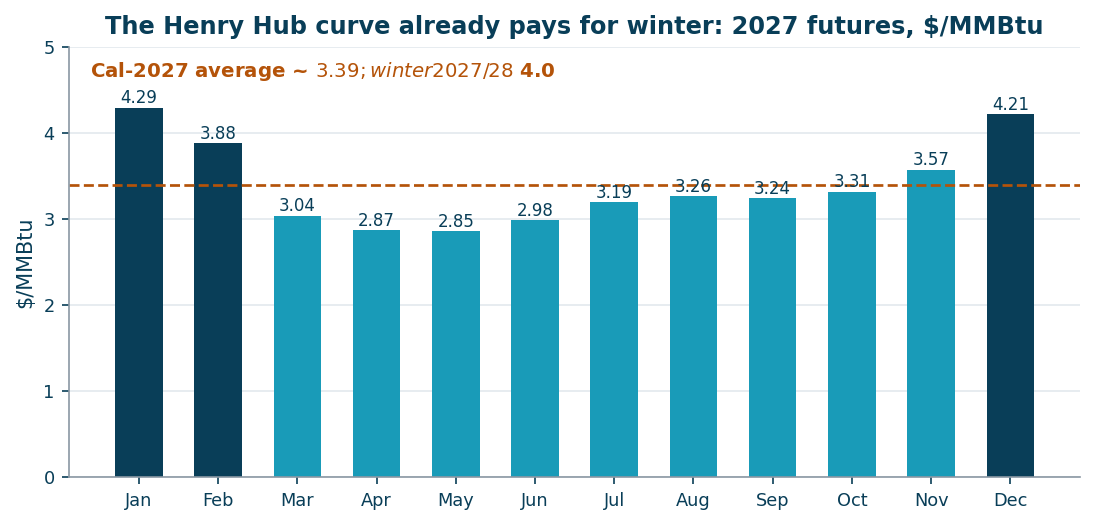
US LNG export capacity grows from 15.4 Bcf/d to ~21.2 Bcf/d by 2028 - a wave of ~6 Bcf/d of new structural demand. It is not a forecast, it is concrete: Plaquemines runs at full rates, Corpus Christi Stage 3 is commissioning, Golden Pass (delayed two years) shipped its first cargo in April 2026 and adds two more trains through 2027, Port Arthur and Rio Grande follow in 2027. On top of that, AI data centers: independent estimates (S&P Global, East Daley) see +3-6 Bcf/d of gas demand for power by 2030, and the deals are already signed - the 4.5 GW Homer City campus in Pennsylvania, the largest gas-fired plant in the US, is contracted to burn Appalachian gas from 2027. The futures curve already prices the shift partially: calendar-2027 averages $3.39 with winter months above $4.20.
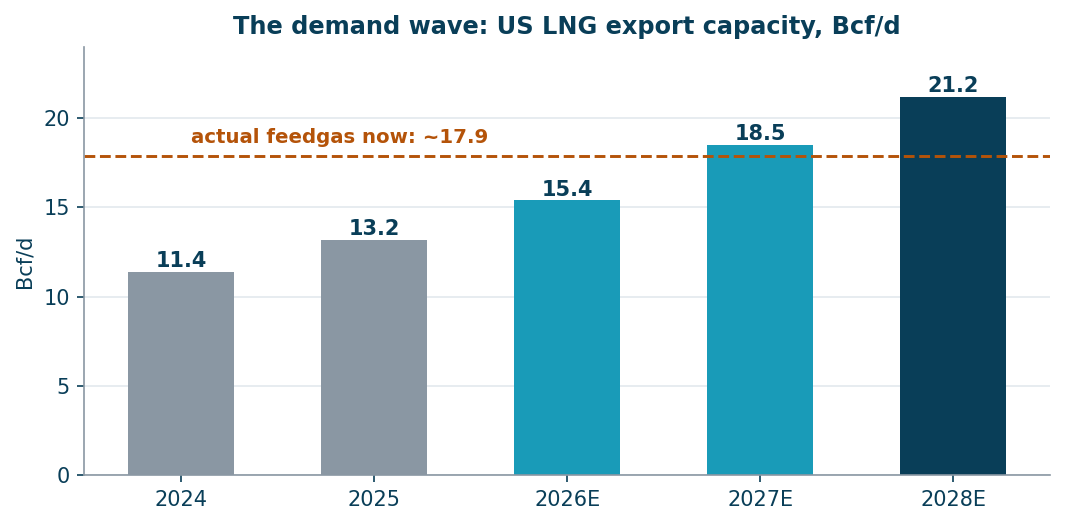
US LNG export capacity: +6 Bcf/d of structural demand by 2028 (EIA)
Henry Hub futures for 2027: winter above $4.20, summer near $2.90

Our screen - and why hedges pick your scenario

Our spot-potential model (recomputed nightly; conservative price basis = the lower of spot and the 3-year average, EV/EBITDA capped) ranks the gas producers as the biggest untapped upside pocket in coverage. Hedges are valued explicitly: a hedge is a contract fixing the sale price of future production, so hedged volumes will not realize the scenario price - the model prices each disclosed hedge book (10-Q volumes and strikes) against its scenario price and books the difference as an adjustment to net debt, a quasi-debt when hedges sit below the scenario price and an asset when above. On that hedge-adjusted basis: CNX +114%, Gulfport +63%, Expand +62%, Range +55%. At the conservative scenario price (~$3) the hedge books are mild assets for everyone - CNX's 2027 swaps at $4.17 alone are worth ~$0.5bn against it. But the same math flips in a rally: at $4.50 gas the hedged volumes become the quasi-debt, and that is where the names differ. CNX has 81% of 2026 and roughly 70% of 2027 sold - its base case is locked in, its rally participation is structurally muted until 2028. Gulfport (~30% hedged for 2027) and Range (~20%) keep the torque; Expand sits in between.
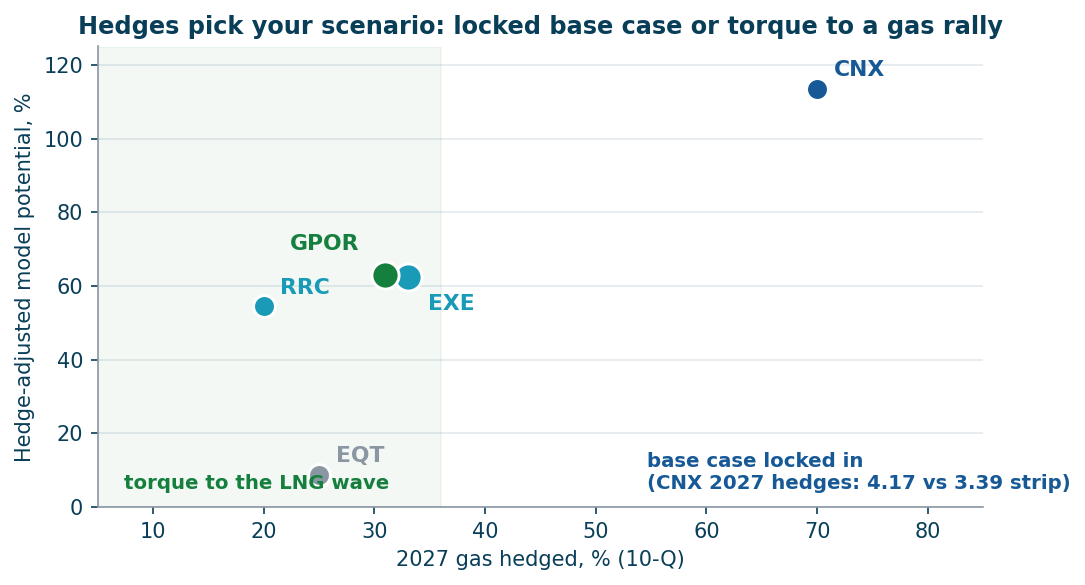
Model potential vs 2027 hedge coverage: pick torque or a locked base case

Pick #1 - Expand Energy (EXE): the scale leader with a Buy consensus

Expand - the Chesapeake+Southwestern merger - is the largest gas producer in the US (~7.5 Bcfe/d, 93% gas) across Appalachia and Haynesville, the basin closest to the LNG plants. Q1 2026: record free cash flow $1.7bn, net debt cut to $2.8bn (~0.5x EBITDA - debt basically solved), merger synergies running at ~$600mn/yr. Valuation: ~3.4x EV/EBITDA, ~12.5% FCF yield, plus a $2.30/yr base dividend (~2.5%). LNG optionality is real: anchor shipper (with an equity stake) on the new NG3 pipeline into the LNG corridor and a 20-year offtake deal with Delfin. Hedges: 66% of 2026 (collars capped at $4.75), roughly a third of 2027 - balanced, not neutered. Street consensus: Buy, average target ~$126-132 (+34-43%). The cleanest single name for the thesis.

Pick #2 - Gulfport (GPOR): the torque and the buyback machine

Gulfport is a ~1 Bcfe/d Utica/Marcellus producer that deliberately keeps 2027 hedges at the bottom of its policy range (~30%) - management is explicitly positioned for stronger gas. Leverage is 0.9x, well-level breakevens below $2.50, ~15 years of inventory. The capital-return math is striking: all free cash flow goes to buybacks - a record $173mn repurchased in Q1 2026 alone against a $2.9bn market cap; roughly 30% of the share base has been retired since 2022. At 3.25x EV/EBITDA and a 12.7% FCF yield, every year of flat gas shrinks the denominator by ~10%. Consensus: Moderate Buy, average target ~$230 (+23%). The risks are structural: only ~18mn shares outstanding, a thin float, and post-bankruptcy holder Silver Point (14.1%) selling down in blocks - expect volatility around those sales.
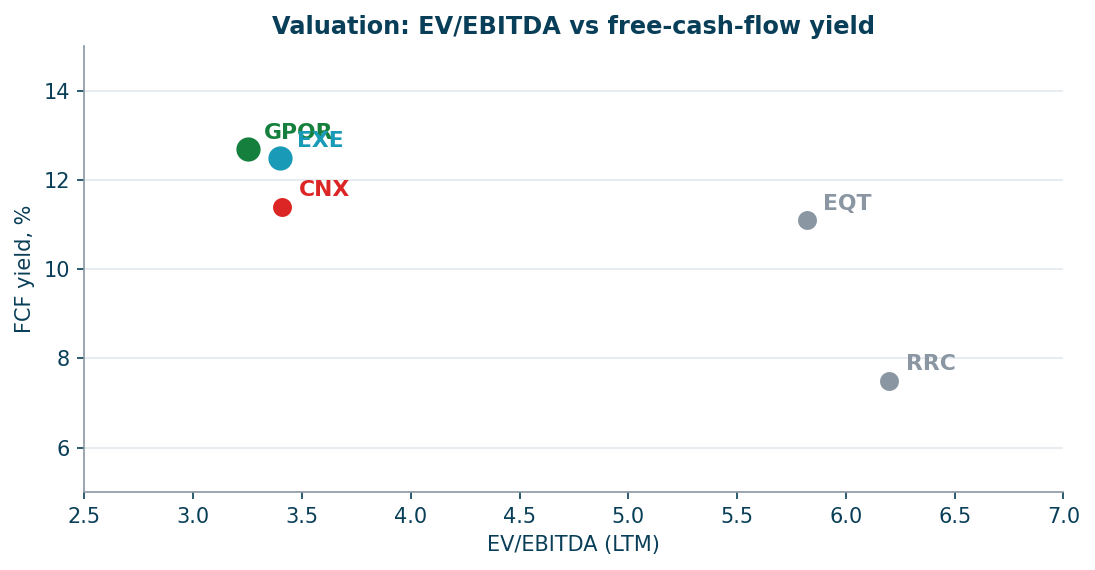
EV/EBITDA vs FCF yield: GPOR and EXE combine cheapness with cash generation

Pick #3 - CNX: the highest hedge-adjusted potential, for the opposite scenario

After the hedge adjustment CNX is the screen leader at +114% - and that deserves a straight answer on why it is not pick #1. The potential is computed at the conservative scenario price (~$3): at that price CNX's $4.17 hedges are a ~$0.5bn asset, its guided ~$525mn of FCF is locked in regardless of what gas does, and the buyback keeps shrinking the base (37% of shares retired since 2020). What CNX does not offer is participation in the LNG wave before 2028 - 70-81% of production is already sold. So the roles split cleanly: EXE and GPOR monetize the bull case, CNX monetizes the base-and-bear case. A barbell of GPOR plus CNX covers both ends; we size the wave leg larger only because the wave is the thesis of this piece. CNX-specific risks to respect: leverage of 1.8x versus 0.5-0.9x at peers, ~12mn shares of convertible dilution in 2026, and ~$70mn of guided FCF rides on 45Z clean-fuel tax credits still awaiting a final Treasury rule.

The bench: Range and EQT

Range Resources is arguably the best asset (30+ years of core Marcellus inventory, ~$2.00 breakeven - the lowest, 30% liquids sold at an export premium) and the least hedged for 2027 (~20%) - but the market knows: 6.2x EV/EBITDA and a Hold consensus make it a quality-at-a-price story, plus a quarter of its gas contracts with LNG exporters reprices into the 2026-27 wave. EQT (we hold it) is the quality consensus pick with the data-center contracts (1.5 Bcf/d signed) - and the most expensive of the five; we are not adding at 5.8x EV/EBITDA.

The Q2 prints landing this week: weak headlines, watch something else

Should you expect strong Q2 reports? Headline-wise, no - and two of the five have already proven it. EQT and Range both reported on July 21. EQT was operationally strong: volumes above the top of guidance, full-year production guide raised by 90 Bcfe with capex cut by $25mn, a record 29,000-foot lateral. Range printed record production and an EPS beat - but realized prices fell from $4.84/mcfe in the spike-quarter Q1 to $3.53, net income declined y/y, and the stock fell on the report. That is the template for Expand (July 28) and CNX (July 30): solid operations, sequentially weaker prices. For the thesis this is fine - expectations are low and the stocks have not moved, so a soft print is already in the price (Range just demonstrated it). What actually matters in these reports: whether 2027 hedge books get extended (that would cut the torque this idea is built on), Expand's buyback ramp now that its debt target is done, production guides into the LNG wave, and CNX's clarity on its 45Z tax credits. One honest irony to note: EQT's guidance raise is itself part of the bear case - operational outperformance is exactly how record supply keeps outrunning demand.

Base case (the current curve, ~$3.4-3.5 through 2027): all four generate high single-digit to low double-digit FCF yields; buybacks convert flat gas into ~10-15%/yr per-share compounding. Bull case (the LNG wave outruns supply, $4.25-4.50 average in 2027): EBITDA of the low-hedged names grows 30-40%+ at multiples of 3-3.5x - this is where the hedge-adjusted potentials of +55-63% for GPOR/EXE/RRC get realized; Expand alone guides to ~$3.85bn annual FCF at $4.00 gas (17% yield). Bear case (supply keeps winning, $2.70-3.00): breakevens of $2.00-2.60 keep everyone FCF-positive, CNX outearns peers on its $4.17 hedges, GPOR/RRC keep shrinking share counts at depressed prices. The main risks: Permian associated gas at $100 oil (price-insensitive supply), LNG project slippage (Golden Pass was two years late), a warm winter on top of +6% storage, and the sector's own capital discipline breaking if prices do rally.

How to buy

All five are liquid US listings (NYSE/NASDAQ), available at any international broker including Interactive Brokers at standard commissions; options are liquid for EXE and EQT. No withholding complexities beyond the standard 15-30% US dividend tax - and for GPOR and CNX there is no dividend at all, returns come via buybacks.

Prepared by Enhanced Investments from company filings (10-Q/10-K, Q1-Q2 2026 releases: Expand Energy, Gulfport, Range Resources, CNX, EQT), EIA data (STEO July 2026, storage and production reports), CME futures and exchange data; July 2026. Not individual investment advice.

Silver linings and energy shadows: commodity winners diverge sharply

This earnings season delivered a stark divide: precious metals miners, led by silver, posted explosive revenue growth, while the energy patch—especially oil & gas—stalled or shrank. The median silver miner grew revenue 95.5% year over year, more than triple the oil & gas sector's median decline of 5.4%. The story is not about absolute profits but about which commodities are riding price waves and which are being left behind.

Revenue growth by industry (median YoY)

Silver mining96Precious-metals royalty90Gold mining71Lithium51Natural gas50Copper mining36Oil26Fertilizers16Coal-1.3Timber & wood-3.5Oil & gas-5.4Natural Gas-110−9696
median revenue YoY, %

Silver and gold miners minted money as metal prices soared

The precious-metals complex was the undisputed winner. First Majestic Silver grew revenue 95.5%, while Endeavour Silver surged 230.2%—the fastest top-line expansion in the entire dataset. Gold miners were not far behind: Coeur Mining posted 137.8% revenue growth, and B2Gold added 117.7%. These gains were not just top-line; EBITDA and net profit often grew even faster, as operating leverage kicked in. For example, Barrick Mining’s revenue rose 66.7%, but EBITDA jumped 141.2% and net profit soared 238.0%.

Oil and gas producers ran out of fuel as revenues contracted

The energy sector was the clear laggard. Among oil & gas companies, median revenue fell 5.4%, with Amplify Energy dropping 48.0% and VAALCO Energy declining 43.3%. Even major integrated players struggled: Chevron’s revenue barely grew 2.1%, while net profit slumped 36.9%. The natural gas sub-sector also saw median revenue decline 11.0%, though a few names like Expand Energy (revenue +100.2%) bucked the trend thanks to production growth.

The biggest surprise: lithium rebounded sharply from a deep slump

The plot twist came from lithium. The sector’s median revenue growth of 51.2% masked a dramatic acceleration: Albemarle, which had seen revenue fall 44.1% in the prior period, reversed to a 32.7% gain—a swing of nearly 77 percentage points. SQM accelerated even more impressively, from a 39.4% decline to a 69.8% increase, a 109-percentage-point turnaround. This is a classic commodity-cycle snapback, and it caught many investors off guard.

Valuations are stretched for some growers, but bargains exist in unloved sectors

For value-focused investors, the dispersion is wide. Gold miner Barrick Mining trades at just 7.4x P/E and 5.0x EV/EBITDA despite 66.7% revenue growth—a clear bargain. B2Gold is even cheaper at 9.3x P/E and 2.2x EV/EBITDA with 117.7% revenue growth. On the expensive end, Cameco’s 85.4x P/E and 59.1x EV/EBITDA price in perfection for a uranium company growing revenue only 9.0%. In energy, Amplify Energy’s 1.6x EV/EBITDA looks distressed, not cheap.

Dividend yields are thin, but a few names offer steady income

Income seekers will find limited options. Among the highest yields, Petrobras offers a solid 11.3x P/E and EV/EBITDA 6.8x, though its revenue growth is modest at 12.5%. Energy Transfer LP yields an attractive combination with 32.1% revenue growth and a P/E of 15.9x. For more conservative plays, Suzano trades at 4.6x P/E and 5.8x EV/EBITDA with steady 6.3% revenue growth, offering a defensive yield in pulp & paper.

Looking ahead, the key question is whether precious-metals momentum can sustain. Three-year revenue CAGRs tell a story: Pan American Silver’s 34.3% CAGR and Alamos Gold’s 30.1% CAGR suggest durable growth, not a one-quarter spike. In contrast, the oil & gas sector’s negative three-year CAGRs (e.g., ConocoPhillips at -9.1%) point to structural headwinds. Next quarter, watch whether lithium’s rebound continues and whether silver miners can maintain their torrid pace.

Players: growth & yield (no absolute levels)

CompanyIndustryRevenue YoYEBITDA YoYNet profit YoYP/E
Exxon Mobil (Q1)Oil & gas+2.4%-20.6%-45.8%24.0x
Rio Tinto (FY)Diversified mining+7.4%+3.8%-11.3%14.9x
BHP Group (FY)Diversified mining-7.9%+9.5%+16.1%19.2x
Chevron (Q1)Oil & gas+2.1%+0.5%-36.9%30.6x
Marathon Petroleum (Q1)Oil refining+8.5%+49.5%n/m20.0x
Phillips 66 (Q1)Oil refining+6.9%-64.9%-57.5%19.6x
Valero Energy (Q1)Oil refining+7.0%n/m+312.3%22.1x
Equinor (Q1)Natural gas-5.3%+10.2%+18.2%17.0x
Energy Transfer LP (Q1)Oil+32.1%+18.4%-5.2%15.9x
Petrobras (Q1)Oil+12.5%+13.6%+3.9%11.3x
Bunge Global (Q1)Agribusiness+87.8%-26.0%-66.2%33.0x
Archer-Daniels-Midland (Q1)Agribusiness+1.6%+5.8%+1.0%36.3x
ConocoPhillips (Q1)Oil & gas-4.6%-13.1%-23.4%19.1x
Anglo American PLC (Q1)Diversified mining+10.8%+119.2%+19.2%n/m

US refiners at peak margins: a deep dive on PBF Energy

PBF →

Research note, data as of 24-25 June 2026. Not individual investment advice. US refining is running at abnormally high margins, and unlike past spikes this one is largely structural. We cover how much refiners earn now, how long it lasts, how much free cash flow PBF can generate, and a backtest of buying cheap on crack-adjusted EV/EBITDA. The lead name is PBF Energy (PBF) — the most concentrated way to play the theme.

The crack spread is ~$46/bbl now — double the norm, but not at its peak

The 3-2-1 crack spread — the notional margin of turning three barrels of crude into two of gasoline and one of diesel — sits around $46/bbl, versus a historical norm of ~$10-12. The headline USGC 3-2-1 averaged ~$42 in April 2026 (+95% YoY) and spiked above $52 in spring on Hormuz tension. In 2024-2025 the crack sagged to ~$20-24, which is why refiner profits collapsed.

Crack spread: where we are in the cycle

Historical norm11Now (Jun 2026)462022 peak64064
$/bbl (3-2-1)

The high crack has lasted only ~4 months of a typical 3-9

The acute phase of the rally began in late February 2026 (Iran/Hormuz), so the high crack has lasted only about 4 months. Historically, elevated margins after a geopolitical shock persist 3-9 months — so the cycle is only partly through, and permanent capacity closures can extend it. Key nuance: PBF has barely monetized this crack yet, because its best plant (Martinez) was down — the bulk of the earnings is still ahead.

Strikes on Russian refineries and Hormuz add fuel — but it's reversible

Ukrainian strikes have knocked an estimated 20%+ of Russia's refining capacity offline; Russia began importing gasoline by sea and curbed product exports, and as a major diesel exporter its lost flows push global cracks up. The Hormuz/Iran conflict added a risk premium and Middle East outages. Both factors are reversible — cracks have eased before when Russian supply recovered — which argues the moment is cyclical, not a permanent new normal.

~900 kb/d shut for good — that lengthens the cycle

Since 2023 the US has permanently retired about 900 kb/d of refining capacity. Shut plants don't come back, which structurally tightens supply regardless of demand. Base case: elevated margins persist another 12-18 months, compressing 20-30% from peaks; bull case 24+ months; bear case a return to 2023 levels within 6-12 months.

US capacity permanently closed since 2023

LyondellBasell Houston264Valero Benicia145Phillips 66 Los Angeles1390264
kb/d

PBF is a pure-play refiner: maximum sensitivity to the crack

PBF is a pure-play refiner — no midstream, no chemicals to smooth the cycle. Six plants, ~1.0 million b/d, weighted Nelson complexity 12.7. That makes it the most crack-geared large name — amplitude in both directions.

PBF refineries

RegionPlantsThroughput (kb/d)
East Coast / ВостокDelaware City + Paulsboro280-300
Mid-continentToledo135-145
Gulf Coast / ЗаливChalmette175-185
West Coast / ЗападMartinez + Torrance250-270
Total / Итого6 plants / 6 заводов850-910

PBF's profit swings wildly: $4.3bn at the peak, ~zero at the trough

A pure-play cuts both ways: adjusted EBITDA was $4.3bn in 2022, collapsed to $0.09bn in 2024 — a 48x swing in two years — and was near zero in 2025 (Martinez outage). At full utilization and current spreads the potential is $2.5-3.5bn a year.

PBF adjusted EBITDA by year

20224.320233.520240.12025 (est)0.2Potential3.004.3
$bn

PBF's margin tracks the crack — depressed now by Martinez downtime

PBF's realized refining margin moved from +$11.7/bbl (Q1'24) to -$3.9 (Q4'24) to +$11.2 (Q4'25), then dipped to +$6.0 in Q1'26 — low despite a high crack because Martinez was down. As Martinez returns to full load in Q2 2026, the margin should re-converge toward the crack environment.

PBF realized refining margin by quarter

Q1'2412Q3'246.8Q4'24-3.9Q1'256.0Q3'259.0Q4'2511Q1'266.00−1212
$/bbl

+$1/bbl of crack ~ +7% of market cap — that's the core leverage

At ~900 kb/d PBF processes ~330 million barrels a year, so every +$1/bbl of durable margin is ~$0.33bn of pre-tax EBITDA, ~$2.8/share, ~7% of market cap. Per $1bn of market cap PBF carries ~188 kb/d of capacity vs ~41 for VLO/MPC — 4.6x more barrels per dollar (but also more debt).

Leverage to the crack: capacity per $1bn market cap

PBF188DINO56MPC41VLO41PSX290188
kb/d per $1bn

At current cracks PBF can earn ~20-40% of its market cap in FCF in a year

Assuming 2026 capex ~$0.9bn, net interest ~$0.19bn and 21% tax: mid-cycle (EBITDA ~$1.8bn) yields ~11% FCF on the $4.8bn market cap; at current high cracks with Martinez running (~$2.5bn) ~22%; at a 2022-style peak (~$3.5bn) ~39%; at the trough FCF is negative. So a sustained high crack can return a fifth to two-fifths of the market cap in free cash flow in a single year.

Estimated PBF FCF yield by state of the cycle

Trough (2024)-3.0Mid-cycle11Current high cracks222022 peak390−3939
% of market cap

Debt is manageable, and Martinez restarts into the high-spread window

Net debt is ~$2.3bn (net debt/cap ~36%, debt/EBITDA ~1.9x), with no maturity wall — 2026 refinancing pushed the 2028 notes out to 2034. Dividend ~2.7% plus a buyback; priority is deleveraging. Martinez (fire 1 Feb 2025, ~$0.9bn insurance recoveries) completes its restart in Q2 2026 — full load returns into the high-spread window.

Backtest: cheap on EV/(crack-adjusted EBITDA) = historically a good entry

We tested buying when a refiner is cheap on EV/EBITDA computed at the current crack (not reported earnings) across VLO/PBF/MPC/PSX/DINO, 2020-2026, monthly, with point-in-time ranking. Cheap names returned +47% on average over the next 12 months (median +45%) versus just +5% for expensive ones.

12-month forward return by cheapness on crack EV/EBITDA

Cheap47Mid18Expensive5.0047
% avg forward return

Statistical weight comes from our Global Commodities strategy, whose refiner signal is built on the same crack model (crack to EBITDA to EV/EBITDA to upside): 2016-2026 it returned ~28% CAGR vs ~14% for the S&P, with a ~+11%/yr cross-sectional ranking edge over an equal-weight basket of the same names.

For cyclicals, multiples on reported earnings mislead — use anchors

For a cyclical, any multiple on reported/peak earnings misleads (P/E and EV/EBITDA alike) — at the margin peak, earnings are huge and the multiple looks low right at the top. Better anchors: EV/EBITDA recomputed at the current crack (as in the backtest), EV/mid-cycle EBITDA, and price-to-book. PBF's P/B range is 0.25x (trough), 1.12x median, 2.55x (peak); now ~0.90x, around or below book (~$44/share). Supercycle history: 2004-2005 saw Valero +239% and HF Sinclair +265%; 2022 saw HF Sinclair +106%, Valero +58%, Marathon +53%.

PBF price / book value (P/B)

Trough min0.2Now0.9Median1.1Peak max2.502.5
x

Risk/reward skews up: base +45%, bull +112%, bear -28%

Combining FCF-driven equity build with multiple normalization toward mid-cycle, rough 12-24 month price scenarios for PBF (current ~$40): base (crack ~$30-35) ~$58 (+45%); bull (crack ~$40+, holds 24 months) ~$85 (+112%); bear (crack to $20) ~$29 (-28%). The risk/reward skews up, but this is a high-volatility cyclical bet — both upside and downside are large. Not a forecast.

PBF illustrative price scenarios

Bear29Current40Base58Bull85085
$ / share

Commodity spot-potential: who is most geared to the price rally

The spot-potential model re-prices each company's revenue at current commodity spot prices versus the LTM-realised average, and reads the implied EBITDA uplift. It is computed for 18 of the 24 commodity names.

Spot-EBITDA potential (selected)

Albemarle (Li)343Alpha Met (coal)246Peabody (coal)129Core Natural (coal)101AngloGold37Newmont35Freeport (Cu)32Barrick30Southern Copper210343
% EBITDA uplift

Operating leverage drives the ranking

The largest potentials belong not to the companies whose commodity rose most, but to those with the thinnest EBITDA margins. Albemarle, Alpha Met, Peabody and Core Natural all earn just 5-11% margins today — so a revenue increment from higher prices drops almost entirely to EBITDA and multiplies a small base. Albemarle is the extreme: lithium prices collapsed, its EBITDA is near-breakeven, and lithium spot sits ~58% above the LTM average — recovering that implies a several-fold EBITDA jump.

The dependable reads

The high-margin gold and copper majors — Newmont, Barrick, AngloGold, Freeport, Southern Copper — show a steadier +20-37%. They already earn 35-65% margins, so a price move lifts EBITDA proportionally rather than explosively. These are the robust signals; the triple-digit coal and lithium figures correctly flag enormous gearing to a price recovery, but are fragile on a near-breakeven base.