1H2026 earnings season: the market pays a premium for the balance sheet, not for the pace
Half-year IFRS reporting season closed on 28-31 August. Enhanced Investments covers 117 Russian issuers, and 99 of them have reported 1H2026 results. Below is a sector-by-sector review: where business is growing and where it is not, who has declared dividends, who looks cheap, and which reports are still to come.
The main result of the season: most companies grew revenue, a minority grew profit. The 14% key rate and the strong rouble work against exporters and highly leveraged companies, and the whole profit gain in the commodity block comes not from business growth but from normalisation after the disastrous 2025.
- Oil and gas reported strongly, but on a low-base effect. Sector revenue barely grew; profit recovered where a year ago there were write-offs and FX losses.
- Ferrous metals is the only sector where everything is falling at once. Revenue, EBITDA and profit are down for the sixth quarter in a row, and there are no dividends.
- Power and grids grew on tariffs. Double-digit revenue growth, but profit is partly eaten by interest and the investment programme.
- Technology is the best sector by growth rate. Ozon and Yandex closed the half-year with a profit on revenue growth of 48% and 19%.
- Pharmaceuticals is the best sector by growth rate. Promomed added 76% to revenue, Ozon Pharmaceuticals 90% to net profit at a gross margin of 50%.
- Developers and leasing are the stress zone. Losses, impairments and debt above 5x EBITDA.
- The year's main dividend yields have already been paid in spring and summer. 11 record dates have been announced for autumn, and none beats the key rate.
- Polyus closed the season on 31 August: with record gold, profit fell 2.8-fold because of the strong rouble. Reports from Surgutneftegas, PIK, Bashneft and KAMAZ are still ahead.
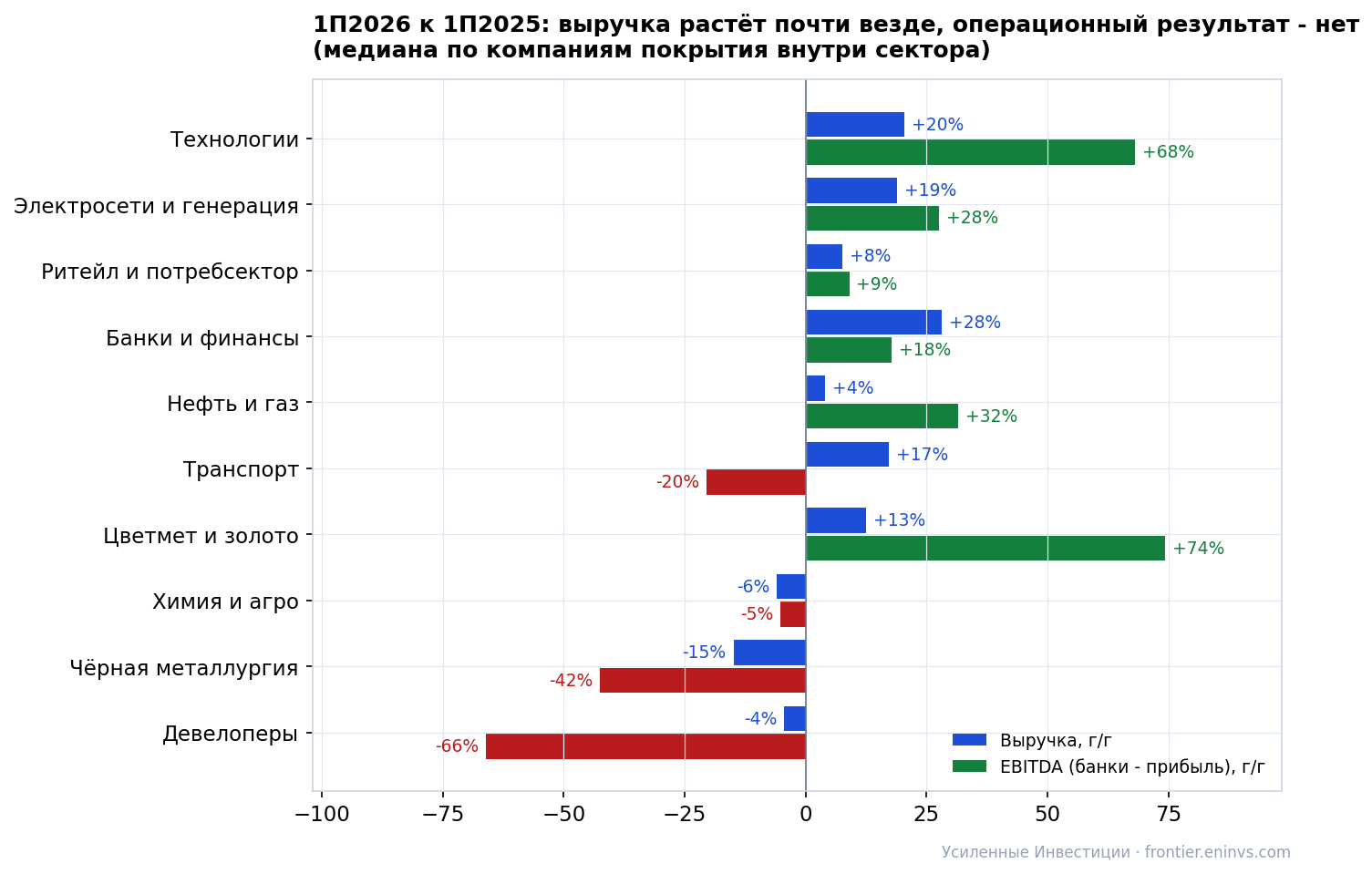
Oil and gas: profit returned where 2025 was a disaster
Sector revenue barely grew over the half-year. The entire profit gain comes from the low-base effect, a narrower export discount and one-off items rather than volume growth, while capital expenditure keeps rising.
- LUKOIL - revenue RUB 2,059 bn (+8% y/y), operating profit RUB 610.9 bn (2.5x), EBITDA RUB 815.3 bn, net profit RUB 440.1 bn vs RUB 288.6 bn, attributable to shareholders RUB 430.9 bn vs RUB 287.0 bn (+50%). Net debt is negative: minus RUB 131 bn. An important caveat: the international segment in the 2025 base was moved to discontinued operations, so the growth "of 4.9x in continuing operations" is an accounting effect, not an operating one.
- Gazprom - revenue RUB 5.30 trn vs RUB 4.99 trn (+6%), EBITDA RUB 1.977 trn (+28%), profit attributable to shareholders RUB 863.9 bn (-12%). The profit decline stems from the absence of the positive FX revaluation recorded in 1Q2025. Net debt RUB 7.95 trn, leverage about 2.4x EBITDA. No dividend for the half-year.
- Rosneft - revenue RUB 4,289 bn (+0.6%), EBITDA RUB 1,296 bn (+23%), net profit RUB 200 bn (-18.4%), capex RUB 858 bn (+11.6%). Profit was cut by non-cash items: exchange differences and impairments.
- Gazprom Neft - revenue RUB 1.88 trn (+5.9%), operating profit RUB 395.0 bn (+92.9%), profit attributable to shareholders RUB 285.5 bn (+69%). The best dynamics in the sector and the only large oil company with a declared dividend.
- Tatneft - revenue RUB 881.7 bn (+15.8%), operating profit RUB 222.0 bn (2x), net profit RUB 165.5 bn (3x). A dividend of RUB 32.88 per ordinary and preferred share is recommended.
- NOVATEK - revenue RUB 836.3 bn (+4%), EBITDA RUB 226.1 bn (+5%), net profit RUB 221.0 bn (-3%). A steady half-year, net debt close to zero.
- Transneft - revenue RUB 740.1 bn (+3%), EBITDA RUB 295.1 bn (-4%), net profit RUB 157.2 bn (-3%), net cash position RUB 229 bn.
- RussNeft - revenue RUB 120.5 bn (+1%), EBITDA RUB 33.1 bn (+38%), net profit RUB 15.9 bn (+35%).
Ferrous metals: a loss instead of a profit and a sixth quarter without dividends
Domestic steel demand is shrinking, and the strong rouble finishes off exports. None of the three large steelmakers recommended a dividend.
- Severstal - revenue down 13.5% y/y, net profit RUB 4.12 bn (-88.8%), EBITDA margin about 13% vs 22% a year earlier.
- NLMK - revenue RUB 387.7 bn (-11.6%), profit down 54.3%. Net debt is negative - the strongest balance sheet in the sector.
- MMK - revenue down 10%, net loss; the cash position of RUB 81 bn remains a cushion.
- TMK - the hardest situation: revenue RUB 149.4 bn (-37%), EBITDA RUB 8.8 bn (-78%), net loss RUB 30.1 bn, net debt RUB 318 bn - above 5x EBITDA.
- Mechel - revenue RUB 117.3 bn (-23%), negative EBITDA, net loss RUB 43.2 bn, net debt RUB 306 bn against a market capitalisation of about RUB 20 bn.
- Raspadskaya - revenue RUB 56.7 bn (-4%), loss RUB 8.3 bn: coal remains loss-making.
- ALROSA - revenue RUB 93.3 bn (-31%), EBITDA RUB 2.7 bn vs RUB 19.6 bn. The diamond market has not recovered.
Non-ferrous metals were carried by output, but Polyus lost two-thirds of its profit despite record gold
- Polyus - revenue RUB 352.7 bn, net profit RUB 61.2 bn vs RUB 172.5 bn a year earlier, a 2.8-fold decline. Revenue from gold sales in dollars grew 27%, but in roubles only 14.5%: the strong rouble took away half of the gain at record metal prices. Dividends are suspended until 2030 because of the investment programme.
- Nornickel - revenue RUB 632.7 bn (+12.8%), EBITDA RUB 301.1 bn, net profit RUB 153.2 bn (+102%). The board of directors recommended RUB 1.85 per share, RUB 28.3 bn in total, record date 12 October. The yield is modest, about 1.5%, but the return to payouts is itself a signal for the cycle.
- RUSAL - revenue RUB 638.8 bn (-3%), EBITDA RUB 88.2 bn (+74%), net profit RUB 32.1 bn vs a loss a year earlier. The constraint is unchanged: net debt RUB 702 bn, about 7x EBITDA.
- En+ - revenue RUB 774.2 bn (-1%), EBITDA RUB 171.7 bn (+46%), net profit RUB 69.3 bn (+138%): the power division offsets the aluminium one.
- Yuzhuralzoloto GK - revenue RUB 84.1 bn (+91%), EBITDA RUB 38.0 bn, net profit RUB 15.4 bn. The 2025 base was depressed by a suspension of mining, so the growth rate is not representative of future periods.
- Seligdar - revenue RUB 41.7 bn (+47%), EBITDA RUB 13.1 bn (+146%), net profit RUB 3.4 bn. Debt of RUB 155 bn, almost 5x EBITDA, is the main risk of the story.
Power and grids: tariffs gave double-digit revenue growth, but interest and construction take the profit
- Rosseti - revenue RUB 943.6 bn (+19%), EBITDA RUB 317.5 bn. Net debt of RUB 805 bn and the investment programme are the reason there is no dividend.
- RusHydro - revenue RUB 387.1 bn (+19%), EBITDA RUB 148.0 bn (+47%), net profit RUB 60.1 bn (+90%). But net debt of RUB 776 bn, over 3x EBITDA, and payouts are frozen.
- Inter RAO - revenue RUB 953.4 bn (+17%), EBITDA RUB 81.0 bn (-8%), net profit RUB 68.7 bn (-17%). A rare case: a net cash position of RUB 138 bn, yet profit still falls - interest income no longer offsets the growth in costs.
- Rosseti Moscow Region - revenue RUB 159.0 bn (+22%), EBITDA RUB 53.3 bn (+28%), net profit RUB 24.4 bn (+47%).
- Rosseti Centre and Volga Region - revenue RUB 85.9 bn (+13%), profit RUB 14.8 bn (+24%), net debt is negative. Rosseti Centre - revenue RUB 80.6 bn (+14%), profit RUB 8.5 bn (+58%). Rosseti Volga - profit RUB 7.3 bn (+62%). Rosseti North-West - profit RUB 3.8 bn (+115%).
- Mosenergo - revenue RUB 179.5 bn (+25%) with profit of RUB 11.8 bn (-19%). OGK-2 - revenue RUB 95.4 bn (+19%), profit RUB 1.5 bn (-29%) with debt of RUB 46 bn.
- Unipro - revenue RUB 64.1 bn, profit RUB 20.9 bn, the cash position is preserved; payouts remain blocked by the temporary-management status.
- Rosseti Lenenergo - revenue RUB 35.7 bn (+13%), profit RUB 9.3 bn (+6%); the preferred share remains a clear dividend story with a charter formula.
- The Rosseti group's investment programme is not ending but accelerating - from RUB 725 bn in 2025 to about RUB 900 bn in 2026. The burden is carried by FSK: there is no dividend, the Ministry of Energy is discussing extending the moratorium beyond 2026, plus an additional share issue of about RUB 120 bn. This does not extend to the subsidiaries - eight sector issuers paid dividends for 2025, Rosseti South for the first time since 2018.
Financials: only Sberbank grows profit, the rest fail to beat the 2025 base
- Sberbank - net profit RUB 1,019.1 bn (+18.6%), return on equity 24.2%, loan portfolio RUB 52.6 trn (+3.9% year to date). The only large bank with confident profit growth.
- DOM.RF - net profit RUB 57.2 bn (+46%), net interest income RUB 89.1 bn (+30%), fees RUB 23.7 bn (+47%), ROE 23.8%. Management raised its 2026 profit guidance to RUB 117 bn. The largest IPO of late 2025 is growing faster than Sberbank.
- VTB - net profit RUB 225.2 bn (-19.8%): interest income is recovering, but last year's base was inflated by one-off items. A separate factor is the Wildberries deal (postponed to September): for it the supervisory board proposed an additional share issue with a limit above RUB 540 bn, which dilutes shareholders and lowers the chances of a large dividend for 2026.
- T-Technologies - net profit RUB 74.5 bn (-7.1%), minus 15% y/y in 2Q: portfolio growth runs into the cost of risk.
- Sovcombank - net profit RUB 45.3 bn vs RUB 17.5 bn a year earlier.
- Bank Saint Petersburg - profit RUB 16.5 bn (-33%): the margin is shrinking as rates decline.
- MTS Bank - profit RUB 7.2 bn (2x), Europlan - RUB 4.3 bn with new business falling, Zaymer - RUB 0.9 bn (-51%).
- Moscow Exchange - operating income RUB 65.7 bn (+14%), net profit RUB 32.9 bn (+18%): fee income is growing, interest income is falling together with the rate.
- SFI - a loss after the sale of Europlan: the one-off income of 2025 is not repeated, and the company does not plan dividends.
- Renaissance Insurance - the half-year figures in our database were extracted incorrectly, so no figures are given for the company here.
Retail: revenue grows by double digits, profit goes to rent and interest
- X5 - revenue RUB 2,480.5 bn (+11%), EBITDA RUB 141.3 bn (+9%), net profit RUB 34.5 bn (-28%).
- Magnit - revenue RUB 1,887.2 bn (+12.8%), EBITDA RUB 171.8 bn (+14%), net loss RUB 9.5 bn vs a profit of RUB 0.2 bn. Net debt RUB 1,143 bn against a market capitalisation of about RUB 112 bn - the main imbalance in the sector.
- Lenta - revenue RUB 648.5 bn (+26%), EBITDA RUB 58.3 bn (+12%), profit RUB 10.7 bn (-25%). Growth is largely due to consolidation of acquired chains.
- Fix Price - revenue RUB 155.3 bn (+5%), EBITDA RUB 17.0 bn, profit RUB 2.7 bn (-30%).
- O'Key - revenue RUB 67.1 bn (-4%), loss RUB 5.6 bn.
- M.Video - net loss RUB 4.6 bn vs RUB 25.2 bn a year earlier: the loss is shrinking, but the business has not yet returned to profit.
- Novabev - revenue RUB 74.4 bn (+8%), profit RUB 1.3 bn (-38%); an interim dividend of RUB 8 has been declared.
- Cherkizovo - revenue RUB 141.6 bn (+3%), EBITDA RUB 31.5 bn (+24%), profit RUB 14.1 bn (2x). Inarctica - revenue RUB 13.8 bn (+38%) with a negative net result because of biomass revaluation. Henderson - revenue RUB 11.2 bn (+4%), profit RUB 0.5 bn (-53%).
Technology is the strongest sector of the season, but it has split internally
- Ozon - revenue RUB 635.1 bn (+48%), adjusted EBITDA RUB 106.7 bn (+49%), net profit RUB 14.6 bn vs a loss a year earlier. The best report of the season in terms of pace combined with a turnaround to profit.
- Yandex - revenue RUB 759.0 bn (+19%), adjusted EBITDA RUB 162 bn (+41%), adjusted net profit RUB 82.2 bn (roughly 2x). A dividend of RUB 110 has been declared, record date 18 September.
- VK - revenue RUB 81.0 bn (+12%), EBITDA RUB 13.0 bn (+25%), but at the net level there is still a loss of RUB 3.8 bn.
- Astra - revenue RUB 7.8 bn (+17%), EBITDA RUB 1.9 bn (+23%), profit RUB 1.1 bn (+67%). Given the weak 1Q, growth is more modest than the half-year suggests.
- Positive Technologies - revenue RUB 9.5 bn (+41%), the half-year is loss-making: the company's revenue is shifted to 4Q, so the interim result says little.
- Softline - revenue RUB 38.7 bn (+16%), EBITDA RUB 2.9 bn (-18%), operating cash flow is negative.
- HeadHunter - revenue RUB 19.6 bn, down 1% y/y: the vacancy market has cooled, and HR technology sees this first in the cycle. A dividend of RUB 200 has been declared, yield 7.5%.
- Arenadata - revenue RUB 2.5 bn (+86%) with a loss-making half-year; Diasoft and IVA Technologies also had a weak half-year.
- B2B-RTS - revenue RUB 5.45 bn (+17% for the half-year, +13% in 2Q), EBITDA RUB 2.89 bn (+18%), net profit RUB 2.0 bn (+9%). EBITDA margin 53%, one of the highest in the coverage. Pays quarterly: RUB 3.29 bn was paid for 2025, about 15% of the current market capitalisation; the latest payment was RUB 5.19, record date 9 July.
Pharmaceuticals is the best sector by growth rate, but growth is paid for with channel discounts
- Promomed - revenue grew 76% y/y against an annual plan of +60%, and the second quarter accelerated to +83%. EBITDA RUB 7.7 bn. A caveat on the quality of growth: discounts and bonuses to pharmacy chains and distributors were RUB 17.1 bn vs RUB 6.5 bn a year earlier, and EBITDA includes RUB 0.86 bn from a release of receivables provisions; without it the margin is about 30% vs 34%.
- Ozon Pharmaceuticals - revenue RUB 14.8 bn (+12%), adjusted EBITDA RUB 5.8 bn (+33%), net profit RUB 3.25 bn vs RUB 1.71 bn (+90%). The main achievement of the half-year is a gross margin of 50.0% vs 43.4%: cost of sales fell 1.4% on rising revenue, and raw materials became 22.7% cheaper. Packs sold were 1% lower, so the entire gain came from average price and mix. Dividend RUB 0.49 per share, record date 29 September.
Transport: Sovcomflot turned around from a loss, Aeroflot almost wiped out its profit
- Sovcomflot - revenue RUB 78.1 bn (+46%), EBITDA USD 547 mn (+108%), net profit USD 284 mn vs a loss of USD 435 mn a year earlier, adjusted profit grew 14-fold. The turnaround comes from freight rates and the absence of last year's write-offs.
- Aeroflot - revenue RUB 429.8 bn (+3.6%), operating expenses RUB 449.2 bn (+9.7%), adjusted net profit RUB 0.47 bn (-88.4%). Jet fuel, which became more expensive in 2Q, ate the whole cushion.
- NMTP - revenue RUB 39.7 bn (+3%), EBITDA RUB 27.4 bn, profit RUB 23.3 bn (+8%) with a net cash position.
- FESCO - revenue RUB 92.1 bn (+5%), but EBITDA down 32%, profit wiped out.
- Sollers - revenue RUB 33.0 bn (+29%) with a loss of RUB 2.7 bn; UWC closed the half-year with negative EBITDA.
Telecom: revenue grows 11-12%, but all of MTS's profit comes from one-off items
- MTS - revenue RUB 414.7 bn (+11.8%), OIBDA +17% for the half-year (+16.3% in 2Q, to RUB 84.6 bn), operating profit RUB 89.2 bn (+25%), net profit RUB 74.0 bn vs RUB 7.7 bn a year earlier. The main contribution to profit came from the sale of 49.9% of the Tower Infrastructure Company: RUB 21.7 bn in cash plus deconsolidation of more than RUB 80 bn of debt - but even without the one-off deal the operating dynamics are confident. Net debt of RUB 707 bn (2.3x EBITDA) remains the main thing holding back a re-rating.
- Rostelecom - revenue RUB 435.7 bn (+10.5%), OIBDA RUB 171.4 bn (+11%), net profit RUB 14.0 bn (+9%).
- Tattelecom - revenue RUB 7.0 bn (+18%), profit RUB 1.4 bn (+33%), net cash position.
Developers are the main stress zone: losses, impairments and debt above 5x EBITDA
- LSR - revenue RUB 97.1 bn (+0.7%), net loss RUB 57.6 bn, 23 times last year's: asset impairment plus higher interest payments. Liabilities about RUB 530 bn.
- Samolet - revenue RUB 117.4 bn (-31%), EBITDA RUB 31.3 bn (-40%), net loss RUB 22.3 bn, net debt RUB 778 bn.
- Etalon - revenue RUB 54.4 bn (-10%), loss RUB 13.2 bn (7% less than last year's), debt RUB 190 bn.
- APRI - revenue RUB 12.0 bn (+29.5%), but profit fell 8-fold to RUB 0.12 bn.
- Glorax - revenue RUB 27.0 bn (+45%), profit RUB 1.6 bn (-32%).
Chemicals and forestry: fertilisers lost half their EBITDA, Segezha remains loss-making
- PhosAgro - revenue RUB 281.4 bn (-5.7%), adjusted EBITDA RUB 62.4 bn (-45.9%), net profit RUB 18.7 bn vs RUB 75.5 bn (-75%). The cause is rising costs with a strong rouble.
- Acron - revenue RUB 112.9 bn (-9%), EBITDA RUB 47.6 bn (+18%), profit RUB 26.1 bn (-14%).
- Nizhnekamskneftekhim - revenue RUB 128.4 bn (-6%), EBITDA RUB 16.6 bn (-49%), profit RUB 1.6 bn (-94%).
- Segezha - revenue RUB 38.0 bn (-15%), net loss RUB 15.3 bn: the additional share issue did not close the debt problem.
- Rusagro - revenue RUB 183.0 bn (+9%), EBITDA RUB 13.8 bn (-29%), profit practically wiped out.
A separate story: EuroTrans has not been meeting its obligations to bondholders since August
EuroTrans has been publishing notices of non-performance of obligations to holders of securities on the disclosure feed since 11 August - there were more than ten such notices in August. The company has not presented half-year IFRS statements. For holders of the issues this is no longer a story about multiples but about the queue of creditors.
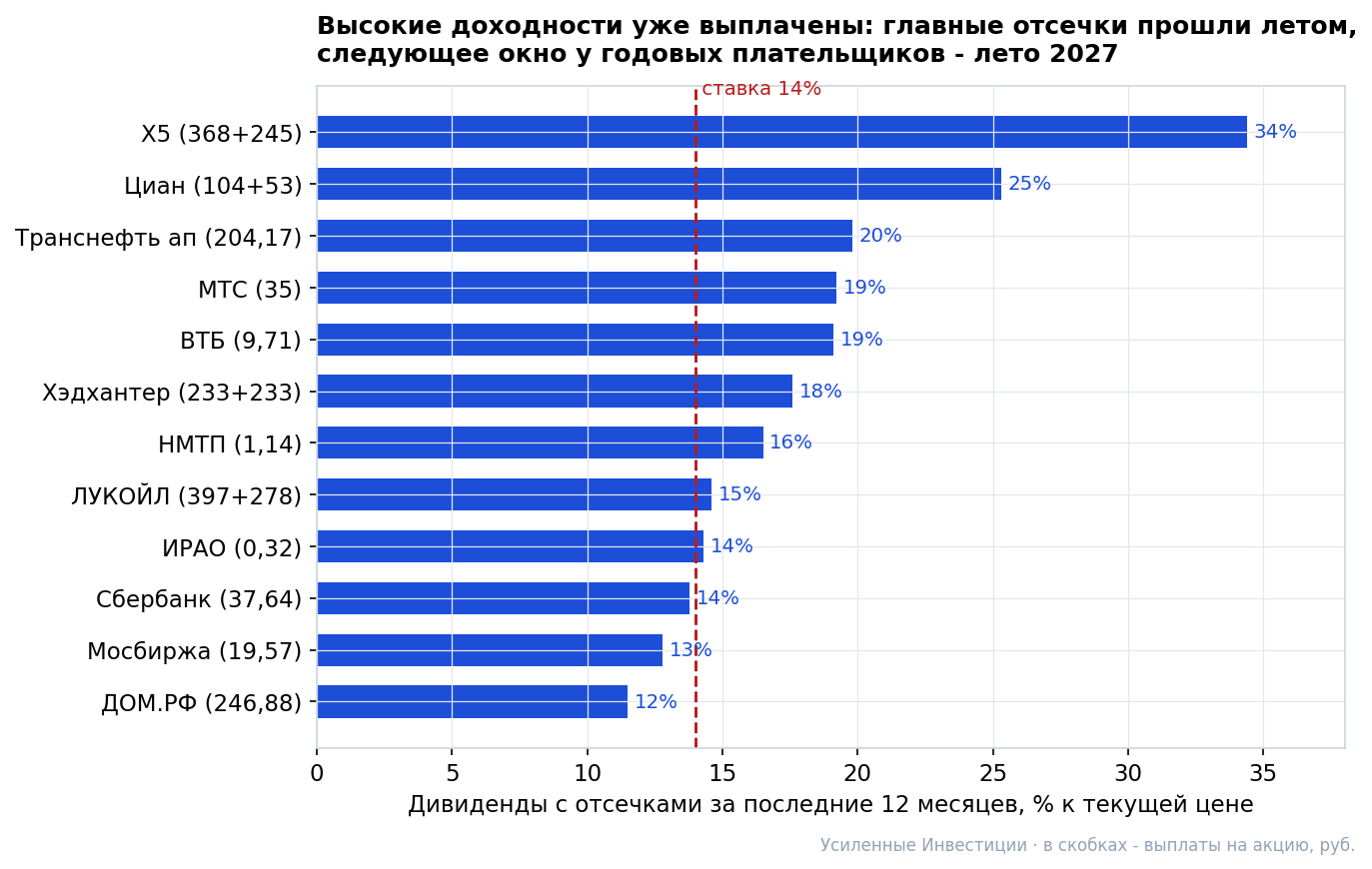
Dividends: this year's main yields have already been paid in spring and summer
Most annual payouts were made before the end of July - for Sberbank, VTB, MTS, Transneft, Inter RAO and Moscow Exchange the record dates for 2025 are already behind, and the next window for these names is summer 2027. Below is what was actually paid over the last 12 months (in two tranches where the company pays twice a year), with the yield to the current price:
- X5 - RUB 613 (368 in January + 245 in July), 34%. Based on a special payment, low repeatability.
- CIAN - RUB 157 (104 in December + 53 in June), 25%: a special dividend after the relocation, also one-off.
- Transneft pref. - RUB 204.17 for 2025, register closed on 20 July, 20% to the current price.
- MTS - RUB 35 (July), 19%. VTB - RUB 9.71 (July), 19%.
- HeadHunter - RUB 233+233, 18%; NMTP - RUB 1.14 (July), 16%.
- LUKOIL - RUB 675 (397 in January + 278 in May), 15%.
- Inter RAO - RUB 0.32 (June), 14%; Sberbank - RUB 37.64 (July), 14%; Moscow Exchange - RUB 19.57 (July), 13%.
- DOM.RF - RUB 246.88 for 2025 (pays once a year), register closed on 20 July, 11.5%.
Autumn record dates are announced for 11 names, and none beats the rate
What has been announced for payment over the next six weeks, yield to the Moscow Exchange price on 31 August:
- Gazprom Neft - RUB 42.51, 8.2%, last day to buy 12 October
- HeadHunter - RUB 200, 7.5%, 25 September
- Tatneft ord. and pref. - RUB 32.88, 5.9% and 6.1%, 12 October
- Zaymer - RUB 4.86, 3.6%, 9 October
- Novabev - RUB 8, 3.2%, 9 October
- Yandex - RUB 110, 3.1%, 18 September
- T-Technologies - RUB 4.70, 1.9%, 11 October
- Nornickel - RUB 1.85, 1.5%, 9 October
- Diasoft - RUB 16, 1.4%, 20 September
- Ozon Pharmaceuticals - RUB 0.49, 1.1%, 28 September
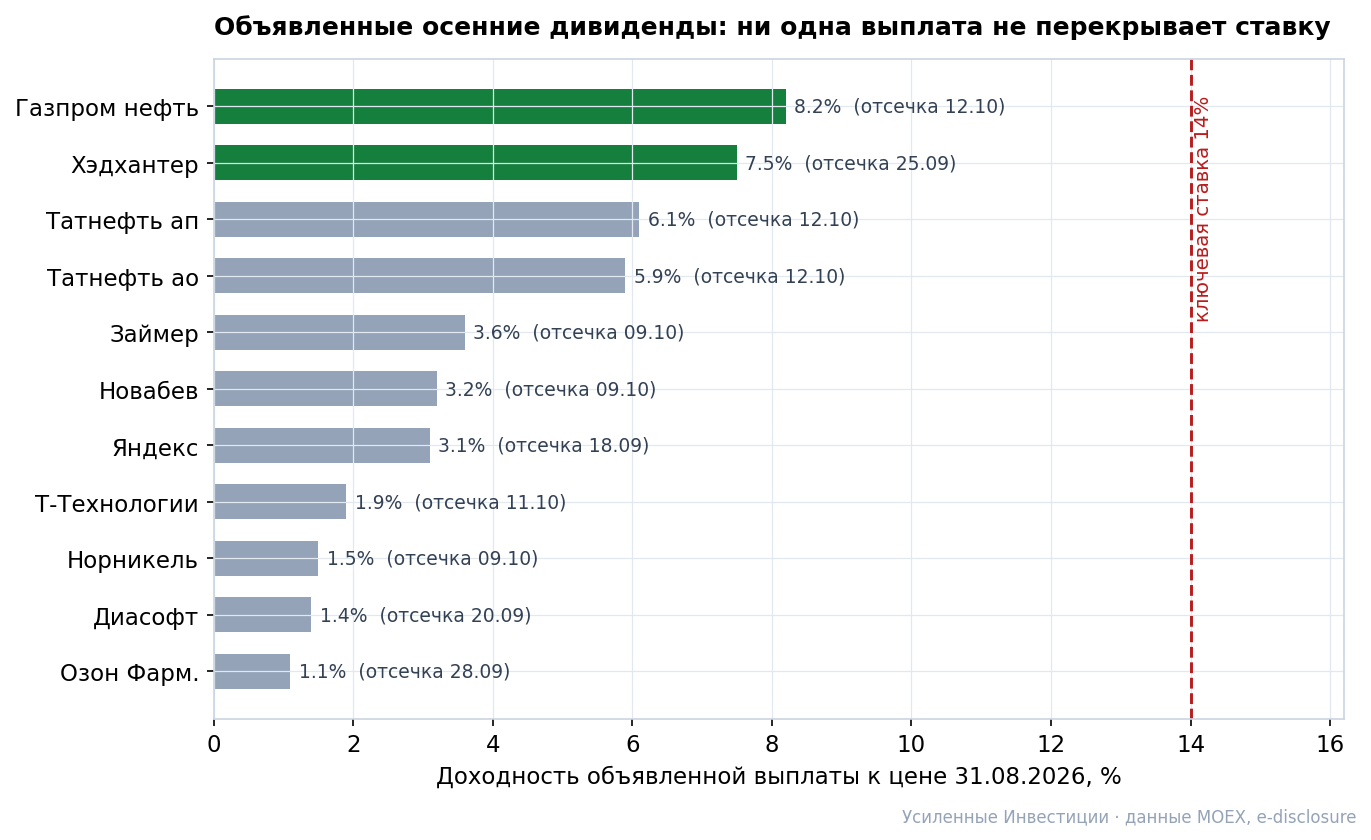
With a 14% rate, no announced payment offers a premium to cash. A short debt instrument now yields more than any of the listed record dates - and this is the key reason why dividend stories are so far losing to the debt market.
What else may be announced before year-end:
- LUKOIL - an interim dividend for 1H2026, usually announced in October. The strong cash flow of the half-year and the net cash position support a payout of roughly last year's size.
- X5 - a second payment for 9 months is possible in December: the policy implies two payments a year with a target debt of 1.2-1.4x EBITDA, and the size will be noticeably more modest than the January special dividend.
- NOVATEK - an interim dividend for 1H2026, the announcement is expected in October (last year RUB 35.5 was paid).
- Bank Saint Petersburg - an interim dividend for 1H2026 (it announced one in autumn in previous years); half-year profit is down 33%, so we expect a payout below last year's.
- DOM.RF - pays once a year; at a policy of 50% of profit the payout for 2026 is estimated at about RUB 325 per share, roughly 15% yield, but the announcement is in spring 2027.
For the annual payers - Sberbank, VTB, MTS, Transneft, Inter RAO, Moscow Exchange - do not expect further payments before summer 2027. For VTB an additional restraining factor is the share issue above RUB 540 bn for the Wildberries deal. For MTS, the sale of the stake in the tower company supported profit and deconsolidated over RUB 80 bn of debt - which, if anything, helps a payout at the level of RUB 35.
Who definitely will not pay. Polyus announced on 8 July a suspension of payouts until 2030 because of the investment programme; the last payment was RUB 29.05 for 1Q2026. Severstal, NLMK, MMK, Gazprom, RusHydro, Magnit, Segezha, Mechel, TMK, Samolet, LSR and SFI are also distributing nothing for the half-year.
Who looks cheap after the reports: profitable companies with a net cash position
Below are the names where three things coincided at the half-year: profit is growing or stable, leverage is low or negative, and LTM multiples are below market averages.
- Inter RAO - P/E of about 3 with a net cash position of RUB 138 bn. Profit is falling, but no one else on the market has such a margin of safety on the balance sheet.
- Transneft pref. - EBITDA has barely grown, but net debt is negative, the tariff is regulated and the formula is 50% of profit; the dividend for 2025 (RUB 204.17) has already been paid in July, and the next payment in summer 2027 is expected to be comparable.
- Sberbank - P/E of about 3.5 at ROE of 24.2%: the only bank whose profit grows together with its portfolio.
- LUKOIL - a net cash position, recovered profit and a dividend based on adjusted cash flow.
- Gazprom Neft - the best operating dynamics in oil and gas and the only real yield above 8% among those announced.
- NMTP - EBITDA margin of about 70%, a net cash position, growing profit.
- Moscow Exchange - fee income is growing, and the market has already priced in the decline in interest income.
- Ozon - a move into sustainable profit at a revenue growth rate of 48%. Expensive on multiples, but the only large player where turnover and margin are rising at the same time.
- Nornickel - a doubling of profit and a return to dividends at a leverage of about 2x EBITDA, moderate for the cycle.
Who looks risky: debt is growing faster than results
- TMK, Mechel, Segezha - negative or near-zero operating result with debt above 5x EBITDA. The question here is not valuation but solvency.
- Samolet, LSR, Etalon - losses, impairments and funding costs at a 14% rate. A turnaround is possible only through monetary policy easing.
- Magnit - net debt of RUB 1.14 trn against a market capitalisation of about RUB 112 bn and a half-year loss.
- AFK Sistema - EBITDA of RUB 250 bn with net debt of RUB 1.68 trn; at the group level the half-year is again loss-making.
- Severstal, NLMK, MMK - cheap on the balance sheet, but the reports show no signs of a turn in the steel cycle.
- ALROSA - EBITDA shrank to RUB 2.7 bn with debt of RUB 114 bn.
What else we are waiting for: where a positive is likely and where it is not
- Surgutneftegas - reports last of all. There is one intrigue: the FX revaluation of deposits. With a strong rouble it works against profit, and the preferred dividend is calculated precisely from profit. More likely a negative.
- PIK - half-year IFRS not disclosed. Against the results of the other developers, a positive should not be expected.
- Bashneft - the group does not disclose consolidated statements, only RAS is published, and the dividend is calculated from it.
- KAMAZ - given the falling truck market we expect weak figures; the board of directors met twice in August.
- Abrau-Durso, Rosseti Ural, Inarctica North-West - reports are expected in September.
- TGK-14 and VseInstrumenty.ru already reported on 31 August: TGK-14 has revenue of RUB 13.0 bn (+19.2%) and profit of RUB 0.84 bn (2.1x); VseInstrumenty has revenue of RUB 89.6 bn (+3%) and net profit of RUB 2.6 bn.
A positive is more likely where revenue is tied to a tariff and debt does not eat the result. A negative is more likely where demand depends on credit: developers, the auto industry, long-cycle retail, and also Surgutneftegas with its FX revaluation. Polyus showed a separate lesson of the season: a high commodity price does not help if revenue is in foreign currency and costs are in roubles.
Conclusion: the market pays a premium for the balance sheet, not for the pace
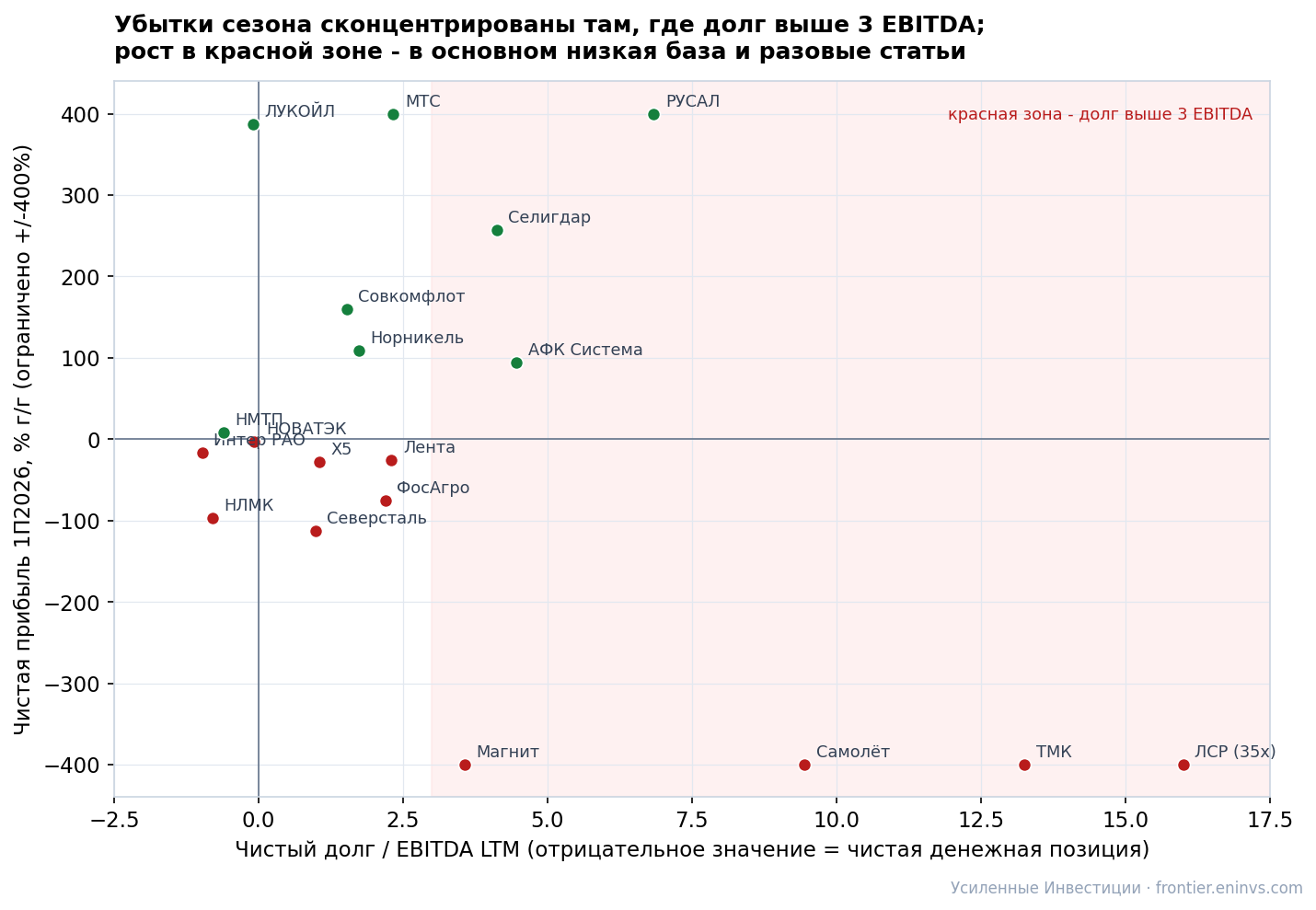
The 1H2026 season did not set a common direction - it separated companies by balance-sheet quality. Where net debt is negative, the half-year closed with a profit in almost any sector; where leverage is above 3x EBITDA, even growing revenue does not reach the bottom line. While the key rate stays at 14% and the next Bank of Russia meeting is scheduled for 11 September, this split will persist: policy easing is the main trigger for a re-rating of leveraged stories and at the same time the main risk for those who today earn on interest income.
Summary table: valuation, growth rates and actual yields across the whole coverage
Everything reviewed above on one screen. EV/EBITDA is calculated on EBITDA for the 12 months to 30.06.2026, for banks - P/E on LTM profit. Growth rates are for the latest reporting period: 2Q y/y where the company discloses quarters, the half-year for the rest. Dividend yield is the actual payments with record dates over the last 12 months to the current price. FCF is calculated in reverse: the decline in net debt over 12 months plus dividends paid (an asterisk marks a direct calculation from the cash flow statement where net debt dynamics are not comparable):
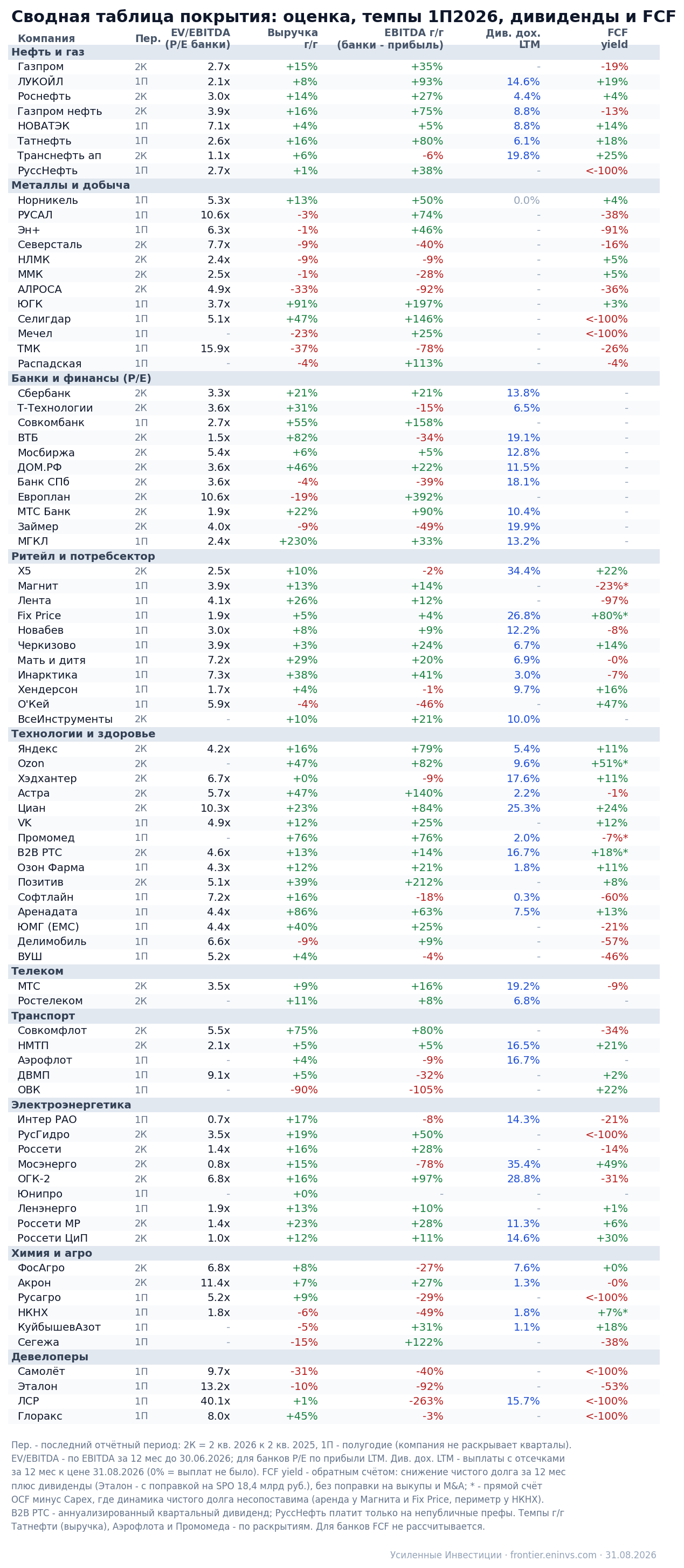
Extended cards with all periods, multiples and sources for each company are on our portal: frontier.eninvs.com/region/ru.
See also: market overview · valuation map · stock screeners